
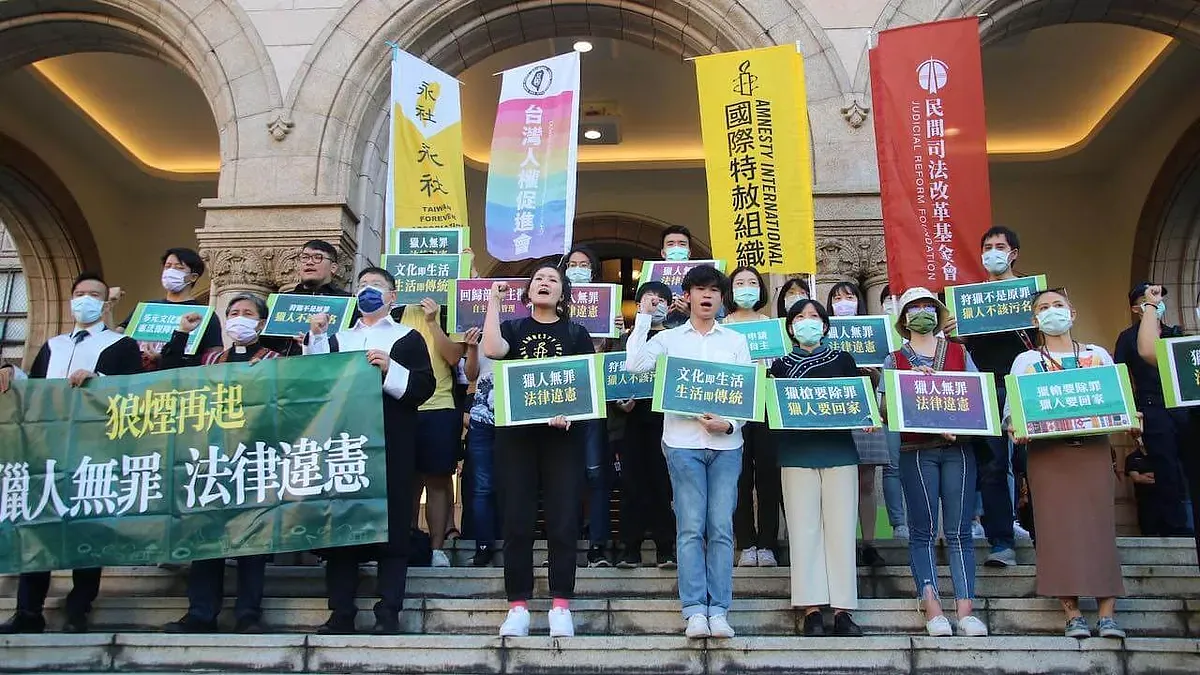
Press Conference on the Constitutional Interpretation in the Indigenous Hunting Rights Cases of Wang Kuang-Lu, Pan Chih-Chiang, and Others
Last edited: 2026-08-30
Today (May 7), the Judicial Yuan announced Interpretation No. 803 in the constitutional cases concerning the Indigenous hunting rights of Wang Kuang-Lu, Pan Chih-Chiang, Huang Chia-Hua, and others. The Grand Justices upheld the prior-approval requirement in Article 21-1 of the Wildlife Conservation Act and the provisions of the Controlling Guns, Ammunition and Knives Act that limit the relevant decriminalization to self-made hunting rifles. At the same time, they held that rules requiring an application five days in advance for unexpected hunting needs and requiring hunters to specify in advance the species and number of animals to be hunted violated the principle of proportionality and ceased to apply immediately. The Interpretation also found deficiencies in the statutory framework governing self-made hunting rifles and required the competent authorities to review and amend it within two years. After the decision was announced, the legal team held a press conference and connected by telephone with two of the petitioners.
Pan Chih-Chiang said by telephone: "Hunting is an important part of Indigenous culture. Respecting Indigenous peoples' cultural right to hunt and giving Indigenous people safe tools for that hunting culture is a concrete expression of the Constitution's respect for cultural pluralism." He invited the Grand Justices to go into the mountains with hunters and see the forest as it actually exists. Asked whether he would continue hunting, he answered: "Unless the laws of the Republic of China sentence me to death, or my legs can no longer take me up the mountain, I will not stop hunting-because this is our culture."
Wang Kuang-Lu could not hide his disappointment. "We want safe hunting rifles. The guns we have now aren't safe at all and can discharge accidentally. And second, our people have hunted for hundreds of years-so now you're telling us the animals disappeared because of us?" His point was that Indigenous hunters should not be treated as the enemies of wildlife conservation.
Amis attorney Hsu Cheng-Tzu, speaking for the legal team, said the case's central unresolved issue was whether the restriction to self-made hunting rifles was unconstitutional, and on that issue the petitioners had not prevailed. The Grand Justices concluded that limiting decriminalization to self-made hunting rifles while taking public-safety concerns into account fell within the legislature's policy discretion; expanding the scope of decriminalization would therefore require legislative action. The legal team would continue studying possible arguments in the individual cases.
Rev. Omi Wilang, Secretary-General of the Atayal National Council, said that even after democratization and transfers of political power, Indigenous peoples still feel the legacy of colonial rule in restrictions on their languages, hunting, and land. He called the Interpretation "a farce-like throwing a few pieces of candy to a crying child." He asked how many hunters using hunting rifles actually threaten public safety and said that if Taiwan expects Indigenous people to live with dignity on this land, it must first learn from Indigenous cultural contexts. "That is one of the most important lessons Taiwan has to learn."
Chien Nien-Yu, an Amis youth and member of the Indigenous Youth Front, described the result as hesitant and incomplete. He argued that the Grand Justices had abandoned three important opportunities for public dialogue: to confront the cultural rupture caused by existing hunting-gun rules; to explain that Indigenous hunting is not indiscriminate shooting; and to make clear that traditional hunting culture and ecological conservation are not inherently in conflict. "Today the Grand Justices tell us Indigenous rights and ecological conservation each have to take a step back," he said. "But whether we are talking about identity or the transmission of traditional culture, Taiwan's Indigenous peoples are already standing below the cliff. Where exactly are we supposed to retreat to?"
Attorney Chou Yu-Hsiu, Chairperson of the Taiwan Association for Human Rights and a member of the legal team, said the decision gave little sense that the individual cases themselves had been taken seriously. In recent years, both competent authorities and ordinary courts had generally adopted a more accommodating approach to Indigenous hunting, including cases involving protected species, while the Grand Justices' position now appeared more restrictive. He emphasized that Taiwan's human-rights movements have often used constitutional litigation to pursue rights, but even a successful constitutional interpretation is never the end of the work. "Today's decision is not the finish line. We have to continue from other directions."
Organizations supporting the petitioners included the Indigenous Youth Front, LIMA Taiwan Indigenous Youth Group, Taitung County Bunun Youth Sustainable Development Association, Millet Ear Indigenous Cultural Foundation, Taiwan Indigenous Peoples Policy Association, Amnesty International Taiwan, Taiwan Association for Human Rights, Judicial Reform Foundation, Indigenous Ministry Committee of the Presbyterian Church in Taiwan, Atayal National Council, and Taiwan Forever Association. The groups called for the legislature to address the legal defects identified by the Interpretation and for Taiwanese society to deepen its understanding of Indigenous peoples' right to hunt.
This article is an AI-generated translation of the original Chinese text. In the event of any discrepancy, the Chinese version shall prevail.