
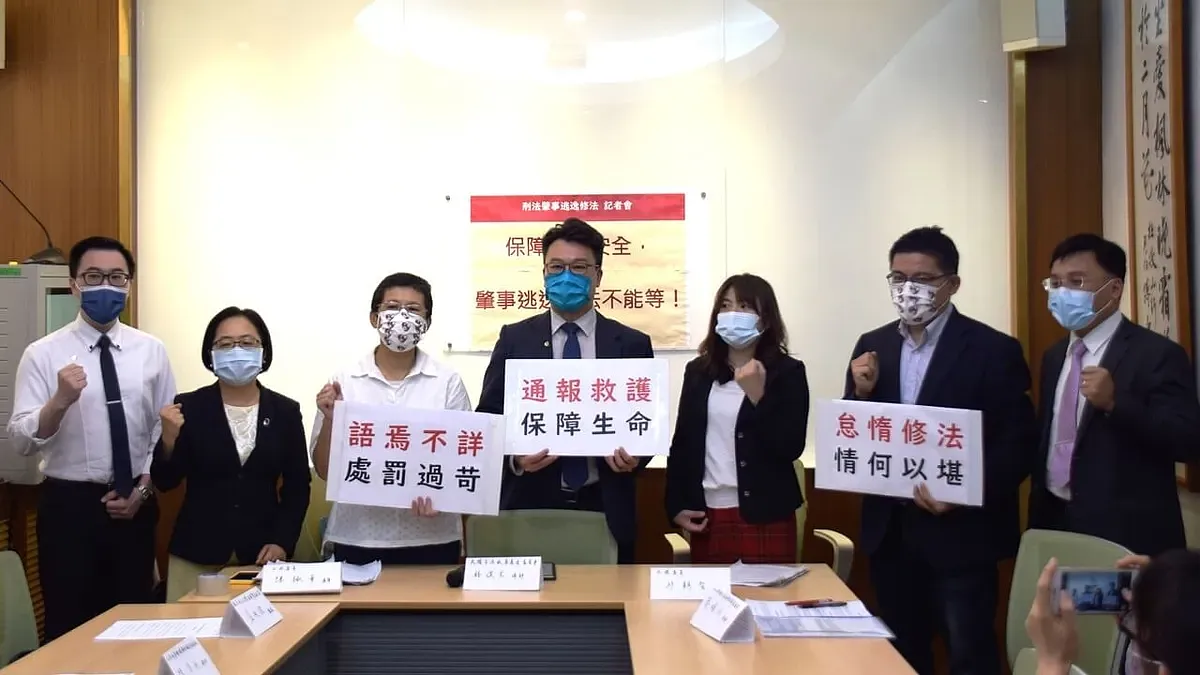
Protecting Life and Road Safety: Reform of the Hit-and-Run Offense Cannot Wait!
Last edited: 2026-08-30
On May 31, 2019, Judicial Yuan Interpretation No. 777 held parts of the Criminal Code's hit-and-run provision unconstitutional under the principle of legal certainty and the constitutional requirement of proportionality between crime and punishment. The Interpretation gave the government no more than two years to amend the law-making May 31 of this year the deadline.
With that deadline imminent, the Executive Yuan and the Ministry of Justice, the agency principally responsible for the amendment, did not send a draft to the Legislative Yuan until April 27. The proposal was rushed and poorly drafted. Worse, it did not faithfully implement Interpretation No. 777 and would not effectively protect life and road safety.
JRF therefore urges the Legislative Yuan not to adopt the Ministry of Justice's draft reflexively. It should return to the purpose of the hit-and-run offense, clarify the post-accident duties imposed on drivers, and enact a rule that both helps determine responsibility for traffic accidents and gives people greater confidence that injured persons will receive timely assistance.
-
The Ministry of Justice Waited Until the Last Minute - What Does That Say About Respect for the Legislative Yuan and the Constitutional Court?
The Grand Justices expressly told the responsible authorities two years ago to complete the amendment within a fixed period. Yet the Ministry of Justice did not send its draft to the Legislative Yuan until April 27. After scheduling and other legislative procedures, lawmakers may have had no more than a week of actual deliberation time.
Courts in a democracy do not possess executive machinery for implementing their own constitutional decisions. The executive and legislative branches therefore must respect judicial decisions if the rule of law and separation of powers are to function. Executive indifference to a constitutional judgment can erode checks and balances and, in the extreme, leave executive power unchecked at the expense of individual rights. The Grand Justices typically allow competent authorities one or two years to amend an unconstitutional law. Yet the Ministry of Justice has repeatedly waited until the end of those periods and left the Legislative Yuan with inadequate time to legislate.
Judicial Yuan Interpretation Law Requiring Amendment Responsible Authority Date Submitted to the Legislative Yuan Deadline Status No. 775 Criminal Code provisions on recidivism Ministry of Justice 2021/2/9 2021/2/22 Deadline already passed No. 777 Criminal Code Article 185-4 (hit-and-run) Ministry of Justice 2021/4/27 2021/5/31 No. 790 Narcotics Hazard Prevention Act provision on cultivation of cannabis Ministry of Justice 2021/3/11 2021/3/20 Deadline already passed The situation is even more troubling because scholars had already criticized the poor quality of the Ministry's draft, and 2,756 Chinese characters-more than half of the explanatory material-consisted of objections from the Judicial Yuan. The Ministry's delay and low-quality proposal placed the Legislative Yuan in a manufactured dilemma: reject the draft and risk missing the constitutional deadline, or pass deficient legislation simply because time has run out. Responsibility for creating that dilemma rests squarely with the Ministry of Justice.
JRF believes the Legislative Yuan should begin with protection of life and safety, determine clearly what legal interest Article 185-4 is meant to protect, and refuse to rush the Ministry's bill through. It should consider JRF's proposal, hear from experts and scholars, and complete legislation by the end-of-May deadline.
-
The Protected Legal Interest Remains Unclear, and the Draft Does Not Implement Interpretation No. 777
Interpretation No. 777 specifically states that a revised hit-and-run offense should clearly define the affirmative duties that arise after a traffic accident so that drivers know what they must do, beyond merely remaining at the scene, to further the provision's regulatory purpose. The Ministry's draft largely ignored that direction. It changed the statutory phrase from "causes an accident" to "a traffic accident occurs," but retained "flees" as the operative element. The Judicial Yuan therefore objected during inter-agency consultation and reiterated the Interpretation's reasoning.
Under the old provision, the law essentially said only that a driver involved in an accident must not flee. It did not clearly answer whether a driver who remains must call for emergency assistance, whether a person who leaves valid contact information may depart before police arrive, or whether someone who stays must affirmatively identify themself. Those questions have long troubled both drivers and courts.
As Grand Justice Hsu Tsung-Li wrote in his concurring opinion, the law should specify people's post-accident duties concretely and clearly rather than continue a legislative technique that treats those duties as "obvious" and expects people to "use their imagination" to play the role of a "good driver." That approach reflects legal moralism, not the constitutional principle of a state governed by the rule of law. The Ministry's failure to confront these questions or take responsibility for resolving longstanding disputes is disappointing.
-
A Step Backward in Criminal-Law Interpretation: Contrary to Supreme Court Case Law and the Culpability Principle
The Ministry's draft set different penalties depending on whether the accident resulted in ordinary injury, serious injury, or death. Its legislative explanation expressly characterized "causing injury," "causing serious injury," and "causing death" as objective conditions of punishment.
An objective condition of punishment does not require proof that the defendant knew the condition existed. On that theory, even a driver who did not know that an accident had occurred could leave the scene and still be punished for hit-and-run.
The Supreme Court had already rejected that approach. Stable case law required the driver to know that the accident resulted in death or injury before Article 185-4 could apply-for example, Supreme Court Criminal Judgment 109-Tai-Shang-1054. Reintroducing an abandoned interpretation would be a major doctrinal regression and would conflict with the culpability principle, including the rule that there can be no punishment without culpability.
-
The Draft Still Gives a Driver Who Leaves No Incentive to Call for Help
The Ministry's draft still focused only on whether a driver "flees." It did not create a meaningful incentive to call police or an ambulance. Once a panicked driver leaves the scene, reporting the accident afterward would not change whether the offense was complete. The legislative explanation nevertheless says the provision is intended to ensure that injured people receive prompt medical assistance and to prevent injuries from worsening. That stated purpose and the actual statutory design do not fit. The old formulation had created interpretive problems for years, yet the new draft largely reproduced them.
-
The Draft Uses Vague Language and Expands Criminal Liability Too Far
Article 12, Paragraph 1 of the Criminal Code provides that conduct is not punishable unless committed intentionally or negligently. Against that background, the Ministry's phrase "without negligence in causing injury" was unclear. Did "without negligence" modify the occurrence of the traffic accident, the resulting death or injury, or the act of leaving? The phrase also lacked an established criminal-law usage and did not track Interpretation No. 777's formulation of an accident "not attributable to the driver's intention or negligence," such as one caused by force majeure or by the intent or negligence of the victim or a third party. The draft therefore risked suggesting that even faultless conduct remains criminal.
Suppose the phrase means that the driver was not at fault for the traffic accident. A motorist stops lawfully at a red light; an oncoming motorcycle violates traffic rules, crashes into the stationary car, and the rider suffers a minor injury. The driver checks that the rider is not seriously hurt and then leaves. Even if accident investigators conclude that the motorist was entirely without fault-and therefore committed no negligent-injury offense-the Ministry's proposal could still subject the driver to criminal punishment under Article 185-4.
Article 62 of the Road Traffic Management and Penalty Act already imposes administrative duties on drivers after traffic accidents, including duties relating to remaining at the scene. Where a driver was entirely without fault, layering criminal punishment on top of those administrative obligations may be excessively harsh.
-
Encourage Drivers to Call for Emergency Assistance and Protect Life
Because the priority after a traffic accident should be medical assistance for injured people, JRF proposes treating a driver's prompt effort to summon help as a ground for reducing or remitting punishment. Responsibility can be sorted out afterward; first, someone who is injured needs help. JRF also believes the vague term "fleeing" should be replaced with a more concrete rule focused on "leaving the scene before one's identity has been confirmed."
For those reasons, JRF drafted an alternative "Offense of Leaving the Scene of a Traffic Accident (Hit-and-Run)" and compared it with the Ministry of Justice proposal in the attachment.
Interpretation No. 777 gave the responsible authorities two years to revise the law. Yet the Ministry's proposal looks like work turned in at the last minute merely to meet a deadline. JRF therefore urges the Legislative Yuan to:
- Complete the amendment by May 31, the deadline specified in Interpretation No. 777.
- Review the many defects in the Ministry of Justice proposal rather than passing it reflexively.
- Consider JRF's proposal together with views from experts and the public, carefully identify the legal interest the hit-and-run offense is intended to protect, and enact a law that protects life and safety.
Attachment
Attendees
Lin Chun-Hung / Attorney; Standing Executive Committee Member, Judicial Reform Foundation
Lu Ying-Chieh / Professor, Department of Law, National Chung Cheng University
Tsai Ching-Yu / Attorney; Member, Criminal Law Committee, Taipei Bar Association
Chen Yi-Ting / Attorney; Vice Chair, Taiwan Criminal Defense Attorney Association
Chen Jiao-Hua / Legislator
Chiu Hsien-Chih / Legislator
This article is an AI-generated translation of the original Chinese text. In the event of any discrepancy, the Chinese version shall prevail.