
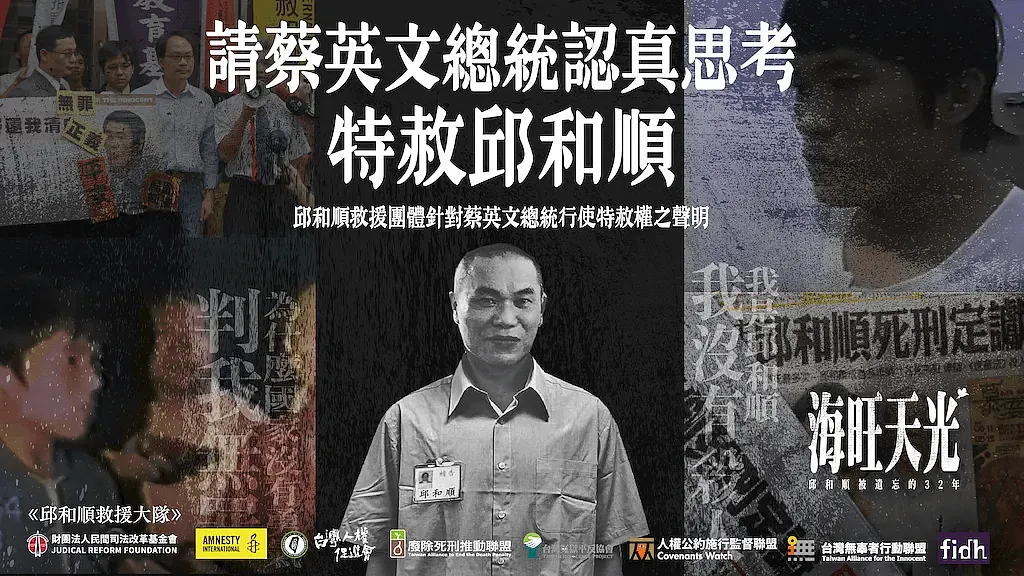
President Tsai Ing-Wen Should Seriously Consider Pardoning Chiu Ho-Shun - Statement Following the President's First Exercise of the Pardon Power
Last edited: 2026-08-30
Today (May 20, 2021), President Tsai Ing-Wen, acting under Article 40 of the Constitution and Article 3 of the Amnesty Act, granted a pardon to Talum Suqluman (Wang Kuang-Lu), who had been convicted in an Indigenous hunting case. This was President Tsai's first exercise of the pardon power since taking office in 2016.
On April 7, 2020, organizations supporting Chiu Ho-Shun submitted a pardon petition asking President Tsai to grant a pardon that would nullify both his conviction and sentence. Nearly 110,000 people from almost 50 countries and regions have since signed in support. President Tsai, however, has still not responded substantively to the request from Chiu and the support organizations.
Chiu Ho-Shun was accused in 1988 of involvement in the Lu Cheng and Ko Hung-Yu-Lan cases despite the absence of direct evidence. The prosecution's case rested on 288 confession statements riddled with contradictions and obtained through torture. Chiu has now been held at the Taipei Detention Center for 33 years, and the case is widely regarded in Taiwan and abroad as one of the country's most urgent wrongful-conviction cases. The pro bono legal team has sought retrial four times on the basis of torture. In 1994, Control Yuan members impeached ten police officers and two prosecutors responsible for the investigation for using violence and coercion and for closing the case perfunctorily. The Prosecutor-General also filed an extraordinary appeal, arguing that the final judgment failed to investigate evidence that should have been examined at trial, violated evidentiary rules, and contained contradictory and inadequate reasoning. The courts nevertheless rejected both the retrial petitions and the extraordinary appeal.
The justice system has still refused to correct the systemic failures exposed by Chiu Ho-Shun's case or accept the legal and moral responsibility for wrongfully depriving him of liberty for more than 33 years. The case has consequently become a major stain on Taiwan's justice system and human-rights record internationally. If the ordinary judicial process can no longer remedy the injustice Chiu has suffered, the constitutional pardon power now provides the only realistic means of ending it in time-and Chiu's health does not allow him simply to keep waiting in a cell.
President Tsai's first use of the pardon power demonstrates that she is willing to exercise that authority in an individual case on human-rights grounds. The Chiu Ho-Shun Pro Bono Legal Team and the support organizations therefore urge her to consider Chiu's case seriously, including his physical condition, the injustice he has suffered, and the unfairness of his trial, and to use the pardon power granted by the Constitution to issue without delay a pardon nullifying both his conviction and sentence.
Organizations Issuing the Statement
Chiu Ho-Shun Pro Bono Legal Team
Judicial Reform Foundation
Taiwan Alliance to End the Death Penalty
Taiwan Association for Human Rights
Taiwan Innocence Project
Covenants Watch
Amnesty International Taiwan
Taiwan Innocent Prisoners Action Alliance
International Federation for Human Rights (FIDH)
This article is an AI-generated translation of the original Chinese text. In the event of any discrepancy, the Chinese version shall prevail.