
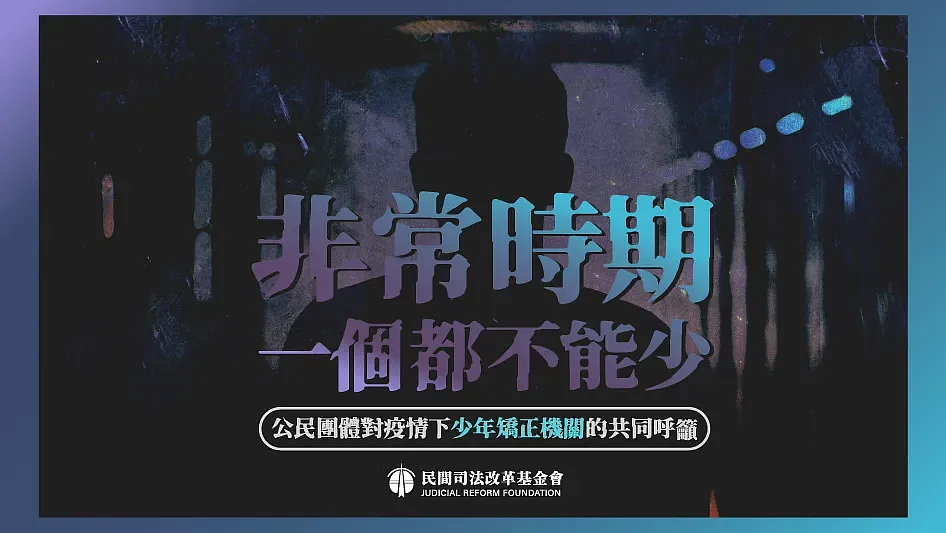
Joint Statement | In Extraordinary Times, No One Can Be Left Behind - Civil-Society Appeal for Juvenile Correctional Institutions During COVID-19
Last edited: 2026-08-30
One island, one shared fate: Taiwan is fighting the pandemic together. The country's most urgent task is to control COVID-19 and protect public health while keeping daily life, public institutions, and education functioning as normally as possible.
In late January 2021, a hospital cluster occurred at Taoyuan General Hospital, Ministry of Health and Welfare. Because one confirmed case was a staff member at a northern correctional institution that worked with the hospital, the institution immediately suspended classes, family visits, and other outside contact, and did not lift the restrictions until late February after Lunar New Year. When the outbreak intensified again on May 15, correctional institutions in Taipei, New Taipei, Keelung, and Taoyuan began limiting in-person visits to one visitor, stopped accepting food sent in from outside, suspended external work programs, and halted treatment and educational programs that were not legally required. Taiwan entered Level 3 alert on May 18, and on May 21 the Agency of Corrections announced that correctional institutions nationwide would suspend ordinary visits, receipt of food and other items, and entry by outside social workers, psychologists, teachers, and other service providers.
We fully support necessary measures to protect public health at this critical point in the pandemic, and we also urge special attention to densely populated settings such as prisons and other correctional institutions, including the safety and rights of the people who work there. Juvenile correctional institutions, however, have an additional problem. They carry educational, rehabilitative, and correctional responsibilities, while the juveniles in custody do not live in an ordinary environment: they cannot freely use electronic devices or access the internet. Their education cannot simply be imagined as "online learning from home."
To help juveniles in correctional institutions maintain physical and psychological stability and continue everyday life under these extraordinary conditions, civil-society organizations make three recommendations concerning external communication, the right to education, and the right to health. We call on the Ministry of Justice and the Agency of Corrections to address them urgently.
Maintain Outside Contact and Psychological Support: Expand Mobile Video Visits and Correspondence
Ordinary visits and face-to-face attorney visits have been suspended at correctional institutions nationwide, leaving juveniles in custody largely cut off from the outside world and under substantial psychological pressure. When COVID-19 first spread in Europe, the WHO Regional Office for Europe issued interim guidance on March 20, 2020: Preparedness, Prevention and Control of COVID-19 in Prisons and Other Places of Detention . Among other measures, the guidance recommends psychological support to reduce harmful group behavior driven by fear. Keeping people in custody informed about prevention procedures and institutional response strategies can itself reduce fear by allowing them to understand what is happening.
Maintaining outside contact provides psychological support and also helps correctional institutions remain stable. Because face-to-face visits are currently unavailable, and because institutions across Taiwan-including juvenile reformatory schools-began implementing visits by mobile video device nationwide in March, we strongly recommend increasing the frequency of mobile video visits and allowing more frequent correspondence regardless of institutional classification. Authorities should also use this opportunity to review equipment at each institution and simplify the application process. As the agency responsible for procuring the system, the Agency of Corrections should work actively with vendors to eliminate technical barriers.
Restrictions tied to institutional classification should likewise be relaxed comprehensively so that juveniles can communicate with the outside world and reduce psychological stress during this extraordinary period.
Protect Juveniles' Right to Education: Do Not Let the Pandemic Reduce Education to a Formality
Schools across Taiwan have shifted to learning from home. Teachers, students, and schools are working to overcome technical barriers to remote instruction, improve courses, and help economically disadvantaged families obtain equipment and internet access. Students in juvenile correctional institutions, by contrast, may be left sitting together in hot, poorly ventilated halls watching prerecorded videos without a teacher present. There is no meaningful interaction and little way to know how students are learning. Education under those conditions exists largely in form. We strongly urge the Agency of Corrections and Ministry of Justice to inspect each juvenile correctional institution immediately and determine how to install the equipment, create the spaces, and establish the procedures needed for genuine online instruction-bringing students and teachers back into direct interaction.
COVID-19 is a long-term global challenge. Preparations need to begin now if students in juvenile correctional institutions are to receive stable education over an extended period.
Protect Children's and Juveniles' Right to Health: Address Dangerous Indoor Heat in Juvenile Correctional Institutions
Adolescents generally have somewhat higher body temperatures than adults. Spending an entire day in an overheated, poorly ventilated classroom during Taiwan's hot season can itself threaten health. With a forehead temperature of 37.5°C or above treated as abnormal under pandemic screening standards, juveniles kept in excessively hot indoor environments may also be more likely to register misleadingly high temperatures.
The WHO's Housing and Health Guidelines include a systematic review of the health effects of indoor heat. Prolonged exposure to high indoor temperatures can harm health. The review discusses maximum indoor temperatures in six locations-Boston, New York, London, Harbin, South Korea, and Thailand-and gives 32°C as the relevant maximum for Thailand, whose climate is relatively similar to Taiwan's.
Extreme heat is an increasingly serious health challenge under global climate change. Taiwan is both hot and humid. Ventilation and cooling cannot be achieved by willpower; institutions need actual equipment that lowers indoor temperature and improves circulation between indoor and outdoor air.
We therefore urge the Ministry of Justice and Agency of Corrections to protect the health rights of children and juveniles by promptly addressing overheated indoor conditions in juvenile correctional institutions, so that juveniles can receive correctional education without their health being put at risk.
Organizations Issuing the Joint Statement
Humanistic Education Foundation
Taiwan Association for Human Rights
Taiwan Alliance for Advancement of Youth Rights and Welfare
Covenants Watch
Judicial Reform Foundation
Prison Watch
This article is an AI-generated translation of the original Chinese text. In the event of any discrepancy, the Chinese version shall prevail.