
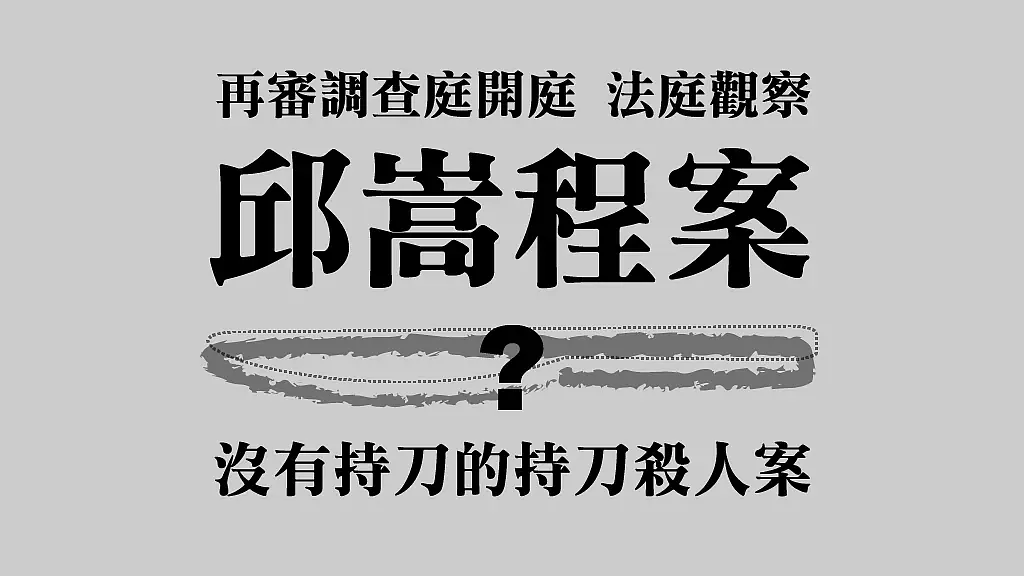
Court Observation | First Evidentiary Hearing on the Retrial Petition in the Chiu Sung-Cheng Case
Last edited: 2026-08-30
Late one night, brothers Chiu O-Ming and Chiu Sung-Cheng arranged to meet a creditor at a closed restaurant to discuss a debt. The restaurant was dimly lit, with only streetlights from the sidewalk across the road casting an orange-red glow over the tables and chairs and drawing long, slanted shadows across the floor. The creditor arrived, but not alone: more than a dozen men followed him, carrying clubs and short knives and blocking the restaurant's entrances. Anyone in that situation would likely have been frightened. The discussion quickly broke down and turned into a melee. After several minutes, the creditor's men scattered and the brothers left. Only afterward did they learn that two members of the creditor's group had died. The court found that Chiu Sung-Cheng had stabbed one of them, Cheng OO, with a knife, convicted Chiu of murder, and sentenced him to life imprisonment. The conviction became final after the Supreme Court dismissed Chiu's appeal in Judgment 104-Tai-Shang-3581 (for details, see the Chiu Sung-Cheng Case official case page).
Why This Hearing Was Held
Chiu Sung-Cheng has consistently maintained that he never held a knife during the melee, much less stabbed Cheng OO, but the courts did not accept his account. Chiu's father worked tirelessly to clear his son's name and, with JRF's assistance, eventually filed a petition for retrial. Last year, the Taiwan High Court Kaohsiung Branch Court denied the petition on the ground that it did not meet the statutory requirements for retrial (Case No.: Taiwan High Court Kaohsiung Branch Court Criminal Ruling 109-Sheng-Tsai-123). Fortunately, after his attorneys filed an interlocutory appeal, the Supreme Court vacated the Kaohsiung Branch Court's ruling (Case No.: Supreme Court Criminal Ruling 110-Tai-Kang-355) and remanded the matter to the Kaohsiung Branch Court for a new ruling. Chiu Sung-Cheng has once again knocked on the door of retrial. Will the court answer this time?
The Hearing
On the afternoon of May 13, 2021, the Kaohsiung Branch Court held the first hearing in the Chiu Sung-Cheng case after the Supreme Court's remand-an evidentiary hearing on the retrial petition. The principal purpose was to clarify the positions of the two sides, retrial petitioner Chiu Sung-Cheng and the prosecutor, and to determine what evidence should be examined, which witnesses should be summoned, and whether any expert examinations should be conducted. Perhaps because the Branch Court had previously questioned whether the evidence supporting the retrial petition was truly "new evidence" and had denied the petition for failing to satisfy the retrial requirements, defense counsel devoted particular attention to a PowerPoint presentation identifying each item of evidence, explaining why it qualified as new, and citing numerous Supreme Court decisions in support.
After defense counsel finished, the judge asked for the prosecutor's view. The prosecutor remained seated, paused for several seconds, and then said in a cold tone, "I think these... are all just those people's... subjective opinions..." He was expressing skepticism toward the opinions of experts retained by the defense and suggesting that the defense's arguments were highly questionable. But he did not identify any specific evidence that he considered questionable.
Finally, the judge asked questions about several matters in the record, confirmed the details of the defense's requests for evidentiary investigation, announced the date of the next hearing, and concluded the session.
My Reflections
In the summer of 2017, while interning at JRF, I took part in investigating the Chiu Sung-Cheng case. The conviction had already become final, and Chiu Sung-Cheng was serving his sentence in prison. JRF was reviewing the original case record in search of grounds for a retrial.
 Photo / Discussion after the hearing
Thinking back, my teammates and I discussed whether questioning-and even trying to unsettle-a final court judgment in this way was itself a kind of arrogance. Yet, as Rawls argued, in a liberal democracy the coercive acts of government are acts undertaken in the name of the people as a whole, and government action therefore requires the people's consent. If the exercise of state authority cannot be questioned, that only reinforces a hierarchy between government and the people. If someone can be imprisoned for something they did not do, government action becomes indistinguishable from the violence of unchecked power. Examining court judgments and seeking relief through institutional procedures reflects the people's trust in the system; it is also an expression of the democratic spirit.
Several years later, many more people have joined the effort to assist Chiu Sung-Cheng. Thanks to their work, the grounds supporting his innocence have become more numerous and more substantial-far beyond what I could have imagined at the time, and not something a handful of people could have achieved by working for only a few months. After the hearing, defense counsel spoke modestly outside the courtroom. He said that arguing in court was nothing especially remarkable; the truly remarkable work was done by those who quietly studied the case file behind the scenes and found the evidence and leads. I would add that whether in front of the public or behind the scenes, everyone has a role to play. A team functions only because each person does their part, and every part of that work matters.
The road to exoneration is long. I only hope that this time the court will carefully consider the new evidence presented by the attorneys and open the door to a retrial for Chiu Sung-Cheng.
This article is an AI-generated translation of the original Chinese text. In the event of any discrepancy, the Chinese version shall prevail.