
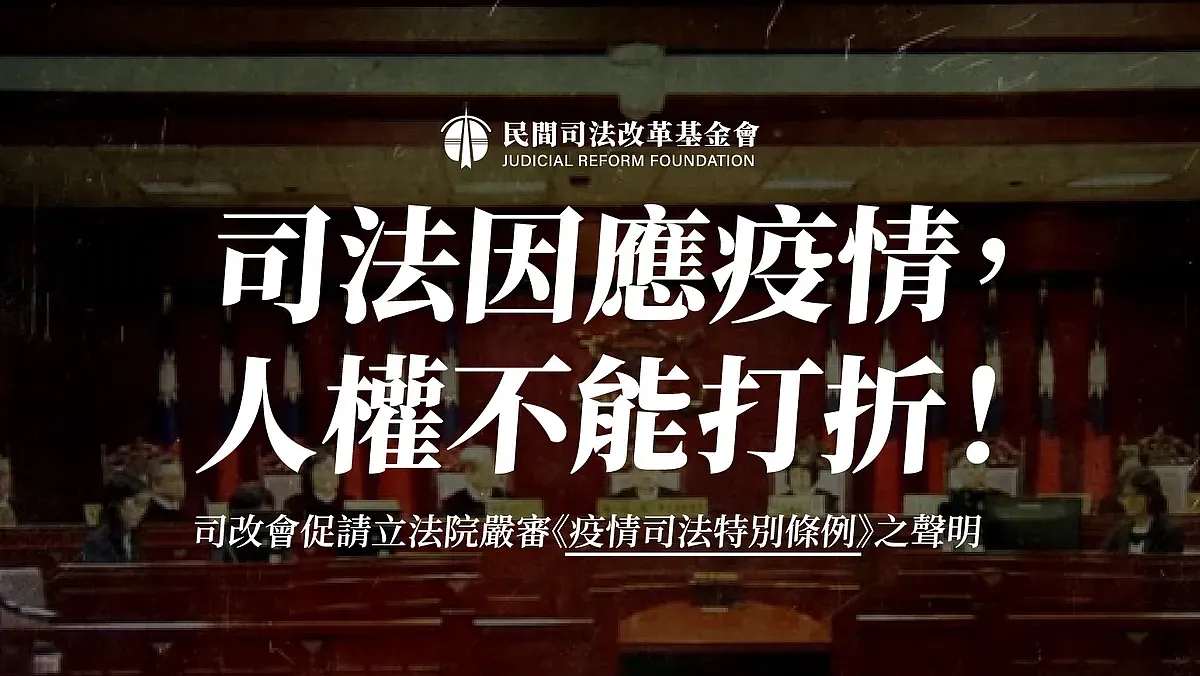
"Human Rights Must Not Be Compromised in the Judicial Response to the Pandemic!" - JRF Statement Urging the Legislative Yuan to Closely Review the Special Act on Judicial Procedures During Severe Communicable Disease Epidemics
Last edited: 2026-08-30
To respond to the emergency epidemic-control measures implemented by the central authority responsible for communicable-disease control, the Judicial Yuan approved the draft Special Act on Judicial Procedures During Severe Communicable Disease Epidemics on June 1. The Executive Yuan approved the joint submission on June 3 and sent the draft to the Legislative Yuan for deliberation. The draft raises several concerns: (1) no interlocutory appeal is available from a judge's decision to conduct a remote hearing; (2) it does not relax the rules allowing restoration after a party misses a statutory peremptory period; (3) it does not ensure confidential communication between parties and counsel or the right to effective assistance of counsel; (4) defense counsel are not included among the recipients eligible for electronic service; (5) it does not require subsequently prepared hearing records to be verbatim; and (6) remote hearings are excluded from the principle of public trial. Because these and other issues may impair judicial human-rights protections, the Taiwan Bar Association, Taipei Bar Association, and the Taiwan Association of Criminal Defense Lawyers have each issued statements identifying problems and offering recommendations.
The Legislative Yuan has convened an extraordinary session this week and placed the draft on its agenda. To urge legislators across party lines to discharge their duties and review the bill effectively so as to safeguard judicial human rights, JRF has prepared a counterproposal (see the attachments below) emphasizing six principal amendments and makes the following three statements:
1. The State Must Not Curtail Judicial Human Rights in Responding to the Pandemic
As explained in Paragraph 16 of General Comment No. 29 on the International Covenant on Civil and Political Rights: "The Committee is of the opinion that the principles of legality and the rule of law require that fundamental requirements of fair trial must be respected during a state of emergency." In other words, the state may not use war or an emergency as a basis for restricting or diminishing the fundamental fair-trial protections guaranteed by the Covenant. Therefore, measures adopted by the state in response to the pandemic must not impair the judicial human rights to which people are ordinarily entitled; doing so would violate the state's obligation to comply with the Covenant. Moreover, Taiwan has not formally declared a state of emergency, so the relevant response measures should be exercised with even greater restraint. On the basis of the human-rights covenants incorporated into domestic law, JRF will work with civil society to monitor measures implemented by judicial authorities during the pandemic and ensure that human rights are not infringed.
2. The Legislative Process Should Incorporate Broad Input and Improve the Special Act
The Judicial Yuan deserves recognition for drafting the Special Act in an effort to keep judicial proceedings functioning effectively during the pandemic. But legislation drafted under emergency conditions is not necessarily complete-for example, the draft provides for remote hearings but not remote public access-and various groups have therefore proposed amendments. JRF believes technology should help protect judicial human rights, not hinder them. The same technology that makes remote hearings possible can also make remote public observation possible. The core problem is not the limits of technology, but the determination to protect human rights. JRF therefore urges the Legislative Yuan to consider recommendations broadly and enact a more complete and carefully designed statute. Our counterproposal (see the attachments below) identifies six principal amendments:
- Remote hearings should allow remote public observation, consistent with the constitutional principle of public trials.
- Protect the right of parties to communicate confidentially with counsel and to receive effective assistance of counsel.
- Remote hearings should be video-recorded in full, with verbatim records used in place of ordinary hearing minutes.
- A judge should order a remote hearing by ruling, and that ruling should be subject to interlocutory appeal.
- A party who misses a statutory peremptory period because of the pandemic should be permitted to apply for restoration.
- Revise the terminology and provide that when a court conducts a proceeding remotely pursuant to law, it must do so by ruling.
3. Remote Court Observation for All: Public Oversight of Fair Adjudication
Public trial is one of the most important constitutional principles for maintaining public confidence in the judiciary. Yet the Judicial Yuan's draft provides for remote hearings without providing for remote public observation, which plainly conflicts with the constitutional requirement of public trial. This is especially concerning because Taiwan's judiciary has not earned broad public trust. A system of remote hearings closed to public observation would inevitably deepen public doubts about judicial proceedings. JRF therefore urges legislators from both the ruling and opposition parties: if remote hearings are to be authorized by law, the legislation must also establish rules for remote public observation so that judicial proceedings remain fair, impartial, and public. JRF will also launch online court-observation initiatives, encouraging students, members of the public, and the media to observe proceedings remotely and monitor the quality of judicial adjudication during the pandemic.
Press Contact
Lu Cheng-Yen, Staff Attorney, Judicial Reform Foundation
Attachments
This article is an AI-generated translation of the original Chinese text. In the event of any discrepancy, the Chinese version shall prevail.