
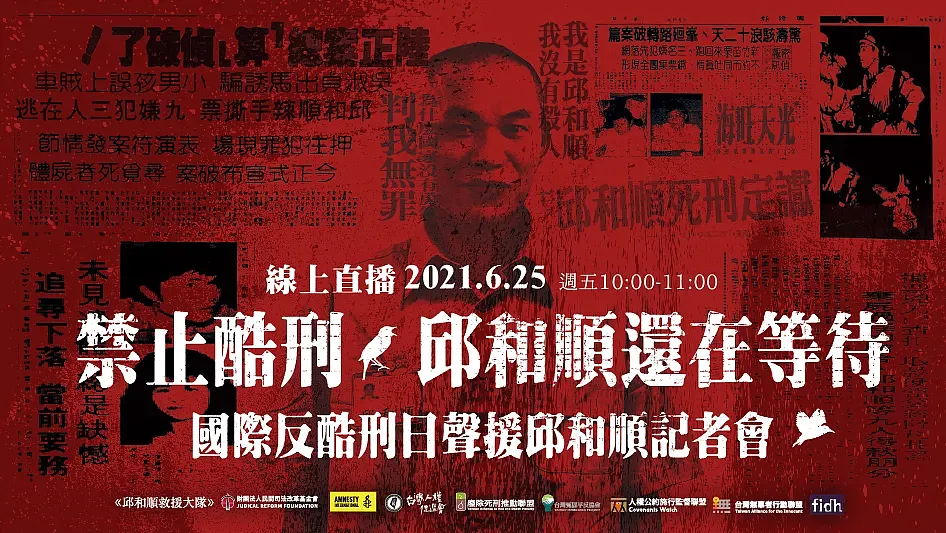
End Torture-Chiu Ho-Shun Is Still Waiting: Press Conference on the International Day in Support of Victims of Torture
Last edited: 2026-08-30

June 26 is the United Nations International Day in Support of Victims of Torture. The observance traces back to the Convention against Torture and Other Cruel, Inhuman or Degrading Treatment or Punishment (the "Convention against Torture"), adopted by the UN General Assembly on December 10, 1984 and entering into force on June 26, 1987. June 26 was designated to commemorate the Convention's entry into force, support victims of torture around the world, and remind the public of the grave harm that torture and other inhuman treatment inflict on human dignity and physical and psychological well-being.
The Chiu Ho-Shun case is one of Taiwan's most prominent wrongful-conviction cases. Substantial evidence indicates that he was tortured during the investigation, and his prolonged detention has subjected him to severe physical and psychological suffering. Beyond being a well-known case involving torture in Taiwan's judicial history, it has become a serious stain on Taiwan's judicial system and international human-rights record and warrants sustained public attention. On the eve of the International Day in Support of Victims of Torture, the Chiu Ho-Shun Rescue Coalition therefore invited the National Human Rights Commission to hold a joint press conference in support of Chiu Ho-Shun, who remains in custody.
National Human Rights Commission Vice Chairperson Kao Yung-Cheng stated that the Control Yuan had issued four investigation reports on the Chiu Ho-Shun case, and that the Simulated Asian Human Rights Court had also reviewed the case; these reviews concluded that Chiu Ho-Shun was innocent. Nevertheless, the court imposed a death sentence despite improper interrogation and the absence of corroborating evidence, in clear conflict with the International Covenant on Civil and Political Rights.
The judiciary has repeatedly rejected applications for extraordinary appeal and retrial in this case and has failed to address the numerous investigative and trial irregularities identified by the Control Yuan, international experts, scholars, and civil society groups. Refusing to confront torture and an unfair trial risks acquiescing in torture as an investigative method and runs contrary to Article 16 of the Convention against Torture, which requires the state to prevent acts of cruel, inhuman, or degrading treatment or punishment committed, instigated, consented to, or acquiesced in by public officials or others acting in an official capacity. Because the judicial system has failed to provide a fair remedy, Vice Chairperson Kao supports calling on the President to grant Chiu Ho-Shun a full pardon before June 26.
Yu Po-Hsiang, Managing Director of the Judicial Reform Foundation and convener of Chiu Ho-Shun's pro bono defense team, noted that two days earlier, at the "2021 Professional Forum on International Torture-Prevention Mechanisms and Fishers' Human Rights," National Human Rights Commission Chairperson Chen Chu had said that although Taiwan no longer sees the forms of torture associated with the authoritarian era, torture also encompasses corporal punishment, inhuman or degrading treatment, and mistreatment of migrant fishers. Chairperson Chen expressed hope that legislation implementing the Convention against Torture would be enacted promptly so the Commission could perform its torture-prevention function. Attorney Yu stressed, however, that Chiu Ho-Shun represents "torture in the present tense": even after the end of authoritarian rule, torture remains a reality in Taiwan. The investigative methods used in this case were paradigmatic forms of torture, yet the courts relied on statements obtained through torture to convict him, contrary to the Convention against Torture's prohibition on the use of statements obtained by torture as evidence against the victim. During as many as four months of incommunicado detention without counsel, Chiu Ho-Shun and his co-defendants gave 288 mutually inconsistent statements. Given the strong possibility that the statements resulted from torture or inhuman treatment, the prosecution should have borne the burden of establishing their voluntariness; instead, the court required the defendants to prove they had been tortured. Chiu Ho-Shun was convicted after this gravely unfair process and remains on death row. Every day he continues to await execution under these circumstances constitutes further torture or inhuman treatment. During the lengthy proceedings, he also spent four years in solitary confinement and wore six-kilogram leg irons for 18 years. His health has since deteriorated substantially in detention. The state knows the case is deeply flawed, yet neither executes nor releases him. Attorney Yu therefore argued that a presidential pardon is currently the best legal means of ending the continuing torture; the Ministry of Justice should permit his release for medical treatment, and prosecutors should promptly pursue retrial and extraordinary appeal.
Chou Yu-Hsiu, Chairperson of the Taiwan Association for Human Rights, noted that Article 7 of the ICCPR, which has domestic legal effect in Taiwan, expressly prohibits torture and cruel, inhuman, or degrading treatment or punishment. Decisions of the UN Human Rights Committee and the Committee against Torture recognize that severe physical or mental pain or suffering may constitute torture and that prolonged solitary confinement in harsh conditions and isolation may also amount to torture. Police torture during the investigation of the Chiu Ho-Shun case is an established fact, and Chiu Ho-Shun has been confined at the Taipei Detention Center since he was detained in the case. Even though Taiwan has not yet enacted legislation implementing the Convention against Torture, the spirit of international human-rights law fully supports releasing or pardoning him on the basis of the ICCPR.
Huang Sung-Li, Convener of Covenants Watch, explained that when the rescue coalition launched a 2020 petition urging a presidential pardon, Covenants Watch contacted international experts who had previously reviewed Taiwan's national human-rights reports under the two UN Covenants. After learning the facts of the Chiu Ho-Shun case, the experts joined the petition without hesitation. The Simulated Asian Human Rights Court likewise concluded in 2019 that Chiu Ho-Shun had been tortured by the state and denied a fair trial. The case also violated Taiwan's Code of Criminal Procedure. Although the judgment became final in July 2011, Article 156 had already been amended in 2002 to provide that a defendant's confession may not be the sole basis for conviction and that, when a defendant alleges that a confession was obtained through improper means, the court must investigate that allegation before examining other evidence. The judges failed to do so and instead repeatedly accepted one-sided accounts, contrary to the principle of a fair trial. Covenants Watch therefore calls on the National Human Rights Commission to recommend that the President pardon Chiu Ho-Shun. The relevant questions are not whether his innocence can now be proved beyond doubt, but whether he ever received a fair trial and whether the judgment rested on clear evidence. The answers are clear; his freedom should be restored and the state should provide redress for the torture he suffered.
Chiu I-Ling, Secretary-General of Amnesty International Taiwan, said that although Taiwan is not a UN member state, it has incorporated several international human-rights conventions into domestic law through implementation acts. The Executive Yuan and National Human Rights Commission are likewise working toward legislation implementing the Convention against Torture. For decades, Amnesty International has conducted global campaigns concerning Chiu Ho-Shun, including featuring him in the 2012 Write for Rights campaign to demand a fair retrial, organizing rescue and letter-writing actions, and addressing the case in its death-penalty and human-rights reports. Amnesty International sections and supporters around the world have continued sending letters to the Presidential Office. The Tsai administration responded earlier this year only that there were differing views on the case and that the Presidential Office would carefully consider them. Thirty-two years have passed, Chiu Ho-Shun remains on death row, and nearly all judicial remedies have been exhausted. He has aged from a healthy 28-year-old man into a man in his sixties with gray hair and multiple illnesses. Amnesty International opposes the death penalty, cruel and inhuman treatment, and unfair trials in all circumstances; Taiwan's judiciary and government should likewise do everything possible to protect every person's dignity and safety.
Secretary-General Chiu I-Ling added that, beginning June 26, Amnesty International Taiwan would launch its next campaign: the "2021 Chiu Ho-Shun Rescue Campaign-Letter-Writing Initiative." Supporters are invited to write to President Tsai Ing-Wen on Chiu Ho-Shun's behalf and tell the government that every additional day he remains imprisoned as a result of an unfair trial is another day of injustice. The campaign calls on the President to pardon Chiu Ho-Shun and restore the freedom and human rights delayed for 32 years. Instructions and related information will be published on Amnesty International Taiwan's website and social-media channels, and every letter will ultimately be delivered to the Presidential Office.
Finally, Lin Hsin-I, Executive Director of the Taiwan Alliance to End the Death Penalty, said that the rescue coalition had pursued every available avenue, including Taiwan's two international reviews of the UN Covenants, engagement with the UN Special Rapporteur on torture, and review by the international experts participating in the Simulated Asian Human Rights Court. After examining the files and evidence, these experts concluded that Chiu Ho-Shun is a wrongfully convicted death-row prisoner who was subjected to torture. On the eve of the International Day in Support of Victims of Torture, the pro bono defense team and rescue coalition hope to renew public attention to the torture suffered by Chiu Ho-Shun and other defendants in wrongful-conviction cases. They call on the government to provide the necessary relief, including prompt exercise of the President's constitutional pardon power and enactment of legislation implementing the Convention against Torture to protect everyone's right to be free from torture.
Organizers: National Human Rights Commission, Chiu Ho-Shun Case Pro Bono Defense Team, Judicial Reform Foundation, Taiwan Association for Human Rights, Taiwan Alliance to End the Death Penalty, Taiwan Association for Innocence, Amnesty International Taiwan, Covenants Watch, Taiwan Alliance of Innocent Victims
This article is an AI-generated translation of the original Chinese text. In the event of any discrepancy, the Chinese version shall prevail.