
JRF Newsletter
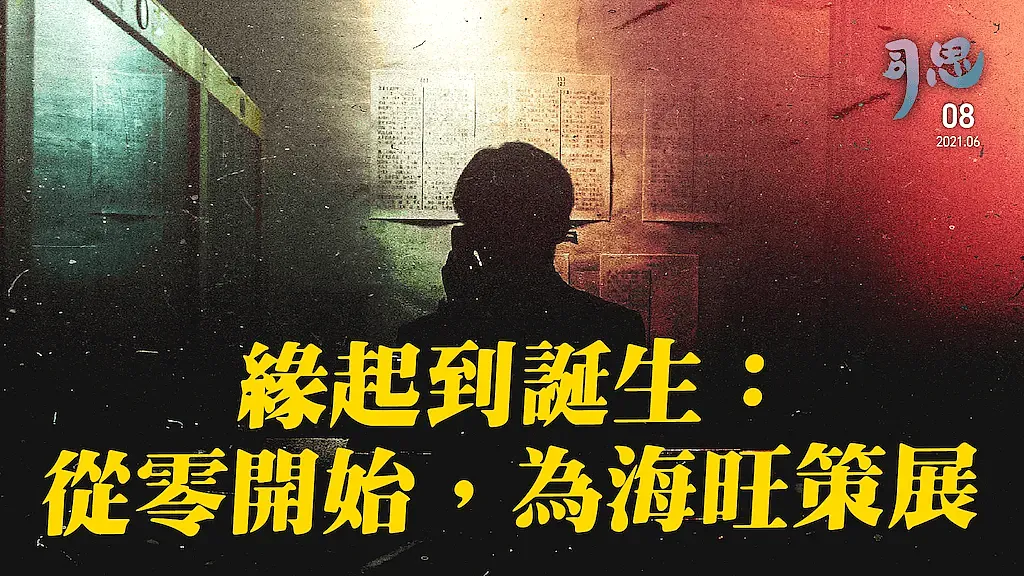
How It Began: Curating Shining Haiwang from Scratch
Last edited: 2026-08-30
Shining Haiwang was my first experience curating an exhibition. The curatorial team consisted of several advocacy staff members and volunteers, and curation and preparation took two months in all. Because none of us had any exhibition experience, we initially thought one month would be enough (laughs). In the end, it took two full months of intense work to bring the exhibition to life. Looking back, the process was extremely nerve-racking: I was constantly worried that one mistake might undo everyone's hard work.
I often wonder what design can bring to this world. Thank you to the volunteers who experienced and explored this journey with me; I hope to record these moments. All these hard-found possibilities are meant to bring the light of dawn to Haiwang.
From Litigation to Exhibition Space: The First Stop in Taipei
As the first stop of the Shining Haiwang exhibition, Taipei posed a formidable challenge because none of the team had prior curatorial experience. The schedule was also tight: a mistake at any stage could have caused us to miss the opening date, so every step felt nerve-racking.
The curatorial team first had to select suitable elements from more than a decade of litigation and advocacy materials concerning the Chiu Ho-Shun case and decide how to turn them into exhibits. Once the presentation formats were settled, we divided the work of organizing materials and drafting copy. Only after the text was finalized could we move on to graphic layout and video production. At the same time, we had to work out how to install everything in the venue-what adhesives could be used on the walls, how to suspend projectors, and so on. Designing printed materials was especially difficult because I had never done it before. From exhibit dimensions and materials to font sizes, we did not dare overlook any detail.
Beyond producing the exhibits, another crucial part of curating was "promotion." Because in-person events tend to attract visitors, we arranged four talks during the two-week exhibition, which also had to be factored into our staffing plans.
The venue also deserves mention. Finding a space in Taipei, where space is costly, gave us a major headache. Beyond budget, we wanted a venue that was not overly bright and that carried a certain weight, so visitors could better sense the predicament of Chiu Ho-Shun after 32 years without freedom. We ultimately chose Wetland for the Taipei exhibition; its ruin-like interior helped convey the somber atmosphere of prolonged confinement.
Throughout this process, I learned how a curator can care for and respect all team members' ideas as much as possible, discuss appropriate execution and division of labor, and balance the exhibition's atmosphere with budget constraints-all of which were first-time learning experiences for me.
From Taipei to Zhunan, and Then to Taichung
Drawing on our experience in Taipei, the Zhunan exhibition largely followed the same model. But because Zhunan is Chiu Ho-Shun's hometown, "collaboration with local organizations" became an especially important goal. We hoped to train more local volunteers, tell more residents about the case, and remind people that a fellow Zhunan native is paying a price he should never have had to bear for the state's mistake. We wanted the exhibition not simply to be a copy transplanted from Taipei, but to develop its own local character.
We also made some adjustments to the main visual design:
 Image / "Shining Haiwang" Standard Font
The standard lettering for "Shining Haiwang" overlays the characters with motifs resembling prison bars, symbolizing Chiu Ho-Shun trapped in detention, while a bird flying freely in the upper-right corner represents our hopes for him. Ocean waves form the central motif of the main visual, representing Longfeng Harbor, the hometown landscape Ah-Shun misses.
The Taipei exhibition used red and black to evoke an oppressive atmosphere. On either side appeared words once spoken by Chiu Ho-Shun, including "I am Chiu Ho-Shun. I did not kill anyone" and "Why don't you have the courage to acquit me?" The Zhunan exhibition instead used blue and pink for a softer tone and added the wind turbines common along the Zhunan coast. Surrounding text read, "Haiwang, when are you coming home?" and "Haiwang, we hope you can come home soon." Because Zhunan, Miaoli has Hakka communities, we used both Hakka and Taiwanese to express our care and support for Ah-Shun.
After Zhunan, Shining Haiwang traveled to Taichung, where colleagues at the JRF Taichung Office took over preparations. The Taichung exhibition emphasized warm sunlight and the feeling of being surrounded by mountains, using warm yellow and green tones. The phrases "Haiwang, have you ever seen scenery like this?" and "When you come back, we'll take you to see this world" expressed our hope that one day we can take Ah-Shun to see more of the world.
 Image / Main visuals of the Taipei, Zhunan, and Taichung exhibitions
One thing I especially want to share is that the venue of the Taichung Office includes a three-story basement, which offered more possibilities compared to Wetland in Taipei, but made volunteer tour-guiding manpower more challenging. Therefore, a major highlight of the Taichung leg was the addition of an audio guide provided by the curatorial team, allowing visitors to scan a QR code in every exhibition area to hear the audio introduction regardless of whether a volunteer guide was available.
Each of the three exhibitions had its own unique characteristics. Haiwang's story carries our blessings across different artistic expressions.
The Soul of the Exhibition: People Who Once Lived Through Profound Injustice
In addition to the volunteers who participated and helped, wrongful-conviction exoneree Hsu Tzu-Chiang unexpectedly became a crucial force behind Shining Haiwang. The reconstructed visitation room and detention cell grew out of his work, and he also helped with many other parts of the exhibition layout and installation.
Another wrongful-conviction exoneree, Cheng Hsing-Tse, readily agreed to write "Chiu Ho-Shun Is Innocent" at the opening press conferences for all three exhibitions and also created the "Shining Haiwang" banner that everyone signed.


Having suffered the pains of wrongful convictions, they now stepped forward to assist in realizing Shining Haiwang. They hoped to use their own strength, along with similar past experiences and feelings, to contribute a share of effort for Chiu Ho-Shun, who is still awaiting rescue. This role reversal and mutual support among those wronged became another touching and poignant aspect of the preparation process.
Let This Exhibition Embrace Us, and Let More of Us Hope for Dawn for Haiwang Together
I do not think visitors are merely passive recipients of information; everyone who enters the exhibition becomes part of the action. Some visitors we met were shocked, while others felt so discouraged that they said there was nothing they could do beyond seeing the exhibition. But the relationship between an exhibition and its visitors is not one-way. When an innocent person is convicted, none of us is entirely free. In that sense, the exhibition embraces every one of us.
Little Hai-wang, may you return home soon.
Appendix: Exhibition Photography Collection
 Photo / Exhibition planning sketch
We hope visitors can understand the Chiu Ho-Shun case and Chiu Ho-Shun as a person through the exhibition.
Under these two frameworks, for the former, we planned six exhibition areas: "Police Torture and Coerced Confessions," "Timeline of the Case," "Doubts in the Case," "Chiu Ho-Shun's Monopoly of Life," "Demands of the Rescue Team," and "Case Newspapers"; for the latter, we divided it into three areas: "Chiu Ho-Shun's Singing," "Handwritten Letters," and "Memories of Hometown."
Finally, we hoped that besides introducing Chiu Ho-Shun, we could also discuss other wrongful conviction cases. Therefore, where space permitted, we additionally planned "Stories of Ten Wrongful Conviction Cases," giving visitors an opportunity to learn about more cases.
"The Prelude to Confinement is Blood," "Dawn Shining Through Iron Windows," "Ah-shun, How Are You Lately?," "Chronicle of Chiu Ho-Shun's Life," "Why Choose to Rescue Chiu Ho-Shun?," "Chiu Ho-Shun's Monopoly of Life," "Ten Forgotten Stories," and "Case Map." We presented the exhibition using eight different materials and formats.
We may know the facts-brutal interrogation and torture, more than thirty years in a detention cell measuring only 1.368 ping (about 4.5 square meters), decades spent under the weight of a wrongful accusation, an aging body, and loved ones passing away one after another-but these are forms of pain we can never truly experience for him. We can never fully inhabit another person's life. Still, through visual, auditory, and other sensory approaches, we hoped to come a little closer to his experience and find one more reason not to remain indifferent.

"The Prelude to Confinement Is Blood" began with the idea of a torture-experience room and was ultimately presented as a video. We drew on audio and visual materials concerning police torture documented in the investigation led by Control Yuan Member Wang Ching-Feng. To make the reenactments more realistic, volunteers recreated interrogation methods used against Chiu Ho-Shun and others, with Hsu Tzu-Chiang serving as an on-site technical adviser. Although Ah-Chiang had not himself been tortured, he had heard about many methods used by police, including pinching nipples, placing a phone book against a person's chest and striking it with a metal hammer, forcing chili water into the mouth, and covering the eyes with towels. To show that torture causes not only physical injury but also profound fear and psychological trauma, we interviewed wrongful-conviction survivors Cheng Hsing-Tse and Su Ping-Kun. Through their accounts, we hoped visitors could better understand the terror and panic of being subjected to torture.

In "Ah-shun, How Are You Lately?," we recorded Chiu Ho-Shun's singing in the detention center in 2019. The songs not only represent Chiu Ho-Shun's will, but also serve as first-hand material for visitors to get to know him better. In the past, Chiu Ho-Shun could only sing the songs he composed in the meeting room, so we reconstructed the appearance of the meeting room and placed a mirror inside instead of a cardboard cutout of Chiu Ho-Shun. The purpose was to let visitors see themselves in the mirror while listening to Ah-shun's singing, because any of us could be the next Chiu Ho-Shun.

In "Ten Forgotten Stories," we assembled ten wrongful-conviction cases. Some involved people who were eventually exonerated; Wang Hsin-Fu and Chiu Ho-Shun were still awaiting rescue; and Chiang Kuo-Ching, Lu Cheng, Tu Ming-Hsiung, and Tu Ming-Lang were executed before they could be saved. Through these real cases from Taiwan, we wanted to show the devastation caused when the justice system fails and the miscarriages of justice that remain unavoidable so long as the death penalty exists. Whether someone was exonerated, left waiting, or lost before rescue arrived often came down to luck.
Thanks to all friends who contributed to this exhibition:
|Curatorial Team|
- Li Li-Cheng
- Wang Ting-Chun
- Brian
- Yang Kang
- Yu Hui-Yu
- Liu Ying-Lien
- Wu Yi-Fen
- Yen Fu-Tai
- Ying Chi-Wei
- Sun Tsai-Ti
- Tsai Shang-Jung
- Wang Jung
- Wang Hao-Han
- Hsu Tzu-Chiang
- Lin Hsin-I
- Lo Li-Han
- Ma Chien-Ya
- Lin Chih-Fang
- Chang Chih
- Ko Yun-Ching
- Wu Ting-Chen
- Wang Yu-Hsiang
- Mu Yu-Feng
- Wang Chen-Yun
- Chang Hua-Che
- Hsieh Chia-Chen
- Mido
|Special Thanks|
- Cheng Hsing-Tse
- Su Ping-Kun
- Director Li Chia-Hua
- Carue
- Sky
- Chang Li-Hui
- Tsai Ping-Heng
- Plain Law Movement
- Councilor Sung Kuo-Ting
- Councilor Chen Pin-An
- Councilor Tseng Wen-Hsueh
- Moshi Living Studio
- Wild Art Studio
- Heart Carving House
- Haomin Cultural Action Association
- Good Temperature Taiwan Youth Foundation
- Central Office, Humanistic Education Foundation
- Legislator Chiu Hsien-Chih
- Legislator Freddy Lim
- Legislator Wang Wan-Yu
Finally, we must thank the volunteers who looked after the Taipei, Zhunan, and Taichung exhibitions from beginning to end. Without you, this exhibition could not have happened.
This article is an AI-generated translation of the original Chinese text. In the event of any discrepancy, the Chinese version shall prevail.