
JRF Newsletter
After the Exhibition | Being Brave Together Through the Years of Confinement
Last edited: 2026-08-30
I kept asking myself these questions while planning the exhibition, but through the exhibition itself I gradually began to find answers.
"This miscarriage of justice has trapped not only the defendant, but all of us."
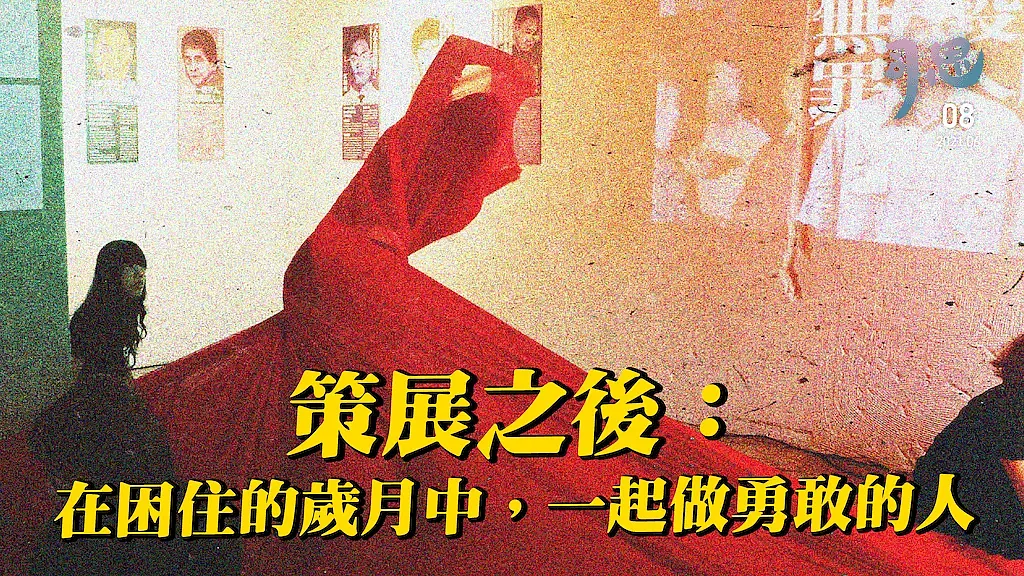
On the opening day in Taipei, we invited Chan Tien-Chen of the Tsai Jui-Yueh Dance Research Institute to perform. Bound in red cloth, the dancer struggled desperately but could not break free, rushing from side to side with nowhere to escape, as though destined to remain trapped forever.
 Photo courtesy of Attorney Yu Po-Hsiang
After the performance, Attorney Yu Po-Hsiang, convener of the pro bono defense team for the Chiu Ho-Shun case, took the stage. He said, "I have always felt that Chiu Ho-Shun is not the only one trapped inside. To some extent, all of us are trapped. This miscarriage of justice has trapped not only the defendant but all of us-or, more precisely, the conscience of society itself. Only when society recognizes the problems in this case will everyone have a chance to escape this snare." As Attorney Yu's voice choked with emotion, people in the room began to cry. Perhaps that is because this journey has truly been so long.
Attorney Yu said that we are all trapped. More than a decade of commitment is difficult to put into words; there have been periods of stagnation when it felt impossible to continue. Yet whenever even a sliver of light appears, everyone gathers themselves and moves forward again, because what is at stake is a person's innocence, freedom, and, above all, life. The rescue team cannot afford the luxury of pessimism.
 Photo courtesy of Minister without Portfolio Lo Ping-Cheng
During the Taipei exhibition, Minister without Portfolio Lo Ping-Cheng, who had previously worked on wrongful-conviction rescue efforts, also visited. While guiding two high-school students, he joked, "Uncle will give you a tour," and said, "I also helped rescue some of the people whose names are on this wall." Two visitors later became volunteers for the Taichung exhibition: one was a high-school student we met in Zhunan, and the other had been dragged by a friend to see the exhibition in Taipei. Through their own participation, they hoped to share Chiu Ho-Shun's story with more people.
As this energy gradually accumulates and society slowly develops a collective consciousness, can we continue to move forward? Perhaps in the process of holding such exhibitions, it is not merely a one-way presentation of the collected evidence and materials to everyone; everyone's feedback and reflections also inversely become the strength that supports us in carrying on.
"Even if we cannot yet bring Ah-shun home, we must first tell his story to the people of his hometown."
Traveling along Taiwan's west coast and looking out the car window, we saw countless wind turbines turning in the strong sea breeze. I remember coming to Zhunan, Miaoli, while preparing for the exhibition there-Ah-Shun's hometown, familiar to him yet now also somewhat distant.
We hailed a taxi outside the station and headed to the exhibition venue. As we chatted with the driver about why we had come to Zhunan, we mentioned the Chiu Ho-Shun case. To our surprise, the driver actually knew Ah-Shun.
Among the later visitors were many local residents in their forties and fifties. Only then did we realize that quite a few people in the area had heard of or known Ah-Shun and could still recall impressions of him from years ago. Yet they did not necessarily know the full story or what happened later, and some were astonished to learn that Chiu Ho-Shun was still confined in the detention center.
Through the exhibition, we brought Ah-Shun's videos, recordings, letters, and other materials to Zhunan, giving people a tangible way to reconnect with Chiu Ho-Shun and narrowing the distance created by time. We hoped to renew local awareness, invite residents to look again at the Chiu case after thirty years, and give people a chance to know Ah-Shun anew. That may also have been why we chose Zhunan: even if we cannot yet bring him home, we can tell his story here to his family, friends, and neighbors, hoping that when he finally returns-even if he no longer recognizes the changed landscape of his hometown-the people here will not feel like strangers.
"It turns out so many people are willing to walk together."
 Photo of author and teacher Chang Chuan-Fen's signature
Later I heard Chang Chuan-Fen say that the exhibition encouraged her because the case had gone on for such a very long time. Eleven years had passed without progress, and Chiu Ho-Shun remained in the detention center under a final death sentence-an extraordinarily discouraging reality. Yet for the lawyers who had devoted themselves to the case for years, and for everyone involved in the rescue effort, the exhibition transformed more than thirty years of time and painstaking work into room after room of tangible space and showed them how many people were willing to walk alongside them.
During the two weeks in Taipei, I saw volunteers who had followed Chiu Ho-Shun's case for more than a decade, reporters who had tracked it over the years, and names familiar from old rescue archives appearing on the signature banner for the "Shining Haiwang" exhibition. Although I did not know them personally, I knew they were there. If the exhibition could offer even a little encouragement to these rescuers who had worked quietly for so long, that was more than enough. It was something I had never expected the exhibition to do.
Shining Haiwang: To Be Continued
After Taipei, Miaoli, and Taichung, the "Shining Haiwang" exhibition was supposed to travel next to Tainan, but the severe pandemic forced a postponement. We do not know whether Tainan will be its final stop or how much farther the rescue effort can go. But we are grateful to all of you for standing as "catchers in the rye," trying to catch those who keep falling into the abyss of the justice system.
Heartfelt thanks to all the friends who contributed to this exhibition:
|Curatorial Team|
- Li Li-Cheng
- Wang Ting-Chun
- Brian
- Yang Kang
- Yu Hui-Yu
- Liu Ying-Lien
- Wu Yi-Fen
- Yen Fu-Tai
- Ying Chi-Wei
- Sun Tsai-Ti
- Tsai Shang-Jung
- Wang Jung
- Wang Hao-Han
- Hsu Tzu-Chiang
- Lin Hsin-Hsiang
- Lo Li-Han
- Ma Chien-Ya
- Lin Chih-Fang
- Chang Chih
- Ko Yun-Ching
- Wu Ting-Chen
- Wang Yu-Hsiang
- Mu Yu-Feng
- Wang Chen-Yun
- Chang Hua-Che
- Hsieh Chia-Chen
- Mido
|Special Thanks|
- Cheng Hsing-Tse
- Su Ping-Kun
- Director Li Chia-Hua
- Carue
- Sky
- Chang Li-Hui
- Tsai Ping-Heng
- Plain Law Movement
- Councilor Sung Kuo-Ting
- Councilor Chen Pin-An
- Councilor Tseng Wen-Hsueh
- Moshi Life Studio
- Wild Art Studio
- Mind Sculpture House
- Haomin Cultural Action Association
- Good Temperature Taiwan Youth Foundation
- Central Office of the Humanistic Education Foundation
- Legislator Chiu Hsien-Chih
- Legislator Freddy Lim (Lin Chang-Tso)
- Legislator Wang Wan-Yü
Finally, we thank all the volunteers who helped look after the Taipei, Zhunan, and Taichung exhibitions from beginning to end. Without you, this exhibition could never have happened.
This article is an AI-generated translation of the original Chinese text. In the event of any discrepancy, the Chinese version shall prevail.