
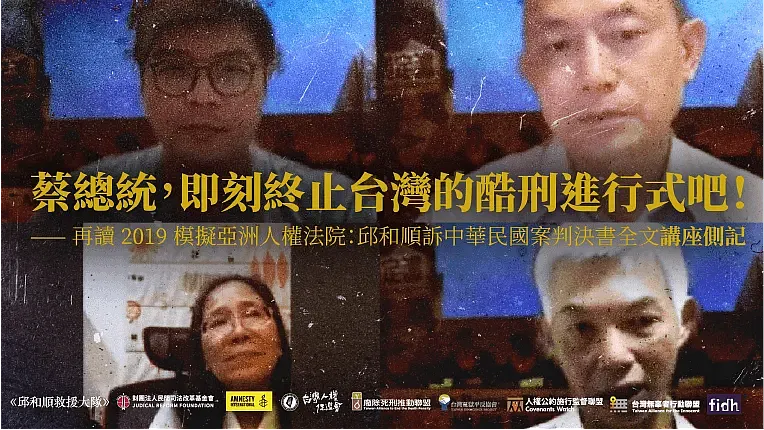
Lecture Sidelights | President Tsai, End Taiwan's Ongoing Torture Now!
Last edited: 2026-08-30
"The moment you look at it, you feel the pain"-that is how former Grand Justice Hsu Yu-Hsiu describes Chiu Ho-Shun's life since 1988. We hope readers already know who Chiu Ho-Shun is, because everyone in Taiwan should know him: he represents the "ongoing reality of torture" in a democratic Taiwan that has long since emerged from authoritarian rule.
In 1988, Chiu Ho-Shun was accused, together with 11 other defendants, in connection with the 1987 dismemberment of Ko Hung-Yu-Lan and the kidnapping of Lu Cheng. During the investigation, he was tortured and coerced into confessing, and he spent four months in incommunicado detention without defense counsel or an assistant. During the trial, the original judge failed to recuse himself. After four years in solitary confinement and 18 years wearing six-kilogram leg irons, his death sentence became final in 2011.
On October 17, 2019, Asia's first simulated human-rights court-the Simulated Asian Human Rights Court (SAHRC)-issued a judgment in the Chiu Ho-Shun case, finding that the Taiwanese government had violated Article 6 (right to life), Article 7 (prohibition of torture), and Article 14 (right to a fair trial) of the International Covenant on Civil and Political Rights (ICCPR). The judgment was unequivocal: Chiu Ho-Shun had been tortured, sentenced to death without ever receiving a fair trial, and remained imprisoned; his continuing confinement under those circumstances constituted torture. The judgment urged Taiwan's courts to provide a fair retrial and take concrete steps to investigate the original allegations effectively.
It was the first time Chiu Ho-Shun had received a fair hearing, but the simulated judgment itself lacked binding legal force.
On June 26, 2021, the International Day in Support of Victims of Torture, SAHRC initiator and former Grand Justice Hsu Yu-Hsiu joined Yu Po-Hsiang, convener of Chiu Ho-Shun's pro bono defense team; Huang Sung-Li, convener of Covenants Watch; and Shih Yi-Hsiang, Secretary-General of the Taiwan Association for Human Rights, to revisit the SAHRC judgment. Reflecting on what the judgment means for Taiwan, they again called on the Tsai Ing-Wen administration to pardon Chiu Ho-Shun immediately.
At the beginning of the seminar, Hsu Yu-Hsiu emphasized that although the SAHRC is "simulated," its judges are international human-rights experts fully qualified to sit on a real regional human-rights court. The case itself is real, and Chiu Ho-Shun's suffering is real as well.
As the initiator of the SAHRC, Hsu Yu-Hsiu argued that the simulated judgment established a precedent for a future regional human-rights court in both procedural and substantive respects. Procedurally, it modeled due-process safeguards in two dimensions: oral proceedings and party-led presentation. She noted that Taiwan still relies heavily on written proceedings and argued that this practice lies behind many wrongful convictions. Substantively, the SAHRC judgment affirmed that Taiwan's obligation to comply with international human-rights covenants is not defeated by a non-retroactivity objection.
Taiwan gave the ICCPR domestic legal effect in 2009 through an implementation act. The SAHRC judgment noted that although the Chiu Ho-Shun case arose in 1988, the Republic of China had signed the ICCPR as early as 1967 and, because the Covenant forms part of international human-rights law, Taiwan was already obliged to respect its principles before the 2009 implementation legislation took effect. Similarly, although Taiwan has not yet enacted the Implementation Act of the Convention against Torture and Other Cruel, Inhuman or Degrading Treatment or Punishment and its Optional Protocol, the prohibition of torture is a rule of customary international law and even a peremptory norm (jus cogens), and Taiwan is therefore bound by it.
Attorney Yu, convener of Chiu Ho-Shun's pro bono defense team, said that although the SAHRC judgment itself is not legally binding, it "genuinely examines Taiwan's present human-rights conditions and legal environment and faithfully reflects the distance between Taiwan's judicial practice and international human-rights standards."
Attorney Yu recalled that during the first ten years of his 23-year career, nearly every criminal defendant who had confessed told him the confession had been obtained through torture, "and sadly, nine times out of ten, it was true." The Code of Criminal Procedure clearly prohibits torture by the state-but how well is that prohibition actually enforced?
The Chiu Ho-Shun case was litigated from 1988 to 2011, and no one dared to acquit him "because this case has 'torture' written across its forehead," Attorney Yu said. "If there were truly nothing wrong with the case, could it have gone on for 23 years and through 11 trials?" By the eleventh retrial, the defense team sought evidence for scientific testing, but two crucial items had disappeared: audio recordings from the Lu Cheng case and the victim's belongings and suspected murder weapon in the Ko Hung-Yu-Lan case. "These defendants never received a fair trial. They were not even given a chance to prove their innocence through scientific testing, and we do not even know at which stage the evidence disappeared."
Huang Sung-Li, convener of Covenants Watch, said an important lesson from the SAHRC judgment is that enacting implementation legislation for human-rights covenants is not enough; Taiwan must continue working across every part of the legal system to make universal human rights a reality.
A regional human-rights court is intended precisely to prevent human rights from being treated differently from country to country and to give effect to universal values across borders. Europe, the Americas, and Africa already have regional human-rights systems; Asia remains the only region without one. Human-rights groups jointly issued a nongovernmental Asian Human Rights Charter in 1998, but governments did not follow. Huang noted that Asia's vast geography, complex cultural backgrounds, debates over "Asian values," and the China factor make regional consensus difficult in the near term. Rather than beginning with an Asian Human Rights Convention, he suggested using the core UN human-rights treaties as a common foundation and, drawing on a proposal by Economic Democracy Union attorney Lai Chung-Chiang, establishing a human-rights forum and working group within APEC as a step toward an Asia-Pacific human-rights court.
In the meantime, Taiwan should promptly enact the Implementation Act of the Convention against Torture and Other Cruel, Inhuman or Degrading Treatment or Punishment and its Optional Protocol, clearly define torture, establish a National Preventive Mechanism (NPM), and criminalize torture under the Criminal Code. It should also review Code of Criminal Procedure provisions governing investigation, interrogation, and apprehension by judicial police and establish a sound legal framework for the management of evidence.
Regarding the Chiu Ho-Shun case, Huang called on the National Human Rights Commission to formally recommend that the President grant a pardon. He cautioned against asking the wrong question: "The question is not 'Can we establish that Chiu Ho-Shun is innocent?' Under the presumption of innocence, the questions should be: 'Did the court ever give Chiu Ho-Shun a fair trial?' and 'Were the court's judgments based on clear evidence?'" The SAHRC judgment had already answered the latter two questions.
As Taiwan works to take its place on the international stage, Attorney Yu asked, "Are we willing to confront honestly the history of serious covenant violations in our own past?" We call on the Taiwanese government to pardon Chiu Ho-Shun immediately and end this stain on Taiwan's human-rights record-his 33-year "ongoing reality of torture."
This article is an AI-generated translation of the original Chinese text. In the event of any discrepancy, the Chinese version shall prevail.