

Rights Handbook for Inmates and Defendants | Mail Inspection and Perusal
Last edited: 2026-08-30
Introduction
Article 66 of the former Prison Act provided that incoming and outgoing correspondence was subject to inspection and perusal by prison officials. In practice, this meant prison officials could both inspect and read all mail sent or received by inmates. J.Y. Interpretation No. 756 rejected that approach by distinguishing between "inspection" and "perusal." Inspection is intended only to determine whether contraband is enclosed; where the inspection method is reasonably related to that purpose, it does not violate the freedom of secrecy of correspondence protected by Article 12 of the Constitution. Perusal is different. Because the former law allowed prison officials to read all correspondence without distinguishing the type of mail or considering the circumstances of the individual case, it imposed an excessive restriction on the freedom of secrecy of correspondence of both inmates and their correspondents and was therefore unconstitutional.
In response to Interpretation No. 756, the Prison Act and Detention Act were amended in 2020 to revise the rules governing correspondence. This chapter of the Rights Handbook for Inmates and Defendants introduces the new rules on mail inspection and perusal and discusses problems reported by people in correctional custody.
Legal Rules
For the rules governing inmate and defendant correspondence, see Article 74 of the Prison Act and Article 66 of the Detention Act.
The rules broadly distinguish between "inspection" and "perusal." Prison or detention-center personnel may inspect all incoming and outgoing correspondence. The sole purpose of inspection is to determine whether contraband is enclosed. Inspection may be carried out by opening the mail, using instruments, or other appropriate means. Whatever method is used, inspection must not be used as an opportunity to read the contents of the correspondence.
As for reading the contents, the law distinguishes between correspondence that may never be read and correspondence that may be read only under specified conditions.
- No perusal permitted: correspondence exchanged with a lawyer, defense counsel, or public agency.
- Conditional perusal: the statutory grounds differ slightly for sentenced inmates and defendants, as summarized below:
Sentenced Inmates
- The inmate has committed acts disrupting prison order or security, which are still under investigation.
- The inmate is serving a disciplinary period.
- There are facts and reasonable grounds to suspect that the inmate is at risk of escape.
- There are facts and reasonable grounds to suspect an intention to harm or harass others.
- Correspondence exchanged among inmates within correctional institutions.
- There are facts and reasonable grounds to suspect a risk of endangering prison safety or order.
Defendants
- The defendant has committed acts disrupting detention center order or security, which are still under investigation.
- The defendant is serving a disciplinary period.
- There are facts and reasonable grounds to suspect that the defendant is at risk of escape.
- Correspondence exchanged among inmates within correctional institutions.
- There are facts and reasonable grounds to suspect a risk of endangering detention center safety or order.
After prison or detention-center personnel read correspondence on a statutory ground, content may be deleted only if one of the following circumstances applies:
- It clearly endangers the safety or order of the prison.
- It incites or instigates others to commit crimes or violate laws and regulations.
- It uses symbols, code words, or other methods to make it impossible for inspection personnel to understand the contents of the correspondence.
- It involves matters relating to escape.
- It describes the security status of the correctional institution, or the locations of cells and workshops, to an extent that affects custody safety.
If content must be deleted, the procedure differs depending on whether the person in custody is the sender or the recipient.
- Sender: the prison shall state its reasons and either return the letter for safekeeping or require revision before mailing. If the inmate refuses to revise it, the prison may delete the relevant content and send the letter.
- Recipient: the prison shall state its reasons, delete the relevant content, and then deliver the correspondence to the inmate.
Where content is deleted, the prison must retain a photocopy of the original correspondence and return that copy to the inmate upon release.
Administrative Directive
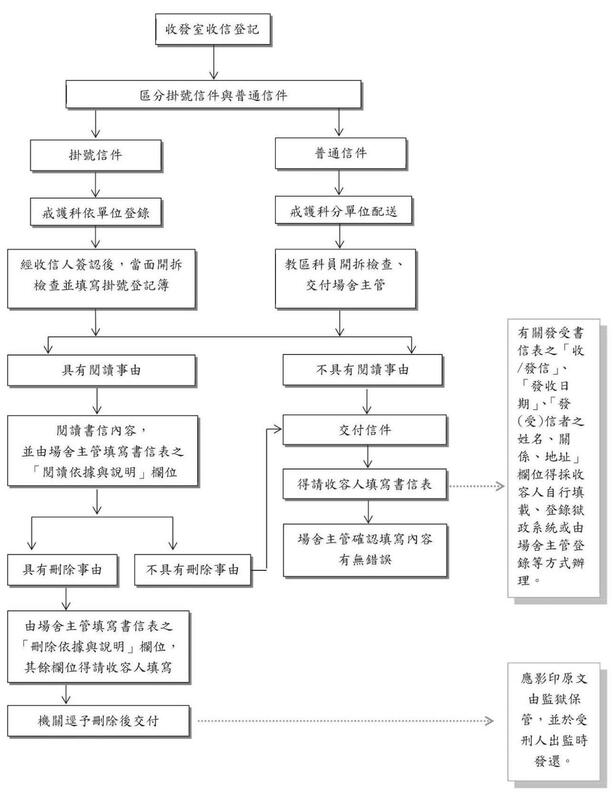
On November 4, 2020, the Ministry of Justice issued Directive Fa-Jiao-Zi No. 10904008740, which sets out the operational workflow for inspecting correspondence in practice. Figures 1 and 2 provide examples of the relevant procedures.
Figure 1 / Inmate Sending Mail
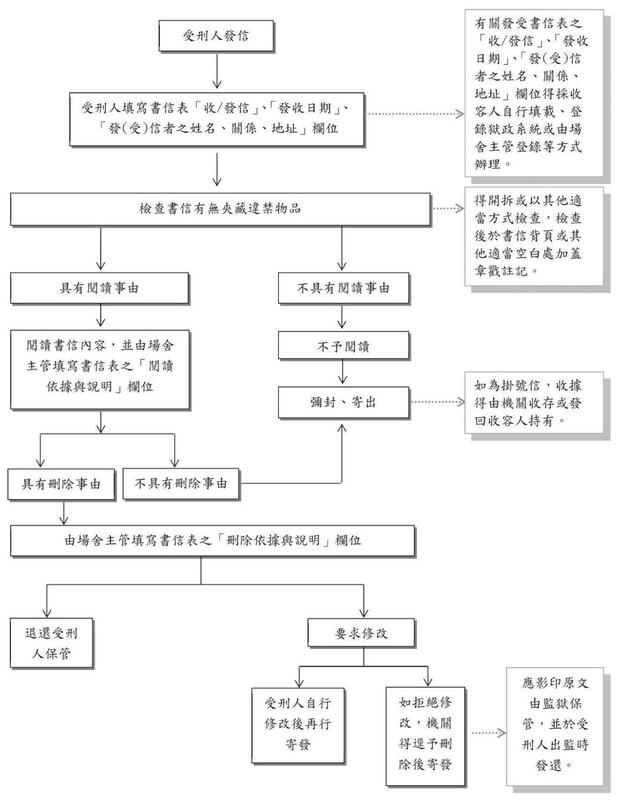
Figure 2 / Inmate Receiving Mail
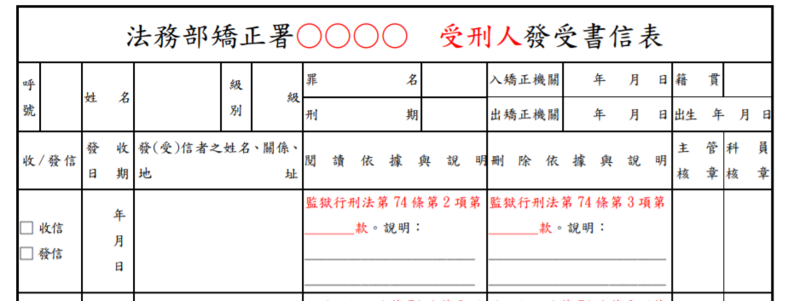
If a prison reads or deletes correspondence because it believes a statutory ground applies, it must record the legal basis and explanation on the "Inmate Incoming/Outgoing Mail Form" (Figure 3). Correspondence should never be read or altered without a record of the action.
Practical Issue: Can Mail Inspection Be Used as a Pretext to Read the Contents?
Some inmates have reported that, for outgoing mail, their facility requires every inmate to submit the written letter unsealed together with the envelope and mail form, after which an officer conducts the inspection. Because the letter is handed over unsealed and the inspection does not take place in the inmate's presence, inmates worry that staff may use the inspection process to read the contents. For incoming ordinary mail, staff first open and inspect the envelope before distributing it, again outside the recipient's presence. The same concern therefore arises. Yet, when compared with the Ministry of Justice directive, this type of inspection procedure appears to be formally permissible.
Returning to Interpretation No. 756, the Grand Justices pointed out:
Article 12 of the Constitution provides: "The people shall have the freedom of secrecy of correspondence." The purpose of this right is to protect people from arbitrary interference by the State or others with whether, with whom, when, how, and what they communicate. It is a concrete form of the constitutional right to privacy and is essential to human dignity, individual autonomy, personality development, the protection of the intimate sphere of private life, and autonomous control over personal information. [...]
[...] The purpose of inspection is to determine whether contraband is enclosed in correspondence (including packages). Inspection does not necessarily intrude into the contents of the correspondence, and that purpose is legitimate. So long as the inspection method is reasonably related to that purpose-for example, examining the exterior or contents after opening the mail, or using instruments-the measure does not exceed what is necessary under Article 23 of the Constitution and does not contravene the freedom of secrecy of correspondence protected by Article 12.
In other words, the Constitutional Court accepted universal inspection because inspection, properly understood, does not involve reading the contents and therefore need not compromise secrecy of correspondence. The difficulty is that current procedures do not clearly show how that distinction is protected in practice. Some institutions stamp mail "Opened Without Perusal" to indicate that staff did not read it, but the stamp itself is not the key safeguard. The real question is whether the inspection procedure actually prevents staff from reading correspondence when no statutory ground for perusal exists. This concern is especially serious when outgoing letters must be submitted unsealed and inspected outside the inmate's presence. The purpose of contraband inspection is principally to prevent prohibited items from entering a correctional institution, not leaving it. If institutions believe outgoing mail must also be inspected, they should explain what prohibited items they are seeking to prevent from leaving and use inspection methods that are reasonably tailored to that concern without intruding on secrecy of correspondence.
We welcome information from inmates about how mail is inspected in their prison or workshop, including whether different workshops use different procedures and whether those procedures actually protect secrecy of correspondence. We want to collect examples of both good and bad practices. If you believe staff have used mail inspection as an opportunity to read correspondence, please contact the JRF and describe in detail how your mail was inspected and why you believe its contents were read.
Case Example
One inmate reported that different workshops in the same prison used very different inspection practices. In Workshop O, outgoing mail was inspected while the inmate held the letter and personally pulled out the sheets for the officer to check and stamp; a clerk then sealed the envelope. For incoming mail, the inmate went to the officer's desk, where the envelope was opened in front of the recipient; the recipient then pulled out the letter for inspection and took it back immediately afterward. Both incoming and outgoing inspections were recorded on body-worn cameras. Only correspondence that the prison was legally permitted to read-such as correspondence between people held in correctional institutions-was submitted together with the mail form for perusal.
The inmate's own workshop used a different process. All outgoing mail had to be submitted with the envelope and unfolded letter sheets clipped to the mail form. The procedure was the same for correspondence that could legally be read and ordinary correspondence whose contents could not. Incoming mail was also opened and inspected by the officer before being handed to a clerk for distribution. Under this procedure, there was no practical safeguard against an officer using inspection as an opportunity to read the contents.
The inmate also described an incident in which he believed this actually happened. He had written to a JRF staff member and, as required by workshop rules, submitted the letter unsealed for inspection. On the day it was mailed, a correctional officer called him to the supervisor's desk, where he saw his letter spread open on the desk. The officer then asked why he had raised certain questions with the JRF.
The above case is a typical example of taking advantage of correspondence inspection to read letters. The report identified the time and place, the workshop's inspection procedure, the person who allegedly read the letter, and the basis for the inmate's belief: he personally saw the letter laid open on the desk and was questioned about why he had written it..
Court Decisions
The following summarizes court decisions concerning inspection and perusal of inmate correspondence. So far, inmates alleging that prison staff used inspection as a pretext to read correspondence have almost always lost. Since the amended Prison Act and Detention Act took effect, only one such case has been identified, and the inmate lost there as well. The central evidentiary problem is proving that staff actually read the contents rather than merely inspecting the mail. There is, however, one state-compensation case in which an inmate prevailed at first instance; the prison appealed. In that case, after Interpretation No. 756 had been issued, the prison not only read the inmate's correspondence but also photocopied and retained it.
Administrative Litigation
- Taiwan New Taipei District Court Judgment 108-Su-144 (Judgment during the new law period)
The plaintiff, an inmate, pointed out that during litigation with the prison, the Taipei Detention Center did not adopt face-to-face inspection for the legal briefs submitted to the prosecutor, but instead required him to submit the briefs for inspection, which he argued could not ensure his freedom of secrecy of correspondence. The defense of the Taipei Detention Center was that for the legal briefs submitted by the plaintiff to the prosecutor, the center only inspected whether there was contraband by "opening without examination," without reading the contents of the correspondence. After the inspection, it was registered and mailed, which did not impair the plaintiff's right of litigation. Moreover, the law only stipulates checking whether contraband is enclosed in correspondence sent and received by inmates and their relatives and friends through methods such as "opening without examination" and "auxiliary equipment"; as for whether inspections must be conducted face-to-face in the presence of the inmate, there is no explicit statutory provision. However, to prevent inmates from knowing the inspection process and focus in order to evade it, it is an appropriate management measure for the center to deliver the correspondence to the inmate after inspection.
The court held that for the legal briefs submitted by the plaintiff to the prosecutor, the Taipei Detention Center only inspected whether there was contraband by "opening without examination" and did not read the contents of the correspondence. After the inspection, it was registered and mailed, which naturally did not unlawfully infringe upon the fundamental rights of the plaintiff guaranteed by the Constitution.
(Judgments during the old law period)
- Taiwan Taitung District Court Judgment 107-Jian-15
- Kaohsiung High Administrative Court Judgment 108-Jian-Shang-70
- Taiwan Taitung District Court Judgment 109-Jian-Geng-Yi-2
- Kaohsiung High Administrative Court Judgment 110-Jian-Shang-1
The plaintiff, an inmate, argued that the management measure of the Green Island Prison arbitrarily inspecting his correspondence was illegal. The court held that Interpretation No. 756 of the Judicial Yuan declared the relevant provisions unconstitutional on December 1, 2017, and prescribed that they would cease to be effective no later than two years from the date of the interpretation's promulgation, adopting a periodic unconstitutionality interpretation. Subsequently, the Prison Act amended the relevant provisions on January 15, 2020, which took effect on July 15 of the same year. Before the new law took effect, Article 66 of the Prison Act at the time of the acts remained a valid law, meaning all correspondence sent and received by inmates was subject to inspection.
(Judgments during the old law period)
- Taiwan Taitung District Court Judgment 107-Jian-20
- Kaohsiung High Administrative Court Judgment 109-Jian-Shang-21
The plaintiff, an inmate, argued that the Taitung Prison opened letters received by him on its own initiative before forwarding them to him, which infringed upon his freedom of secrecy of correspondence. The court held that prison wardens may still inspect correspondence sent and received by inmates within the scope of confirming whether contraband is enclosed; regulations do not exclude the prison warden's authority to inspect documents served to inmates by courts, prosecutors' offices, or administrative agencies, or legal briefs sent by inmates to courts, prosecutors' offices, or administrative agencies, within the scope of confirming whether contraband is enclosed. Therefore, Taitung Prison's opening and inspecting of sealed correspondence that the inmate wished to send or receive (including correspondence between the inmate and relevant public agencies or appointed lawyers) before forwarding or mailing it, without completely ruling out the risk of endangering prison discipline, was not contrary to the law.
(Judgment during the old law period)
The plaintiff, an inmate, argued that Taitung Prison's management measure of arbitrarily opening his letters was illegal. The court held that Taitung Prison's management measures were executed in accordance with Article 66 of the Prison Act and Judicial Yuan Interpretation No. 756, which complied with legal regulations.
(Judgments during the old law period)
- Taiwan Taitung District Court Judgment 107-Jian-16
- Kaohsiung High Administrative Court Judgment 108-Jian-Shang-36
The plaintiff, an inmate, argued that Taitung Prison's management measures in inspecting the letters he sent and received were illegal, particularly because some of the correspondence consisted of letters sent by the court which could not possibly contain contraband, and thus Taitung Prison should not have inspected them. Based on the materials obtained, the court found that Taitung Prison inspected the contents of the plaintiff's letters solely because the letters were sealed; to ensure whether there was contraband inside, it required the plaintiff to unpack the letters on the spot. This did not constitute an inspection "touching upon the contents" and did not infringe upon the plaintiff's freedom of communication. In addition, the court held that letters sent to inmates by courts, prosecutors' offices, or administrative agencies must still pass through multiple units and handlers before delivery; to ensure that contraband was not mistakenly placed during transit (contraband listed by prisons is sometimes ordinary items in society) or intentionally placed by someone, the court affirmed the necessity for Taitung Prison to conduct "inspections not touching upon the contents" for letters sent to inmates by courts.
- Taiwan Taichung District Court Judgment 107-Jian-73 (Judgment during the old law period)
The plaintiff, an inmate, applied to the Taichung Prison regarding certain matters via an application form (report form). Taichung Prison replied in writing that the matters stated in the application form did not meet the requirements for grievances, and transmitted this reply via electronic official document to the Green Island Prison where the plaintiff was then located. Green Island Prison then printed out the official document and delivered it to the plaintiff. The plaintiff argued that Taichung Prison transmitting the document to Green Island Prison via electronic official document amounted to allowing Green Island Prison to see the contents of his correspondence, undermining the correspondence privacy and litigation defense guaranteed to him by Interpretation No. 756. The court held that the subject matter of the lawsuit filed by the plaintiff, based on the facts alleged, was manifestly groundless in law and dismissed the lawsuit through a judgment without holding oral arguments, without actually addressing the plaintiff's aforementioned arguments.
Civil Litigation - State Compensation
-
Currently the only case where an inmate won a state compensation lawsuit regarding correspondence inspection:
Taiwan Taitung District Court Civil Judgment 108-Guo-10, the defendant (Green Island Prison) shall pay the plaintiff (inmate) NT$3,000.
The plaintiff, an inmate, argued that during his imprisonment in Green Island Prison from September 25, 2017, to May 30, 2018, Green Island Prison personnel unlawfully ordered him to sign for documents served by government agencies and then had Green Island Prison civil servants read the contents and register them. Regarding legal briefs sent by him to government agencies, they also unlawfully ordered him to unseal them and first hand them over to Green Island Prison civil servants to register the contents of the dispatched letters, and further recorded the contents of the dispatched letters one by one in the important correspondence record book before mailing them, severely infringing upon the secrecy of correspondence guaranteed by Judicial Yuan Interpretation No. 756. Therefore, he claimed state compensation from Green Island Prison. Green Island Prison's defense was that prior to the rendering of Interpretation No. 756, it conducted correspondence inspection in accordance with relevant laws and regulations, including official directives. Although it continued to photocopy and register documents sent by the plaintiff to government agencies after the promulgation of Interpretation No. 756 on December 5, 2017, this was because the interpretation had just been issued and the superior authority had not timely provided relevant directives; due to this delayed reaction, it registered them according to past practices, and thereafter ceased reading contents and only registered the headers of the briefs.
The court held that although Article 66 of the pre-amendment Prison Act remained a currently valid law because Interpretation No. 756 only declared it to lose effect within a time limit, civil servants belonging to Green Island Prison should still comply with the intent of the aforementioned interpretation. Inspections of documents between the plaintiff and government agencies should be limited to checks for contraband and should not extend to reading the contents, so as to comply with the intent of Judicial Yuan Interpretation No. 185 and the administrative command for administrative agencies to act in accordance with the law. This did not differ simply because the Agency of Corrections of the Ministry of Justice delayed issuing a directive in accordance with the intent of Interpretation No. 756 until May 1, 2018. Consequently, after the promulgation of Interpretation No. 756, civil servants belonging to Green Island Prison failed to cautiously execute the provisions of Article 66 of the pre-amendment Prison Act in accordance with the intent of the aforementioned interpretation, and instead violated it by continuing to read, photocopy, or transcribe documents between the plaintiff and government agencies, which was naturally unlawful. Green Island Prison's defense that its actions were in accordance with the law cannot be adopted.
-
Lawsuits seeking state compensation for correspondence reading conducted by prisons prior to the issuance of Interpretation No. 756 have all resulted in defeats.
Taiwan Hsinchu District Court Civil Judgment 108-Guo-10, Taiwan High Court Civil Judgment 110-Shang-Guo-5, Taiwan Hsinchu District Court Civil Judgment 110-Guo-Geng-Yi-1 (Judgments during the old law period)
The plaintiff, an inmate, argued that during his detention in Hsinchu Prison from 2013 to 2016, Hsinchu Prison ordered him to unseal and submit his daily outgoing mail for registration elsewhere, and further recorded the summaries of the letter contents one by one in the important correspondence record book. For daily incoming mail, it ordered him to sign for it after unsealing and taking it elsewhere for registration, undermining the secrecy of correspondence guaranteed by Judicial Yuan Interpretation No. 756. The court held that regarding the correspondence received by the plaintiff, Hsinchu Prison personnel indeed opened and inspected the correspondence before handing it over to the plaintiff to sign for; additionally, regarding correspondence sent by the plaintiff, summaries of the letter contents were also filled out prior to mailing. It can be affirmed that the plaintiff's assertions that Hsinchu Prison opened and read his sent and received correspondence during his detention are true. However, the acts of Hsinchu Prison personnel in inspecting the plaintiff's correspondence all took place before the promulgation of Interpretation No. 756. Hsinchu Prison personnel executed the inspection and registered the plaintiff's correspondence in accordance with Article 66 of the pre-amendment Prison Act and Article 82-1 of the Enforcement Rules of the Prison Act, which were valid at the time and had not been declared unconstitutional. These constituted acts in accordance with the law, and it is difficult to find them unlawful.
Similar Cases
Taiwan Taoyuan District Court Civil Judgment 108-Guo-4, Taiwan High Court Civil Judgment 108-Shang-Guo-Yi-31. In the above judgments, the plaintiff inmate argued that prior to the rendering of Interpretation No. 756, Taoyuan Prison read and registered the contents of his correspondence, infringing upon his secrecy of correspondence, and claimed state compensation from Taoyuan Prison, but lost the lawsuit.
-
Lawsuits seeking state compensation because public agencies served official documents via commissioned service (Zhu-Tuo-Song-Da), enabling prisons to read the contents of correspondence, have all resulted in defeats.
-
a. Public agencies sent physical official documents via commissioned service. Under this method, the prison where the inmate is located is explicitly listed as the recipient on the envelope, and the prison opens and reads it first before forwarding it to the inmate.
Taipei Summary Court Civil Ruling 109-Bei-Guo-Jian-4, Taiwan Taipei District Court Civil Judgment 110-Guo-Jian-Shang-3 (Judgments during the old law period)
The plaintiff, an inmate, argued that the Executive Yuan delivered the written administrative appeal decision to Taitung Prison via commissioned service, and Taitung Prison opened and read it before forwarding it to the plaintiff. The Executive Yuan's method of delivering the written administrative appeal decision infringed upon his freedom of secrecy of correspondence, and therefore he claimed state compensation from the Executive Yuan. The court held that the plaintiff was serving a sentence in Taitung Prison, and pursuant to Paragraph 3, Article 47 of the Administrative Appeal Act, which mutatis mutandis applies the provisions of Article 80 of the Code of Administrative Litigation, the service of the written administrative appeal decision made by the Executive Yuan shall be commissioned to the warden of said prison or correctional institution. Civil servants belonging to the Executive Yuan handling the commissioned service in accordance with the aforesaid provisions acted pursuant to the law, and their actions lacked illegality. Moreover, documents received by the appellant in the prison must be inspected by prison personnel; there is no equivalent causal relationship between the opening of the written administrative appeal decision and the commissioned service handled by civil servants belonging to the Executive Yuan.
Similar Cases
- Taipei Summary Court Civil Judgment 109-Bei-Guo-Jian-9, Taiwan Taipei District Court Civil Judgment 109-Guo-Jian-Shang-16; Taipei Summary Court Civil Judgment 109-Bei-Guo-Jian-10, Taiwan Taipei District Court Civil Judgment 109-Guo-Jian-Shang-6; Taipei Summary Court Civil Judgment 109-Bei-Guo-Jian-7, Taiwan Taipei District Court Civil Judgment 109-Guo-Jian-Shang-4; Taipei Summary Court Civil Judgment 109-Bei-Guo-Jian-15, Taiwan Taipei District Court Civil Judgment 109-Guo-Jian-Shang-7; Taipei Summary Court Civil Judgment 108-Bei-Guo-Xiao-30, Taiwan Taipei District Court Civil Judgment 109-Guo-Xiao-Shang-11; Taitung Summary Court Civil Judgment 109-Dong-Guo-Jian-7, Taiwan Taitung District Court Civil Judgment 109-Guo-Jian-Shang-1; Taipei Summary Court Civil Judgment 109-Bei-Guo-Xiao-1, Taiwan Taipei District Court Civil Judgment 109-Guo-Xiao-Shang-8; Taipei Summary Court Civil Judgment 108-Bei-Guo-Jian-12, Taiwan Taipei District Court Civil Judgment 108-Guo-Jian-Shang-2. In the above judgments, the plaintiff inmates all filed state compensation lawsuits targeting the Executive Yuan's use of commissioned service to enable their respective prisons to open and read their letters, and all lost.
- Taipei Summary Court Civil Judgment 108-Bei-Guo-Xiao-13, Taiwan Taipei District Court Civil Ruling 109-Guo-Xiao-Shang-5; Taipei Summary Court Civil Judgment 108-Bei-Guo-Xiao-8, Taiwan Taipei District Court Civil Judgment 109-Guo-Xiao-Shang-2. In the above judgments, the plaintiff inmate filed a state compensation lawsuit targeting the Ministry of Transportation's use of commissioned service to enable the prison where he was located to open and read his letters, and lost.
- Taipei Summary Court Civil Judgment 108-Bei-Guo-Xiao-6, Taiwan Taipei District Court Civil Judgment 108-Guo-Xiao-Shang-7. The plaintiff inmate filed a state compensation lawsuit targeting the Ministry of Justice's use of commissioned service to enable the prison where he was located to open and read his letters, and lost.
-
b. Public agencies sent electronic official documents via commissioned service. Under this method, the prison where the inmate is located receives the electronic official document, prints it out, and forwards it to the inmate.
Luodong Summary Court Civil Judgment 109-Luo-Guo-Xiao-1, Taiwan Yilan District Court Civil Judgment 110-Guo-Xiao-Shang-3 (Unable to confirm whether it is a judgment during the new law or old law period)
Dozens of official documents issued by Yilan Prison to the plaintiff inmate were all sent via commissioned service, first transmitted as electronic official documents to the prison where the plaintiff inmate was located, and then printed out in paper form by the prison where he was located and delivered to the plaintiff inmate. The plaintiff inmate argued that Yilan Prison's practice infringed upon his freedom of secrecy of correspondence, and therefore claimed state compensation from Yilan Prison. The court held that Yilan Prison acted in accordance with Article 80 of the Code of Administrative Litigation by commissioning the warden of the prison or correctional institution where the plaintiff was located to effect service in paper form, which was not illegal. In addition, the legislative reasoning of Article 74 of the Prison Act states: "Correspondence exchanged between an inmate and their lawyer, defense counsel, or public agency, such as legal briefs filed by an inmate with a court or prosecutors' office, or documents served to an inmate by a court or prosecutors' office; or correspondence sent or received regarding matters such as an inmate's suggestions for administrative innovation, inquiries about administrative laws and regulations, reporting of administrative irregularities, or the protection of administrative rights and interests; or correspondence sent or received for the needs of litigation due to cases involving administrative litigation, civil litigation, or criminal litigation and retaining a lawyer in accordance with the law, etc. If it formally constitutes correspondence exchanged between an inmate and their lawyer, defense counsel, or public agency, regardless of the text content of the correspondence or whether any of the circumstances in the paragraphs of the second paragraph apply, the prison may only check and shall not read the contents of the correspondence, hence the provision of the proviso in the second paragraph." Viewed in light of this legislative purpose, the "public agency" in the latter half of Paragraph 2, Article 74 of the Prison Act should refer to agencies other than the prison where the inmate is located, and therefore the correspondence regulated by this article should not include letters exchanged between the inmate and the prison where they are located. The official documents in dispute in this case were documents produced and issued to the plaintiff by Yilan Prison, which do not match the scope of freedom of secrecy of correspondence intended to be protected by the aforementioned legislative reasoning.
Similar Cases
- Taipei Summary Court Civil Judgment 109-Bei-Guo-Jian-12, Taiwan Taipei District Court Civil Judgment 109-Guo-Jian-Shang-9; Taipei Summary Court Civil Judgment 109-Bei-Guo-Xiao-2, Taiwan Taipei District Court Civil Judgment 109-Guo-Xiao-Shang-9; Taipei Summary Court Civil Judgment 108-Bei-Guo-Xiao-9, Taiwan Taipei District Court Civil Judgment 109-Guo-Xiao-Shang-6. In the above judgments, plaintiff inmates filed state compensation lawsuits targeting the Ministry of Justice adopting commissioned service and serving official documents via electronic official documents, and all lost.
- Taipei Summary Court Civil Judgment 108-Bei-Guo-Xiao-20, Taiwan Taipei District Court Civil Judgment 109-Guo-Xiao-Shang-4. Targeting the National Police Agency of the Ministry of the Interior adopting commissioned service and serving official documents via electronic official documents, a state compensation lawsuit was filed and lost.
- Taipei Summary Court Civil Judgment 107-Bei-Guo-Xiao-11, Taiwan Taipei District Court Civil Ruling 108-Guo-Xiao-Shang-6. Targeting the Ministry of Education adopting commissioned service and serving official documents via electronic official documents, a state compensation lawsuit was filed and lost.
-
c. Prosecutors' offices serving official documents via commissioned service.
Jincheng Summary Court Civil Judgment 109-Cheng-Guo-Xiao-1, Fujian Kinmen District Court Civil Ruling 109-Guo-Xiao-Shang-1 (Judgment during the old law period)
The Fujian Kinmen District Prosecutors Office delivered official documents via commissioned service to the Taoyuan Prison where the plaintiff inmate was located, and Taoyuan Prison opened and read them before forwarding them to the plaintiff. The plaintiff inmate believed that the Fujian Kinmen District Prosecutors Office adopting the aforesaid practice granted Taoyuan Prison the right to open and read his correspondence, impairing his rights such as the right to privacy. The court held that if a civil servant with judicial or prosecutorial duties infringes upon people's freedoms or rights in the performance of their duties, and compensation for damages is sought from the agency to which the civil servant belongs, Article 13 of the State Compensation Law specifically provides that it is required that such a civil servant has committed a crime in the performance of their duties involving participating in trials or prosecuting cases, and has been convicted by a final judgment, before it may be done. One cannot simply claim compensation for damages sustained from the agency to which the civil servant with judicial or prosecutorial duties belongs solely based on Paragraph 2, Article 2 of the State Compensation Law (referencing the intent of Supreme Court Judgment 75-Tai-Zai-115). In this case, the prosecutor belonging to the Fujian Kinmen District Prosecutors Office had no circumstances where they committed a crime in the performance of their duties involving participating in trials or prosecuting cases and were convicted by a final judgment. Therefore, regardless of whether the facts alleged by the plaintiff were true, his claim that the defendant should compensate for his damages in accordance with the provisions of the State Compensation Law was manifestly groundless in law and should be dismissed.
Similar Cases
Taitung Summary Court Civil Judgment 108-Dong-Guo-Xiao-5, Taiwan Taitung District Court Civil Judgment 108-Guo-Xiao-Shang-4. In the above judgments, the plaintiff inmate filed a state compensation lawsuit targeting the Taiwan Taitung District Prosecutors Office's use of commissioned service to enable the prison where he was located to open and read his letters, and lost.
-
d. A prison sued for state compensation over accepting official documents on behalf of an inmate.
Taiwan Taitung District Court Civil Judgment 108-Guo-2
The plaintiff, an inmate, argued that he was imprisoned in Green Island Prison due to a case from September 25, 2017, to November 5, 2018, and Green Island Prison, for the sake of operational convenience, without obtaining his consent and despite his repeated objections, presumptuously acted as an agent to agree to receive hundreds of official documents from various government agencies on the plaintiff's behalf. This undermined the secrecy of correspondence, the legitimate and effective exercise of litigation defense, and personal data legal interests guaranteed to the plaintiff by Judicial Yuan Interpretation No. 756, and further did not conform to the requirement under Article 4 of the Electronic Signatures Act to obtain the recipient's consent. Therefore, he claimed state compensation from Green Island Prison. The court held that Green Island Prison received official documents transmitted electronically by various agencies in accordance with Article 12-1 of the Statute for Official Document Protocols and the Regulations Governing Electronic Exchange of Official Documents among Agencies, and thus Paragraphs 1 and 2 of Article 4 of the Electronic Signatures Act were naturally not applicable. The plaintiff's assertion that civil servants belonging to the defendant infringed upon his rights by violating provisions such as the Electronic Signatures Act was unacceptable.
-
a. Public agencies sent physical official documents via commissioned service. Under this method, the prison where the inmate is located is explicitly listed as the recipient on the envelope, and the prison opens and reads it first before forwarding it to the inmate.
Appendix
| Article 74 of the Prison Act | Article 66 of the Detention Act |
|---|---|
Prison personnel may open or use other appropriate methods to check correspondence sent and received by sentenced inmates for the presence of contraband. In the circumstances of the preceding paragraph, except as otherwise provided by law, prison personnel may read the contents of correspondence if any of the following circumstances apply; provided, however, that this shall not apply to correspondence exchanged between a sentenced inmate and their lawyer, defense counsel, or public agency: After reading a sentenced inmate's correspondence, if any of the following circumstances apply, the prison may state its reasons and delete it: The deletion of correspondence referred to in the preceding paragraph shall be handled in the following manner: The original text of correspondence deleted as referred to in the preceding paragraph shall be photocopied and kept in the custody of the prison, and returned to the sentenced inmate upon their release. If a sentenced inmate dies before release, it shall be handled in accordance with the provisions of Article 81 and Subparagraph 4 of Paragraph 1 of Article 82. Documents sent by a sentenced inmate which are in the nature of manuscripts may be permitted to be submitted to newspapers, magazines, or media outlets, and the preceding five paragraphs shall apply mutatis mutandis. Postage for sending letters shall be paid by the sentenced inmate. However, if the sentenced inmate is unable to afford it and the prison deems it appropriate, it may be paid by the prison. |
Detention center personnel may open or use other appropriate methods to check correspondence sent and received by defendants for the presence of contraband. In the circumstances of the preceding paragraph, if any of the following circumstances apply, except as otherwise provided by law, detention center personnel may read the contents of correspondence; provided, however, that this shall not apply to correspondence exchanged between a defendant and their lawyer, defense counsel, or public agency: After reading a defendant's correspondence, if any of the following circumstances apply, the detention center may state its reasons and delete it: The deletion of correspondence referred to in the preceding paragraph shall be handled in the following manner: The original text of correspondence deleted as referred to in the preceding paragraph shall be photocopied and kept in the custody of the detention center, and returned to the defendant upon their release. If a defendant dies before release, it shall be handled in accordance with the provisions of Article 73 and Subparagraph 4 of Paragraph 1 of Article 74. Documents sent by a defendant which are in the nature of manuscripts may be permitted to be submitted to newspapers, magazines, or media outlets, and the preceding five paragraphs shall apply mutatis mutandis. Postage for sending letters shall be paid by the defendant. However, if the defendant is unable to afford it and the detention center deems it appropriate, it may be paid by the detention center. |
This article is an AI-generated translation of the original Chinese text. In the event of any discrepancy, the Chinese version shall prevail.