
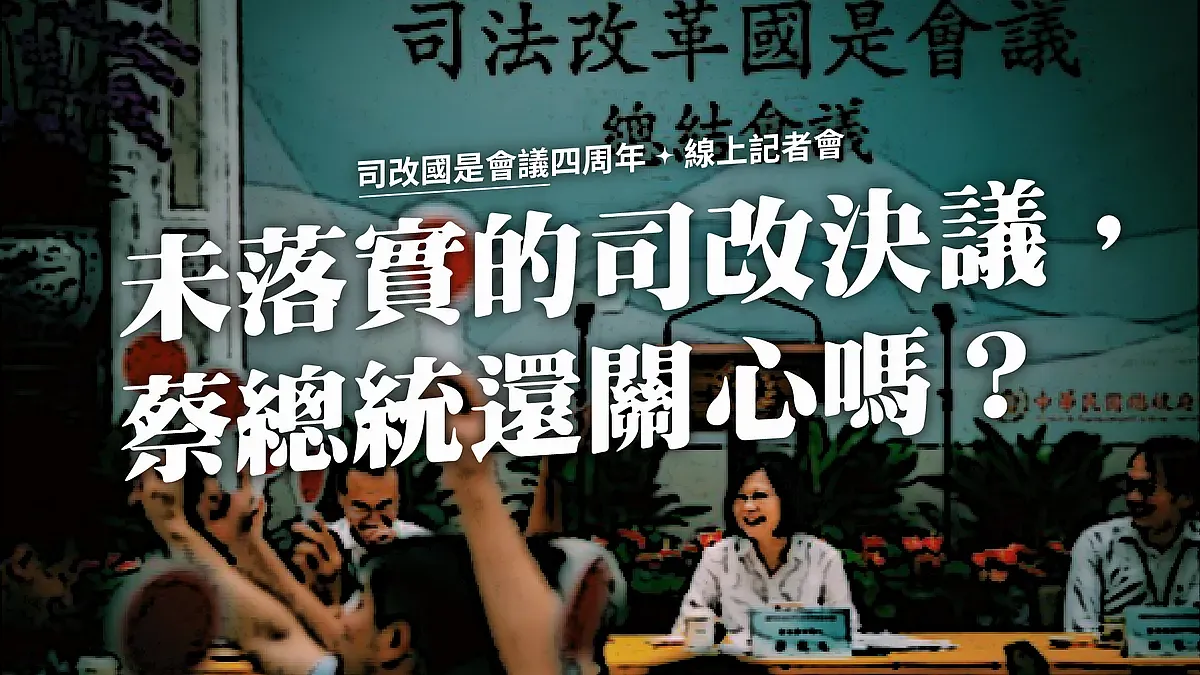
Does President Tsai Still Care About Unimplemented Judicial Reform Resolutions? Press Conference Marking Four Years Since the National Conference on Judicial Reform
Last edited: 2026-08-30
Four years have passed since the National Conference on Judicial Reform concluded. The Judicial Yuan, Ministry of Justice, and other responsible agencies have amended laws or introduced new measures on some issues, but many resolutions have received little attention and still show no concrete or substantive progress.
Despite this, the Judicial Yuan and Executive Yuan discontinued the regular "Semi-Annual Judicial Reform Report" at the end of 2020, causing many neglected resolutions to disappear almost entirely from public view. We therefore ask whether President Tsai-who convened the Conference and promised to "personally keep a close eye on the progress of reform"-still cares about these forgotten issues.
The Civil Society Alliance for Monitoring Implementation of the National Conference on Judicial Reform Resolutions calls on President Tsai Ing-Wen not to forget the thunderous applause that greeted her call for judicial reform at her inauguration, and not to forget the commitments she made to the public. When responsible agencies selectively ignore issues and fail to communicate adequately with civil society, the Alliance urges the government to restore the suspended Semi-Annual Judicial Reform Report immediately and rebuild a channel for meaningful communication between government and civil society. The Alliance will also organize a series of forums and press conferences on individual resolutions to continue monitoring implementation of judicial reform.
The Alliance therefore reviews the implementation of the Conference resolutions under four categories: reforms that have been forgotten and show no concrete progress; reforms for which an overall direction exists but executive agencies have yet to finalize a plan; mature legislative proposals still awaiting enactment; and new systems that have already taken effect but whose results remain uncertain or troubling.
I. Forgotten Judicial Reform Issues with No Concrete Progress
Upon reviewing the relevant work reports of the Judicial Yuan and the Ministry of Justice, the Alliance found that on the following issues, aside from holding meetings, there has been almost no concrete progress or clear direction to date:
| Reform Item | Responsible Authority | Progress | Resolution No. | |
|---|---|---|---|---|
| 1 | Mechanism for reviewing miscarriages of justice | Judicial Yuan | 1. No concrete legislative progress. 2. After completion of the Ministry of Justice-commissioned study "Feasibility of Establishing a Judicial Error Research Center in Taiwan," no institutional plan or implementation steps followed. 3. The Judicial Yuan commissioned scholars to analyze controversial cases, and the Judges Academy held a "Special Workshop on Major Controversial Cases." |
5-3 |
| 2 | Reform of special post-conviction relief for wrongful criminal convictions (CCRC) | Judicial Yuan | 1. Opposed by the Judicial Yuan. 2. After amending the criminal retrial system, the Judicial Yuan took the position that there was "no need to create a duplicative additional system" and opposed separate legislation. 3. However, following the passage of the new law, the threshold for retrial relief remains quite strict. |
5-4 |
| 3 | Establish a national "Forensic Science Commission" to formulate and promote forensic technical standards, accreditation of forensic institutions, and professional certification | Ministry of Justice | 1. No concrete progress. 2. When Control Yuan members urged implementation in 2020, the Ministry of Justice merely stated it had no objection and that the matter was still in the opinion-consultation stage. |
12 |
| 4 | Establish an evidence custody and management system | Ministry of Justice | 1. No concrete legislative progress. 2. A Ministry of Justice-commissioned research project concluded in 2020 that the Code of Criminal Procedure should be amended and related regulations strengthened. No concrete legislative progress has followed. 3. The Ministry of Justice is introducing RFID technology to manage seized-property and evidence repositories at district prosecutors offices and has directed offices to clear evidence left unresolved for more than ten years. The Ministry should further explain the effectiveness of these measures. |
13-4 |
| 5 | Common rules of evidence for criminal, civil, and administrative proceedings | Judicial Yuan | 1. Various departments of the Judicial Yuan consider that the rules of evidence in various litigation procedures should be strengthened, with no need to formulate common rules. 2. Rules of evidence for criminal trials are still under study, with no concrete progress. |
13-1 |
| 6 | Adopt non-transfer of case files and evidence with the indictment in ordinary criminal trials | Judicial Yuan, Ministry of Justice | 1. Shelved by the Judicial Yuan. 2. The Judicial Yuan has deferred the issue, stating that it will first observe how non-transfer of case files and evidence operates under the Citizen Judges system. 3. The Ministry of Justice's work plan discusses only the Citizen Judges Act and does not address adopting non-transfer of case files and evidence in ordinary criminal proceedings. |
45 |
| 7 | Public participation in review of non-prosecution decisions | Ministry of Justice | 1. In September 2019, the Ministry of Justice prepared a 56-article draft "Act on Citizen Participation in Review of Non-Prosecution Decisions." 2. After the Judicial Yuan expressed disapproval of locating the citizen prosecutorial review committee within district courts, there has been no further concrete progress. |
38-5 |
| 8 | Establish an "Indigenous Peoples Judicial Advisory Committee" | Council of Indigenous Peoples | No concrete progress. | 11-2-1 |
| 9 | Establish a "Police Special Project and Performance Management Committee" | Establish a "Police Project and Performance Management Committee" | 1. The National Police Agency has no plans to establish it. 1. The National Police Agency has no plan to establish such a committee.2. At a December 2017 meeting, the National Police Agency concluded that it "agreed with the problems identified in the resolution, but would not adopt the proposed solution and would instead develop an alternative."" |
69-2 |
| 10 | Protect and enhance the rights and agency of persons with disabilities in judicial proceedings | Judicial Yuan, Ministry of Justice | 1. The Criminal Department of the Judicial Yuan stated it would initiate a drafting group, but has taken no concrete action. 2. Consistent with Article 13 of the Convention on the Rights of Persons with Disabilities, the Judicial Yuan should establish guidelines on reasonable accommodation and procedural accommodation in court proceedings. |
9-3 10-6 |
| 11 | Establish "joint and several liability" for environmental cases to ensure that liability for damages is genuinely assumed collectively by the relevant pollution creators or environmental destroyers | Establish joint and several liability for environmental-damage cases so that polluters and those responsible for environmental harm actually share compensation liability | 1. No concrete progress. 2. The Industrial Technology Research Institute held a meeting in October 2018 recognizing the necessity of adding "joint and several liability," but no amendment draft has been released to date. |
40-1-3-1 |
| 12 | Legalization of administrative case filings (administrative file closing) |
Ministry of Justice |
Formalize the legal framework for administrative closure of prosecutorial matters |
Regarding items 1 to 6 above, all are closely related to "avoiding miscarriages of justice and improving the quality of criminal trials," yet none have seen concrete progress. Professor Li Chun-Yi, member of the First Division of the National Conference on Judicial Reform, stated that regarding the establishment of a national-level forensic science organization, integrating resources to promote forensic science policy, as well as other evidence custody, appraisal norms, institutional accreditation, and personnel certification, there has been absolute zero progress (see For reforms 1 through 6 above, all are closely connected with preventing wrongful convictions and improving the quality of criminal adjudication, yet none has made concrete progress.).
Judicial Reform Foundation Using the "evidence custody and management system" as an example, the JRF noted that although the Ministry of Justice convened agencies in 2019, the conclusion was that most participating agencies believed existing evidence-management rules worked without difficulty and that uniform rules would be harder to establish. But if existing systems are adequate, why was the blood-stained wooden block bearing a palm print in the Chiang Kuo-Ching case lost? Why did the extortion-call recording in the Chiu Ho-Shun case disappear? And how was Hsu Su-Liang, a section chief in the Investigation Bureau's Maritime Affairs Investigation Office, able to steal and sell seized narcotics for eight years and obtain more than NT$300 million in illegal profits? Existing rules also fail to address clearly the legal consequences when evidence is lost.
Lo Shih-Hsiang, Executive Director of the Taiwan Innocence ProjectLo Shih-Hsiang, Executive Director of the Taiwan Association for Innocence, noted that the Executive Yuan had finally submitted the Judicial Yuan's proposed amendments to the expert-evidence chapter of the Code of Criminal Procedure, but that the Ministry of Justice disagreed with the Judicial Yuan's approach to polygraph evidence. Debates over polygraphs or forensic medicine alone, however, miss the forest for the trees. The Conference therefore called for a National Forensic Science Commission capable of reviewing forensic-science policy comprehensively. That resolution has also been forgotten. The Ministry of Justice last convened a meeting on national forensic-science policy in February 2019-two and a half years earlier. The government should explain whether the work has simply stopped.
Environmental Jurists Association stated that although the Industrial Technology Research Institute held an "Expert Consultation Seminar on the Revision of Article 71 of the Waste Disposal Act" in October 2018, recognizing that the lack of joint and several liability provisions might prevent compensation when subcontractors hired by waste haulers dump waste in illegal locations, thus creating considerable loopholes in the prevention of environmental violations, and planned to amend Article 71 of the Waste Disposal Act as a general reference version for other environmental regulations, there is still no concrete progress at present, nor has any amendment draft been seen (see Attachment II).
Covenants Watch Covenants Watch noted that the Judicial Yuan had recently proposed amendments to the Code of Criminal Procedure creating an "emergency guardianship" mechanism that could divert persons with disabilities into security measures before a judgment became final, potentially producing discriminatory effects. Civil society was not consulted during drafting. The organization also stressed that when counsel has been appointed, judges may become less attentive-not more-to a person with disabilities' independent right of access to information. Judicial procedure should be designed around the agency of the parties, particularly criminal defendants and other vulnerable participants. More professional training is needed, and these concerns will become even more important when the Citizen Judges system begins operating.
Shih Yi-Hsiang, Secretary-General of the Taiwan Association for Human Rights and Director of the Indigenous Peoples Policy AssociationShih Yi-Hsiang, Secretary-General of the Taiwan Association for Human Rights and a director of the Association for Taiwan Indigenous Peoples' Policies, said J.Y. Interpretation No. 803 on Indigenous hunting rights failed to become a constitutional milestone protecting Indigenous hunting culture. Instead, it again demonstrated the need-even among Constitutional Court Justices-for sensitivity to cultural conflict and knowledge of Indigenous law. That makes the Conference resolution calling for effective mechanisms to protect Indigenous rights and greater cultural-competence training for judicial professionals all the more important. Yet despite the widespread creation of Indigenous specialized divisions in the courts, there has been little progress on the medium-term goal of reconsidering a system that assigns cases based simply on ethnic identity without asking whether the case actually involves cultural conflict. Nor is there visible progress on creating a specialized judicial-professional certification for Indigenous matters. Attachment III).
Taiwan Police Rights Association The Taiwan Police Union reported that the National Police Agency has not established the Police Project and Performance Management Committee and that other problems remain: frontline police officers are not meaningfully represented in related meetings; independent third-party experts do not participate; meeting information is not proactively disclosed; and there has been no concrete public review of recent law-enforcement problems tied to performance metrics or deficiencies in police training.
II. Issues with Overall Amendment Directions Awaiting Executive Finalization
II. Overall reform directions exist, but the responsible agencies still need to finalize the details
| Reform Item | Responsible Authority | Progress | Resolution No. | |
|---|---|---|---|---|
| 1 | Amending the Genetic Health Act to protect women's bodily autonomy | Ministry of Health and Welfare | 1. Legislative amendments regarding the removal of the requirement for statutory agent or spouse consent for artificial abortions have not yet been completed. 2. Married women: On February 1, 2021, the Health Promotion Administration stated on the Public Policy Join-Online platform that the current amendment direction is to abolish the spouse consent provision under Article 9 of the Genetic Health Act, allowing married women to autonomously decide whether to reproduce. 3. Minors: According to an official letter issued by the Ministry of Health and Welfare to the Judicial Reform Foundation on December 17, 2020 (Document No.: 1091762707), for cases where minors undergo artificial abortion without the consent of their statutory agent, the Health Promotion Administration is considering having judicial units act as a third party to make rulings. |
87 |
| 2 | Reversal of the burden of proof in public nuisance dispute cases | Environmental Protection Administration | 1. Since thoroughly drafting the amendment to the Public Nuisance Dispute Handling Act in 2019, no further actions have been taken. 2. The special project work plan for researching and amending provisions on the reversal of the burden of proof in public nuisance cases and legal revisions, studied from 2017 to 2018, finalized its final report in December 2019, and proposed a bill to amend the law. 3. The draft would add Article 33 to ease the victim's burden of proving causation in environmental-pollution disputes. A victim seeking compensation would need to show only a "reasonable probability" that the defendant's operation or management of a business or facility affected the environment in a way capable of causing the damage. |
40-1-6-3 |
| 3 | Adding an estimation mechanism for illegal gains from environmental damage | Environmental Protection Administration | 1. No concrete progress. 2. In the draft amendment to the Marine Pollution Control Act pre-announced by the Ocean Affairs Council in July 2020, provisions for estimating illegal gains were added, which is truly commendable. However, as of today, it is still under internal discussion without a clearer legislative schedule, nor has it been submitted to the Legislative Yuan for deliberation. It is hoped that relevant ministries and agencies can actively and smoothly advance this bill. |
40-1-6-2 |
| 4 | Pyramid-shaped litigation system reform | Judicial Yuan | 1. In April and September 2020, the Judicial Yuan submitted amendments to the Code of Civil Procedure concerning procedural simplification, prevention of vexatious litigation, and strengthening fact-finding trials to the Legislative Yuan for deliberation, and publicly stated in June this year that it has completed the study of the third-instance pyramid for criminal trials. 2. Any reduction in appellate caseload and transition to a pyramidal litigation system must not diminish litigants' rights. It requires supporting reforms such as stronger fact-finding at trial, a sound expert-evidence system, special remedies for wrongful convictions, and an overall assessment of staffing and personnel allocation. |
19-1 20 |
The Garden of Hope Foundation stated that regarding the amendment of the Genetic Health Act, it is recommended that the Ministry of Health and Welfare promptly abolish the spouse consent provision under Article 9; as for the third-party mechanism for artificial abortions of minors, it is recommended to be administered by the Ministry of Health and Welfare within the social welfare system rather than judicial units (see Attachment IV).
Environmental Jurists Association The Environmental Jurists Association noted that although agencies have developed proposed directions for reversing burdens of proof in environmental-pollution disputes and estimating unlawful gains from environmental harm, implementation has stalled. Once the Environmental Protection Administration finalizes the proposals, it should promptly submit legislation to the Legislative Yuan.
III. Issues with Mature Draft Amendments Awaiting Enactment
For the issues in the table below, the responsible authorities have completed the revision of the laws or the content is approaching maturity:
| Reform Item | Responsible Authority | Progress | Resolution No. | |
|---|---|---|---|---|
| 1 | Protecting the rights and interests of crime victims | Ministry of Justice | 1. The Ministry of Justice has actively consulted and discussed with civil society organizations on the amendments to the Crime Victim Protection Act, and the scope of its amendments is broader than the contents in the judicial reform resolutions, which is commendable. 2. Consultation meetings have made concrete progress on the draft amendments, and the contents are nearing completion. |
1-1 2-2-2 2-3-1 2-3-2 |
| 2 | Amendment to the Evidence Chapter of the Code of Criminal Procedure |
Judicial Yuan, Ministry of Justice | 1. In May 2019, the Judicial Yuan completed the draft and submitted it to the Executive Yuan for joint submission. 2. In July 2021, the Executive Yuan completed joint submission and sent it to the Legislative Yuan for deliberation. |
13-2 13-3 |
| 3 | Enacting the "Whistleblower Protection Act" | Ministry of Justice | 1. A draft was previously proposed in the last term of the Legislative Yuan but did not pass, and it has not yet been re-submitted in the current term of the Legislative Yuan. 2. Currently, the Air Pollution Control Act, Water Pollution Control Act, and Toxic and Concerned Chemical Substances Control Act all contain whistleblower protection clauses. However, the Waste Disposal Act, which is vitally related to the environment, still lacks this provision, and other environmental protection-related regulations are also deficient. Therefore, before the passage of the "Whistleblower Protection Act," it remains necessary to add whistleblower protection provisions to individual environmental regulations. |
62-1-3 62-2-2 40-3-1 |
Judicial Reform Foundation The JRF noted that the Executive Yuan had finally completed co-signature of amendments to the expert-evidence chapter of the Code of Criminal Procedure and sent them to the Legislative Yuan. Agencies were also actively discussing the comprehensive amendment of the Crime Victim Protection Act with civil society. The JRF hoped both sets of amendments could pass during the second half of the year so that implementation could finally begin.
Regarding the "Whistleblower Protection Act" of great concern to all sectors of society, it has been nearly 10 years from study to formulation, and it was not deliberated and passed by the previous Legislative Yuan. Overall, it is a long-delayed and severely overdue bill. Judicial Reform Foundation and Taiwan Labour Front call upon the Ministry of Justice to swiftly submit the completed draft to the Legislative Yuan, and the Legislative Yuan should actively deliberate and complete its enactment at an early date.
IV. New Systems Already Rolled Out, but Effectiveness is Unclear or Concerning
On the following issues, although relevant laws and administrative orders have been revised, the implementation situation is concerning:
| Reform Item | Responsible Authority | Progress | Resolution No. | |
|---|---|---|---|---|
| 1 | Direct citizen request for individual evaluations of judges and prosecutors |
Judicial Yuan, Ministry of Justice |
1. Legal amendments were completed in 2019. |
36-3 |
| 2 | Implementation of the principle of non-disclosure of investigations |
Ministry of Justice |
1. Revision of measures completed in 2019. 2. Police and prosecutorial agencies mostly reduce review reports to mere formalities in practice. Moreover, situations violating the non-disclosure of investigations remain common in practice, yet corresponding actions by agencies are rare. |
14-1 |
| 3 | Establishing an external inspection system for prisons and detention centers |
Ministry of Justice | 1. Amendments to the Prison Act and Detention Act completed in 2019. 2. The authorized regulations, "Regulations for the Implementation of External Inspection Panels for Prisons and Detention Centers," were published and implemented in 2021. 3. The members of the first external inspection panel have been selected and appointed, and the first external inspection report has been released. However, the "externality" and "independence" of the external visits are concerning. |
58-2 |
| 4 | Implementation efficacy and review mechanism of the Labor Incident Act |
Judicial Yuan, Ministry of Labor |
1. The Labor Incident Act was passed in December 2018 and officially implemented in January 2020. 2. Upon passage, the Legislative Yuan attached a supplementary resolution requiring a re-evaluation 3 years after implementation. The deadline for submitting the review is approaching; it is recommended that the Judicial Yuan and the Ministry of Labor immediately initiate relevant operations and submit implementation issues and reports in the first quarter of next year. |
26-2 |
| 5 | Upgrading interpreter quality and protecting rights of foreigners |
Judicial Yuan, Ministry of Justice, National Police Agency |
1. The Judicial Yuan has successively completed compiling and printing interpreter manuals, revising measures, and translating procedural documents. However, the most important information, such as the main text of judgments and remedy instructions, is still frequently untranslated in practice. 2. In July 2020, the Ministry of Justice notified prosecutors offices nationwide by official letter to provide rights notification forms for 5 types of prosecutorial documents (indictments, motions for summary judgment, non-prosecution dispositions, suspended prosecution dispositions, and revocations of suspended prosecution), with translated versions available in English, Vietnamese, Thai, Japanese, Indonesian, and other foreign languages. 3. For coercive measure documents, the National Police Agency has prepared foreign language translation versions in English, Thai, Vietnamese, Indonesian, etc., but lacks an inspection mechanism for translation quality. 4. Certain terms and phrases in different languages are difficult to translate accurately, and how these translated versions can be effectively used in practice cannot be evaluated either. |
10-4 10-5 10-6 10-7 |
| 6 | Enhancing gender awareness among judicial personnel |
Judicial Yuan, Ministry of Justice |
1. Lacks an effectiveness evaluation mechanism. |
57-4 76 |
| 7 | Preventing vexatious litigation |
Judicial Yuan, Ministry of Justice |
1. The Ministry of Justice officially implemented the review center system across district prosecutors offices starting in September 2020, and statistically, the number of cases received monthly by prosecutors shows a downward trend. |
24 |
| 8 | Simplifying written judgments and documents |
Judicial Yuan |
Refer to the Judicial Yuan's progress report for details. | 35-5-3 |
Judicial Reform Foundation The JRF pointed to the new individual judge- and prosecutor-evaluation system. Although the number of petitions rose substantially after members of the public were finally allowed to file directly, more than a year of operation produced only one substantiated judge-evaluation case and two substantiated prosecutor-evaluation cases-and none had been initiated directly by a member of the public. In other words, not a single directly filed public petition had been substantiated, raising concern that the system's supervisory effectiveness had actually declined.
The new external inspection system for prisons and detention centers also raises concerns. Under the Regulations for the Implementation of External Inspection Panels for Prisons and Detention Centers, the institution itself proposes candidates, the supervisory authority forwards the list, and the Ministry of Justice approves appointments. Many nominees are people already familiar with the institution, creating doubts about the panels' externality and independence. Published external inspection reports also show instances in which institutional personnel drafted reports for the panels. Because preparing the report is a core responsibility of the external inspection panel, institutional staff should not write it on the panel's behalf. Finally, although no statute prescribes a mandatory report format, the Agency of Corrections has required reports submitted by correctional institutions to follow an internal format and has declined to publish portions that do not comply. The Agency should not use internal rules to interfere with this core function of an external inspection panel.
The Garden of Hope Foundation stated that gender awareness training needs to continue, and curriculum contents must keep pace with the times. In addition, there should be an evaluation mechanism to understand whether judicial personnel possess gender awareness and apply it in their work, accompanied by further improvement and capacity-building programs for judicial personnel lacking gender awareness.
Sun You-Lieng, Secretary-General of the Taiwan Labour FrontSun Yu-Lien, Secretary-General of the Taiwan Labour Front, said the Labor Incident Act is a major labor-justice reform. Nearly two years of implementation have raised questions about the composition of labor mediation committees in district courts, the allocation of roles between judges and mediators, and consistency in judges' understanding of the Act and substantive labor law. Because the Legislative Yuan's accompanying resolution requires a post-implementation review, the Judicial Yuan and Ministry of Labor should begin that work immediately and publish an implementation review in the first quarter of next year.
Diocesan Migrants Pastoral Care Center, Catholic Diocese of HsinchuThe Vietnamese Migrant Workers and Immigrants Office of the Catholic Diocese of Hsinchu reported cases in which detention facilities conducting remote hearings for foreign nationals asked other detained migrant workers to interpret. The results were extremely poor: those individuals had limited language and communication skills, no professional interpreter training or testing, and no qualifications to serve as interpreters. There was also no mechanism to supervise or evaluate quality. The organization further questioned the quality of translated documents issued by the National Immigration Agency, National Police Agency, and Ministry of Labor, which migrant workers often cannot understand, and noted that hospitals commonly lack interpreters as well.
Lastly, Judicial Reform Foundation Finally, the JRF stressed that judicial reform must also address the working conditions of frontline judicial personnel. Without reducing the rights of litigants, the system should effectively reduce unnecessary workload for judges, prosecutors, and other frontline personnel so that they can improve the quality of justice. Possible reforms include reviewing the scope of plea bargaining, deferred prosecution, and non-prosecution, and considering whether records of pronouncement could replace full written judgments in certain simplified proceedings.
V. President Tsai Should Coordinate Various Agencies to Implement Resolutions and Reinstate Dialogue and Communication Mechanisms with the Public
At present, meaningful communication between government and civil society usually occurs only when the responsible agency chooses to initiate it. Issues that government agencies have "forgotten" therefore receive little discussion or progress. The Alliance calls on President Tsai to review and supervise implementation of the National Conference on Judicial Reform resolutions and restore the Semi-Annual Judicial Reform Report-or create another effective mechanism for public oversight and exchange-to fulfill the government's judicial-reform commitments.
VI. The Alliance Will Hold Press Conferences and Seminars on Various Issues to Continuously Urge the Implementation of the Resolutions of the National Conference on Judicial Reform
The National Conference on Judicial Reform covered a wide range of issues. In addition to calling on President Tsai to strengthen oversight, fulfill reform commitments, and restore dialogue, the Alliance will organize a series of follow-up press conferences and forums to continue monitoring implementation:
Press Conference / Seminar Topic |
Time |
|
|---|---|---|
| 1 | How to Avoid Miscarriages of Justice? - Discussing Evidence Custody and Institutional Establishment of Forensic Science |
August 26 (Thu) 19:00-21:00 |
| 2 | Press Conference on Reviewing the 1st Anniversary of the Implementation of the New Judges Act System |
September 2 (Thu) 10:00-11:00 |
| 3 | Seminar on Promoting Amendments to the Crime Victim Protection Act |
September 16 (Thu) 19:00-21:00 |
| 4 | Symposium on "Alleviating Judicial Burdens and Enhancing Judicial Quality" |
October 2 (Sat) 13:00-17:30 |
| 5 | Protection of Judicial Human Rights for Interpreters and Foreign Nationals |
To be announced successively |
| 6 | Environmental Protection and Judicial Reform - How to Make Laws Effectively Protect the Environment? |
To be announced successively |
| 7 | Studied for Ten Years, Lagging Behind the World by Twenty Years - How Much Longer Must We Wait for the Anticipated "Whistleblower Protection Act"? |
To be announced successively |
| 8 | Judicial Plight of Persons with Disabilities |
To be announced successively |
Aside from the above issues, the Alliance also plans to hold related activities concerning various unimplemented judicial reform resolutions.
The Conference resolutions established the direction of Taiwan's judicial reform. Although the Judicial Yuan, Ministry of Justice, and other agencies have advanced some issues, many of the matters reviewed here have been neglected or actively resisted. The quality of implementation also matters: perfunctory compliance will only deepen public distrust in the judiciary. Many major legislative amendments are now awaiting review in the Legislative Yuan. The Alliance hopes the next legislative session will give priority to judicial-reform legislation, implement the Conference resolutions, and respond seriously to the public's expectations.
Attending Representatives
Lin Yung-Sung, Chairman / Judicial Reform Foundation
Huang Sung-Li, Convener / Covenants Watch
Li Chun-Yi, Professor / Member of the First Division of the National Conference on Judicial Reform
Wang Yueh-Hao, Executive Director / The Garden of Hope Foundation
Lo Shih-Hsiang, Executive Director / Taiwan Innocence Project
Sun You-Lieng, Secretary-General / Taiwan Labour Front
Shih Yi-Hsiang, Secretary-General / Taiwan Association for Human Rights
Chang I-Chun, EIA Specialist / Environmental Jurists Association
Father Nguyen Van Hung / Diocesan Migrants Pastoral Care Center, Catholic Diocese of Hsinchu
Tai Yu-ping, Specialist / Diocesan Migrants Pastoral Care Center, Catholic Diocese of Hsinchu
Press Contacts
Lu Cheng-Yen, Staff Attorney / Judicial Reform Foundation
02-2523-1178#37
elvin@jrf.org.tw
Attachments
- Attachment I: Professor Li Chun-Yi - 4th Anniversary Tracking Status of Resolution Items on Improving Forensic Science Issues in 2021
- Attachment II: Environmental Jurists Association - 2021 Tracking Progress on Environmental Legal System Items of the National Conference on Judicial Reform
- Attachment III: Statement by the Taiwan Association for Human Rights
- Attachment IV: Statement by The Garden of Hope Foundation
This article is an AI-generated translation of the original Chinese text. In the event of any discrepancy, the Chinese version shall prevail.