
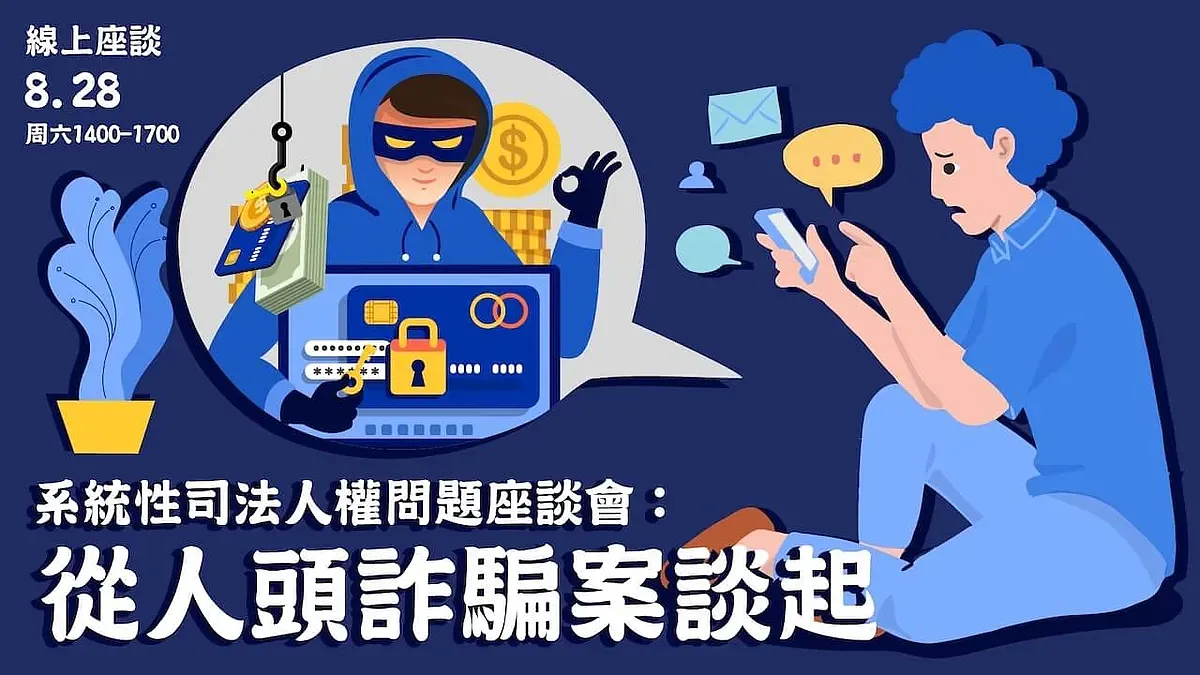
Forum | Systemic Judicial and Human Rights Problems in Dummy-Account Fraud Cases
Last edited: 2026-08-30
Before a fraud scheme can obtain a victim's money, the fraud ring first needs the tools of the crime: dummy bank accounts, phone numbers registered in other people's names, and people to withdraw or move the money. For nearly fifteen years, Taiwan's justice system has therefore repeatedly encountered victims who are later treated as perpetrators-people tricked into handing over bank accounts, people with little money who are deceived into providing phone numbers, personal information, or SIM cards, and job seekers who are duped into acting as cash couriers. They may ultimately be prosecuted as aiders or accomplices.
As early as 2014, civil society groups held a joint press conference criticizing how courts infer fraudulent intent from the mere provision of dummy accounts. That same year, a scholar compared district-court and high-court judgments on aiding fraud and argued that the High Court's method for inferring a defendant's knowledge was inconsistent with the principle of in dubio pro reo. Yet disputes over dummy-account fraud have continued. Standards for finding conditional intent to aid fraud remain broad and inconsistent, and in recent years many people who provided dummy accounts have also been prosecuted for money laundering, creating additional controversy. Accordingly, the JRF reported this systemic judicial problem to the National Human Rights Commission in early May 2020, and we understand that the matter is now being handled by the Control Yuan's Committee on Judicial and Prison Administration Affairs.
At the same time, over the past six months dozens of pro bono attorneys have reviewed indictments in cases from across Taiwan that resulted in first- or second-instance acquittals from the second half of 2018 onward. A significant number involve dummy accounts. In the first half of this forum, attorneys will analyze problems at the charging stage in those acquittal cases and, from a practitioner's perspective, identify recurring problems in conviction cases. In the second half, scholars, prosecutors, and other practitioners will discuss possible solutions from different perspectives.
The forum will also present new conviction statistics and examine recent cases involving bankbooks obtained by fraud, dummy phone numbers, and related conduct from charging through trial. Everyone is welcome to join the online discussion.
Time
8/28 (Sat.) 14:00-17:00
Venue
YouTube livestream; the event link will be emailed to registered participants.
Agenda
| Time | Content | Moderator / Speaker |
| 14:00-14:05 | Opening Remarks |
Lu Yung-Sheng / Chairperson, Taichung Bar Association |
| Session I: What First- and Second-Instance Acquittals Reveal About Dummy-Account Cases | ||
| 14:05-14:10 | Opening Remarks by Moderator |
Chair Chiang Cheng-Feng / Attorney, Chien Li Law and Land Joint Office |
| 14:10-15:00 | ・Problems in convictions involving dummy accounts ・Charging-stage problems in dummy-account cases that resulted in acquittal ・The shift from aiding fraud to aiding money laundering ・Charging-stage problems in similar acquittal cases involving dummy SIM cards, misuse of personal information, and related conduct |
Speaker Li Jui-Jen / Attorney, Li Jui-Jen Law Office Chang Kai-Ting / Attorney, Jih-Hsin Joint Law Offices Chiang Wan-Chen / Attorney, Sheng Fang Law Office |
| 15:00-15:20 | Q&A | -- |
| 15:20-15:30 | Intermission | -- |
| Session II: How Can We Address Systemic Judicial Problems in Dummy-Account Cases? | ||
| 15:30-16:30 | How Can We Address Systemic Judicial Problems in Dummy-Account Cases? |
Chair Panelist |
| 16:30-17:00 | Q&A | -- |
This article is an AI-generated translation of the original Chinese text. In the event of any discrepancy, the Chinese version shall prevail.