JRF Newsletter
2021 Judicial Reform Summer Watchlist | South Korea: Law School
Last edited: 2026-08-30
A puzzle piece turning in Professor Yang's hand runs like a thread through all sixteen episodes of Law School.
Set at a law school in South Korea, the story centers on the murder of Professor Seo Byung-Ju. Yang Jong-Hoon, a former prosecutor who now teaches criminal law, leads his students as they search for the truth.
Every clue is a puzzle piece. The task of these legal professionals is to find the scattered pieces and assemble as complete a picture of the facts as possible.
Don't See Only What You Want to See, or Hear Only What You Want to Hear
A murder at the law school of a top Korean university is bound to attract intense media attention. That media spotlight, in turn, becomes pressure on police and prosecutors to solve the case.
Under that pressure, investigators focus their suspicion on the person they believe has the strongest motive: Professor Yang Jong-Hoon.
Seo Byung-Ju, then a chief prosecutor, had once been Yang Jong-Hoon's superior and close friend. But after Seo was prosecuted for bribery, the two went their separate ways. When Seo was later acquitted, Yang resigned from the prosecution service in protest.
Once investigators make Professor Yang their principal suspect, everything seems to point toward him: fingerprints on a water glass, a shoeprint at the scene, hair clutched in Professor Seo's hand before his death, and the absence of an alibi.
 Source | From the Netflix trailer
But was Professor Yang really the killer?
"Don't see only what you want to see, or hear only what you want to hear," Professor Yang tells the investigators.
After a crime, we naturally want to know what happened. We identify a suspect and ask whether the evidence points to that person. The danger begins when a hypothesis becomes a bias: once we are committed to a conclusion, we start seeing and hearing only what confirms it. Then every piece of evidence can seem to prove that the suspect must be the culprit.
The irony is that, over the next several episodes, as the drama reveals Professor Seo Byung-Ju's relationships with other people, almost everyone seems to have a plausible motive-and evidence that could be read against them.
That is why the presumption of innocence matters. Until guilt is established, we begin from innocence and preserve room for doubt, reducing the risk that a mistaken conclusion will destroy an innocent person's life.
We are not omniscient; we cannot look directly into the past. We reconstruct events from evidence and logic. Only by remaining humble, considering competing possibilities, and being willing to question our own reasoning can we come closer to the full picture.
People use evidence to reconstruct the truth-and people, carrying their own biases, can also create wrongful convictions.
Unvarnished Justice: The Most Instinctive Image of a New Law Student
 Source | From the Netflix trailer
One reason I love this drama is the instinctive, uncomplicated sense of justice carried by its protagonist, Kang Sol A.
From the moment she enters law school, Kang Sol A is outspoken, headstrong, and certain about what feels right. Years earlier, when she was a defendant, she could not afford the 3 million won needed to hire a lawyer or the 2 million won in damages she might owe if she lost. She was forced to accept the cheapest option-a 1 million won settlement-which wiped out her savings. That experience drives her to fight her way into law school because she wants to "make the law apologize to her."
During Han Joon-Hwi's mock trial, Sol A throws herself into defending him because she believes he is innocent. But when Professor Yang suddenly assigns her the prosecutor's role, she cannot say a word: she cannot distort or attack what she genuinely believes.
Kang Sol A may be the least conventionally "legal" person among her classmates, but she is also the one who listens most closely to her conscience. She worries more about Professor Yang's trial and the case involving the abusive parents than about being held back a year. After Professor Seo is killed, she is even angry that her classmates can simply study for finals as though nothing has happened.
Sol A is no genius; every exam is a struggle just to reach the passing line. But she cares about people. Even before an exam, she stays up late reading cases and drafting pleadings for the abusive-parents case, eventually collapsing with a nosebleed in the examination room from exhaustion.
Working hard because you believe in something, pushing yourself because you care, and following the voice of your conscience-more than grades, those are the qualities that may make Kang Sol A a good lawyer.
You Can Be Capable Yet Unfit to Practice Law-and Nothing Is More Dangerous
 Source | From the Netflix trailer
In contrast with Kang Sol A's awkward sincerity, Kang Sol B and Yoo Seung-Jae are brilliant and pragmatic. The contrast between these two kinds of law students is sharp.
Calling them calculating may be too harsh, but calling them realistic is not. One has collected awards since childhood; the other was a medical student on track to become an obstetrician. Both are intelligent and accomplished, yet each makes a serious mistake. To keep a promising future from collapsing, they choose to hide the truth. From that moment, like the late Professor Seo Byung-Ju, they open a door to hell and become trapped between conscience, lies, and the need to cover one lie with another.
"You are capable, but you are not qualified to be a legal professional. Nothing is more dangerous than that," Kang Sol B's father tells her.
Competence is only the ability to do something. Whether a person's moral compass points in the right direction determines how that ability will be used. A skilled lawyer without integrity can manipulate technique and weaponize the law-and that is what makes such a person dangerous.
Is the Law Just?
In front of the mock courtroom donated by Professor Seo Byung-Ju stands a stone engraved with the words, "Your contribution will bring justice." But that was not the inscription Seo originally wanted. His choice was: "The law is not just."
How could that be? the dean objected. The law has to be just.
After Professor Seo's death, the dean stands before the stone and tells Han Joon-Hwi the story. It is a little bleak, a little sad, and painfully true.
Seo Byung-Ju, as a chief prosecutor, abuses public power to conceal his own hit-and-run and even bargains with a defendant accused of rape. Powerful lawmaker Ko Hyeong-Su uses the media to smear political opponents, bribes prosecutors to control investigations, and pressures lawyers not to represent Jeon Ye-Seul. These acts make the law look profoundly unjust-a system that seems to protect only the powerful.
Yet the same law, through the efforts of Professor Yang and the study group, clears Jeon Ye-Seul, brings Professor Seo's real killer to justice, and leads to Jin Hyeong-Woo becoming the first prosecutor indicted for violating the rules on non-disclosure of investigations.
The law is the same, yet it can produce justice or injustice. What makes the difference? People.
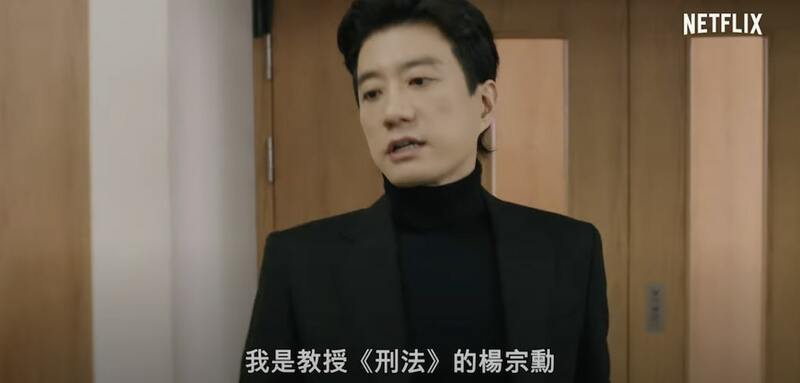
The justice system is a vast and complicated machine, but people are the ones who make it move. "As a professor of criminal law, I have never taught my students that the law itself is justice. What makes law just is a judge's fair judgment grounded in the presumption of innocence and the principle of adjudication based on evidence." Professor Yang says passionately in closing argument in his own case-a moment that nearly brought me to tears.
 Source | From the Netflix trailer
His intensity is not simply the anxiety of a defendant. It is a legal professional's vision of what law should be, and what those who practice law should demand of themselves.
At a crossroads in my own legal career, Professor Yang's words resonated deeply. After five years of legal education and a year and a half in practice, I no longer naively believe that law is inherently just. Physical evidence, witness testimony, confessions-every stage of fact-finding can fail. Innocent people can be wrongly convicted, and guilty people can be treated too leniently. Under crushing caseloads, media pressure, and a culture focused on promotion, the presumption of innocence and adjudication based on evidence can easily become distant slogans rather than lived principles.
Since I began studying law, I have watched friends leave the profession-not because they lacked ideals, but because those ideals seemed impossibly far away. Unable to see the light and afraid of being swallowed by the darkness while pursuing it, they chose to turn away rather than let themselves become numb.
Yet many excellent legal professionals still carry the same vision as Professor Yang and keep moving toward it. They are not deterred by the difficulty of the system. They light candle after candle in the darkness, creating hope and illuminating the road ahead.
"The law is a wonderful tool, but the law has its limits," former U.S. federal prosecutor Preet Bharara writes in Doing Justice, "what we need are people-brave, strong, and good people."
In the end, whether law produces justice depends on the people who use it.
This article is an AI-generated translation of the original Chinese text. In the event of any discrepancy, the Chinese version shall prevail.