
JRF Newsletter
2021 Judicial Reform Summer Watchlist | United States: The Trial of the Chicago 7
Last edited: 2026-08-30
Seven years ago, on March 18, the Sunflower Movement began. People concerned about Taiwan's future traveled from across the country to the Legislative Yuan in support. Complete strangers sat side by side on the ground, and political, historical, and social questions that had once seemed distant suddenly became part of everyday life. The movement shook a generation out of political apathy, profoundly affected Taiwanese politics, and helped make the emergence of a stronger Taiwanese identity impossible to ignore.
Yet even in twenty-first-century Taiwan, which prides itself on democracy and the rule of law, one blood-stained chapter of the Sunflower Movement remains vivid: the March 24 Executive Yuan incident. In dispersing those who had entered the Executive Yuan compound, police used retaliatory and disproportionate force. Water cannons were deployed, people were struck with batons and shields, and unarmed individuals were chased and beaten in nearby alleys. The images of blood and people crying in pain remain difficult to forget.
After seven years of litigation and the painstaking review and organization of extensive materials, the criminal cases came to an end in 2020. Senior police officials who ordered the dispersal, along with then-President Ma Ying-Jeou and then-Premier Jiang Yi-Huah, bore no criminal responsibility, while the officers who used violence were ultimately "unidentifiable." Questions of accountability for state violence and civil disobedience nevertheless remain important. Remembering what happened, and preventing it from happening again, still matters.
That is why I want to recommend The Trial of the Chicago 7. For those of us who experienced retaliatory prosecution after protest, the film's defendants feel painfully familiar.
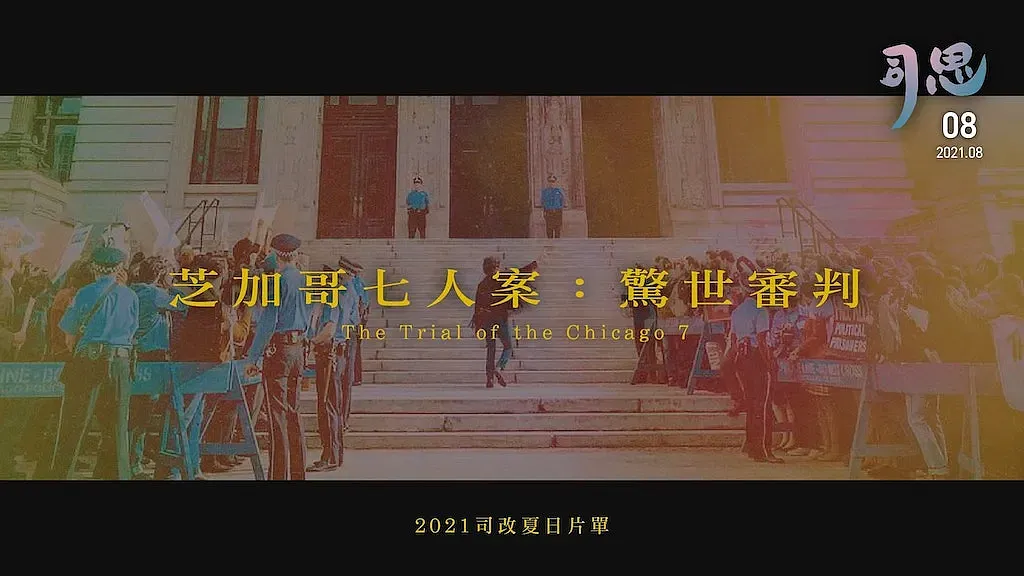
 Source | From the Netflix trailer
The Trial of the Chicago 7 is a 2020 American courtroom drama written and directed by Aaron Sorkin. It is based on the real prosecution arising from the 1968 anti-war demonstrations in Chicago. Eight movement leaders were initially charged with conspiring to incite a riot, and the politically charged prosecution became one of the defining legal dramas of the turbulent 1960s.
The United States of the 1960s was in upheaval. Baby-boomer youth increasingly challenged the society around them, while the Black civil-rights movement, the Stonewall uprising and gay-rights movement, women's liberation, opposition to the Vietnam War, and the counterculture all changed the country-and, in different ways, the world.
A peaceful anti-war protest was met with disproportionate police force and was followed by political retaliation and years of courtroom battles. As one of the private prosecutors in the litigation arising from Taiwan's March 24 incident, I found the parallels deeply resonant.
Peaceful and nonviolent protest; heavily equipped police confronting comparatively vulnerable demonstrators; difficult questions about civil disobedience and excessive police force. Will the story again end with those responsible being "unidentifiable"? I will leave that unspoiled.
The American jury system, very different from Taiwan's traditional model of adjudication, is one of the film's major features, and the film also raises questions about jury fairness and impartiality. Judicial independence is another central theme. Sacha Baron Cohen, one of the lead actors, has also publicly supported Hong Kong's anti-extradition movement, a reminder of the dangers that arise when authoritarian political power dominates the courts.
Fortunately, those of us in Taiwan are not alone. The Judicial Reform Foundation has been a strong source of support for people working to defend the rule of law and human rights. I am especially grateful that, on March 24 this year, the JRF organized an exhibition marking the seventh anniversary of the violent dispersal at the Executive Yuan, documenting years of struggle against state power. Although the criminal proceedings ended with the officers responsible remaining "unidentifiable," the case has already become an important marker in Taiwan's judicial history and has influenced both policing and public understanding.
Do people who care about judicial reform sometimes feel alone? When the crowd in the film chants, "The whole world is watching," it is hard not to feel that the work is worthwhile. Change happens bit by bit, and all of us are part of it.
 Source | From the Netflix trailer
Further Reading
This article is an AI-generated translation of the original Chinese text. In the event of any discrepancy, the Chinese version shall prevail.