
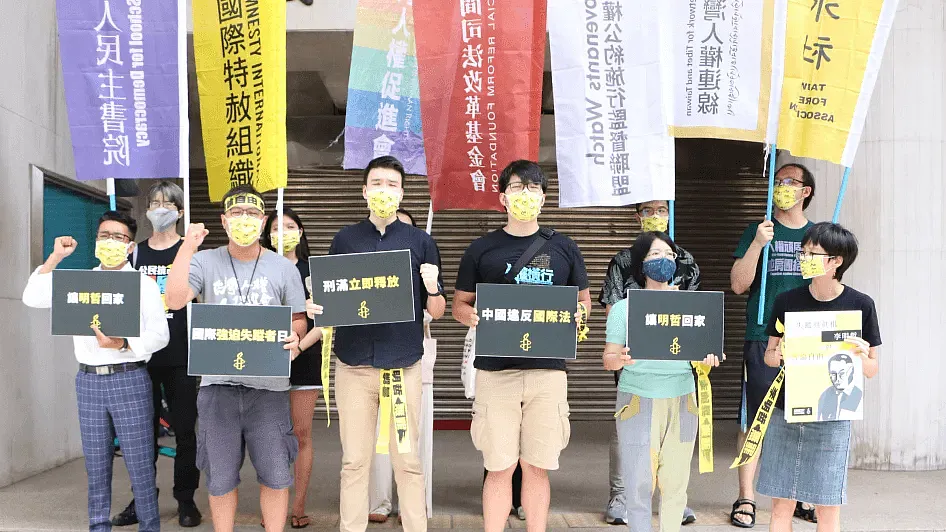
Bring Ming-Che Home: Press Conference for the International Day of the Victims of Enforced Disappearances
Last edited: 2026-08-30
Li Ming-Che had been detained in China for more than 1,623 days. His communications with his family had been cut off, his health condition was unknown, and the Chinese government still had not told his family a specific release date. Civil society groups therefore held a press conference on August 30, the International Day of the Victims of Enforced Disappearances, calling on the Chinese government to notify the family promptly of his official release date. They also urged Taiwan's Mainland Affairs Council (MAC) to seek information on Li's current situation and to study both the disappearance and imprisonment of Taiwanese citizens in China and the human-rights risks of travel to China, Hong Kong, and Macau.
Chiu I-Ling, Secretary-General of Amnesty International Taiwan, noted that Li Ming-Che was the first case involving a Taiwanese person taken up by the United Nations Working Group on Enforced or Involuntary Disappearances. Enforced disappearance is a grave human-rights violation because family members cannot even know whether the disappeared person is alive or dead. Because of the pandemic, Li had been unable to communicate with his family for more than a year, leaving them without information about his treatment or health in prison. As the end of his five-year prison term approached, China had still not announced a release date or provided his judgment to his family. Li had also been sentenced to two years' deprivation of political rights. Under Article 58 of the PRC Criminal Law, that supplementary punishment runs from completion of imprisonment or criminal detention, or from the date of parole. Chiu stressed that China should not use the supplementary punishment as a pretext for further restrictions on Li's personal liberty beyond the judgment or in violation of the international prohibition on arbitrary detention. Amnesty International Taiwan also announced plans to launch a board game on "Li Ming-Che and Freedom of Expression" in September to help more people understand the case, freedom of expression, and China's human-rights situation.
Legislator Chiu Hsien-Chih , said that Chinese law itself gives Li Ming-Che rights to correspondence and family visits, yet China had deprived him even of those minimum rights ordinarily retained by a person whose liberty has been restricted. Keeping Li in a condition of enforced disappearance spreads fear, he argued, and is a method of authoritarian control. People in Hong Kong, Xinjiang, Tibet, as well as Chinese dissidents and human rights lawyers, face similar risks. Anyone who supports democracy and freedom could therefore become another Li Ming-Che. Chiu said he would press Taiwan's government to fulfill its duty to protect citizens, urged the MAC to help the family obtain information promptly, and called for systematic risk analysis and warnings for Taiwanese people traveling to or transiting through China.
Legislator Freddy Lim (Lin Chang-Tso) , said the Li Ming-Che case is an important benchmark for assessing China's claim to be governed by law. Whatever China says about differences from Western political values or outside interference, releasing Li when his sentence expires is required by China's own law, not by foreign pressure. China should therefore comply with its law and release him on time.
Cheng Hsiu-Chuan, President of Wenshan Community College, said that Ming-Che had been forcibly disappeared since March 19, 2017-four and a half years earlier. During the previous year and a half, the pandemic had cut off almost all information: China did not allow family visits, letters, or phone calls. To his family and colleagues, he had effectively disappeared. They were waiting for him to come home.
Legislator Hung Sun-Han , said enforced disappearance may seem remote to many people in Taiwan, but Taiwan has its own painful history. Forty years earlier, Dr. Chen Wen-Chen returned from the United States, was taken away by the Taiwan Garrison Command, and was later found dead on the National Taiwan University campus with signs of torture. More than four years earlier, Taiwanese citizen Li Ming-Che traveled to China, was arrested and forcibly disappeared for 177 days, and was later sentenced to five years' imprisonment for subversion of state power. Since the pandemic began, China had blocked Li Ching-Yu from visiting him and prevented communication. His sentence was approaching completion, yet China still had not given a definite date for his return. Hung again called on China to release Li Ming-Che.
Chang Chih, Deputy Director, Advocacy Department, Judicial Reform Foundation, explained that Li Ming-Che had been sentenced to five years' imprisonment and two years' deprivation of political rights for subversion of state power and had already been deprived of liberty for nearly four and a half years. Based on Article 47 of the PRC Criminal Law and Article 76 of the PRC Criminal Procedure Law, his five-year prison term should end around April 12-14, 2022. But completion of a prison term in China does not necessarily mean immediate freedom. Under Article 58 of the Criminal Law, the two-year deprivation of political rights begins only after imprisonment ends. China's Exit and Entry Administration Law also restricts departure by a person whose criminal punishment has not yet been fully executed and may subject the person to public-security supervision and control. Chang therefore called on Taiwan's government to engage China actively and ensure that Li can return to Taiwan once he completes the five-year prison sentence, without unnecessary additional restrictions.
Yang Kang, Researcher, Covenants Watch, pointed out that Li Ming-Che is not a PRC citizen. His departure from China is not "going abroad" in the sense relevant to Chinese citizens, and once he returns to Taiwan he cannot exercise PRC political rights and has no reason to remain subject to PRC "supervision and control." Yang urged Taiwan's government to clarify with Chinese authorities how those rules would be applied and to secure Li's right to return after completing his principal five-year sentence. He also called for systematic interviews and data collection concerning Taiwanese people who disappear or serve sentences in China, so Taiwan can better understand patterns of human-rights violations and advocate internationally for its citizens.
Shih Yi-Hsiang, Secretary-General, Taiwan Association for Human Rights (TAHR), said the recent 11-year sentence imposed on Canadian Michael Spavor for espionage-related offenses illustrated the lack of transparency in China's judicial process and its failure to meet minimum international-law standards. Travel to China, Hong Kong, and Macau therefore carries serious human-rights risks, especially after Hong Kong implemented the National Security Law and its Article 43 implementation rules in July 2020. Although Taiwan's MAC had aligned its advisories with the Ministry of Foreign Affairs and issued red travel alerts for China, Hong Kong, and Macau, those alerts were not principally designed to explain the human-rights risks Taiwanese travelers could face. Shih called on the MAC and other agencies to establish a comprehensive human-rights warning and risk-assessment mechanism and provide practical information on rescue and remedies if rights are violated.
Organizers
Amnesty International Taiwan
Judicial Reform Foundation
Taiwan Association for Human Rights
Covenants Watch
Wenshan Community College, Taipei City
Taiwan Society
Taiwan Labour Front
Taiwan Alliance to End the Death Penalty
Taiwan-Hong Kong Association / Human Rights Network for Tibet and Taiwan
Frontline Island Nation
Prison Watch
New School for Democracy
Appendix
This article is an AI-generated translation of the original Chinese text. In the event of any discrepancy, the Chinese version shall prevail.