
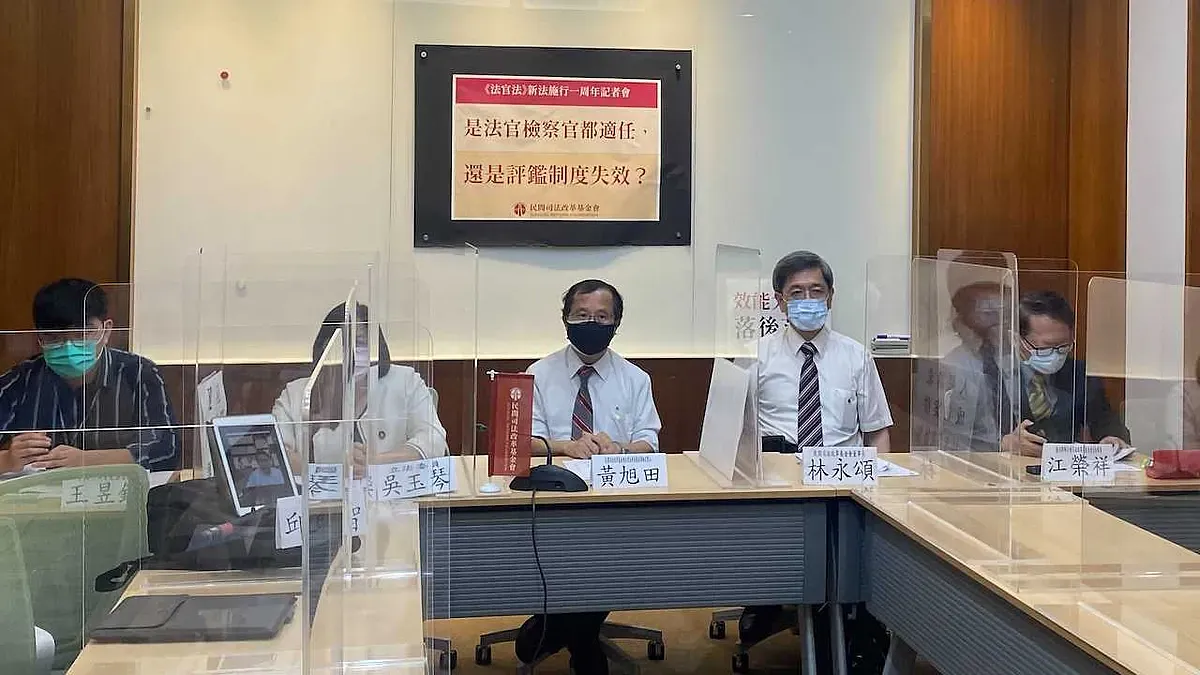
Are All Judges and Prosecutors Fit, or Has the Evaluation System Failed? Press Conference Marking One Year Under the Amended Judges Act
Last edited: 2026-08-30
Civil Society Annual Observation Report: One Year Under the Amended Judges Act
After years of advocacy by many sectors of society, Taiwan established an individual judge-evaluation system under the Judges Act in 2011. The law was amended again in 2020 to allow members of the public to petition directly for evaluation of misconduct by judges or prosecutors. Taiwan relies on a professional, non-elected judiciary whose judges generally enjoy secure tenure. Against a background of low public confidence in the justice system, individual evaluation carries substantial public expectations. People are watching to see whether the evaluation committees will listen to them and make a "people-centered judiciary" more than a policy slogan.
The first year under the amended law is therefore troubling. Among petitions filed directly by members of the public seeking evaluation of judges or prosecutors, not a single petition was found well-founded; indeed, none received a full substantive examination of the alleged misconduct. Nothing comparable occurred during the nine years under the prior system. The problem cannot simply be attributed to members of the public "not understanding the law" or filing indiscriminate petitions. The system itself must be examined: how can Taiwan build an accessible and effective evaluation process that earns public trust?
The JRF analyzed the problems in the current system and prepared a 20-pageCivil Society Annual Observation Report. The report makes five concrete recommendations to the Judicial Yuan, Ministry of Justice, Judge Evaluation Committee, and Prosecutor Evaluation Committee (see pp. 14 et seq.):
- The evaluation committees should actively hear petitioners and investigate the facts. They should reduce practical barriers to preparing written submissions and, where possible, help petitioners state the alleged misconduct with sufficient specificity.
- The committees should proactively cooperate with organizations such as the Legal Aid Foundation to lower barriers for people with limited financial resources or disabilities, and should establish branches or service offices outside Taipei that can provide consultation, guidance, and intake services.
- People directly exposed to alleged misconduct-including litigation representatives and complainants-should be permitted to file petitions. To protect vulnerable people who cannot petition on their own, future amendments should adopt a dual-track system allowing both individuals and qualified civil society organizations to seek evaluation.
- The committees should not invoke the fact that a petition concerns a "legal interpretation" as a reason to overlook conduct that may independently amount to judicial or prosecutorial misconduct.
- The committees should publish annual implementation reports and evaluate the system's effectiveness so that the public can monitor its operation.
The JRF also calls on the Legislative Yuan to hold public hearings on how to build an accessible, user-friendly, and effective evaluation system. Until the responsible agencies present concrete improvement plans, the Legislative Yuan should consider freezing the evaluation committees' budgets so that an ineffective system does not further damage public confidence in the judiciary.
-
First Year of the New System: Zero Publicly Filed Petitions Found Well-Founded
According to JRF statistics, during the first year of the new system the Judge Evaluation Committee found only one petition well-founded, and that case had been referred by the Taoyuan District Court. The Prosecutor Evaluation Committee found two petitions well-founded: one referred by the Pingtung District Prosecutors Office and one filed by the JRF under the prior law. The overwhelming majority of cases did not even receive substantive review of the alleged misconduct.
Substantive Review of Evaluation Petitions Cases Disposed Of
CasesCases Receiving Substantive Review Substantive Review
RateWell-Founded Petition
RateNot Well-Founded Well-Founded Judge Evaluation Committee 159 cases 2 cases ( 2 cases) 1 case ( 0 cases) 1.9% ( 1.3% ) 0.6% (0) Prosecutor Evaluation Committee 148 cases 0 cases 2 cases ( 0 cases) 1.4% ( 0 ) 1.4% (0) Note: Figures in parentheses indicate cases filed directly by members of the public and the corresponding rates.
Source: Judicial Yuan Website > Judicial Services > Judge Evaluation > Statistical Data; Ministry of Justice Website > Open Government Information > Prosecutor Evaluation Committee > Statistical Data -
Performance Worse Than the Prior System-and Behind the UK System
Comparing the first year under the amended law with the committees' own prior performance, the JRF's historical handling of public complaints, and the United Kingdom's Judicial Conduct Investigations Office (JCIO) likewise shows how limited the present system has been.
Comparison of Substantive Review and Well-Founded Petition Rates Institution / Unit Substantive Review Rate
(or Petition Rate)Well-Founded Petition Rate[1]
(Number of Well-Founded Petitions)Amended-Law Period
2020/7~2021/7Judge Evaluation Committee 1.9% 0.6% (1 case) Prosecutor Evaluation Committee 1.4% 1.4% (2 cases) Prior-Law Period
2011/12~2020/7Judge Evaluation Committee 84.1% 49.2% (34 cases) Prosecutor Evaluation Committee 66.2% 36.9% (24 cases) Judicial Reform Foundation
2011/12~2020/7Petitions for Judge Evaluation (5.1%) 39.1% (18 cases) Petitions for Prosecutor Evaluation (7.3%) 35.4% (17 cases) UK Judicial Conduct Investigations Office 14.9% 2.8% (343 cases) Cases handled by the evaluation committees under the prior system had already been screened by civil society organizations, so those cases were naturally more likely to warrant substantive review and ultimately be found well-founded. Even so, the overall well-founded rate remained below fifty percent. Under the amended law, by contrast, the committees receive petitions directly from the public but apply standards so restrictive that most cases never reach substantive examination of whether a judge or prosecutor engaged in misconduct. The committees also appear insufficiently active in investigating and identifying misconduct once a petition is filed.
The result is that a petition filed directly by a member of the public has almost no realistic chance of substantive review and, during the first year, no such petition was found well-founded. The number of well-founded cases under the amended law was extremely small, the substantive-review rate was even lower than the JRF's historical petition rate, and the system's performance lagged far behind the UK JCIO.
In short, during the first year after direct public petitions became available, not a single publicly filed petition was found well-founded. Under the prior law, successful petitions were not common, but members of the public who worked through civil society organizations never saw a complete "zero." The figures raise a serious question about whether individual evaluation can still function as a meaningful mechanism for supervising and removing unfit judges and prosecutors.
-
High Filing Barriers and Inadequate Supporting Measures
Did you know that disagreement with a judge's or prosecutor's factual findings or legal interpretation, by itself, is not a ground for individual evaluation? In nearly sixty percent of the judge-evaluation cases reviewed, petitioners apparently did not understand this distinction, and their petitions ended with a decision not to initiate evaluation.
The JRF's experience handling public complaints shows why this happens. Most people initially describe their grievance as an unfair factual finding or an incorrect legal view-because that is what matters most to them. Only after further discussion may it become clear that the underlying problem was, for example, abusive treatment by a judge in court, or confusion about procedural rules that the person did not understand. Without guidance, people often cannot distinguish conduct that may be subject to evaluation from disagreement with a judicial decision that is not.
If the committee deals with people who do not understand the law or the evaluation system solely through written submissions, it is easy to dispose of a petition without initiating evaluation. But if the goal is to understand why a person experienced the justice system as unfair and whether misconduct occurred during the proceeding, the committee itself must investigate and ask questions. The present paper-based approach gives little reason for confidence.
The JRF also found that, among petitioners who asked the committee to investigate evidence, more than half wanted an opportunity to explain their position orally, yet the published decisions show no such opportunity was provided. Before the 2020 amendment, professional organizations prepared evaluation petitions, so drafting a formal written submission was generally not a problem. Once ordinary people were allowed to file directly, however, the written-petition requirement became a significant procedural barrier. For people who cannot afford counsel and are acting for the public interest, the committees should provide practical assistance so they can be heard and the substance of their complaints can be understood.
-
Public Evaluation Petitions Serve the Public Interest: Committees Must Listen and Investigate Proactively
Individual evaluation differs from ordinary litigation because it does not directly remedy the petitioner's own case. Even if a judge is ultimately disciplined, the petitioner does not thereby change the original judgment or disposition. People who file evaluation petitions are therefore helping the justice system identify misconduct in the public interest-preventing unfit judges and prosecutors from continuing to harm others while also protecting the overwhelming majority of diligent judicial personnel from indiscriminate criticism.
The purpose of the system is not for an evaluation committee to sit above the public and decide whether ordinary people's complaints are sophisticated enough. The committee is not itself the final disciplinary court. It should instead invite members of the public to help identify misconduct and take responsibility for reducing the barriers they encounter when doing so. Courts provide litigation-assistance services even when people pursue their own private rights; a system that asks people to act for the public interest should provide at least as much guidance and support. That is why the JRF repeatedly stresses that the committees should not passively wait for members of the public to "produce evidence" proving misconduct. They should actively investigate the circumstances described by petitioners who come forward.

In February 2021, the Crime Research Center at National Chung Cheng University released its survey of public satisfaction with the justice system and public safety. Only 26.7 percent of respondents were satisfied that judges could adjudicate cases fairly and impartially. The judiciary is supposed to be the state's last line of defense for justice, yet public confidence remained below thirty percent. What kind of reform will people actually feel-and what will it take to rebuild trust?
The JRF is disappointed by the first year of the amended system but hopes the Judicial Yuan, Ministry of Justice, and evaluation committees will take the problem seriously and allow individual evaluation to perform its important role in rebuilding confidence. When the public sees that the system can genuinely identify and remove unfit judicial personnel, it can also see a justice system capable of self-examination and correction. A sound evaluation system is a basic step toward restoring trust. If every publicly filed petition ends without evaluation being initiated, however, the system risks damaging that trust again.
Appendices
- Civil Society Annual Observation Report: One Year Under the Amended Judges Act
- How Do People Who Have Actually Dealt with the Evaluation Committees View the System?
Attendees
Chiu Hsien-Chih / Legislator, New Power Party
Wu Yu-Chin / Legislator, Democratic Progressive Party
Wang Yu-Chun / Taiwan People's Party Caucus Policy Staff
Huang Hsu-Tien / Convener, JRF Special Group on Judges Act Reform
Lin Yung-Sung / Chairperson, Judicial Reform Foundation
Chiang Jung-Hsiang / Chairperson, Judicial Reform Committee, Taipei Bar Association
Press Contacts
Lu Cheng-Yen, Staff Attorney, Judicial Reform Foundation
Phone: 02-2523-1178#37
Email: elvin@jrf.org.tw
Notes
[1] The JRF's well-founded petition rate uses the number of petitions it filed as the denominator and the number ultimately found well-founded as the numerator. Comparison with the committees' overall rates suggests that petitions submitted by public institutions were more likely to be found well-founded. If the denominator is instead all complaints received by the JRF, the resulting rate is 2.2% for judge-evaluation matters and 2.4% for prosecutor-evaluation matters.
This article is an AI-generated translation of the original Chinese text. In the event of any discrepancy, the Chinese version shall prevail.