
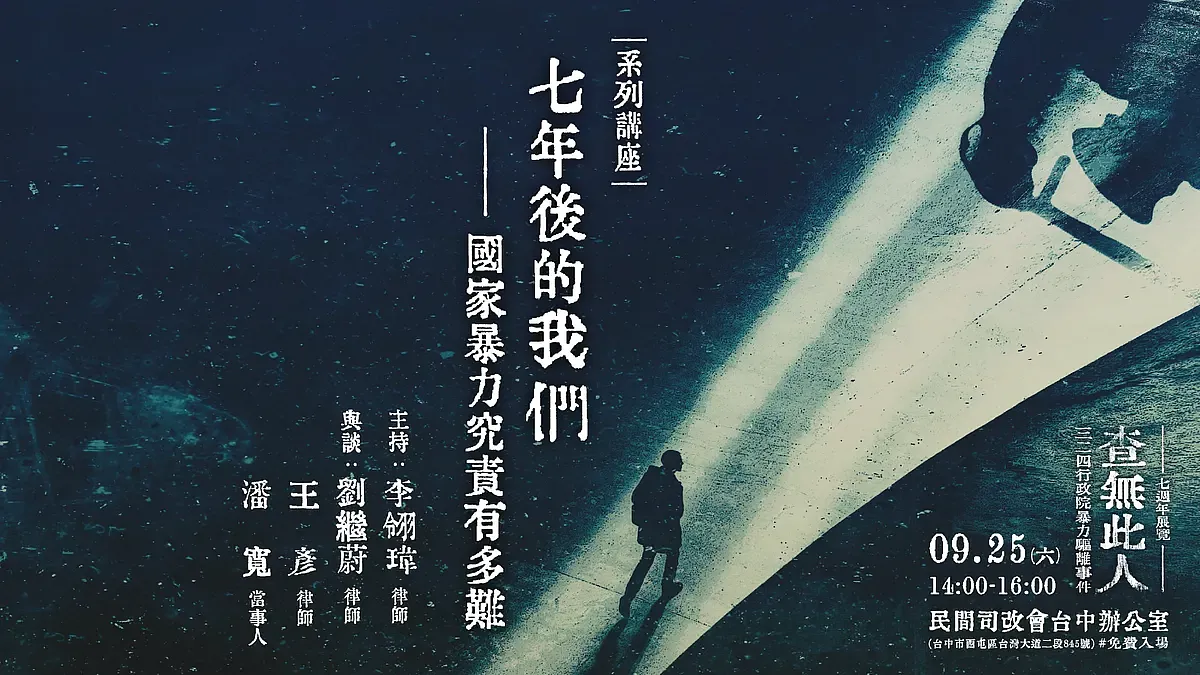
Seminar Transcript | Unidentifiable: Us Seven Years Later-How Hard Is It to Hold State Violence Accountable?
Last edited: 2026-08-30
Many lawyers and participants were present on the night of the March 24 violent dispersal at the Executive Yuan, and the state violence of that night affected an entire generation of young people in different ways. Seven years later, how are they doing? Has the way they understand the movement-and its impact on their lives-changed?
For this seminar, we invited Attorneys Li Ling-Wei, Liu Chi-Wei, and Wang Yen, together with participant Pan Kuan, to reflect on the difficulty of holding state violence accountable from the perspectives of both lawyers and people directly involved. Seven years of litigation ended with the conclusion that no unlawful conduct could be identified. What does that outcome mean to them? Did the movement, and the years of legal struggle that followed, leave anything lasting behind?
Young people today may know about protest movements in Hong Kong, Thailand, and Myanmar while knowing little about a movement that took place in Taiwan only seven years ago. Through this seminar, we hope to revisit that history, take stock of both the setbacks and gains in efforts to hold state violence accountable, and carefully search together for a path forward.
Unidentifiable: Us Seven Years Later-How Hard Is It to Hold State Violence Accountable?
▮ Time: September 25, 2021 (Sat.), 14:00-16:00
▮ Moderator: Li Ling-Wei / Attorney
▮ Speakers: Liu Chi-Wei / Attorney; Wang Yen / Attorney; Pan Kuan / Participant
▮ Transcript: JRF interns from the Department of Law, Providence University
■ Moderator: Attorney Li Ling-Wei

For me, once I became involved in these lawsuits, I came to see the litigation itself as a form of social movement. Social movements have often worked this way: one percent of society confronts an entire structure-and even the other ninety-nine percent, who may dismiss protesters as a mob creating disorder without realizing that those protesters are fighting for rights that benefit society as a whole, including the people mocking them. If we think of litigation as social movement, the traditional Chinese image is the Foolish Old Man removing the mountains one basket at a time; in the West, perhaps it is Sisyphus pushing the stone uphill only to watch it roll back down. The point may not be to obtain a single "just" judgment, because we know there are systemic causes and structural problems.
If I myself were the judge, could I really issue the impartial decision that, as a lawyer, I believe should be made? Faced with those pressures, I am not sure I could answer. That is why the value of this litigation cannot depend only on obtaining a particular judgment. Every public hearing can become an opportunity: we hold press conferences, bring people into the courtroom to observe and take notes, and organize discussions afterward. Eventually we may get to confront and cross-examine the commanders themselves, require them to place absurd explanations on the public record, and leave those statements in history for later generations to examine.
That process is why the work still matters. Attorney Liu mentioned how, in the early protest cases, courts would almost automatically convict supposed "ringleaders" for refusing to disperse. Later people began printing "I am the ringleader" on their shirts; everyone became a ringleader, challenging the courts to look seriously at whether the administrative authorities had acted lawfully-whether the warning signs, dispersal orders, and enforcement procedures themselves were proper-instead of treating the legitimacy of state action as beyond question. These changes were won through enormous effort, blood, sweat, and in some cases lives. We are now living inside that historical current and helping write its next chapter.
■ Speaker: Attorney Liu Chi-Wei
All of these stories teach us one thing:

Being vigilant toward those who exercise power does not mean that everything we do is "anti-government." Democracy requires rational discussion and constant vigilance. We should not lazily hand over our rights to the government and then accept that whatever the government says must be right. History does not simply repeat itself in exactly the same form; abuses evolve. Even if we remember what happened before, the most basic democratic requirement is still the same: citizens must remain engaged rather than passive. I am not claiming to be unusually diligent myself. But many civil society organizations help all of us remain attentive. Their role is to point out that something in society-or something the state is doing-may be wrong. You do not have to participate in any particular way or assume any specific role. What matters is staying alert, paying attention to government power, and fulfilling our responsibility as citizens of a democracy to make society better.
■ Speaker: Attorney Wang Yen
When I studied history, I learned about the Wild Lily movement and Kuomintang authoritarianism, but to me those were simply historical events. It was only when I personally participated-or when something happened to my friends-that I understood that confrontation with those in power can still occur even in a democracy. Memory therefore requires more than reading. It also requires participation. And, as an advertisement, you can participate through the Judicial Reform Foundation.
There will always be protest, injustice, minority groups, and vulnerable communities. When people facing injustice take to the streets, we can see how those in power respond. Even an elected government can misuse coercive state power. Whether it was the Kuomintang then, or cases such as the South-Link Railway expropriation under the Democratic Progressive Party, we still need to observe whether state force is lawful or abused. When you are physically present, the force of state power becomes unmistakable, and you understand much more clearly why people feel compelled to act.

When more people participate, the state knows that someone is watching. These matters cannot be handled through crude or expedient methods; officials must take them seriously. The essence of democracy is checks and balances. Civics textbooks teach that phrase, but checks and balances do not happen simply because we elect a political party and assume everything will be fine. We have to keep paying attention to the issues that matter to us. That is the lesson I have taken from my own experience.
■ Speaker: Participant Pan Kuan
At the beginning, before things became tense, everyone was sitting on the ground discussing issues related to the Cross-Strait Service Trade Agreement. We were a completely nonviolent group. A few hours later, police vehicles began arriving one after another, and in the distance officers started locking shields together. Instructions among the protesters changed: link arms, lie down. The lawyers had already told us to write down the phone numbers for legal aid or the JRF and reminded us that, if anything happened, we could remain silent and ask for a lawyer. If we were loaded onto a police vehicle and taken far away, we would have to figure out how to get back ourselves.
But no one had told us that the police might simply attack the crowd. The officers began dragging people away one by one like an explosive version of pulling radishes. I still do not know whether a superior had ordered a deadline or imposed some other operational target for completing the dispersal. Once you passed through the police line, the world changed. People were surrounded and beaten. While I was being dragged along the ground, punches and kicks came from all directions. It felt like a scene from a movie. I kept my arms over my head to protect myself, but blows kept coming. Then I suddenly felt something warm splash onto me. When I finally stood up outside the cordon, I realized: it was a pool of blood.
That was the moment I realized I had been attacked by the police. I completely froze. The worldview I had been taught since childhood began to collapse piece by piece.

It was similar to my experience in the marriage-equality movement. What adults had taught us about gay people when we were young was completely different from what I later experienced while participating in that movement. My assumptions about police enforcement and political parties were overturned in the same way. I originally wanted to stand outside for a moment, catch my breath, and check my injuries, but then the water cannon started firing and the force of the stream was so strong that I had to run again.
But no one had told us that the police might simply attack the crowd. The officers began dragging people away one by one like an explosive version of pulling radishes. I still do not know whether a superior had ordered a deadline or imposed some other operational target for completing the dispersal. Once you passed through the police line, the world changed. People were surrounded and beaten. While I was being dragged along the ground, punches and kicks came from all directions. It felt like a scene from a movie. I kept my arms over my head to protect myself, but blows kept coming. Then I suddenly felt something warm splash onto me. When I finally stood up outside the cordon, I realized: it was a pool of blood. That was the moment I realized I had been attacked by the police. I completely froze. The worldview I had been taught since childhood began to collapse piece by piece.
It was similar to my experience in the marriage-equality movement. What adults had taught us about gay people when we were young was completely different from what I later experienced while participating in that movement. My assumptions about police enforcement and political parties were overturned in the same way. I originally wanted to stand outside for a moment, catch my breath, and check my injuries, but then the water cannon started firing and the force of the stream was so strong that I had to run again.
/
Attachment
Full Transcript: Us Seven Years Later-How Hard Is It to Hold State Violence Accountable?

This article is an AI-generated translation of the original Chinese text. In the event of any discrepancy, the Chinese version shall prevail.