
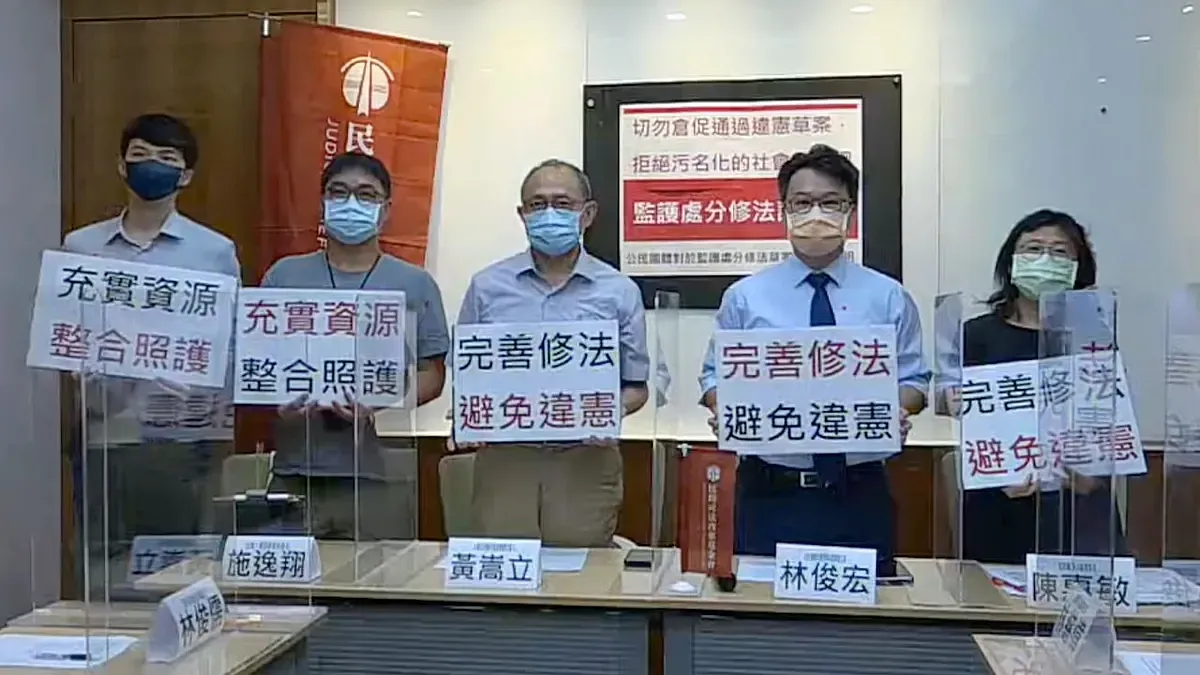
Press Release | Do Not Rush Through Constitutionally Problematic Drafts: Reject a Stigmatizing Social Safety Net-Civil Society Statement on Custodial-Disposition Reform
Last edited: 2026-08-30
To address criminal cases involving persons with mental disorders, the Legislative Yuan's Judiciary and Organic Laws and Statutes Committee is scheduled to review draft amendments concerning custodial dispositions tomorrow (October 7). The proposals would remove the existing five-year maximum and create an "emergency custody" mechanism. Significant concerns remain: both the Judicial Yuan and Executive Yuan have identified possible constitutional defects, and the proposals have not been coordinated with amendments to the Mental Health Act. The legislature should not rush them through. At the same time, reform must take forensic psychiatry and community-based support seriously, comprehensively review treatment resources, and provide appropriate treatment and meaningful assistance to persons with mental disorders who come into conflict with the law if it is genuinely to improve public safety.
Coordinate Reform with the Mental Health Act
Japan once proposed a "treatment disposition" comparable in function to Taiwan's custodial disposition for persons with mental disorders who committed offenses. In 1971, the Japanese Society of Psychiatry and Neurology rejected the proposal at its general assembly by 446 votes to 2, with 4 abstentions, arguing that it would amount to social exclusion in the name of "treatment" and encourage the public to equate mental illness with criminality. Japan instead addressed the issue through mental-health legislation. After further study and debate, it enacted the Act on Medical Care and Treatment for Persons Who Have Caused Serious Cases Under the Condition of Insanity in 2003, which took effect in 2005. That framework emphasizes medical necessity, treatment planning, adjustment of living environments, inter-agency cooperation, and reintegration into society.
Taiwan has long used custodial dispositions. The current proposals would not only extend a form of rehabilitative disposition that Japan declined to adopt in the same form, but would add "emergency custody," inviting even greater constitutional and policy concerns. Nor has the relationship with the Mental Health Act been adequately examined. Because amendments to the Mental Health Act were also pending in the Legislative Yuan, the government should coordinate the relevant reforms and review together the Criminal Code, Code of Criminal Procedure, Rehabilitative Disposition Execution Act, Mental Health Act, and the requirements of the Convention on the Rights of Persons with Disabilities (CRPD). Only an integrated approach can adequately protect individual rights.
Drafts Raising Serious Constitutional Concerns Should Not Be Rushed Through
The draft has not been integrated with the Mental Health Act, and even the responsible branches of government disagree. The Judicial Yuan, for example, questioned the Executive Yuan's proposed amendment to Article 87 of the Criminal Code because it could allow custodial dispositions to be extended repeatedly without an overall maximum. Without adequate safeguards, a person could in effect remain confined for life, contrary to the principles reflected in J.Y. Interpretation No. 799. We agree. Repeatedly extending confinement also does not, by itself, create genuine public safety.
At the same time, the Executive Yuan questioned the Judicial Yuan's proposed Article 301-1 of the Code of Criminal Procedure. It argued that execution should ordinarily follow a final judgment, while the proposal would allow a rehabilitative disposition to be imposed before a judgment becomes final, raising concerns under the presumption of innocence and the Constitution. We agree that, even if some form of emergency custody is necessary, lawmakers must carefully examine its relationship with pretrial detention and ensure adequate forensic-evaluation resources and other safeguards for defendants with mental disorders.
The Executive Yuan and Judicial Yuan were respectively responsible for amendments to the Criminal Code and Code of Criminal Procedure, yet disagreed about central features of one another's proposals. Under these circumstances, the legislature should not hastily enact an incomplete framework that may conflict with the Constitution. Respecting constitutional rule-of-law principles and designing a coherent public-safety framework are responsibilities the Legislative Yuan cannot avoid.
Strengthen Treatment Resources to Build a Real Social Safety Net
A genuine social safety net begins with adequate treatment resources both inside institutions and in the community. Taiwan needs investment in understaffed services and coordination among the justice, health, police, labor, and social-welfare systems, together with community care. Otherwise "treatment" becomes only a slogan: people with mental disorders who come into conflict with the law may face indefinite institutional confinement, forensic psychiatry will be asked to carry an impossible burden on its own, and the underlying gaps in care will remain.
A reform tilted too heavily toward punishment-especially indefinite extensions of custodial dispositions-moves away from integrated care, fails to protect medical rights, and may worsen mental health through long-term institutionalization. The underlying problem remains unresolved, stigma deepens, and society is no safer. Before amending the law, the responsible agencies should inventory existing resources and invest in psychiatric care, community support infrastructure, and qualified personnel. That is how the gaps in the social safety net can actually be repaired.
Co-signing Organizations
Judicial Reform Foundation
Taiwan Alliance to End the Death Penalty
Prison Watch
Covenants Watch
Taiwan Association for Human Rights
Eden Social Welfare Foundation (joined as co-signatory)
Taipei Life of Heart Association (joined as co-signatory)
Taiwan Association for Psycho-Social Rehabilitation (joined as co-signatory)
Taiwan Mad Alliance (joined as co-signatory)
Participants
Lin Chun-Hung / Chair, Criminal Law Committee, Taipei Bar Association
Chen Hui-Min / Chairperson, Prison Watch
Huang Sung-Li / Convener, Covenants Watch
Shih Yi-Hsiang / Secretary-General, Taiwan Association for Human Rights
Lin Tzu-Wei / Director of Legal Affairs, Taiwan Alliance to End the Death Penalty
Lin Chun-Ju / Director, Legal Policy Department, Judicial Reform Foundation
This article is an AI-generated translation of the original Chinese text. In the event of any discrepancy, the Chinese version shall prevail.