
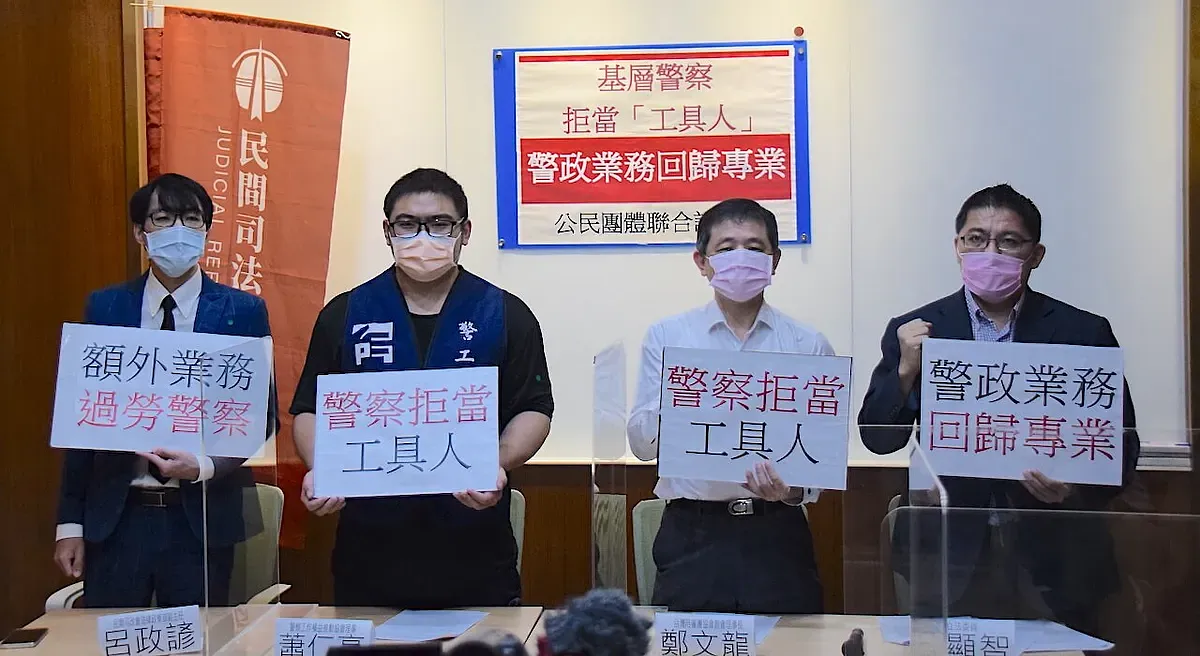
Frontline Police Refuse to Be "All-Purpose Tools"! Press Conference Calling for Professional Boundaries in Police Work
Last edited: 2026-08-30
In August 2021, as concern about African swine fever intensified, the National Police Agency launched a special operation targeting smuggled pork. Frontline police were instructed to inspect pork vendors and food-waste containers, while police departments in places including Taichung and Tainan used performance metrics and statistical reporting to require officers to count and report food-waste containers.
Police were not treated as all-purpose manpower only during the African swine fever response. During the COVID-19 pandemic, officers whose core mission is public order were also required to document mask violations and private gatherings for referral to health authorities. Civil society had already urged the National Police Agency not to keep expanding police involvement in public-health enforcement. Frontline officers began referring to themselves sarcastically as "mask police" and "food-waste police," reflecting mounting frustration at being treated as general-purpose tools for any administrative task.
Non-Core Duties Are Overloading Frontline Police
The smuggled-pork operation exposes a long-standing problem: unclear lines of responsibility have led police agencies to spend years "assisting" with work outside core policing. Another familiar example is enforcement against noise from modified motorcycle and automobile exhaust systems. Environmental authorities are the competent agencies, yet police have long been expected to conduct frontline inspections and enforcement.
These non-core duties increase workloads and make it harder for officers to focus on public safety. They also allow other agencies to rely excessively on police instead of developing adequate specialist staffing, administrative expertise, and clear divisions of responsibility. The Taiwan Police Union had previously highlighted the same problem in a press conference criticizing endlessly expanding duties and performance pressures.
Clarify the Legal Framework and Return Policing to Professional Police Work
In response to criticism of "mask police," the National Police Agency invoked the principle of administrative unity, arguing that officers who encounter public-health violations while on duty may document the facts and refer them to health authorities without violating the law. In response to criticism of "food-waste police," the agency emphasized generous special-operation bonuses.
Civil society organizations stress that administration according to law is a basic principle of a state governed by the rule of law. For years, the National Police Agency has assigned frontline officers duties that plainly fall outside core policing. It should not answer criticism simply by invoking "administrative unity," nor should bonuses substitute for legal clarity. The agency should publish the relevant documents and explain whether the requirements of the Administrative Procedure Act for administrative assistance have been followed. The Executive Yuan and Legislative Yuan should also review whether the scope and limits of administrative assistance need clearer statutory rules.
Article 19 of the Administrative Procedure Act governs circumstances and procedures in which an administrative agency may request assistance from another agency. But the law does not clearly specify when the requested agency may accept or refuse assistance or how broad that assistance may be. That gap helps explain the frontline complaint that "if nobody else is responsible for it, it becomes the police's job." The National Police Agency should therefore adopt clearer administrative rules and a complete standard operating procedure.
In the present controversy, the National Police Agency should explain under which subparagraph of Article 19, Paragraph 2 of the Administrative Procedure Act the environmental authority requested police assistance; why the agency agreed; and what the scope, duration, and objectives of the assistance were. Frontline officers and the public are entitled to clear answers.
Resolution 40-2-1 of the Third Subcommittee of the 2017 National Conference on Judicial Reform called for more dedicated environmental inspection personnel so that the Seventh Special Police Corps would no longer bear so much of the Environmental Protection Administration's enforcement burden. But environmental cases are only one example. Police are also expected to handle public-health enforcement, noise complaints, and other tasks outside core policing. A professional and efficient police service requires clearer law and a genuine division of responsibilities among agencies.
At a more fundamental level, reasonable frontline workloads require reform of police performance management-another issue addressed by the National Conference on Judicial Reform but still lacking meaningful progress. The Judicial Reform Foundation and Taiwan Jury Association will therefore hold an October 16 forum, "Investigative Issues Facing Frontline Investigators: Police Performance Metrics, Amendment of Article 92 of the Code of Criminal Procedure, and Pseudo-Criminal Property Cases," and invite the public to participate.
We are also collecting cases. Frontline officers who are treated as "general-purpose tools" and required to perform duties unrelated to policing may contact the Taiwan Police Union or the JRF through the following channels:
Taiwan Police Union
- Facebook: @policeright.tw
- Email: taiwanpolicetradeunion@gmail.com
Judicial Reform Foundation
- LINE: @jrftw
- Phone: (02) 2542-1958 - Researcher Chen
Attachments
- Summary of Legislator Chiu Hsien-Chih's Remarks
- Press Release by the Taiwan Police Union
- Reference Materials Provided by Hsu Chien-Hsiang
Participants
Chiu Hsien-Chih / Legislator
Hsiao Jen-Hao / Board Member, Taiwan Police Union
Cheng Wen-Lung / Founding Chairperson, Taiwan Jury Association
Hsu Chien-Hsiang / Member, JRF Prosecutor-Police Reform Project
Lu Cheng-Yen / Deputy Director, Legal Policy Department, Judicial Reform Foundation
Press Contact
Chen Yang / Legislative Researcher, Judicial Reform Foundation
This article is an AI-generated translation of the original Chinese text. In the event of any discrepancy, the Chinese version shall prevail.