
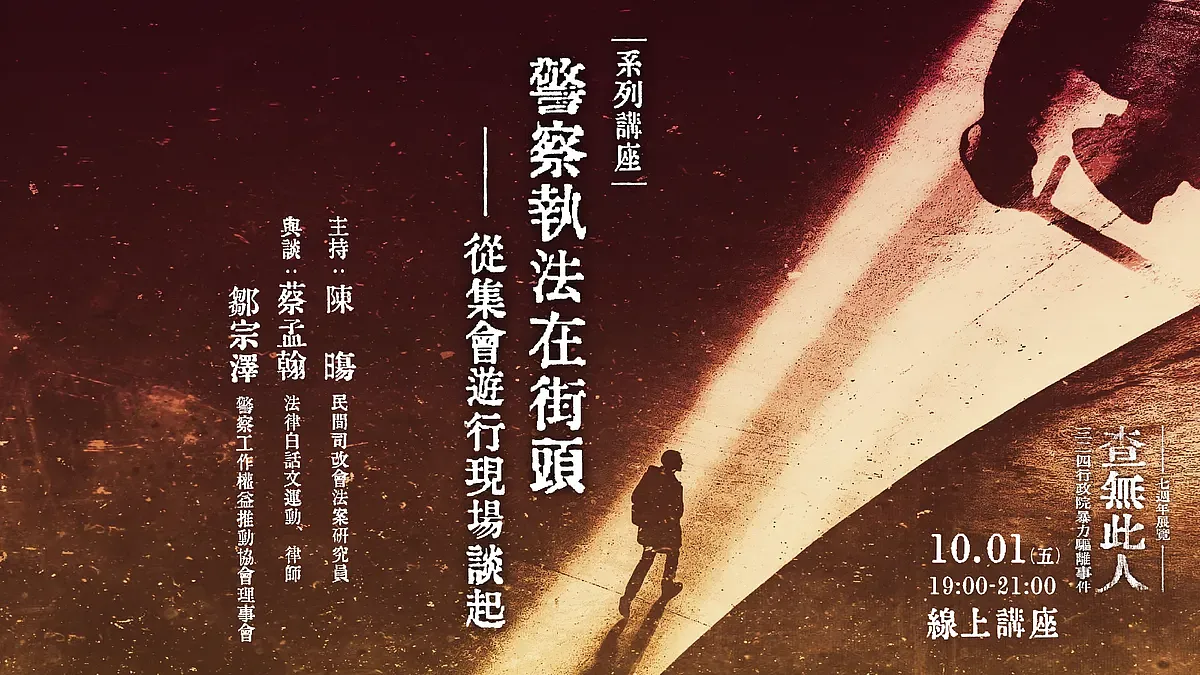
Seminar Transcript | Unidentifiable: Police Enforcement on the Streets-Starting from the Scene of Assemblies and Demonstrations
Last edited: 2026-08-30
During the March 18 Movement, the relationship between protesters and police shifted from moment to moment. At times crowds collectively thanked exhausted officers; at others, police protected protesters from gang members who had forced their way into the scene. But the night of March 24 also produced brutal images of officers striking people with batons and shields and stepping on them with police boots.
Individual officers act within institutions that constrain and shape their decisions. This seminar therefore examines the tensions and boundaries of police enforcement at assemblies and demonstrations. JRF legislative researcher Chen Yang, who has long worked on prosecutor-police reform, moderates a discussion with former police officer Tsou Tsung-Tse on frontline enforcement experience and Attorney Tsai Meng-Han of the Plain Law Movement on the legal framework governing assemblies and demonstrations.
Unidentifiable: Police Enforcement on the Streets-Starting from the Scene of Assemblies and Demonstrations
▮ Time: October 1, 2021 (Fri.), 19:00-21:00
▮ Moderator: Chen Yang / Legislative Researcher, Judicial Reform Foundation
▮ Speakers: Attorney Tsai Meng-Han / Plain Law Movement; Tsou Tsung-Tse / Taiwan Police Union
▮ Transcript: Liu Cheng-Yen / Intern, Department of Law, Ming Chuan University
Applying Before an Assembly or Demonstration
Tsai Meng-Han /
Article 8 of the Assembly and Parade Act requires an organizer to apply to the competent authority before holding an assembly or demonstration. Under Article 3, the competent authority is the police precinct for the place where the event will occur. Taiwan currently uses a permit system rather than a notification system: under a permit system, advance approval is required before the right may be exercised; under a notification system, the organizer gives advance notice of details such as time and place but does not need government approval.
Many people have therefore advocated replacing Taiwan's permit system. They argue that freedom of assembly is a fundamental right and that a permit requirement makes the right look like a favor granted by the government. In practice, however, only a very small number of applications are denied each year-usually because of conflicts with other events or insufficient lead time-and police generally do not reject applications based on the content of the proposed assembly.
How Do Frontline Officers View the Permit System?
Tsou Tsung-Tse /
Frontline officers are primarily responsible for on-site safety and traffic control. From their perspective, whether the law uses a permit or notification system is less important than practical questions: whether emergencies arise, whether the event ends on time, and how officers should respond. Senior commanders may worry that incidents will reflect badly on them or on the city government and therefore become more conservative in staffing and planning. A permit system gives police more lead time to arrange personnel; a notification system may create greater time pressure.
Evolution of the Assembly and Parade Act
Tsai Meng-Han /
J.Y. Interpretations Nos. 445 and 718 set constitutional limits on the Assembly and Parade Act. A permit system is not necessarily unconstitutional, but the competent authority may not conduct substantive review of the political message-for example, views on same-sex marriage or cross-strait unification-because those views lie at the core of freedom of expression. The Constitutional Court also held that requiring applications six days in advance was too rigid for spontaneous responses to sudden public events and that exceptions must be available.
During an Assembly or Demonstration
Tsou Tsung-Tse /
Police are responsible for public order and surrounding traffic. Depending on circumstances, officers may form lines or barriers to separate groups and prevent escalation. But Taiwan still lacks sufficiently clear operational standards and legal guidance for many unexpected situations at demonstrations; even commanding officers may be unsure whether a particular order is lawful. That uncertainty itself can contribute to conflict between police and the public.
Is Criminal Liability Appropriate for Unexpected Conduct During an Assembly or Demonstration?
Tsai Meng-Han /
A person who remains after police lawfully order dispersal may face criminal liability.
A warning is essentially a notice, yet the Assembly and Parade Act does not specify how many warnings must be given or the interval between them. In practice, police often give three. Continued noncompliance can potentially lead to criminal liability, including under Article 30 of the Act and Article 149 of the Criminal Code. Whether these provisions satisfy the principle of legal certainty-and whether the Assembly and Parade Act needs separate criminal offenses when the Criminal Code already contains relevant rules-remains open to debate.
Police authority at assemblies is not derived solely from the Assembly and Parade Act. Relevant powers are dispersed across statutes including the Police Power Exercise Act and rules governing the use of police equipment and force. Practices such as transporting protesters away from a demonstration and leaving them elsewhere, if lawful at all, would need a clear statutory basis such as the protective-control authority under Article 25 of the Assembly and Parade Act.
Before an Event, Do Police Receive Operational Briefings?
Tsou Tsung-Tse /
Police generally assign officers to intersections and entrances, arrange traffic control, and equip officers with body-worn cameras and batons. Even where the event has been approved in advance, however, there is no sufficiently clear operational SOP for many situations. For sit-ins, police may physically carry people away after warnings, but even here the practical rules are fragmented and often unclear.
What Should Be Improved in the Assembly and Parade Act?
Tsai Meng-Han /
The state often regulates people as though they were children, assuming that it must prevent every possible mishap. When reform of the Assembly and Parade Act was first proposed during the Ma Ying-Jeou administration, many considered the law outdated; after the change in governing party, however, reform lost momentum.
The distinction between permit and notification systems is not always as sharp as it appears. Other provisions also deserve review-for example, whether the restricted zones in Article 6 remain necessary and whether dispersal under Article 25 is proportionate where an assembly has not actually threatened life or property and has caused, at most, traffic disruption. The state should use the least restrictive means available rather than defaulting to dispersal.
Chen Yang /
When I was serving in the military, an animal-abuse incident at our base led people to throw eggs at the gate and demand that the person responsible be identified. The Assembly and Parade Act prohibited assemblies near military facilities, yet the unit did not take action against the protesters. Once people felt they had made their point, they left. The Ministry of National Defense likewise did little. Situations like that suggest the need for clearer, more proportionate operational guidelines.
Q&A
Q: Are police officers subject to special restrictions if they participate in assemblies or demonstrations or publicly express a political position?
Tsou Tsung-Tse /
The rules are broadly similar to those governing other civil servants. Officers generally cannot participate while on duty, but participation during leave is not inherently prohibited. There is no simple rule stating that a police uniform can never be worn in a particular context, though broad disciplinary concepts such as "damaging the reputation of the police" can still be invoked depending on the seriousness of the conduct.
Q: As a lawyer, have you participated in any especially memorable demonstration, and what legal issues did it raise?
Tsai Meng-Han /
For our generation, the Sunflower Movement is probably the most memorable. I was there, and views of the movement remain deeply divided. The way government views protesters directly affects the way police power is deployed. If demonstrators are treated as enemies and every possible risk is minimized through barricades and dense police deployment, officers themselves become exhausted and may understandably develop resentment toward the people they are policing.
Taiwan is a democracy where assemblies are common. In Ximending, for example, one group may advocate unification while another advocates independence on the opposite side of the street. That is something worth preserving. Compared with places where police responses to demonstrations are much harsher, Taiwan should continue thinking from the top down about how public power can protect-rather than merely control-the exercise of fundamental rights.
Q: Commanders often remind officers to turn on body-worn cameras before maintaining order. Are there clear rules governing their use?
Tsou Tsung-Tse /
In practice, instructions to turn on cameras can be more aspirational than workable. Conflicts are unpredictable, batteries do not last indefinitely, and there is no clear rule governing exactly when recording must begin. Some agencies issue body-worn cameras, but equipment quality and budgets vary; officers sometimes buy their own devices.
Tsai Meng-Han /
Article 9 of the Police Power Exercise Act regulates circumstances in which police may record and requires destruction of recordings after the relevant purpose ends. But pervasive recording raises its own privacy concerns. People expressing political views at a peaceful demonstration may worry that recordings will later be used against them or draw attention from superiors. Routine recording of peaceful assemblies therefore deserves careful scrutiny.
Q: Who owns footage recorded on a body-worn camera, whether privately purchased or officially issued? Are officers required to turn it over?
Tsou Tsung-Tse /
There is no simple answer. From a commander's perspective, footage recorded while an officer is on duty is work-related and must be provided if an official review requires it.
Chen Yang /
When officers use privately purchased body-worn cameras or phones to record evidence and then post the footage on personal social-media accounts to mock suspects, that can violate the principle of non-disclosure of investigations.
Q: Would a law prohibiting assemblies from advocating communism be unreasonable?
Tsai Meng-Han /
The Assembly and Parade Act contains restrictions on advocating communism or territorial separation. I consider that problematic. The ICCPR permits certain restrictions on expression, including advocacy of war or discriminatory hatred, but communism is not inherently synonymous with anti-democratic conduct. Assembly is itself a form of expression. A democracy may defend itself against genuine advocacy of violent overthrow, but prohibiting an ideology as such goes too far. The law should target speech that crosses into concrete incitement to violence, not merely the expression of communist views.
Attachment
This article is an AI-generated translation of the original Chinese text. In the event of any discrepancy, the Chinese version shall prevail.