
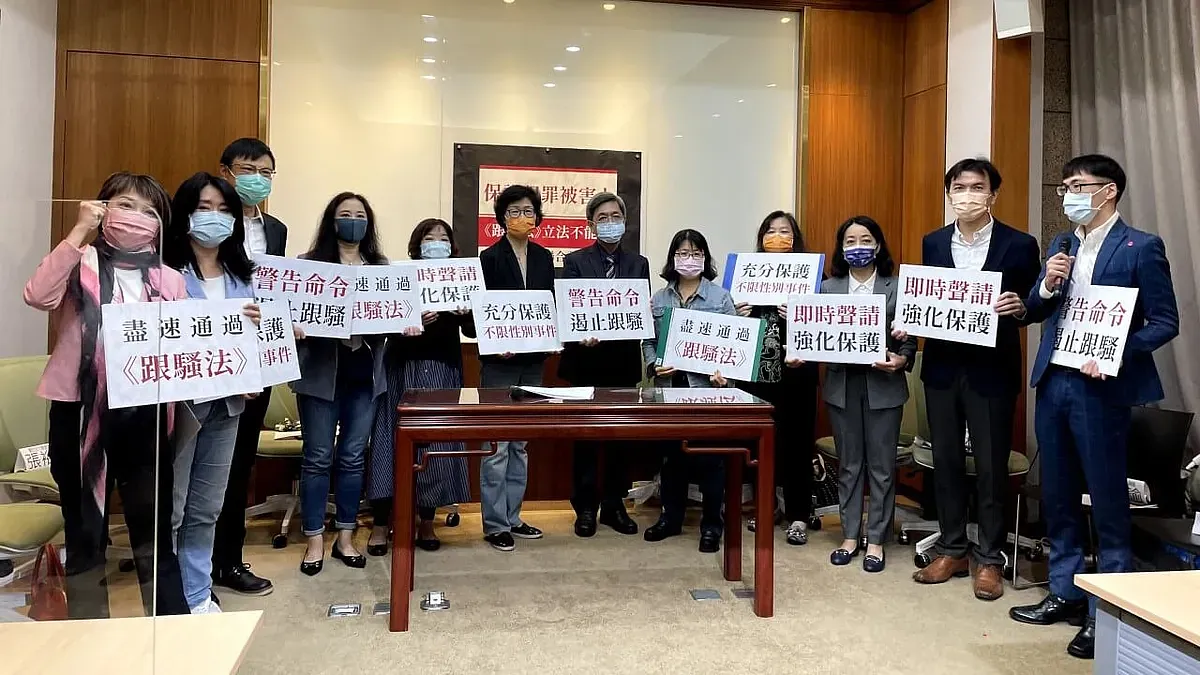
Protect Crime Victims-The Stalking and Harassment Prevention Act Cannot Wait: Taiwan Crime Victims' Rights Alliance Press Conference
Last edited: 2026-08-30
More than six years have passed since the first draft of the Stalking and Harassment Prevention Act was introduced in the Legislative Yuan in 2015. Legislation has stalled, while tragedies have continued. In both the 2020 murder of a female Chang Jung Christian University student in Tainan and the 2021 murder of a female telecom-store employee in Pingtung County, the perpetrators had engaged in stalking before the killings. Earlier intervention under a stalking-prevention law might have prevented those deaths.
The Taiwan Crime Victims' Rights Alliance believes that crime victims and their families are too often neglected in criminal proceedings. When offenders use stalking or harassment to pressure victims into showing "leniency," settling, or withdrawing complaints, victims can be left without effective protection. Secondary victimization of this kind is not uncommon in practice.
On April 26, to ensure that legislation genuinely protects personal safety, mental well-being, and human dignity, the Civil Society Legislative Working Group on the Stalking and Harassment Prevention Act put forward five demands concerning the Executive Yuan draft and called for swift enactment:
- Written warnings lack immediacy and clarity.
- A protection order should not depend on first obtaining a written warning.
- The harm caused by stalking is not necessarily related to sex or gender.
- The competent authority should establish a dedicated stalking-and-harassment prevention task force.
- The government should provide protective services to victims of stalking and harassment.
Although the draft went through its first round of cross-party negotiations on May 13, the Legislative Yuan had not yet convened further caucus negotiations after the new session opened. To protect crime victims, the Alliance supports the five demands above and joined women's organizations from the working group in calling on the legislature to negotiate actively and complete the third reading during the current session. For provisions still reserved for negotiation, we make the following recommendations:
-
To Protect Victims Fully, Stalking Should Not Be Limited to Conduct "Related to Sex or Gender"
Article 3 of the Executive Yuan draft defines stalking and harassment as repeated or continuous conduct, carried out against a specific person's will through people, vehicles, tools, devices, electronic communications, the internet, or other means, that is related to sex or gender and causes fear sufficient to affect the person's daily life or social activities.
But should only stalking connected with gender or intimate relationships be subject to intervention? A 2018 survey by the Modern Women's Foundation found that 57 percent of cyberstalkers were strangers or people whose identity was unknown. How are frontline police supposed to determine whether such conduct is "related to sex or gender"? If that element is difficult to establish, enforcement gaps may create another serious weakness in personal-safety protection.
The Chang Jung Christian University case illustrates the problem. One month before the murder, the perpetrator had randomly stalked and attempted to abduct another person. If the law protects only stalking tied to gender or intimate relationships, random stalking and other common patterns-such as illegal debt collection or school bullying-could fall outside its scope. The Alliance therefore supports removing the "related to sex or gender" requirement from the statutory definition so that the Stalking and Harassment Prevention Act can protect crime victims more effectively.
The Executive Yuan draft already lists eight categories of stalking conduct. However, Japan amended its Anti-Stalking Act in May 2021 to cover the use of electronic devices to obtain another person's location information, responding to newer forms of stalking. Drawing on the Japanese approach, the Alliance recommends adding a ninth category to Article 3: obtaining another person's location information or movement status, without consent, through electronic devices, software, electronic records, or similar means.
-
Define Clear Exclusions to Prevent the Law from Becoming Overbroad
Expanding protection also requires sensible exclusions. If the definition is too broad, police authority may expand unnecessarily and limited police resources may be diverted from serious cases. The KMT version under negotiation contains a useful set of exclusions:
Conduct listed in Paragraph 1 shall not constitute stalking or harassment when undertaken in any of the following circumstances:
1. To protect national security or national defense.
2. Pursuant to law or lawful authorization.
3. To prevent or investigate crime or maintain public safety.
4. Measures taken in accordance with social custom to protect the public interest, where the conduct remains within tolerable limits.
5. Measures taken in accordance with social custom to exercise a lawful right, where the conduct remains within tolerable limits.
The specific types and scope of Subparagraphs 4 and 5 shall be prescribed by the competent authority in the enforcement rules after considering social customs, local practices, and generally accepted norms.The Alliance believes that conduct authorized by law should be excluded, while the remaining scope should be interpreted consistently with J.Y. Interpretation No. 689: victim safety must remain the starting point, but the law should also avoid disproportionate restrictions on other fundamental rights, including freedom of the press and freedom of assembly.
-
Allow Prompt Applications for Protection Orders and Strengthen Administrative Intervention
Under Article 5 of the Executive Yuan draft, a victim may apply for a protection order only if the police have first issued a written warning and the stalking continues within two years after that warning.
That framework is too rigid. Some victims report at the earliest stage of harassment; others endure the conduct alone for some time before seeking state protection. The level of danger and the risk of further harm cannot be measured simply by whether those two formal prerequisites have been met. Making them mandatory may create a serious gap in protection.
If someone has been stalked for a long time and the stalker has recently followed the victim home at night, why should the victim have to wait for a police warning before asking a judge for protection? And if police decline to issue a warning-or the victim does not file a criminal complaint-the victim should not thereby lose the ability to seek a court order independently.
The Alliance therefore supports allowing victims to apply for a protection order as soon as stalking occurs, so that personal safety can be protected without unnecessary delay.
Police also need tools to protect victims before a court issues a protection order. Article 4, Paragraph 2 of the Executive Yuan draft provides that where an investigation reveals criminal suspicion of stalking, police shall issue a written warning and, when necessary, take other appropriate protective measures.
But the draft does not define the content of the written warning, the consequences of violating it, or what "other appropriate measures" actually include. Victims may therefore remain exposed while waiting for a court order. This also reveals a structural problem: the Executive Yuan draft treats all stalking as a criminal matter but provides too little immediate administrative intervention, leaving frontline police without clear tools.
The Alliance accordingly supports authorizing police, before a protection order is issued, to issue a warning order where sufficient facts indicate a risk of renewed stalking. The order should prohibit further stalking and, where necessary, be backed by administrative penalties to provide early protection.
The Executive Yuan draft also does not distinguish among ordinary, emergency, and temporary protection orders as the Domestic Violence Prevention Act does. If protection orders are meant to safeguard personal safety, the legislature should consider whether simplifying the system is justified or whether different emergency mechanisms are needed to respond to the circumstances of individual cases.
-
Improve Victim Services and Enact the Crime Victim Rights Protection Act
Last December, the Alliance released a civil-society draft Crime Victim Rights Protection Act. After multiple rounds of Ministry of Justice review, the government version had also matured. Yet the Executive Yuan draft Stalking and Harassment Prevention Act did not clearly provide protective assistance for stalking victims. Stronger inter-agency coordination is also necessary if prevention is to form part of a comprehensive social safety net.
The Alliance therefore supports the fourth and fifth demands of the women's organizations: the legislature should promptly enact the Stalking and Harassment Prevention Act, while the responsible agencies should also advance and enact the Crime Victim Rights Protection Act to strengthen the overall victim-protection system.
Attachments
Co-signing Organizations
Taiwan Crime Victims' Rights Alliance
Taiwan Coalition Against Violence
Taipei Women's Rescue Foundation
Garden of Hope Foundation
Modern Women's Foundation
Women in Digital Initiative (WIDI)
Judicial Reform Foundation
(in order of joining)
Attending Representatives
Lin Yung-Sung / Chairperson, Judicial Reform Foundation
Wang Pei-Ling / Chairperson, Taiwan Coalition Against Violence
Tu Ying-Chiu / Chief Executive Officer, Taipei Women's Rescue Foundation
Wang Yueh-Hao / Chief Executive Officer, Garden of Hope Foundation
Chang Yu-Chuo / Standing Executive Director, Women in Digital Initiative (WIDI)
Wang Chiu-Lan / Researcher, Modern Women's Foundation
Lin Yu-Shun / Professor, Graduate Institute of Criminal Investigation, Central Police University
Hung Wen-Ling / Assistant Professor, Department of Crime Prevention and Corrections, Ming Chuan University
Lai Hsiang-Ling / Legislator
Chang Chi-Lu / Legislator
Wang Wan-Yu / Legislator
Fan Yun / Legislator
Li Kuei-Min / Legislator
Chiu Hsien-Chih / Legislator
Press Contact
Lu Cheng-Yen / Attorney; Deputy Director, Legal Policy Department, Judicial Reform Foundation
Phone: (02) 2523-1178 ext. 37
Email: elvin@jrf.org.tw
This article is an AI-generated translation of the original Chinese text. In the event of any discrepancy, the Chinese version shall prevail.