
JRF Newsletter
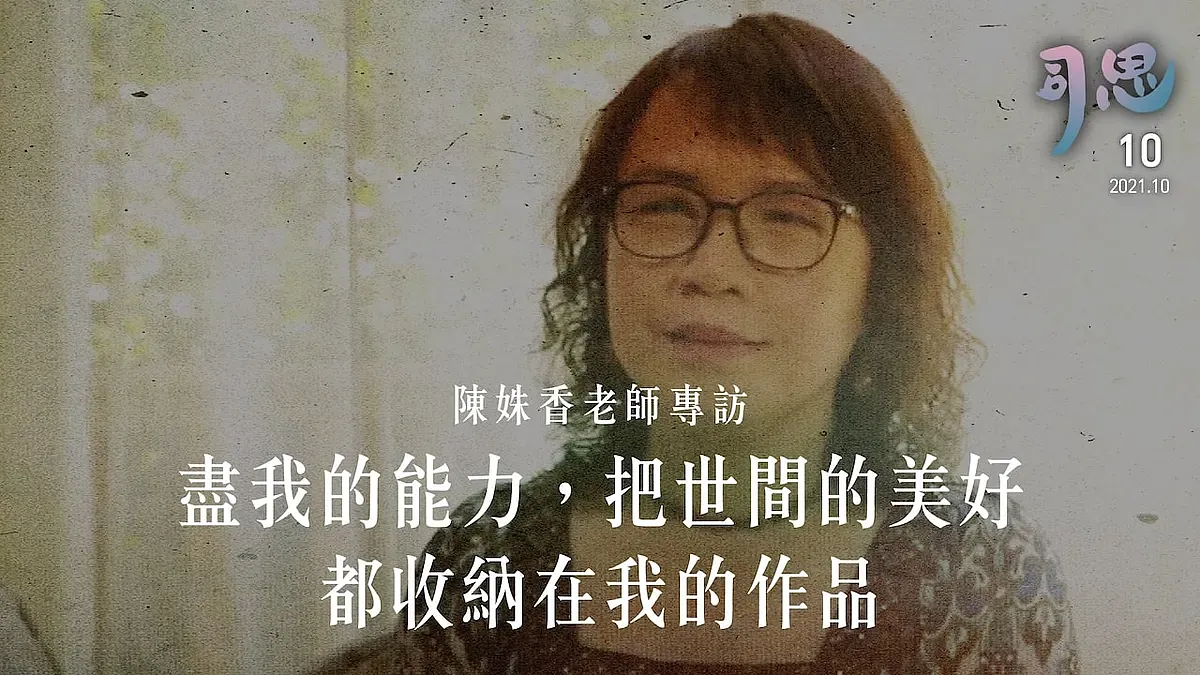
"Doing My Best to Gather the Beauty of the World into My Work": An Interview with Artist Chen Shu-Hsiang
Last edited: 2026-08-30
For many years, Chen Shu-Hsiang has supported judicial reform by donating her artwork.
How I First Became Connected with the JRF
Several years ago, a relative and friend who is an attorney visited my studio and introduced me to the Judicial Reform Foundation. I immediately thought it was a meaningful organization and that donating paintings for charity sales sounded like a wonderful idea. At the time I had not yet retired. Although I taught art, design, and painting, I lacked uninterrupted time and space for sustained creative work. I had already accumulated many pieces, but I did not yet feel they were quite at the level I wanted for a JRF charity sale. Even so, I accepted the invitation and submitted work. Being able to create happily, contribute to the public good, and see work I made with care appreciated by others is genuinely joyful.
After I became involved with the JRF, the positive response to my work unexpectedly strengthened my desire to create. Retirement then gave me the freedom to devote myself to the two things that make me happiest: travel and painting. I finally had the time and space to pursue dreams I had carried for years and to let those two passions inspire one another.
Whether someone acquires one of my works at a charity sale because they want to support a cause or simply because they love the painting, every piece feels like a child I carried for ten months-precious and unique. I hope people experience physical, emotional, and spiritual pleasure from looking at my work, and that even a passing glance can bring renewed joy or feeling.
Thoughts on Judicial Reform
I spent 28 years in art education while also supporting my husband and raising our children. To be honest, the JRF felt very unfamiliar when I first encountered it. Perhaps I had been fortunate: my students were well behaved and accomplished, and I had rarely faced serious trouble. Questions about "what is wrong with the law" therefore seemed remote from my life.
Later, as I thought more about what the JRF actually does and had more time to follow public affairs, I realized that legislation and judicial decisions are intimately connected with all of us. A law is not made for one isolated event; it applies across cases and across people.
I have been fortunate not to encounter a problem that required the justice system to resolve, which is probably why I once felt detached from these issues. But sound legislation and fair judicial decisions are precisely what allow a country-especially a democracy like ours-to function normally.
Creative Motivation and Philosophy: Beginning with the History of Western Painting
Because I think carefully about the composition, brushwork, and color of every painting, explaining my creative approach requires starting with the history of Western painting. This section is a little long, but I will try to keep it concise.
The Renaissance, Fifteenth-Sixteenth Centuries
Before the Renaissance began in the fifteenth and sixteenth centuries-especially during the medieval period-Western artists worked within a world of faith and doctrine, and artistic production was largely devoted to God and the Church.
With the Renaissance, artistic subjects increasingly shifted toward the secular world and toward what we call humanism. The best-known example is Leonardo da Vinci's *Mona Lisa*. Leonardo (1452-1519) excelled in fields ranging from military engineering and urban design to astronomy, yet among the small number of surviving paintings attributed to him, the *Mona Lisa* alone-with the mystery generations have read into its smile-can draw us into the creative flowering of the Renaissance. Its use of sfumato, or atmospheric perspective, has also had enduring importance in modern art education.
Artists of the period still painted many religious subjects, but increasingly placed them within convincing earthly settings. That change was significant because it symbolically narrowed the distance between the divine and the human. Raphael (1483-1520), one of the three great Renaissance masters, was especially celebrated for images of the Madonna whose warmth, tenderness, serenity, and maternal feeling embody Renaissance humanism. (The other two masters are Leonardo da Vinci and Michelangelo [1475-1564].)
Evolution of Western Painting from the Seventeenth to Nineteenth Centuries
In the seventeenth century, Baroque painting embraced dynamic composition and dramatic light, shadow, and color. Artists often avoided rigid vertical and horizontal organization and instead embedded curves and diagonals that lead the viewer's eye through the work. Deep perspective could heighten the sensation of space extending far beyond the canvas.
The eighteenth-century Rococo style added ornate and lighthearted decoration. In nineteenth-century Romanticism, artists embraced dramatic, distant, imagined, or emotionally charged subjects, including scenes of war and massacre. At roughly the same time, Realism moved in the opposite direction, concentrating on ordinary life and things visible in the world around us.
Nineteenth-Century Impressionism
On April 15, 1874, a group exhibition of works rejected by the official Salon opened in Paris. The exhibition drew crowds but harsh criticism. A critic mocked Claude Monet's *Impression, Sunrise* as little more than an "impression," and the participating artists embraced the label. Impressionism emphasized painting outdoors and observing how light changes the colors and appearance of the world.
Claude Monet (1840-1926), for example, painted more than thirty views of Rouen Cathedral between 1892 and 1894. The subject barely changed; the light did. He painted the façade warm yellow in sunlight, blue in cold weather, awakening in morning light, burning red at sunset, dissolving into gray mist, and harmonizing in blue and gold. The series demonstrates Impressionism's emphasis on changing light over fixed outlines and helps explain its close association with plein-air painting.
Because white light contains the visible spectrum, an illuminated surface reflects a mixture of the object's local color and sunlight, while a surface in shadow often shifts toward complementary hues. Impressionists therefore frequently used warm orange and yellow tones in bright areas and cooler blue and violet tones in shadows, often avoiding pure black and pure white.
Vincent van Gogh (1853-1890), still one of the most celebrated painters today, often placed complementary colors side by side so that they visually intensified one another. Art history eventually treated this more passionate development as Post-Impressionism, represented by Van Gogh, Paul Cézanne (1839-1906), and Paul Gauguin (1848-1903).
Cézanne, often called the "father of modern painting," grew dissatisfied with Impressionism's emphasis on atmosphere at the expense of structure and volume. He analyzed objects through spheres, cylinders, cubes, cones, and other basic forms and constructed volume through planes of color. That approach profoundly influenced modern art education.
Painting from the Twentieth Century to the Present
Since the early twentieth century, painting has developed in countless directions, but many of those innovations have moved toward abstraction. Abstract painting treats form and color as sufficient elements in themselves: through effective organization, the material language of painting can carry meaning without depending on literary narrative or external symbolism.
Put simply, abstraction need not depict recognizable objects at all; it can construct an image directly from non-objective form and color. A rough outline can be divided into three stages:
- (1) Precursors to Abstract Painting
- Impressionism: weakening fixed boundaries of form in order to concentrate on light and color.
- (2) Abstract Painting in a Broad Sense
- Fauvism and Cubism: using color more boldly and breaking apart recognizable forms for subjective reconstruction.
- Futurism: disrupting form while emphasizing rhythm and movement.
- (3) Abstract Painting in a Narrow Sense
- Constructivism: composition built primarily from geometric forms.
- Neo-Plasticism: compositions based on vertical and horizontal lines and the primary colors together with black and white.
- Expressionism: spontaneous expression through form and color.
Styles in art history are not invented at a single moment by one person or a small group; they emerge gradually as ideas and techniques evolve. Because we are still so close to the twentieth and twenty-first centuries, it is difficult-and perhaps presumptuous-to declare which movement defines our own era. My guess is that centuries from now, art history may summarize these centuries through the broad category of abstraction because it represents so much of our generation's experimentation. Perhaps abstract works have the best chance of entering the history books.
So Why Don't I Paint Abstract Art?
Whatever the style, almost every artist writes some version of the same thing in a solo-exhibition statement: creation is an expression of the spirit and a home for emotion.
I feel the same joy in creation. At the beginning of a painting I am impatient-I want to move quickly because I am afraid that if I hesitate I will lose the rhythm of the wind carrying the scent of flowers. Without the emotion of that immediate moment, the painting could become dry and lifeless. Once every element has found its place, I can slow down and carefully adjust color and brushwork. That is another kind of pleasure.
I enjoy watching a work gradually become the image I have in mind, and at that stage I deliberately slow down. Through oil paint and canvas, I relive and communicate what moved me during a journey. That is what I want to do now. Whether my style will change in the future, even I cannot say.
Caring for Every Inch of the Canvas
Combined with the almost meditative immediacy of travel, every painting is an experiment. I am in no hurry to define my style; I let each work determine what feeling it needs to convey.
※ Click an image to enlarge
 *Late Autumn*
 captures the depth of autumn in Hokkaido. Trees of different heights fill the foreground; tall trunks carry sparse, dry leaves that move in the wind, while a low hill in the middle distance is covered in thin brown and yellow vegetation. Snow already caps the mountains beyond, and the sky remains gray and hazy. The earth seems ready to fall asleep. Yet at the lower left, warm sunlight reaches along the riverbank and reveals a solitary horse grazing, suddenly bringing life into the quiet scene.
 *Kusasenri*
 depicts the landscape at the foot of Mount Aso. On the road toward the volcano, endless fields of pampas grass roll across the mountains with an almost overwhelming scale. A few cattle bend to graze and give the otherwise tranquil view a sudden sense of life. I painted that expansive landscape in the hope that viewers might feel some of its calm.
 *Village with a Church*
 depicts a December day in England's Lake District. At the entrance to a quiet village, a small church offers local residents a place of spiritual rest and gives travelers somewhere to pause. Along paths between irregularly scattered cottages, black and white sheep, roosters, and ducklings forage contentedly through the muddy farmyard, inviting an almost conversational intimacy with ordinary village life.
These three works use realist techniques. My love of painting villages was influenced by Alfred Sisley (1839-1899), whose temperament and work are among the gentlest and most poetic of the Impressionists.
*Outdoor Café* *Light and Shadow in the Alley*
*Outdoor Café* and *Light and Shadow in the Alley* depict quiet streets in Córdoba, Spain. My memories of Córdoba extend beyond the Mosque-Cathedral and Roman Bridge to flower-filled lanes and white walls beneath intensely blue skies. I borrowed from Post-Impressionist approaches, using fluid brushwork to soften the rigid geometry of the alleyways and large fields of blue to connect sky and shadow. The white walls are not simply white: sunlight becomes warm yellows, while shaded surfaces shift toward pale blue and violet. I added colorful decorative lines to the livelier composition of *Outdoor Café*; *Light and Shadow in the Alley* remains more restrained, preserving the mystery of a quiet street.
 *Cherry Blossoms Beyond the Fence*
 uses atmospheric perspective to soften the background. The pastel-toned painting depicts cherry blossoms near Kumamoto Castle. I spread spring pink across the canvas but preserved the fence and eaves behind it, allowing the rational straight lines of blue architecture and the emotional curves and diagonals of pink blossoms and branches to interact in a dialogue between movement and stillness.
 *Saying Goodbye to Cambridge Again*
 recalls King's College beside the River Cam in cold drizzle. Only after visiting Cambridge did I fully understand the imagination of poet Xu Zhimo: along the riverbank the willows really do appear golden. Their sparse branches ripple in the water like fragments of a rainbow-colored dream. I could no longer tell whether the moisture in my eyes came from rain or from a feeling that seemed to stretch across generations. The composition has become a classic image for me; I departed from naturalistic color and used Impressionist technique to paint the Cambridge that exists in my memory.
Finally, I leave myself these two lines as an aspiration:
Because perseverance allows our potential to unfold without limit; because of art, life can be infinitely rich.
This article is an AI-generated translation of the original Chinese text. In the event of any discrepancy, the Chinese version shall prevail.
