
JRF Newsletter
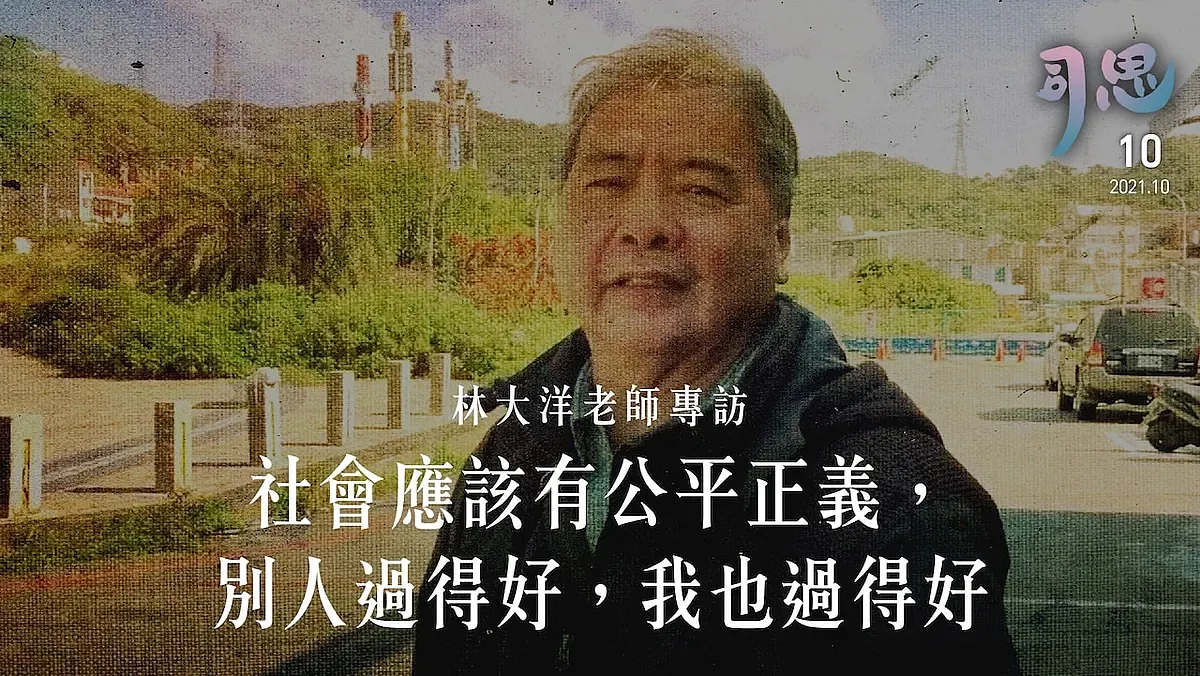
"Society Should Have Fairness and Justice; When Others Live Well, I Live Well Too": An Interview with Artist Lin Ta-Yang
Last edited: 2026-08-30
Shared Life with Indigenous Communities Awakened His Concern for Marginalized People
Standing beside the blue harbor at Ruifang, Lin Ta-Yang looks toward Keelung Mountain with unmistakable affection for this land and its people. That attachment is what led him to make his own distinctive contribution to judicial reform in Taiwan.
Lin says his decision to donate paintings to support judicial reform began with Indigenous miners who had come to work around Keelung Mountain. In the 1970s, comparatively high wages made mining an attractive urban occupation for many Indigenous people. Lin painted his Indigenous friends and often ate and slept alongside them, which made him increasingly aware of their poverty and of human-rights problems that society largely ignored. Once, while riding a motorcycle in Hualien to take a sick Indigenous friend home, he traveled an industrial road scattered with exposed metal, loose rock, and open drainage ditches. There was not a single streetlight along the twisting route, and the ride was frighteningly dangerous.
Road conditions that hazardous would never have been tolerated for long in an urban district populated mainly by Han Taiwanese. Lin could not help asking: "We are all human beings. Why do they have to live in a place like this?" On an island as small as Taiwan, its oldest peoples had nevertheless been systematically overlooked for generations.
The 1980s brought further hardship. Indigenous people were repeatedly targeted by human trafficking; many underage girls were trafficked into illegal brothels, and some cases even involved police acting as intermediaries. Those abuses helped spark campaigns to rescue child victims of prostitution. Activists including poet Mona Neng also pressed for Indigenous name rectification, autonomy, and return of traditional lands, bringing Indigenous-rights issues into greater public view. At the same time, declining fisheries, mining disasters, and new migrant-labor policies made Indigenous livelihoods increasingly precarious. Lin attended activist talks and learned more about the institutional causes behind those problems. He came to see Indigenous communities as marginalized people denied meaningful autonomy and treated for decades as objects of governance-almost as second-class citizens-without an adequate government response.
Watching people around him suffer, Lin could not simply stand aside. To defend the rights and livelihoods of his Indigenous friends, the paintbrush became his strongest weapon.
"Like Che Guevara," Lin said, recalling how the South American revolutionary's motorcycle journey exposed him to profound inequality and pushed him toward political action. For Lin, witnessing the hardship of Indigenous communities produced a different weapon: the paintbrush. Painting-letting more people see the faces of urban Indigenous people-became his way of changing the status quo. Local politicians and officials sometimes openly or indirectly suggested that he concentrate on landscapes rather than people so that uncomfortable conflicts would remain out of view. Lin rejected that idea. No subject, he believes, should be taboo when people's livelihoods are at stake.
"Indigenous people are trying to do the same things as everyone else-earn money, support their families, and raise their children. Why should the price be so high?" Lin went deep into docks and mines to sketch and paint the lives of Indigenous fishers and miners. Strong faces, direct gazes, and muscular arms darkened by coal dust dominate his canvases. He worked day and night to preserve in color the resilient lives of people who had left home simply to survive, using forceful brushwork to record a community's beauty, hardship, and sorrow.
 *A Group of Indigenous Miners from Yuli*
A Commitment to Human Rights and Justice That Is Simple, Steadfast, and Enduring
Asked about human rights, Lin says without hesitation that they are a universal value requiring continuous attention and advocacy. He believes Taiwan still has a long way to go and urges intellectuals to develop "a sense of mission toward human rights": no one should be left behind, and Taiwan should keep pace with international human-rights standards. That belief is why he donated paintings to the JRF's fundraising campaign. Through his own medium, he hopes to improve the land he loves from the bottom up and contribute more to human rights.
In the dim room where he keeps his collection, Lin turns through thick portfolios filled with faces drawn in powerful lines and vivid color. He flips past several pages almost casually and says, "You can have all of these." For human rights, it seems, very little feels too precious to give.
"I am an ordinary person. I am not doing this for fame or profit. I simply believe society should have fairness and justice," Lin says quietly at the end of the interview. The idea is simple but reaches the heart of the matter. How far have we traveled toward the ideal of fairness and justice? What have we changed, and how should we move forward? Indigenous conditions may have improved in some respects, but the road toward effective human-rights protection in Taiwan remains long and needs more people willing to contribute without expecting something in return. "If I do not do it, who will? I do what I believe is right and help other people. That makes me happy, and I grow too. When other people live well, I live well too."
After closing the portfolios containing decades of work, Lin Ta-Yang leads us back into the bright harbor sunlight. His solitary figure against sea and sky is slightly stooped now, but his steps remain firm. People should live with all their strength and keep trying to realize their ideals, he says-whoever they are. "Otherwise, what future would we have?"
This article is an AI-generated translation of the original Chinese text. In the event of any discrepancy, the Chinese version shall prevail.
