
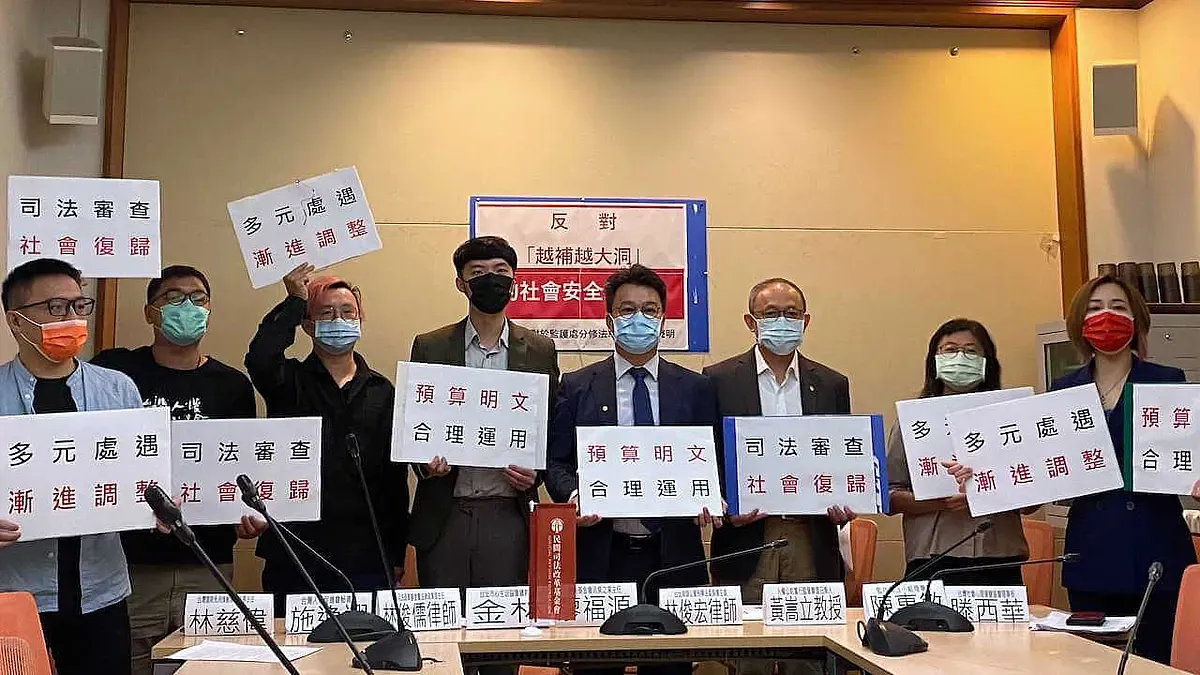
Joint Statement | Do Not Make the Social Safety Net Worse: Civil Society Opposes the Current Custodial-Disposition Amendments
Last edited: 2026-08-30
On October 20, the Judicial Yuan and Ministry of Justice announced a consensus on how the justice system should handle persons with psychosocial disabilities who come into conflict with the law before a final judgment. The Legislative Yuan's Judiciary and Organic Laws and Statutes Committee was scheduled to review related amendments to the Criminal Code, Rehabilitative Disposition Execution Act, and Code of Criminal Procedure on November 4. But the agreed provisions do not resolve all of the constitutional concerns and remain heavily oriented toward institutional confinement. They provide no express budget for custodial dispositions and reject a diversified-treatment model before judgment becomes final. Without funding for professional training and psychological support, the proposal effectively shifts every unresolved problem onto forensic psychiatry. Community-based mental-health resources remain underdeveloped and poorly integrated into early intervention. A social safety net designed this way risks "making the hole bigger while trying to patch it": removing people labeled dangerous from public view without actually solving-or even confronting-the underlying problem.
Oppose a Legal Framework "Without a Budget": Require Dedicated Funding and Rational Allocation of Resources
These amendments would substantially change the treatment of persons with psychosocial disabilities in the justice system, yet the draft contains no provision addressing funding. Treatment costs, professional education and training, and psychological support for staff are all necessary to provide appropriate care. Those expenses should not simply be shifted to National Health Insurance or to the persons subject to the disposition. The Rehabilitative Disposition Execution Act should expressly require the Ministry of Justice to budget for them.
Even if the Ministry of Justice provides funding, every problem should not be pushed into forensic psychiatric hospitals. That approach undervalues community-based mental-health care. Beyond medication during acute phases, people need stable, continuing psychosocial rehabilitation. Such services are essential both to integrated early intervention and to successful reintegration into society afterward.
Oppose a Legal Framework of "Social Exclusion": Strengthen Judicial Review and Reintegration Requirements
Preventive detention in Europe offers a warning. It is likewise justified in the name of social protection while imposing severe restrictions on liberty. In *M. v. Germany* (2009), the European Court of Human Rights found a violation of the European Convention on Human Rights, and European human-rights and anti-torture bodies have emphasized that people subject to such measures must not be deprived of hope for the future. *Ilnseher v. Germany* (2018) likewise underscores the importance of regular judicial review and meaningful arrangements for social reintegration. Legitimate public-safety concerns must be controlled by law rather than allowed to become a mechanism for social exclusion.
Taiwan's existing assessment mechanism is too weak to provide dynamic review of whether continued custodial disposition remains necessary. The draft allows reference to an evaluation team's opinion but gives that opinion no binding effect, and extensions would not receive the kind of regular judicial review contemplated by §67e of the German Criminal Code. Professional evaluation should carry greater legal weight, judicial review should occur at least every six months, and the person subject to the disposition-as well as close relatives or an authorized medical proxy who understands the person's current condition-should be able to petition the court to terminate execution.
Reintegration also needs a denser legal framework. The draft merely requires a transition meeting two months before a custodial disposition expires. Taiwan should instead draw on the reintegration-coordinator model under Japan's medical-treatment and supervision system and require an individualized Social Reintegration Plan, with detailed implementing rules and continuity of judicial protection throughout the process.
Oppose a "Hospitals Only" Framework: Include Diverse Treatment Options in Interim Placement
The provisions agreed upon by the Judicial Yuan and Ministry of Justice still leave major constitutional questions unresolved-including the possibility of indefinite deprivation of liberty under the Criminal Code. At the same time, the agreed amendments create new problems. Most regrettably, the Rehabilitative Disposition Execution Act would abandon the opportunity to provide diverse treatment options for persons with psychosocial disabilities before a final judgment and instead route them entirely into forensic psychiatric hospitals.
That is not only a funding problem. It disregards medical practice and the importance of community-based mental-health services. Sending every person subject to interim placement directly to a hospital may simplify execution for prosecutors, but it can impose serious burdens on hospitals and prevents treatment from being adjusted progressively as the person's condition changes. With interim placement potentially lasting as long as five years under the draft, a hospital-only model is especially difficult to justify. At minimum, diverse treatment options should be incorporated into interim placement so that individual rights and clinical needs can both be respected.
Repair the Social Safety Net-Do Not Create More Stigma and Conflict
We therefore oppose the current directions of "no budget," "social exclusion," and "hospitals only." The legislature should address these defects carefully before committing large public resources to a system that may fail to improve public safety while deepening stigma and social division.
Co-signing Organizations
Judicial Reform Foundation
Taiwan Alliance to End the Death Penalty
Prison Watch
Covenants Watch
Taiwan Association for Human Rights
Eden Social Welfare Foundation
Taipei Life of Heart Association
Taiwan Association for Psycho-Social Rehabilitation
Attendees
Lin Chun-Hung / Chair, Criminal Law Committee, Taipei Bar Association; Standing Executive Committee Member, Judicial Reform Foundation
Chen Hui-Min / Chairperson, Prison Watch
Huang Sung-Li / Convener, Covenants Watch
Shih Yi-Hsiang / Secretary-General, Taiwan Association for Human Rights
Lin Tzu-Wei / Director of Legal Affairs, Taiwan Alliance to End the Death Penalty
Liao Fu-Yuan / Director, Fountain House, Eden Social Welfare Foundation
Chin Lin / Secretary-General, Taipei Life of Heart Association
Teng Hsi-Hua / Chairperson, Taiwan Association for Psycho-Social Rehabilitation
Lin Chun-Ju / Director, Legal Policy Department, Judicial Reform Foundation
Press Contact
Attorney Lin Chun-Ju / Judicial Reform Foundation
(02) 2523-1178 ext. 20
This article is an AI-generated translation of the original Chinese text. In the event of any discrepancy, the Chinese version shall prevail.