
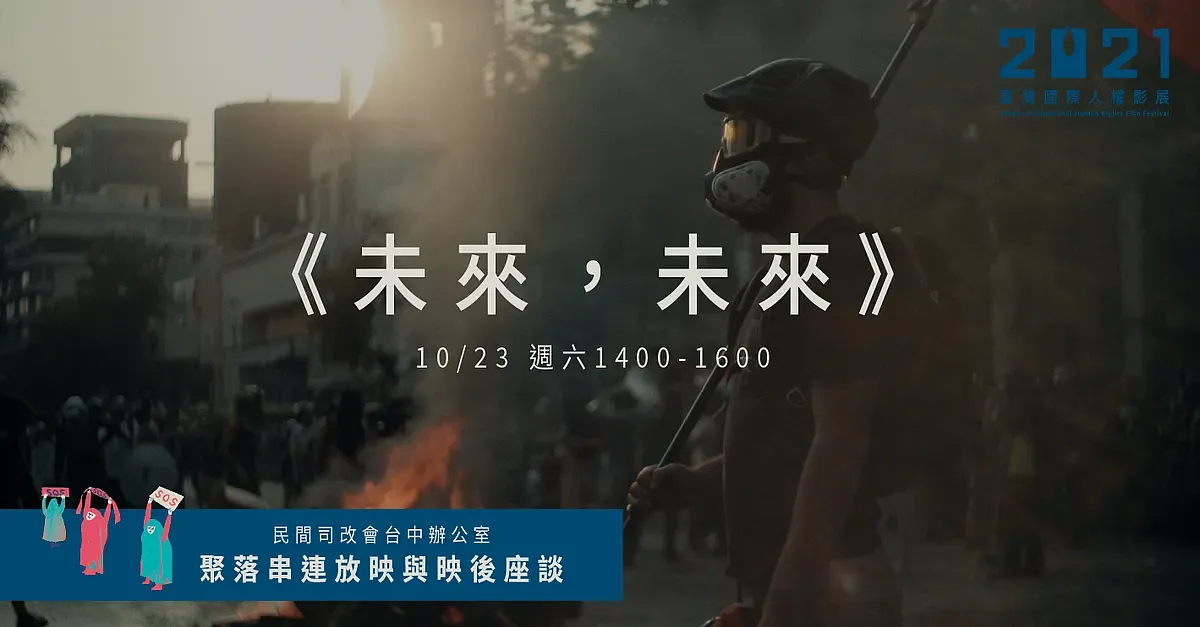
Post-Screening Discussion | Dear Future Children - Youth Activism, Fear, Memory, and Agency
Last edited: 2026-08-30
Hong Kong, Chile, and Uganda are thousands of kilometers apart, yet young people in all three places confront deep generational conflict. *Dear Future Children* follows three young activists fighting respectively for democracy, social equality, and climate justice. They inherit political, social, and environmental problems created before them, while their anger and demands are often ignored by those in power. Through their actions, what will this generation say to the children of the future?
▮ Franz BÖHM
▮ Germany / United Kingdom / Austria
▮ 2021 | Color | 89 min.
Post-Screening Discussion
▮ Time: October 23, 2021 (Sat.), 14:00-16:00
▮ Moderator: Lin Pei-Jung / Attorney
▮ Speaker: Hsu En-En / HackMD Community Manager; Freelance Writer
▮ Transcript: Shen Fang-Ju / Department of Social Work, Tunghai University; JRF Intern
Discussion Transcript
Lin Pei-Jung
Hello, everyone. I'm Attorney Lin Pei-Jung, and I'm grateful to the JRF for inviting me to moderate today's discussion. *Dear Future Children* follows young women activists in Chile, Uganda, and Hong Kong and the struggles they face. We are very fortunate to have Hsu En-En with us today. She has participated in youth movements in both Taiwan and Hong Kong and will share her own experiences and reflections.
Hsu En-En
Hello, everyone. I'm especially grateful that you came to an in-person discussion when so much of this year's Human Rights Film Festival has moved online. Before I introduce myself, I would really like to know what everyone thought of the film. But to get the conversation started, I'll first share some of my own reactions. My name is Hsu En-En-En-En really is my given name. I was born in 1992, so I'm 29 this year.
I don't know whether everyone noticed the exhibition downstairs. It deals with one episode of the 2014 Sunflower Movement, which happened when I was a junior in college. Ever since then I have often spoken about the March 18 Movement. At first, I assumed that people listening to those stories had mostly been there themselves. But as the years pass, I increasingly meet younger people who first learned about the Sunflower Movement in a history textbook. That creates a very different kind of distance.
When I passed the second floor, I heard protest scenes and sounds coming from the screening. After hearing them, I went downstairs again to look at the *Unidentifiable* exhibition. I don't know how many of you have actually been at a protest site. Several years of my university life were spent in places like that. Taiwan was comparatively fortunate; the most serious things I experienced were roughly what you see in the exhibition downstairs. My youth included confronting police, chaining myself to structures, climbing onto roofs, and linking arms with friends in front of homes so excavators could not demolish them.
I grew up in Kaohsiung and started participating in social movements after moving to Taipei for university. Around 2012 to 2014, Taipei and Miaoli saw protest after protest. The sounds you heard in the film were sounds I once heard in stereo, standing right inside them. Hearing those noises again today and then revisiting the Executive Yuan scenes downstairs made me realize how much time has passed. I would hesitate to call it trauma now, but those images still bring back a flood of feeling. They are part of my life.
The three protagonists in the film are a little younger than I was when I was most active on the streets. The documentary covers three countries and three movements, but what interests me most is the inner life of the activists themselves. It records only a short period-perhaps a year or two. Watching it, I kept wondering: five or six years from now, when these three women are my age, how will they look back on what they are doing today?
One line from the Chilean activist stayed with me. She said people think the front line is frightening, but fear can be transformed into something else. I understand that. Before I first faced police at a protest, I thought of police as the people who helped when I lost a wallet or managed traffic. I had never imagined them standing opposite me, much less hitting me. After one or two protests, you might expect fear to take over, but when everyone is there together and you share a conviction, fear can become another kind of energy. At the same time, what we faced in Taiwan was much safer. We knew reporters were filming and lawyers were behind us. In some of the places shown in the film, people could lose their lives.
The greatest sense of powerlessness I have felt in recent years is not simply that social movements in Taiwan seem quieter. It is watching Hong Kong activists of our generation move, in only a few years, into conditions resembling Taiwan's White Terror era. Many can no longer organize at all. When the Hong Kong activist in the film says that fear has overtaken her convictions, it feels painfully real. In Taiwan, we may not fully understand that feeling-and I am fortunate that we do not have to.
I used to know women activists in Hong Kong. We chatted on Facebook about ordinary life like sisters. Now I can only write to some of them in prison. I have to avoid mentioning politics or social movements because the prison may withhold the letter. Living in democratic Taiwan, I never imagined I would have to think that way just to write to a friend. That is why the Hong Kong scenes in the film feel so real to me: people I know are living through exactly that.
I have experienced fear in other forms too. At the first Pride march I attended in Kaohsiung, I was too afraid to walk openly in the parade. I carried a rainbow flag and took a bus along the same route instead. In Miaoli, police detained us and even put us in handcuffs during protests over wind-power development, and the company later litigated against us all the way to the High Court. We believed wind turbines could be built, but not in a way that harmed nearby residents. Years of litigation became another form of fear.
And confronting police is another level entirely. I went to Hong Kong in June 2019 just as the anti-extradition movement was exploding, and I later wrote a report about it. By then there was already tear gas, gunfire, and serious injury. The level of risk was completely different from Taiwan. Social movements can involve genuine fear and danger. That is why parents tell their children not to get involved. But even then, people continue to step forward-just as I once did.
The Ugandan activist, who chose a path of international advocacy, also said something important: we talk too much and act too little. Social movements demand enormous changes, but every activist is still one person who eventually has to graduate, find work, and live a life. Can anyone be an activist forever? If activism gives me opportunities to run for office, do I really deserve those opportunities? I have spoken at hundreds of events, yet I still think movements belong to everyone. Why am I the person holding the microphone?
The Ugandan story brings out the tension between individual and collective action. Social movements confront structures larger than any one person. Sociology often speaks of agency within structure: even when a structure cannot immediately be overturned, a person can still act within it. If an authoritarian government requires every business to display a slogan and refusing means losing the ability to operate, perhaps I cannot refuse entirely. But I can cover part of the slogan, place it lower, or turn it slightly. Even a tiny act shows that I recognize the structure and still possess agency. That awareness can be the seed of social change.
 Still from *Dear Future Children*, courtesy of the Taiwan International Human Rights Film Festival
Lin Pei-Jung
Thank you, En-En, for sharing your own experiences. After watching the documentary, were there any aspects of the film itself that especially stood out to you?
Hsu En-En
When the three activists speak directly to the camera, the director's role is almost invisible. But the person behind a camera is never purely neutral; there is always a position and a relationship. In this film, the director presents himself mostly as an observer. I tend to prefer documentaries that occasionally make the audience aware of what is happening behind the lens. I was also surprised that all three protagonists speak so much English. When they are with family or friends, they switch into their own languages, but they often use English so the director can understand. Advocacy certainly requires communication, but that choice also removes some texture and intimacy from what the camera captures.
The three movements are also very large, high-profile movements. If I were filming on those sites, I would probably want to interview more people around the protagonists. Even the Hong Kong activist often speaks English to the director, which can make the film feel detached from the local environment. One of the closest moments comes when the film visits the family of a Chilean activist who died. But that raises another ethical question: how should a camera approach grieving parents? You can almost see the director wrestling with whether to show grief or ordinary life continuing around it. I would not say the choice is wrong, but personally I wanted more of the local movement beyond the three central figures.
If you are interested in comparing approaches, you might watch Fu Yue's *Our Youth in Taiwan*; the Hong Kong documentary *Inside the Red Brick Wall*; *Mishima: The Last Debate*; or the Thai documentary *100 Times Reproduction of Democracy*. Different directors make very different choices when filming protest and political action. The director of *Dear Future Children* is much younger than I am, so perhaps I am being overly demanding. But if we discuss the film as a film, there is a lot to explore critically.
 Still from *Dear Future Children*, courtesy of the Taiwan International Human Rights Film Festival
Lin Pei-Jung
Thank you. Since you participated in the March 18 Movement, could you talk about why you joined and how it felt? Was it different from the movements you had participated in before? And if another large movement happens in the future, do you think there are better ways to organize it?
Hsu En-En
At the time, going to the Legislative Yuan on March 18 did not feel unusual at all. In 2012, 2013, and 2014, Taipei seemed to have a protest almost every day, and March 18 was not our first action against the Cross-Strait Service Trade Agreement. We were mobilized there expecting another protest and perhaps being carried away by police. Instead, the Legislative Yuan was occupied, and we stayed in the chamber for more than three weeks. That changed everything. In earlier movements we begged reporters to come because cameras could protect us. During March 18, every major media outlet was already there. Suddenly it felt as though we were standing at the center of history. That produced its own kind of ego: we felt extraordinarily important, as though this might be the peak moment when anything-even declaring Taiwan independence-seemed imaginable. It was completely different from the marginal, dangerous feeling of earlier protests that nobody watched.
Earlier movements were usually directed outward: against government or corporations. During March 18, people outside the chamber also criticized us. They said our decision-making was itself becoming a black box-who decided where to push next, or when to leave, without involving everyone who had joined the movement? We could not build a perfect process under those conditions. My job inside the chamber involved daily logistics and coordination meetings, and those meetings could be endless. Everyone was exhausted, tempers sometimes flared, and we were simultaneously worrying about a possible police operation and about hostile groups outside. By the later stages, simply holding a meeting felt incredibly difficult.
After the movement ended, I became much more interested in civic deliberation: how people can communicate and make decisions in an imperfect environment. After graduation I worked first in Taipei City Councilor Huang Yu-Fen's office and later in Minister Audrey Tang's office in the Executive Yuan. I wanted to understand how bureaucracy actually works. On the street, we had criticized bureaucracy and "administration according to law" relentlessly, but representative democracy still depends on institutions to make many things function. That system has an irreplaceable role.
 Still from *Dear Future Children*, courtesy of the Taiwan International Human Rights Film Festival
Q&A
Question: What first motivated you to take to the streets? I was also a university student during March 18 but never joined a movement like that. If you are not personally the victim of an issue, what makes you willing to spend your own time and energy defending someone else's rights?
Hsu En-En
The first time I went into the street was for the first Pride march in Kaohsiung. I had no intention of becoming an activist. But if I could be discriminated against for being gay, then the issue was personal. As a sexual minority, I felt I had to speak. There was no grand ideology behind it; I simply did not want to be discriminated against, and I knew I was a normal person. After moving to Taipei, things changed. I read more, encountered more political ideals, and began asking how government could demolish people's homes or make decisions through opaque procedures. Student-movement clubs were common then. At National Taipei University I joined a group called the Wall-Climbing Club and met friends who believed that when something was wrong, you acted first. Over time, that instinct gradually became a sense of mission.
The hardest decision came when I was considering whether to go to Hong Kong. By then I had spent years in movements and felt I knew clearly what I believed was right or wrong. But Lee Ming-Che had already been detained in China, and people warned me that going to Hong Kong could put me in danger too. Hong Kong police were not going to treat protesters the way Taiwanese police did. I started asking myself very basic questions: what am I living for? Do I owe society sacrifice? But I am also part of society. Thinking about those questions brought me back to the Chinese title of *Dear Future Children*. The future always points back toward history. Participating in movements had taught me that the democracy and freedom we treat as naturally as drinking water were won by people before us.
So I imagined my future self looking back at June 2019. I had a job; I could afford the ticket; I believed something historically important was happening in Hong Kong. If I did not go, would I regret it later? Would I feel that Taiwanese people should have had some presence at that moment? I wanted to witness people who spoke the same language standing at the front line of resistance to authoritarian power.
The alternative future could be authoritarian too. Taiwan is not guaranteed to remain democratic, just as the events of March 23 seven years earlier reminded us that freedom is never automatic. I thought through what it meant to be an individual who had the ability and opportunity to act. I probably still did not think everything through, but I value that unfinished feeling. Social movements often begin with people who have not solved every theoretical question but intuitively know something is wrong and decide to push first, opening a crack through which reform becomes possible.
 Still from *Dear Future Children*, courtesy of the Taiwan International Human Rights Film Festival
Q&A
Question: When you went to Hong Kong, were you afraid? What were you most afraid might happen? Could those fears stop you from joining similar protests in the future? If Taiwan one day faced the same situation, would you still stand up?
Hsu En-En
That is a good question. We had no idea what would happen in Hong Kong. I arrived on June 15, 2019 and passed Pacific Place, where I saw a man on top of a building holding a banner. I assumed he was simply protesting from the roof. That evening I learned from the news that he had fallen to his death. He became the first death associated with the anti-extradition movement.
Witnessing that had an enormous effect on me. Hong Kong mobilized again the next day, June 16, and we joined what became the movement's largest march-described as "two million plus one," the "plus one" referring to the person who had died. He was not the only person to lose his life during the movement. With that many people around, the march itself felt comparatively safe, and I had brought protective gear. I never directly clashed with police, yet after returning to Taiwan I still dreamed about Hong Kong police. Later, friends were arrested and imprisoned. I began asking myself whether, if Taiwan ever became like that, I would be brave enough to make the choices they made. Having participated and known these people makes me want to keep preparing myself so that, when the moment comes, I am not someone who is too afraid to stand up.
I remember President Tsai Ing-Wen saying after an election that we often fail to realize how precious the act of casting a ballot is. The remark resonated with Hong Kong, where meaningful electoral choice was being eroded. Taiwan has remained comparatively stable since I returned, but I have kept a sense of vigilance. If Taiwan moved toward authoritarianism, I would want to remember that resistance can begin at the smallest scale-to be the person who, even if forced to hang the required poster, still moves it slightly out of place.
People who have already participated in social movements may have a responsibility to be a little braver because we have experience, know more about how to protect ourselves, and can help younger partners. I am almost thirty, so perhaps in the next movement I will already feel like the older person telling younger activists to keep going. But I still hope to have a role. That is part of how I honor the generations who fought for Taiwan's democracy before us.
A human life is limited. We cannot fully understand every form of suffering in the world. But Taiwan is small, and the desire to protect our friends, families, communities, and the democracy and freedom we take for granted grows stronger as we get older and see more-especially after watching what has happened in Hong Kong and facing pressure from China. At minimum, we have to protect the people and places closest to us.
Lin Pei-Jung
Thank you, En-En. Your experiences help us understand both the circumstances people face in social movements and the emotional changes that participation can bring. Thank you for sharing, and thank you everyone for joining us today.
Further Reading
Hsu En-En / Discussion Outline
Hsu En-En / How Should Documentaries Capture Protesters? Visual Style and Narrative in *Dear Future Children* - UDN Opinion
 Left: speaker Hsu En-En; right: moderator Attorney Lin Pei-Jung.
This article is an AI-generated translation of the original Chinese text. In the event of any discrepancy, the Chinese version shall prevail.