
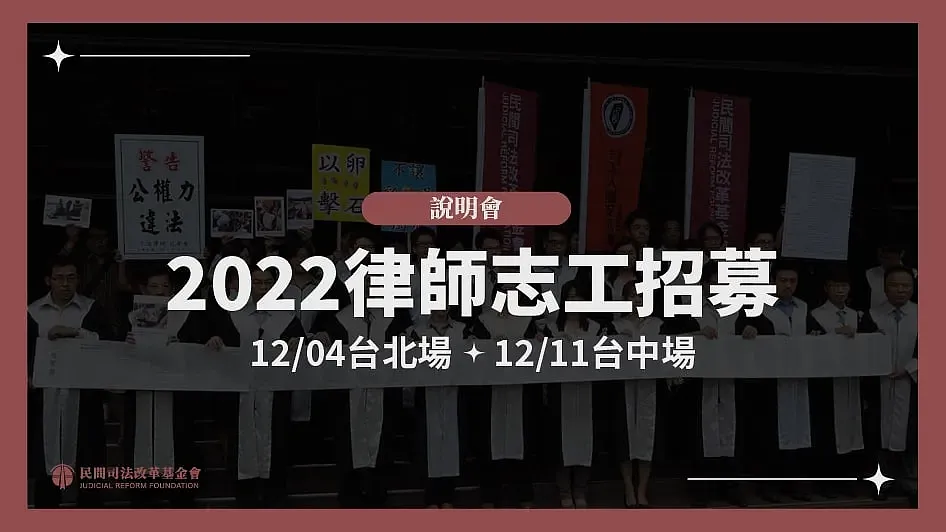
2022 Volunteer Attorney Recruitment Information Sessions
Last edited: 2026-08-30
Have you heard of the Judicial Reform Foundation? Do you know what we do?
Would you be willing to set aside a little time to learn about the reform projects the JRF is working to unlock?
As a professional reform organization, the JRF has accumulated more than 25 years of practical experience. From campaigning to put judges' nameplates on the bench, to building systems for evaluating judges and prosecutors and establishing the Complaint Center, our goal has remained the same: a justice system worthy of public trust. We want to become an even more influential civil-society platform-one that helps everyone in Taiwan enjoy the right to a fair trial as naturally as breathing; provides sustained oversight so that those who hold power cannot abuse it; and encourages the justice system to acknowledge its own imperfections, correct wrongful convictions, and keep improving its institutions.
We invite you to join this civil-society effort and help turn that vision of justice into reality.
To make participation easier for attorneys around Taiwan, this year's information sessions will be held simultaneously in person and online.
December 4 - Taipei Session
Li Ming-Ju Staff Attorney, JRF
SpeakersHuang Hsu-Tien Standing Director and Standing Executive Committee Member, JRF
Lin Chun-Hung Convener, JRF Case Assistance Division
Shih Hung-Cheng Convener, JRF Evaluation Division
Lu Cheng-Yen Staff Attorney, JRF
- Time: December 4 (Sat.), 10:00 a.m.-12:00 p.m.
- Venue: JRF Taipei Office
December 11 - Taichung Session
Li Ming-Ju Staff Attorney, JRF
SpeakersLin Chih-Chung Board Member, JRF
Li Hsuan-Yi Standing Committee Member, JRF
Lin Tzu-Cheng Standing Committee Member, JRF
Tien Yung-Pin Standing Committee Member, JRF
Lu Shao-Wei Standing Committee Member, JRF
Lin Chun-Hung Convener, JRF Case Assistance Division
- Time: December 11 (Sat.), 2:00-4:30 p.m.
- Venue: JRF Taichung Office
Specialized Project Groups
| Project | Convener | Objective |
| Criminal Procedure Reform | Lin Chun-Hung |
Develop legislative proposals and oversight recommendations concerning substantive criminal law, criminal procedure, and related institutions. [Issues and Actions]
|
|
Civil Society Coalition for Monitoring the Citizen Judges Act |
Lin Yung-Sung Lin Chun-Hung |
The coalition monitors the Judicial Yuan's citizen-judge mock trials, supporting measures, and implementing regulations and develops oversight strategies so that the Citizen Judges Act can fulfill its institutional purposes when it takes effect in 2023. [Issues and Actions]
|
| Forensic Science Promotion Alliance | Lo Shih-Hsiang | The National Conference on Judicial Reform resolved that Taiwan should establish a national Forensic Science Commission. Comparable specialized institutions exist in Europe, the United States, Japan, and South Korea, but Taiwan has yet to implement the resolution. The alliance has therefore drafted an Organic Act of the Forensic Science Commission and proposed amendments to the expert-evidence provisions of the Code of Criminal Procedure, with the goal of creating a specialized forensic-science institution and a clearer, more reliable criminal-forensics system. |
| Correctional System and Drug Policy Reform |
Lo Shih-Hsiang Lin Chun-Hung |
To promote more rational correctional institutions and drug policy, this group studies laws affecting people in custody, including the Prison Act, Detention Act, and the proposed Enforcement Act for Accommodation and Rehabilitation at Juvenile Correctional Institutions. It also follows legislation, constitutional review, and Grand Chamber developments concerning drug control and education and conducts public education and advocacy. [Issues and Actions]
|
| Prosecutor-Police Reform |
Chang Ching Cheng Wen-Lung |
This group develops reforms addressing police performance metrics, cooperation between police and prosecutors, and the burden placed on frontline police by large numbers of pseudo-criminal cases. [Issues and Actions]
|
| Reducing Judicial Workload and Improving Judicial Quality | Lin Yung-Sung |
This group examines rules and practices that reduce judicial efficiency and develops amendments to the Code of Criminal Procedure and related prosecutorial guidance so that unnecessary procedures can be streamlined and demands on judicial personnel, resources, and time can be reduced. [Issues and Actions] Review Code of Criminal Procedure provisions on non-transfer of suspects caught in flagrante delicto, the scope of non-prosecution and deferred-prosecution dispositions, and use of records of oral pronouncement in place of full written judgments in appropriate summary proceedings. |
| Crime Victims' Rights Protection | Lin Yung-Sung |
Together with civil-society organizations, scholars, and attorneys concerned with crime victims' rights, the JRF formed the Taiwan Crime Victims' Rights Alliance and prepared a comprehensive civil-society draft of the Crime Victim Rights Protection Act. Legislative advocacy is ongoing. In addition to eliminating the existing subrogation mechanism, the draft redesigns victim-support organizations with the goals of greater independence and professionalization. [Issues and Actions]
|
| Case Assistance Division | Lin Chun-Hung | Review final criminal convictions for possible wrongful convictions and provide legal assistance. Experienced wrongful-conviction attorneys lead case discussions, identify key causes of error, pursue remedies such as retrial and extraordinary appeal, and use individual cases to identify systemic problems. Previously exonerated cases include Hsu Tzu-Chiang, Su Chien-Ho, and Chiang Kuo-Ching. Current assisted cases include Chen Ching-Kai, a former national handball player accused of feigning blindness to commit insurance fraud, and Lo Ming-Tsun, whose case involves a late prosecutorial appeal. |
| Individual Evaluation of Judges and Prosecutors |
Allen Li Shih Hung-Cheng |
This group handles complaints involving judges or prosecutors alleged to have poor courtroom demeanor, violate procedural requirements, or breach professional duties. Following the 2019 amendments to the Judges Act, members of the public may file evaluation petitions directly. The group continues to help people understand and use the Judge Evaluation Committee and Prosecutor Evaluation Committee systems, petition the Control Yuan where appropriate, monitor implementation of the new individual-evaluation framework, advocate broader evaluation reform, and scrutinize judicial quality. |
| Non-Disclosure of Investigations | Shih Hung-Cheng |
To promote compliance with the principle of non-disclosure of investigations, this group has long monitored prosecutorial, police, investigative, and supporting agencies and helped prompt the March 2019 amendment of the Regulations Governing Non-Disclosure of Investigations. Two years after the amended rules took effect, the group continues to review media reports each month for suspected violations and sends formal letters requesting investigation and corrective action. [Issues and Actions]
|
| Constitutional Litigation |
Chou Yu-Hsiu Kao Yang-Hui |
When a complaint reveals a potentially unconstitutional law or regulation, the group evaluates the issue and, where appropriate, assists with constitutional litigation while also considering legislative reform. [Issues and Actions] Assist Tai Li-Shen with constitutional review and provide legislative comments and public advocacy concerning whistleblower-protection legislation. |
| Chiu Ho-Shun Case Assistance | Yu Po-Hsiang | In addition to assisting Chiu Ho-Shun individually, this group studies the systemic problems exposed by his case and seeks public support through Control Yuan petitions, seminars, and invited lectures. The legal team includes a retrial group examining defects in the scientific evidence and seeking new examinations, and a constitutional-litigation group challenging four issues: handcuffing during investigation, courts' and prosecutors' control over expert evidence, judicial distortion of evidence, and failure of judges to recuse. |
| Rule-of-Law Education |
Huang Hsu-Tien Lin Chien-Hung |
With the Citizen Judges Act scheduled to take effect in 2023, the JRF developed a campus citizen-judge mock-trial curriculum that adapts common criminal cases into short courtroom scripts. Students role-play citizen judges, prosecutors, attorneys, defendants, and witnesses, while another group acts as shadow deliberators. Through examination and cross-examination and the later deliberation process, students learn the presumption of innocence and the principle that factual findings must be based on evidence. The JRF also continues to develop teaching materials, train seed instructors through workshops and case discussions, monitor implementation of the citizen-judge system, and prepare to publish its experience with citizen participation in trials for use by schools and volunteer attorney instructors. |
| International Cooperation | Wang Lung-Kuan |
Promote alignment of Taiwan's judicial and human-rights environment with international standards, increase international visibility for Taiwan's judicial-reform experience, and advance human-rights and rule-of-law diplomacy so that Taiwan can contribute more to regional human-rights development. Core missions:
|
| Technology-Assisted Investigation Act Working Group | Lin Chun-Hung |
The Ministry of Justice released a draft Technology-Assisted Investigation Act on September 8, 2020, but important questions remain concerning investigative methods, technical safeguards, and the surrounding regulatory framework. The group brings together legal and technology specialists to prepare a civil-society draft and organize public discussions aimed at building a more sound system for technology-assisted investigation. [Issues and Actions] Prepare a civil-society draft and organize forums on the Technology-Assisted Investigation Act. |
| Judges Act Reform | Huang Hsu-Tien |
Against the backdrop of the first anniversary of the new individual-evaluation system, a decade since the Judges Act took effect, and judicial-ethics concerns exposed by the Weng Mao-Chung case, this group comprehensively reviews current rules on judicial ethics, accountability, administrative supervision, individual evaluation, and comprehensive evaluation and prepares proposed amendments to the Judges Act. [Issues and Actions]
|
| State Compensation Law Amendment Working Group | Chiang Jung-Hsiang |
On September 2, 2021, the Executive Yuan approved the Ministry of Justice's proposed amendments to the State Compensation Law and sent them to the Legislative Yuan. The current law has only 17 articles and no chapters; the Executive Yuan draft expands it to 43 articles in four chapters: General Provisions, Compensation Procedure, Recourse Procedure, and Supplementary Provisions. Because the overhaul could significantly affect individual rights, government operations, and the structure of state liability, the JRF established a working group to examine both the Executive Yuan draft and practical problems in existing state-compensation cases and to develop civil-society amendments or recommendations. [Issues and Actions]
|
This article is an AI-generated translation of the original Chinese text. In the event of any discrepancy, the Chinese version shall prevail.