
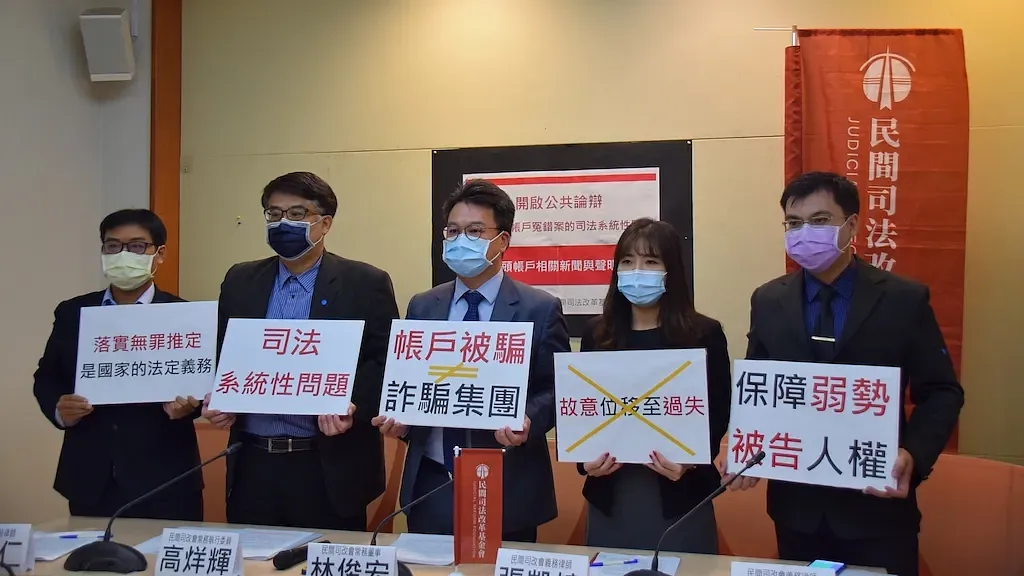
Opening Public Debate and Confronting Systemic Problems in Wrongful Dummy-Account Cases | JRF Response to Media Reports and Statements
Last edited: 2026-08-30
Beginning October 29, the JRF Taichung Office sent letters to prosecutors offices and courts nationwide under the heading "Dummy Accounts: Courts and Prosecutors, Please Listen to Civil Society." The letters urged prosecutors to confront a systemic human-rights problem: indicting people in dummy-account cases even when evidence of subjective criminal intent may be insufficient. The initiative drew attention from the media and the judiciary. We therefore clarify inaccurate reporting and respond to the views that have been raised.
-
The JRF Has Never Argued That All Dummy-Account Defendants Should Be Acquitted
On November 9, the China Times published a report titled "JRF Calls the Shots, Urges Acquittals in Dummy-Account Cases," accusing the Foundation of "intimidating judicial officers," "calling the shots," and "interfering with judicial independence." Those accusations materially mischaracterize the letters we sent to courts and prosecutors offices.
The JRF provided information from actual dummy-account cases in order to prevent wrongful convictions and asked the relevant institutions to take those cases seriously. We did not argue that every dummy-account case should result in acquittal. The letters were posted on the JRF website immediately after they were sent and were also provided to the China Times reporter before publication. The resulting article nevertheless seriously misunderstood their content and should be corrected.The report also built on that misunderstanding to mischaracterize a ruling of the Supreme Court Criminal Grand Chamber, creating a risk of misleading the public about the law. That point should likewise be corrected.
-
Implement the Presumption of Innocence and Confront the Systemic Problems Revealed by Dummy-Account Cases
Internet fraud has become rampant. Fraud rings commonly use job advertisements, loan applications, mobile-phone plans, and online shopping to obtain bank accounts or phone numbers and then use those accounts or numbers to defraud other people. Many of the people whose accounts are obtained are economically vulnerable or inexperienced young people.
To show that this is not merely a collection of isolated cases, beginning in the second half of last year the JRF worked with pro bono attorneys to compile divergent first- and second-instance judgments in dummy-account cases nationwide from 2019 onward, and reported the issue to the National Human Rights Commission as a systemic human-rights problem. In the first half of this year, we also collected and analyzed indictments in dummy-account and dummy-SIM cases that had resulted in acquittals at both the first and second instances since 2019 and organized a public forum. The research showed a recurring tendency in practice to infer "intent" from circumstances and treat people who were themselves deceived into providing accounts as having intent to aid fraud. They may then be prosecuted and convicted as aiders of fraud-and increasingly as aiders of money laundering, which carries heavier penalties-or forced to compensate other victims. The result can be one vulnerable group bearing the losses of another. The deeper legal concern is that a mental element that should amount to criminal intent under the Criminal Code may be lowered toward something resembling negligence. The JRF has received repeated complaints from people who believe this has produced wrongful convictions.
These cases become a systemic problem when "presumed intent" is used routinely and defendants also face practical pressure to plead guilty because maintaining innocence makes probation harder to obtain. Some people may therefore admit to being accomplices simply to end the case. This cannot fairly be blamed on individual judges or prosecutors. It requires reconsideration at the level of criminal-justice policy: when it is genuinely difficult to distinguish someone who was deceived from someone pretending to be a victim, how should culpability be determined? Can courts, prosecutors, financial institutions, and other agencies work together to reduce that uncertainty rather than resolving it through assumptions against defendants?
Some fraud-ring participants undoubtedly pretend to be victims in order to escape liability. But there are also people who truly were deceived into handing over their accounts and were then mistakenly treated as accomplices or aiders. Starting from those facts, we ask both the public and the justice system to see the vulnerable people who may be innocent rather than leaving them forgotten at society's margins.
-
Response to the Judges Association: Public Debate Should Continue
The Judges Association argued that the JRF's letters to courts amounted to "bringing out the Control Yuan to intimidate judges so that the scales of justice can tilt only toward acquittal," interfered with judicial independence, and represented an effort to "play overtime outside the courtroom or dictate the rules of the game." It urged the JRF to return to case-specific advocacy in court. We respectfully disagree.
In an open and pluralistic democracy, judicial independence is not founded on unquestionable authority. It is strengthened when courts can answer criticism through reasoned decisions. Judicial legitimacy likewise does not depend on the premise that courts are always right, but on the judiciary's willingness to recognize errors by the state-and, when necessary, its own. Public debate and communication, together with careful judicial reasoning that engages with and accepts or rejects competing views, are among the few ways the judiciary can meaningfully communicate with society. That dialogue is part of the judicial function.
Courts and members of the public live in the same social reality. Judicial interpretation should therefore understand the conditions of social life before independently applying law in individual cases. By compiling empirical data and judgments and offering an evaluation for judicial reference, the JRF is asking only that diverse perspectives in society have a possibility of being heard. We speak because the systemic practice in some dummy-account cases appears to shift the standard for subjective intent from intent toward negligence, causing the scales of justice to tilt structurally toward conviction. Civil society has a legitimate role in identifying that problem and initiating dialogue.
Every decision made by investigative and judicial institutions exercising state power-large or small-has profound consequences for ordinary people who enter the justice system. Since 2014, many complainants have come to the JRF saying they were wrongfully accused. A substantial number had already pleaded guilty or settled for practical reasons. Telling us of their disappointment and confusion with the justice system was sometimes the last, fragile effort they felt they could still make.
Preventing wrongful convictions and using judicial resources responsibly should be a shared goal of the JRF and the justice system. We will continue conveying civil-society concerns from the standpoint of protecting individual rights. We also welcome the Judges Association's participation in public debate and hope that the problem of wrongful dummy-account convictions can become the subject of sustained and serious social dialogue.
Attendees
Attorney Lin Chun-Hung / Standing Director, Judicial Reform Foundation
Attorney Kao Yang-Hui / Standing Executive Committee Member, Judicial Reform Foundation
Attorney Chang Kai-Ting / Pro Bono Attorney, Judicial Reform Foundation
Attorney Li Jui-Jen / Pro Bono Attorney, Judicial Reform Foundation
Attorney Kao Pei-Heng / Pro Bono Attorney, Judicial Reform Foundation
Press Contact
Li Ming-Ju / Staff Attorney, Judicial Reform Foundation
This article is an AI-generated translation of the original Chinese text. In the event of any discrepancy, the Chinese version shall prevail.