
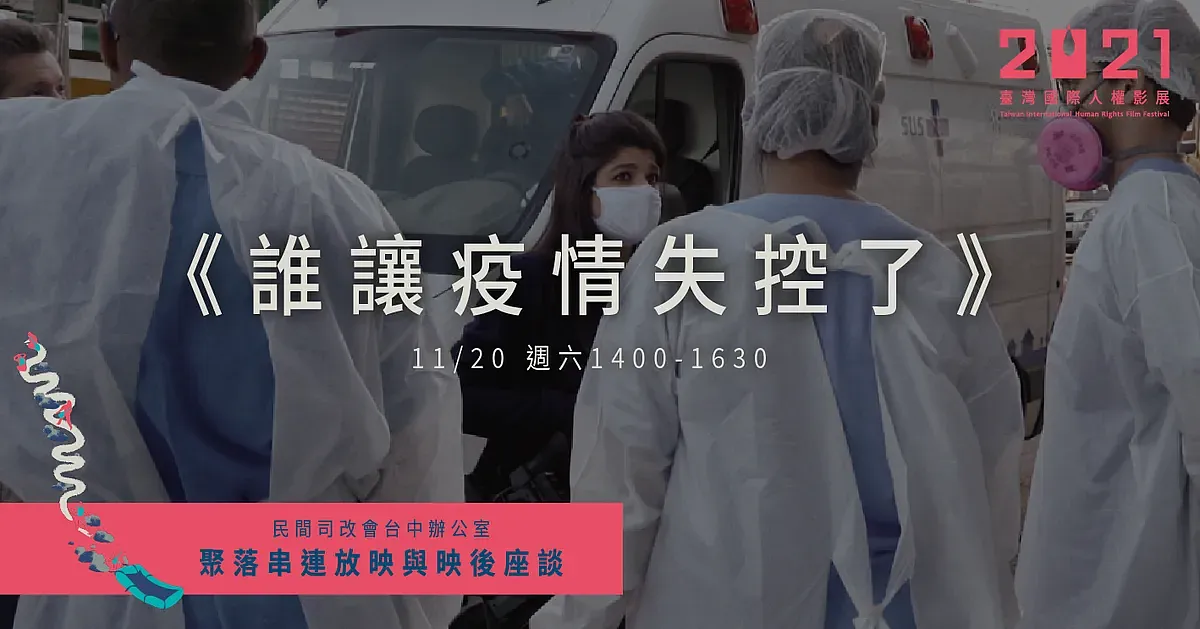
Post-Screening Discussion | 2021 Taiwan International Human Rights Film Festival: Sieged: The Press vs. Denialism
Last edited: 2026-08-30
As COVID-19 swept through Brazil and two health ministers left office in succession, the country faced a public-health crisis with no clear direction and cemeteries filling with new graves. President Jair Bolsonaro repeatedly denied the seriousness of the pandemic, refused reporters' questions, and accused the media of spreading fake news. Faced with mounting deaths and grief, government denial, and an online flood of conspiracy theories and false information, how could Brazilian journalists defend the responsibilities of the press amid hostility, isolation, and misunderstanding?
▮ Caio CAVECHINI
▮ Brazil
▮ 2020 | Color | 117 min.
Post-Screening Discussion
▮ Time: November 20, 2021 (Sat.), 14:00-16:30
▮ Moderator: Chang Hua-Che / Legal Specialist, JRF Taichung Office
▮ Speaker: Attorney Lin Tzu-Cheng / Standing Executive Committee Member, Judicial Reform Foundation
▮ Transcript: Lin I-Hsuan / Department of Law, Providence University; JRF Intern
Discussion Transcript
Chang Hua-Che
During the March 18 Movement, when police began dispersing people and members of the media, students shouted, "The media stay! The media stay!" What role does the press actually play in a social movement? It is a question we rarely discuss. Today, using *Sieged: The Press vs. Denialism* as our starting point, we have invited Attorney Lin Tzu-Cheng to talk with us about it. I'll turn things over to him.
Lin Tzu-Cheng
Thank you all for coming. As Hua-Che just mentioned, my background is in law. This film deals with the media, the pandemic, and Brazilian politics, and honestly much of that is outside my professional expertise. So I see myself less as a lecturer today than as someone sharing impressions after the film. We are a relatively small group, and I hope we can actually exchange ideas. Later I'd like to invite people in the audience to share your own thoughts too. There is no pressure-if you want to speak, please do; if you would rather listen, that is completely fine.
Because I'm today's speaker, this was my second time seeing the film, and I noticed some details I missed the first time. The Chinese title is *Who Let the Pandemic Get Out of Control?*, which makes the film sound like an indictment of the Brazilian government, especially the President's policies. The English title, *Sieged: The Press vs. Denialism*, points to the central confrontation: on one side, journalists; on the other, a president who rejects scientific, medical, and public-health advice, refuses to face the reality before him, and attacks people who challenge his account of events. In that sense, the film is about the press confronting denialism.
The film moves quickly among several news organizations whose reporters do very different kinds of work. Some go to cemeteries and interview gravediggers; some speak with families at hospitals; others cover politics and record exchanges between the President, reporters, and his supporters outside the presidential residence. The director is himself a journalist, and that gives the film an unusually close view of Brazil's media environment. Over the year covered by the documentary, Brazil experienced enormous upheaval in public health, politics, and the economy. We see the President repeatedly dismiss scientific evidence and expert advice. Two health ministers with medical and public-health backgrounds left office. The film does not go into what happened next, but I later read that the third minister was a military officer rather than a specialist in the field; the President, who also came from the military, appeared to prefer someone willing to carry out his approach. The journalists in the film likewise face sustained hostility from presidential supporters, including attacks and threats. So another important theme is the physical safety of media workers.
 Still from *Sieged: The Press vs. Denialism*, courtesy of the Taiwan International Human Rights Film Festival

The film also makes me think about the example Hua-Che mentioned at the beginning. When protesters about to be removed from a site ask the media to stay, that reflects, at least in part, distrust of government. They fear that if no one is watching, the authorities may do things they would hesitate to do in front of cameras. The press is expected to remain as a witness and record what happens. When citizens confront the state, the presence of journalists can constrain public power because officials know that their conduct may later be reported, questioned, or criticized. That watchdog function is one important reason the media matter.
At the same time, Taiwan has had its own disputes over the boundary between press freedom and government regulation-for example, the rejection of CTi News's license-renewal application. I have not studied that matter closely enough to offer a firm conclusion, but it raises the same difficult question. From President Bolsonaro's perspective, and from the perspective of his supporters, hostile media outlets are simply spreading lies. His response was openly confrontational: attack the press and, through government policy, sometimes delay or withhold information so that journalists have greater difficulty doing their work. What would the comparable line look like in Taiwan? I think that is worth reflecting on.
There is another side to the story. Protesters may insist that journalists remain on the scene, yet people in Taiwan also joke, "If you don't study when you're young, you grow up to be a journalist." The joke reflects a widespread belief that reporters can be careless, produce poorly researched stories, or publish things that are hard to take seriously. Taiwan therefore does not have a simple media story. We criticize the quality of some reporting while still relying on journalists to organize and verify information we need. Before coming today, I checked several international press-freedom rankings. Taiwan was roughly around fortieth globally and among the better performers in Asia, while Brazil was far lower. I also compared the death toll described in the film with population size. Brazil's pandemic was extraordinarily severe. The documentary's argument is that at least some deaths may have reflected not only the virus itself but also failures of public policy.
 Still from *Sieged: The Press vs. Denialism*, courtesy of the Taiwan International Human Rights Film Festival

Most of the students and friends here are quite young. Taiwan once had bans on political parties and on new newspapers-things many of you may know only from textbooks. I did not really experience that era either; by the time I was old enough to understand politics, Taiwan was already moving toward democratization. Martial law was lifted only in 1987, and restrictions on newspapers were lifted in 1988. So as of 2021, Taiwan had enjoyed this degree of press freedom for only about thirty-three years. If we measure democratic development from the first direct presidential election in 1996, that history was only twenty-five years old. These institutions are younger than we sometimes imagine.
I mention that because Taiwan certainly still has problems. Some resemble Brazil's and some do not. But historically, Taiwan made enormous progress in just two or three decades. The film also spends a great deal of time on false or misleading information, which can come from media organizations or from government itself. The documentary plainly criticizes President Bolsonaro for statements such as treating chloroquine as an effective cure or dismissing COVID-19 as little more than a minor cold.
Let me give a more personal example. One journalist in the film lost his father and says he devotes enormous effort to combating false information because misinformation can literally kill people. No one in my family died from COVID-19, fortunately. But over the past six months I have watched Taiwan debate vaccines intensely. Based on the information I considered reliable, my own conclusion was simple: getting vaccinated was better than remaining unvaccinated, and getting vaccinated sooner was generally better than waiting; the brand mattered less. Yet many news outlets devoted extensive coverage to possible adverse reactions and differences among vaccine brands. Some older relatives in my family absorbed those stories and became afraid to be vaccinated. I encouraged one of them to get a shot but did not want to start a family argument. The point is that media framing can directly affect ordinary people's health decisions. Older people face greater risks from COVID-19, often together with chronic conditions, yet reports about suspected adverse events did not always make clear whether scientific evidence actually established a causal relationship with vaccination. In my view, some reporting overstated the danger without adequately communicating that uncertainty. That may not be the only reasonable view, but I offer it for discussion.
As I said, I hope everyone will share your own views too. Taiwan's education system does not always encourage people to speak in public, but I am speaking today simply as an ordinary person, not as a media expert. The issues affect all of us. The grief shown in the film-the families who lost people during the pandemic-is unmistakably real. Taiwan's situation was comparatively stable by then, but the risk had not disappeared. We can discuss the pandemic or the media; either way, the film belongs in a human-rights festival under the theme of democracy. Brazil had an elected president whose governance and rhetoric were extremely controversial. In a democracy, how should citizens respond to a political leader who attacks the press or dismisses criticism? Taiwan has also had political figures who attack particular media organizations, spread accusations, or mobilize supporters' hostility without seriously answering the questions raised against them. That is why I think the film gives audiences in both Brazil and Taiwan something important to consider.
Let me offer a few questions for everyone to think about. Suppose you are in government-or support the governing party-and believe a media outlet is publishing reports that are unfair or false. What should you do? If government is going to punish misinformation or "fake news," how could that be done without damaging freedom of expression?
Conversely, if you are a journalist facing direct government attacks-imagine being a reporter in Brazil while the President publicly calls Globo worthless or "garbage media"-how should you defend your work and evaluate the government's accusations? And as citizens, how should we judge that conflict? I do not think any of these questions has a simple answer. I am just putting them on the table for discussion. I'll stop there for now.
 Still from *Sieged: The Press vs. Denialism*, courtesy of the Taiwan International Human Rights Film Festival

Chang Hua-Che
Let me respond briefly, and then I want to hear from everyone else. I kept thinking about Hong Kong's anti-extradition movement only a year or two earlier. Apple Daily occupied a difficult position somewhat analogous to Globo in the film: caught between the government and a large part of the public. During the protests it used its reach to report on the conduct of police and government and tried, at least from its own perspective, to explain events to the public. Yet Hong Kong authorities later searched Apple Daily's offices. Next Digital in Hong Kong also had investments in Taiwan's Apple Daily, and Taiwan received requests connected with efforts to freeze or preserve assets as Hong Kong pursued criminal and civil liability. Whatever one thinks of Apple Daily, the episode raises the question of what happens when a media organization that sees itself as resisting government power is ultimately treated by the state as a wrongdoer: executives are imprisoned, offices are searched, and assets become targets of legal proceedings.
If something comparable happened in Taiwan, people might think of the recent CTi News controversy and the loss of its broadcasting license. Public opinion was sharply divided. I do not think the important question is simply which side is "right." As citizens living amid an explosion of information-different platforms, different sources, and an endless stream of material-how do we distinguish what is reliable from what is false? And when we choose information, do we first recognize the perspective from which it was produced, rather than assuming every report is purely objective?
I have kept thinking about that question from the Hong Kong protests, through the CTi News controversy, and now through this film. When we were students, media stories about so-called "dinosaur judges" were everywhere. Lawyers would read some of those reports closely and think the media had distorted the case, so our impression of journalism could be quite negative. Yet over time I also came to recognize how important the press has been-before the lifting of martial law and in major events ever since. That tension is what I find interesting.
Participant A
I'll share one experience. I once bought two newspapers and compared how they reported the same event, and their accounts did not match. One story involved delayed documents at the Taichung City Government. One paper claimed that members of the public had obtained an internal memo, but an internal memo is not something an ordinary citizen would normally see, so I wondered whether the report was simply wrong. I have also compared television channels covering the same dispute. In one case involving a fish farm and a drainage or waterway problem, one station reported that government staff had already arrived to assist, while another said no one from the government had arrived. Which account was true?
I feel the quality of Taiwan's media often falls short of what we saw from the Brazilian journalists in the film. There are now more independent or self-operated media outlets in Taiwan, and I increasingly rely on some of them. I still watch mainstream media, but I filter what I see. False information is widespread, and media organizations sometimes publish things that are simply inaccurate. Public Television Service, for example, has produced media-literacy videos explaining ways to assess a news item's credibility, such as checking whether an article identifies a responsible editor or author. Those are some of the methods I now use.
Participant B
I want to emphasize the harm false information can cause in private life. In my family, older relatives-roughly fifty-five to eighty years old-receive messages through LINE groups constantly, morning, noon, and night. At first, as their children or grandchildren, we try to explain why a claim is misleading. But one person is effectively arguing against an entire age group and its information network. Vaccine side effects can exist, and people can consult doctors about them. The problem is that when alarming claims are repeated over and over, our attempts to correct them become quieter and quieter. The social effect can be enormous even if the messages never appear in mainstream or independent media. They circulate in private groups, move around any attempt to interrupt them, and over time can become deeply entrenched.
 Still from *Sieged: The Press vs. Denialism*, courtesy of the Taiwan International Human Rights Film Festival

Lin Tzu-Cheng
Exactly. You know what information your relatives are receiving only because you happen to be in the same group. If we are not inside that information network, we may see only the conclusions-for example, a view about vaccines or a political party-without knowing how the person reached them. When our information environments are completely different, meaningful communication becomes much harder.
There is probably also a generational gap in how people process and verify information. Younger people may have more ways to cross-check a claim, while an older relative may rely heavily on a particular LINE group or television channel. I do not think the media have to be without a point of view. A media outlet can have a position, as long as we recognize that position and evaluate it critically. But whatever its perspective, the underlying facts should at least be accurate.

This article is an AI-generated translation of the original Chinese text. In the event of any discrepancy, the Chinese version shall prevail.