
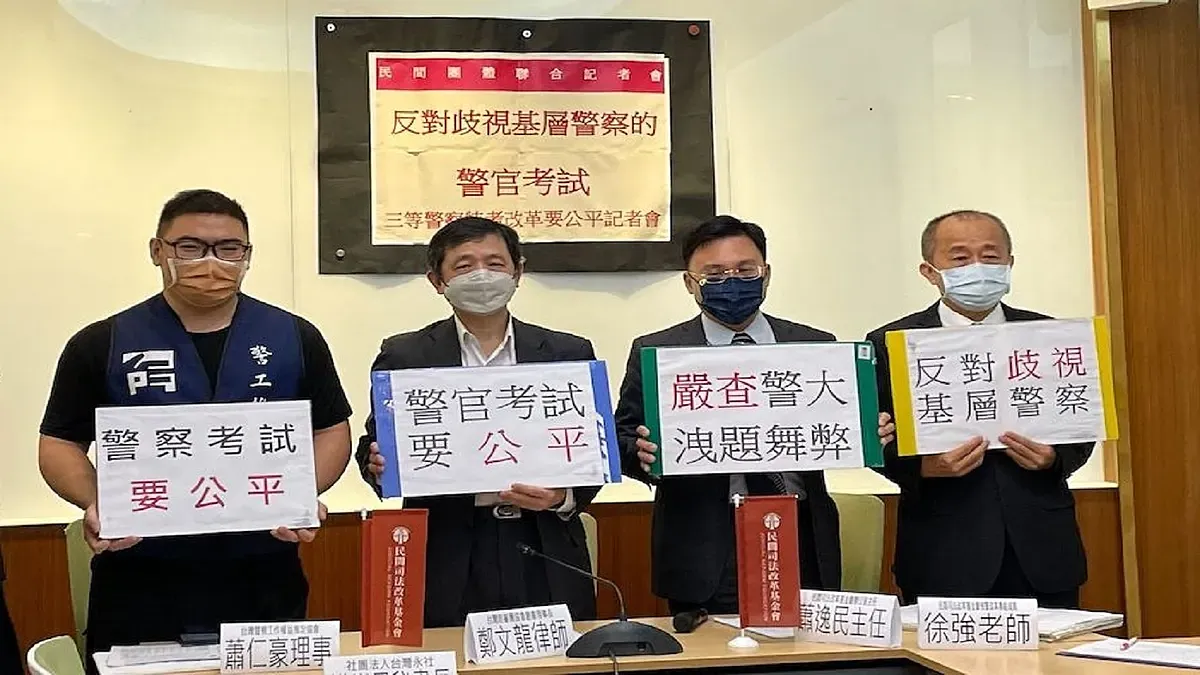
Press Conference | Reform the Police Grade Three Special Exam Fairly-Do Not Discriminate Against Rank-and-File Officers
Last edited: 2026-08-30
The fairness of the Police Grade Three Special Exam has been questioned for years. In recent years, Central Police University (CPU) has also been hit by repeated cheating scandals in which professors involved in preparing examination questions leaked information to students, leading the Control Yuan to impeach personnel involved on two separate occasions. Reform of the examination can no longer be postponed.
According to internal CPU statistics, the success rate of in-service rank-and-file officers in the Police Grade Three Special Exam fell sharply beginning in 2019, leaving rank-and-file officers who were not CPU graduates as little more than also-rans. Concerned about the fairness of the examination, the Judicial Reform Foundation, Taiwan Jury Association, Taiwan Police Union, and other civil-society organizations jointly call for the following:
- The Examination Yuan should investigate the sharp decline in the number of in-service rank-and-file officers passing the examination in recent years, promptly explain the situation to the public, and ensure the fairness of the Police Grade Three Special Exam.
- The Examination Yuan should reject CPU's examination-reform proposal that discriminates against rank-and-file officers, solicit views broadly, and develop a police examination system that is both fair and professionally sound.
I. In-Service Officers Reduced to Also-Rans: The Fairness of the Police Grade Three Special Exam Is in Doubt
The Police Grade Three Special Exam is commonly described as the "internal-track" examination. Successful candidates obtain eligibility for appointment in the Police Inspector ranks and may be assigned to sub-lieutenant positions. The examination therefore helps determine which police personnel can move into supervisory positions with decision-making authority, with significant implications for police culture, criminal-justice policy, and public-safety policy in Taiwan.
Eligibility for the Police Grade Three Special Exam can be divided broadly into two groups: (1) graduates of CPU's four-year undergraduate program ("CPU graduates"); and (2) in-service rank-and-file police officers[1]. Table 1 summarizes CPU research on the share of successful candidates who were CPU graduates from 2012 through 2020. The data in that report show a sharp decline beginning in 2019 in the share represented by rank-and-file officers, even though the examination itself had undergone no corresponding major change. The main change identified by CPU was that pension reform slowed retirements, reducing the total number of successful candidates from nearly 400 to around 300. While the reported performance of rank-and-file officers appeared to deteriorate suddenly, the number of successful CPU graduates remained close to 300.
| Year | Applicants | Successful Candidates | Successful CPU Graduates | Overall Pass Rate | CPU Graduates as a Share of Successful Candidates | Rank-and-File Officers as a Share of Successful Candidates |
| 2012 | 3725 | 413 | 304 | 11.09% | 73.61% | 26.39% |
| 2013 | 3523 | 437 | 285 | 12.40% | 65.22% | 34.78% |
| 2014 | 3095 | 411 | 293 | 13.28% | 71.29% | 28.71% |
| 2015 | 3114 | 398 | 298 | 12.78% | 74.87% | 25.13% |
| 2016 | 2954 | 413 | 301 | 13.98% | 72.88% | 27.12% |
| 2017 | 3014 | 434 | 296 | 14.40% | 68.20% | 31.80% |
| 2018 | 3066 | 410 | 289 | 13.37% | 70.49% | 29.51% |
| 2019 | 2455 | 311 | 294 | 12.67% | 94.53% | 5.47% |
| 2020 | 2238 | 300 | 279 | 13.40% | 93.00% | 7.00% |
| Source: Central Police University (July 2021), Research on Refinement Strategies for the Dual-Track Police Special Examination System, Tables 4-2 and 4-8. | ||||||
December 4 Update: In a November 30 press response the Ministry of Examination stated that CPU graduates and rank-and-file officers accounted for 74.28% and 25.72% of successful candidates in 2019, respectively, and 71.33% and 28.67% in 2020. Those figures differ substantially from the CPU research report cited above. After verification, the JRF concluded that the Ministry of Examination figures reflect the actual results.
After this year's results were announced, 171 members of CPU's graduating class passed the Police Grade Three Special Exam, a pass rate of 70.6%. In other words, current-year CPU graduates accounted for 61% of the 280 successful candidates (see Table 2). To make the overall distribution transparent, the relevant authorities should also disclose the results for CPU graduates from earlier years and clarify whether, as in the previous two years, CPU graduates as a whole again accounted for more than 90% of successful candidates.
These changes in the distribution of successful candidates reasonably raise questions about the fairness of the Police Grade Three Special Exam. As early as 2015, a Control Yuan investigation report on a CPU professor's leaking of examination questions questioned the way subjects were designed for the "internal-track" examination. The report observed, in substance, that the subjects were largely combinations of CPU courses rather than a mechanism for recruiting genuinely scarce specialist talent. It further warned that an examination structure in which only CPU faculty could realistically prepare and review the questions risked turning a national public examination from an open system into a closed one and undermining the equal right to take public examinations and hold public office. Regrettably, no effective institutional reform followed. In 2018, another CPU question-leaking scandal caused that examination to be invalidated, and the Control Yuan issued another investigation report on the CPU question-leaking case in February 2021.
Questions about the fairness of the Police Grade Three Special Exam have persisted for years. Civil-society groups have also received reports alleging unfair grading and instances in which obscure exam questions "coincidentally" matched reference books or materials assigned in CPU classes. Disciplinary Court judgments arising from the CPU question-leaking case (Case 1, Case 2[2]) likewise found that a CPU professor had directly disclosed examination content in class, showing that these concerns were not unfounded. J.Y. Interpretation No. 760 explains that, to guarantee equal opportunities to participate in public office, the state must establish an objective and fair public-examination system and guarantee the overall fairness of examination results. To protect the right to take public examinations on equal terms, the civil-society organizations call on the Examination Yuan to investigate and explain the sharp decline in the share of successful candidates who are rank-and-file officers and to act on the Control Yuan's recommendations for reform.
| CPU Department | Current-Year Graduate Applicants | Current-Year Graduates Passing the Grade Three Exam | Current-Year Graduates Not Passing the Grade Three Exam | Current-Year Graduates Passing the Grade Four Exam | All Grade Three Applicants | All Successful Grade Three Candidates | Overall Grade Three Pass Rate | Current-Year Graduate Grade Three Pass Rate | Current-Year Graduate Grade Three + Grade Four Pass Rate |
| Department of Administration Police | 34 | 20 | 8 | 6 | 1082 | 42 | 3.88% | 58.82% | 76.47% |
| Department of Criminal Investigation | 20 | 10 | 8 | 2 | 504 | 24 | 4.76% | 50.00% | 60.00% |
| Department of Public Security | 15 | 15 | 0 | 0 | 77 | 16 | 20.78% | 100.00% | 100.00% |
| Department of Crime Prevention and Corrections (Crime Prevention Group) | 15 | 11 | 3 | 1 | 166 | 16 | 9.64% | 73.33% | 80.00% |
| Department of Traffic Science (Traffic Group) | 15 | 10 | 4 | 1 | 148 | 16 | 10.81% | 66.67% | 73.33% |
| Department of Traffic Science (Telecommunications Group) | 10 | 10 | 0 | 0 | 13 | 10 | 76.92% | 100.00% | 100.00% |
| Department of Foreign Affairs Police | 15 | 13 | 2 | 0 | 54 | 16 | 29.63% | 86.67% | 86.67% |
| Department of Information Management | 19 | 13 | 4 | 2 | 106 | 22 | 20.75% | 68.42% | 78.95% |
| Department of Forensic Science | 16 | 13 | 3 | 0 | 55 | 16 | 29.09% | 81.25% | 81.25% |
| Department of Border Police | 10 | 9 | 1 | 0 | 69 | 10 | 14.49% | 90.00% | 90.00% |
| Department of Administrative Management | 14 | 10 | 4 | 0 | 99 | 15 | 15.15% | 71.43% | 71.43% |
| Department of Law | 15 | 13 | 2 | 0 | 166 | 17 | 10.24% | 86.67% | 86.67% |
| Department of Fire Science (Disaster Prevention Group) | 15 | 9 | 3 | 3 | 311 | 40 | 12.86% | 60.00% | 80.00% |
| Department of Fire Science (Firefighting Group) | 20 | 7 | 9 | 4 | 12.86% | 35.00% | 55.00% | ||
| Department of Maritime Police | 9 | 8 | 1 | 0 | 67 | 20 | 29.85% | 88.89% | 88.89% |
| Total | 242 | 171 | 52 | 19 | 2917 | 280 | 9.60% | 70.66% | 78.51% |
| Source: Internal statistics of Central Police University. "Current-year graduates" means graduates of the 86th cohort of CPU's four-year undergraduate program. | |||||||||
II. CPU's "Refinement Plan" Favors CPU Graduates and Discriminates Against Rank-and-File Officers
Instead of first resolving longstanding doubts about examination fairness, CPU has considered eliminating rank-and-file officers' eligibility to take the Police Grade Three Special Exam. On April 27, Examination Yuan President Huang Jung-Tsun led a 14-member delegation of Examination Yuan members and Ministry of Examination officials to CPU to review the university'sRefinement Plan for the Dual-Track Police Special Examination System. Because the plan proposed limiting eligibility for the Police Grade Three Special Exam to CPU graduates and removing eligibility for in-service officers (see Attachment 1, p. 6), President Huang directed that the proposal be studied further. CPU nevertheless submitted another report in July,Research on Refinement Strategies for the Dual-Track Police Special Examination System, presenting Options A and B. Its preferred Option A retained the same basic proposal, while adding Category 5 of CPU's Police Officer Training Program as an alternative route for rank-and-file officers who would otherwise lose eligibility for the Police Grade Three Special Exam (see Attachment 2, pp. 78-81). Faced with what was essentially the same proposal in a different form, the Examination Yuan resolved to ask the Ministry of Examination to continue studying the issue (see Minutes of the 47th Meeting of the 13th Examination Yuan, p. 8).
J.Y. Interpretation No. 760 explains that differential treatment involving the right to take public examinations and hold public office should, in principle, be subject to more stringent review. The purpose of the distinction must pursue an important public interest, and there must be a substantial connection between the differential treatment and that purpose. Under the current dual-track system, in-service rank-and-file officers cannot take the external-track Grade Three examination open to the general public. If CPU's "Refinement Plan" were adopted as well, they could lose access to the Police Grade Three Special Exam entirely, raising serious concerns under the constitutional right to take public examinations and hold public office on equal terms. Even if Category 5 of the Police Officer Training Program were offered as a substitute route, unequal protection compared with other Grade Three candidates would still raise equality concerns.
At an April 22 Ministry of the Interior meeting, the National Police Agency expressed a similar view: under the existing dual-track system, in-service officers cannot take the external-track Grade Three examination; further restricting eligibility for the internal-track Grade Three examination would severely damage morale among rank-and-file officers and widen the divide between officers and the rank and file. The NPA also warned that excluding in-service officers could conflict with the existing examination framework and raise concerns under the constitutional principles of equality and proportionality and the right to take public examinations and hold public office. To avoid creating the impression that the system unduly favors CPU graduates, it recommended retaining the existing examination and eligibility framework while improving the content and subjects of the examination.
One justification CPU offered for its "Refinement Plan" was that CPU graduates must compete on the internal track with approximately 2,500 rank-and-file officers who may have prepared for years, creating intense competition and substantial pressure on CPU students that in turn affects teaching quality. But a CPU graduate who does not pass the Police Grade Three Special Exam may still pass the Police Grade Four Special Exam, qualify for police service without having to repay the public funding received while studying at CPU, and continue preparing for the Grade Three examination. In 2021, all 19 CPU graduates who took the Grade Four exam passed. National examinations are competitive for everyone. Rank-and-file officers preparing for the Grade Three exam must do so while carrying demanding frontline duties. The examination system should therefore protect equal access to fair competition rather than respond to competitive pressure by excluding rank-and-file officers.
In summary, the Judicial Reform Foundation, Taiwan Jury Association, Taiwan Police Union, and other civil-society organizations oppose CPU'sRefinement Plan for the Dual-Track Police Special Examination Systembecause it is unfair to rank-and-file officers. In light of the sharp decline since 2019 in the number of rank-and-file officers passing the Police Grade Three Special Exam, we call on the Examination Yuan to investigate the reasons, explain the results to the public, and-consistent with the Control Yuan's recommendations-develop a police examination system that is both fair and professionally sound.
Notes
[1] In-service rank-and-file officers may qualify to take the Police Grade Three Special Exam through three routes: (1) graduation from CPU's two-year program while serving as an in-service officer; (2) holding a university degree and having passed the Police Grade Four Special Exam; or (3) having passed the Police Grade Four Special Exam and served as an officer for at least three years.
[2] Disciplinary Court Judgment No. 109-Cheng-3583 states, in substance: "(1) ... On the stated ground of giving encouragement to graduating students in CPU Department of Fire Science Cohort 83 and other examinees from the same department who had not yet passed the examination, the respondent instructed a research-project assistant to contact them through LINE and ask the former class representative of the Disaster Prevention Group to assemble the students. (2) After the examinees gathered in a CPU classroom at approximately 2:00 p.m. on June 1 of that year, the respondent instructed them not to take notes or make recordings and disclosed key points from the examination questions the respondent had seen while reviewing the questions ..."
Attachments
- Refinement Plan for the Dual-Track Police Special Examination System
- Research on Refinement Strategies for the Dual-Track Police Special Examination System
- Minutes of the 47th Meeting of the 13th Examination Yuan
Attendees
Cheng Wen-Lung / Founding Chairperson, Taiwan Jury Association
Hsiao I-Min / Office Director, Judicial Reform Foundation
Hsu Chiang / Member, JRF Prosecutor-Police Reform Working Group
Hsiao Jen-Hao / Board Member, Taiwan Police Union
Press Contact
Chen Yang / Legislative Researcher, Judicial Reform Foundation
This article is an AI-generated translation of the original Chinese text. In the event of any discrepancy, the Chinese version shall prevail.