
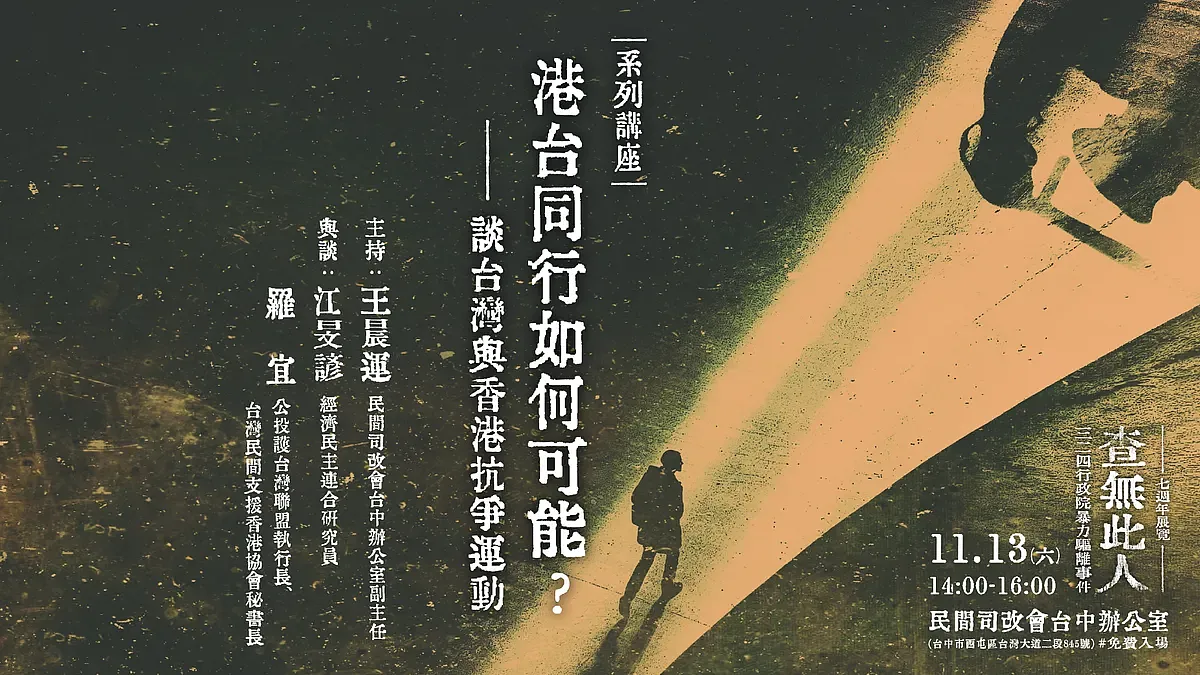
Seminar Transcript | Unidentifiable: How Is Taiwan-Hong Kong Solidarity Possible? Protest Movements in Taiwan and Hong Kong
Last edited: 2026-08-30
During the March 18 Movement, the relationship between protesters and police changed from moment to moment. At times crowds collectively thanked exhausted officers; at others, police protected protesters from gang members who had forced their way into the scene. But the night of March 24 also produced brutal images of officers striking people with batons and shields and stepping on them with police boots.
The *Unidentifiable* exhibition presents state violence that actually occurred in Taiwan seven years earlier and traces the different ways the movement continued to shape society. Around the world, resistance to abuses of state power has never stopped, and the protest movements of Hong Kong and Taiwan have remained especially closely connected.
As Hong Kong's anti-extradition movement approached its second anniversary, Taichung civil-society groups looked back to the "Stand with Hong Kong" rally organized in September 2019, which argued that people enjoying democracy and freedom in Taiwan should support Hongkongers seeking the same and should not leave Hong Kong to struggle alone. In April 2021, the Haomin Cultural Action Association also organized the Freedom Road Arts Festival, using performances, exhibitions, and talks to retell courageous stories that had become difficult to speak aloud and to support resistance and assembly in pursuit of justice and freedom of thought.
How can Taiwan and Hong Kong stand together, and what can people still do? We invited Chiang Min-Yen, a researcher at the Economic Democracy Union, and Lo I, Secretary-General of the Taiwan Association for Supporting Hong Kong, to discuss the protest movements in both places and the possibilities for continuing solidarity.
Unidentifiable: How Is Taiwan-Hong Kong Solidarity Possible? Discussing Protest Movements in Taiwan and Hong Kong
▮ Time: November 13, 2021 (Sat.), 14:00-16:00
▮ Moderator: Wang Chen-Yun / Deputy Director, JRF Taichung Office
▮ Speakers: Chiang Min-Yen / Researcher, Economic Democracy Union; Lo I / Chief Executive, Alliance of Referendum for Taiwan; Secretary-General, Taiwan Association for Supporting Hong Kong
▮ Transcript: Chen Wen-Hsuan / Intern, Department of Law, Providence University
Seminar Transcript
Wang Chen-Yun
Today we are discussing Hong Kong's protest movement, which also involves the problem of state violence. The anti-extradition movement erupted in 2019, and Taiwanese civil-society organizations have played various supporting roles since then. Two years later, what role can Taiwan still play? How should we understand what has happened to the movement in Hong Kong, and how can assistance continue?
We are very pleased to have two speakers with us: Chiang Min-Yen, a researcher at the Economic Democracy Union, and Lo I, Secretary-General of the Taiwan Association for Supporting Hong Kong. I'll turn the discussion over to them.
Chiang Min-Yen
Most of my advocacy work is based in Taipei. Sitting beside me is Lo I, Secretary-General of the Taiwan Association for Supporting Hong Kong. Since 2019, Lo I and I and others have gradually helped build a support system for participants in Hong Kong's movement who came to Taiwan, assisting them in settling and living here. From my perspective, the Hong Kong movement created an enormous ripple effect in Taiwan in 2019; Lennon Walls appeared on campuses throughout the country.
Through the networks around those Lennon Walls, we came to know many Hong Kong and Taiwanese students. National Taiwan University, for example, had a Taiwan-Hong Kong study group in which Taiwanese students kept reading about Hong Kong so that their understanding would be based not only on sympathy but also on accumulated knowledge.
The impact of Hong Kong on Taiwan has been much broader than I expected. I'm curious what brought each of you here today. Perhaps you had not paid much attention to Hong Kong before; perhaps over the past year or two you quietly took part in related actions or organizations in Taichung; perhaps your work now has some connection to Hong Kong; or perhaps you have another experience that made you want to understand the issue better. If not, that is fine too. I would simply like to use this opportunity to get to know the audience.
I grew up in Wuri, Taichung, graduated from Mingdao High School, and then went to university in Hong Kong. That experience is one reason I was able to become so involved so quickly in Taiwan's "Stand with Hong Kong" movement after 2019. If you are comfortable doing so, tell us about any related action you joined in Taichung, a Lennon Wall you encountered, or simply what you hope to hear today. I can then spend more time on the questions people actually care about.
I'm a student at Taichung Girls' Senior High School. I originally came to see the exhibition and decided to stay for the talk. I have not personally participated in related actions, but I have read reports comparing social-movement organizations in Hong Kong and Taiwan and became interested in their differences and effects.
Hello, I'm from Taichung. I only learned about this talk yesterday and decided to come listen. I had not followed the issue especially closely and only realized today that the topic was Taiwan and Hong Kong, so I wanted to stay and learn more.

I used to follow a lot of reporting on the anti-extradition movement. I also have friends who studied in Hong Kong, or who had to give up plans to study there because of what happened. I rarely have an opportunity to hear the movement explained in a more systematic way, so I wanted to stay and organize what I know.
I'm also from Taichung. From the Sunflower Movement through the anti-extradition movement, I have continued following reporting and online information. Because I have been interested in these issues for a long time, an event like this naturally made me want to come.
Since implementation of the Hong Kong National Security Law, Hong Kong has entered an extremely high-pressure period. I want to know what kinds of disagreements or exchanges emerge when young people from Hong Kong and Taiwan talk with one another under those conditions, how they understand Hong Kong's future, and what people can still do to keep the situation from deteriorating further.

I study sociology at Tunghai University. I did not pay much attention to this issue before, but I increasingly feel it matters, so after entering university I wanted to spend more time learning about and participating in social movements.

I also study sociology at Tunghai University. Human-rights issues are closely connected to what I study, so I naturally wanted to learn more. Most of my previous exposure has been to Taiwanese social movements, including the Sunflower Movement. With Hong Kong, I still feel more like an observer because I am not a Hongkonger and did not experience what happened directly. I want to hear how people in Hong Kong and Taiwan understand the movement differently.
I'm from southern Taiwan, but I'm a Hongkonger. I have participated in some activities in Taichung. Today's topic made me want to hear more about how people in Hong Kong and Taiwan can struggle alongside one another.
Hello, I'm also from Hong Kong. I'm glad to hear everyone's questions about the movements in Taiwan and Hong Kong and to think together about how we can keep moving forward.

I'm a second-year student in the humanities and social sciences program at Taichung Girls' Senior High School. When I think about Hong Kong issues, one person who comes to mind is our alumna Chang Pei-Hsin. I followed her on Instagram and saw many posts about Hong Kong.
At school, the anti-extradition movement also comes up often in reports and student research projects. I have seen classmates research Hong Kong law and related issues. Last week I also attended a talk at Taichung First Senior High School by someone who had moved from Hong Kong to Taiwan, so I heard quite a few first-hand experiences.
What struck me most was hearing that authorities in Hong Kong could label news they disliked as fake news and use that as a basis for suppression, while people might not know where the line for arrest was or what statement would cross it. To me, that sounded like a contemporary version of Taiwan's White Terror.

I'm a first-year student at Taichung Girls' Senior High School. I had previously encountered information about Hong Kong on Twitter, through hashtags, and in articles from *The Reporter*. Today I hope to hear the thoughts and experiences of people who actually participated in or became involved with the anti-extradition movement.

I'm also a first-year student at Taichung Girls' Senior High School. I have seen related discussions on Twitter and Instagram and read some newspaper coverage. I hope today's talk gives me a more complete understanding.

I study law at Providence University. The JRF previously came to our department to introduce its civic work and perspectives, so I thought this would be a good opportunity to listen and learn more, both legally and about current social issues.

I study social work at Chaoyang University of Technology. I had heard older relatives and friends mention today's issues but never understood them in much depth, so I came hoping to learn something new.
Chiang Min-Yen
Although I have participated in many Hong Kong-related movements, I still ask myself what my role has been: observer, participant, activist, or organizer?
Let me first introduce my own background and then discuss some of what I experienced. Later, if people have questions, I can respond from those experiences. If I can answer, I will; if something is not appropriate to discuss, I will leave it there. But I hope to share as much as I reasonably can.
I'm 25 this year and went to Hong Kong for university in 2014. I want to use several points in time to describe how Hong Kong and Taiwanese activists responded differently when building political consciousness and confronting political structures. I spent the following years at the intersection between the two places and participated in a range of actions with Hongkongers, so I'll speak from that position.
To explain that, I should begin with my organization, the Economic Democracy Union. Today's exhibition concerns the March 24 events during the Sunflower Movement. EDU itself was formed in Taiwan in the aftermath of that movement, drawing heavily on lawyers and scholars who had participated in it. The movement did not suddenly begin in March 2014; its groundwork had been developing since 2013 around opposition to the Cross-Strait Service Trade Agreement. Civil-society groups had already been trying to explain what the government intended to sign with China and what those arrangements could mean.
A great deal of work took place before the occupation, including public hearings that, as a high-school student at the time, I knew nothing about. Hong Kong's anti-extradition movement had a similar prehistory. Most people in Taiwan noticed it after the enormous June 9, 2019 march, but disputes over the bill had already been developing in the Legislative Council much earlier. Since its establishment, EDU has described its goal as pursuing a free and equal country. One of the issues for which it is best known is resisting political and economic influence from China.
We have continued proposing legislation and democratic-defense mechanisms intended to prevent Chinese political and commercial influence from undermining Taiwan's democracy. Why, then, did I turn so much of my attention toward Hong Kong? One answer is organizational: supporting Hong Kong connects directly with several issues EDU works on. More fundamentally, however, Hong Kong's anti-extradition movement and Taiwan's political situation became deeply intertwined.
When I first arrived in Hong Kong in 2014, I had very little experience with social movements, but I could immediately feel the effect the Sunflower Movement had on Hong Kong students my age. It was something they compared themselves with, imitated, and tried to learn from. I could not understand Cantonese well, so even when Benny Tai announced the launch of Occupy Central or Joshua Wong called on people to enter Civic Square, I often could not follow what was being shouted. I wanted to find a role that would let me participate appropriately, so I joined the student union's long-running student publication. During my interview, students who were only 18 or 19 asked me how Taiwanese students had gotten into the Legislative Yuan. Hong Kong's Legislative Council was enclosed by floor-to-ceiling glass; they were already thinking about the practical question of how an occupation there could even happen.
I had heard that during the occupation in Taipei, protesters ultimately found a way through a relatively weakly secured entrance near the Kangyuan Restaurant. Hong Kong's Legislative Council presented a different physical problem. More importantly, in 2014 a strong argument within the Hong Kong movement warned against becoming too radical because entering the Legislative Council might provoke intervention by the People's Liberation Army. The possibility of the PLA descending on Hong Kong hung heavily over strategic discussions.
Older activists also carried the historical memory of the Tiananmen crackdown. That memory pressed strongly on students in 2014: do not push too far, or the movement could end in catastrophic defeat and casualties. Every step therefore felt cautious. Students asked me why Taiwanese protesters could enter their legislature while Hongkongers could not. Debates over Hong Kong independence raised another set of questions. Students advocating independence or self-determination were challenged to define who counted as a Hongkonger and what a distinct Hong Kong identity meant. Any attempt to define that identity through language, culture, or other supposedly essential characteristics could also become exclusionary.
The European refugee crisis was also unfolding, so young activists were sensitive to the danger of exclusionary nationalism. They asked whether someone could advocate Hong Kong independence while remaining on the political left rather than sliding into right-wing ethnic nationalism. Those conversations unexpectedly led some of them to Taiwan's Su Beng: Hong Kong students asked me what he had written, how he organized, and how he had tried to connect left-wing politics with Taiwan independence. The failure of the Umbrella Movement left Hong Kong civil society under intense pressure and uncertainty. No one knew when another political opening-or another long occupation-might come.
A Chinese University of Hong Kong survey estimated roughly 1.2 million visits to Central and Admiralty during the Umbrella Movement-on the order of one sixth of Hong Kong's population. That scale was remarkable. Hong Kong students looked across the strait and saw Taiwanese protesters who, in their eyes, had achieved something concrete through occupation of the legislature. The Umbrella Movement did not produce universal suffrage or an occupation of the Legislative Council, but it did generate new political forces associated with localism and self-determination. Organizations that emerged or gained prominence included Demosistō, associated with Nathan Law and Joshua Wong; Hong Kong Indigenous, associated with Edward Leung and Ray Wong; Youngspiration, associated with Baggio Leung and Yau Wai-Ching; and Civic Passion.
Then came Taiwan's 2016 election. Watching from Hong Kong, we saw a local Taiwanese party return to national power with an enormous reform agenda-labor rights, marriage equality, energy transition, transitional justice, and many other promises.
To young Hongkongers at the time, Taiwan seemed to have opened a broad window for institutional reform just as Hong Kong's future remained deeply uncertain. New Hong Kong political forces had nevertheless begun winning substantial vote shares and Legislative Council seats. Hong Kong is often stereotyped as a commercial or politically apathetic society, even a "cultural desert," but that did not describe the young people I knew. They looked at political change in Taiwan with envy and with a strong desire to believe Hong Kong might also move forward. In our student publication in 2016, we printed a Cantonese saying that roughly meant: the smell of rice cooking next door has already reached you-have you started cooking your own?
The Umbrella Movement left civil society with both political energy and a heavy sense of defeat. By the 2016 Legislative Council election, new local political forces seemed to have found an opening. But another wave of repression followed. Candidates were disqualified, elected legislators lost their seats, and decisions by authorities in Beijing were implemented through Hong Kong's political and judicial institutions. One politician after another was pushed out of formal politics and back into civil society.
From 2016 through 2018, Hong Kong felt extraordinarily subdued. Friends who had once imagined working on Edward Leung's election campaign watched him lose the opportunity to serve in the Legislative Council and then go to prison. In only a few years, the mood shifted from "Taiwan is changing-perhaps we can do even better" to "who will be arrested next, who will be imprisoned, and how much political space will remain?" Even then, I do not think most of us imagined how bad the situation would become.
That is why the scale of the 2019 anti-extradition movement surprised me. When one million and then two million people marched in June, I had not imagined Hong Kong still possessed that level of mobilizing energy. By then I had returned to Taiwan, so my role became supporting the movement from here. Taiwan itself had just gone through the November 2018 local elections and referendum campaigns, which many people interpreted as a conservative backlash. In January 2019, Xi Jinping's speech marking the 40th anniversary of the Message to Compatriots in Taiwan again put "one country, two systems" at the center of Beijing's policy toward Taiwan.
Taiwanese political discussion at the time was saturated with a sense of national crisis. Then the anti-extradition movement erupted. A Hong Kong reporter called me in June and asked, very directly, whether the movement had helped Tsai Ing-Wen win the Democratic Progressive Party primary. That question made me realize just how deeply Hong Kong's movement had become entangled with Taiwan's party politics, cross-strait anxiety, and broader political structure.
Tsai Ing-Wen's support had already begun rising after her forceful response to Xi Jinping in January 2019. After months of protests and repression in Hong Kong, she went on to defeat Han Kuo-Yu by a wide margin in January 2020. Once again I felt the two places affecting one another-this time, some people said Hongkongers had helped Taiwan. That helped create a continuing question in Taiwanese society: what should Taiwan now do for Hong Kong? The police violence seen in Hong Kong in 2019 was, in scale and severity, even more shocking than the scenes Taiwanese had witnessed in 2014. That generated intense sympathy in Taiwan, while wave after wave of Hong Kong protesters began arriving here seeking assistance.
Taiwan lacked a clear legal and institutional framework for that situation. Civil-society groups therefore stepped in first, negotiated repeatedly with government, helped build support and shelter networks, and advocated for protesters' ability to remain in Taiwan and eventually obtain more stable status. Taiwanese student groups also mobilized. Beginning in June 2019, student unions and Hong Kong students held joint press conferences; Taiwanese groups organized "Stand with Hong Kong" rallies and, by late September, a major march. Hong Kong students studying or graduating in Taiwan increasingly joined these actions alongside Taiwanese NGOs, and the cooperation continued into the following year.
That pattern differed from Hong Kong diaspora movements I saw in places such as the United Kingdom, Canada, the United States, Australia, and Japan. In those countries, Hongkongers usually organized their own rallies, designed the program, invited speakers, and dealt with government institutions, while local NGOs and allies supported them. Taiwan was almost the reverse. Taiwanese NGOs were unusually active, many Taiwanese organizers identified China as a common threat, and Taiwanese groups often became direct advocates to their own government on behalf of Hongkongers and people who had fled the movement.
A good example was the June 13, 2020 rally at Liberty Square marking one year of the anti-extradition movement. The event had one Taiwanese and one Hong Kong host. Sociologist Ming-sho Ho, who has long studied Hong Kong social movements, later wrote about what he observed. His comparison was that Hong Kong movements overseas usually form an "international front": activists adapt their language to local audiences and explain why people in that country should support Hong Kong. They may avoid slogans that make sense only inside Hong Kong's protest culture because outsiders could misunderstand them.
Yet at the Taipei rally, Hongkongers sometimes used exactly the same emotionally charged language heard on Hong Kong streets. Professor Ho's observation was that Hongkongers did not treat Taiwan simply as another part of an international front; Taiwan functioned more like an extension of the local front. The important question, then, is not merely why Hongkongers felt comfortable using those slogans here. It is why Taiwanese people who had never lived in Hong Kong could resonate so strongly with the anti-extradition movement that they themselves adopted language from Hong Kong's local protests. That emotional structure has been central to my experience of Taiwan's "Stand with Hong Kong" movement.
By 2020 and 2021, we had to adjust. In my view, solidarity with Hong Kong in Taiwan reached its symbolic peak around the 2020 presidential election, after Taiwanese voters had watched a year of repression in Hong Kong. The pandemic then sharply reduced travel between the two places. In mid-2020, implementation of the Hong Kong National Security Law also made overseas connections far more dangerous for people remaining in Hong Kong. Local street protest diminished and cross-border organizing became risky. The question therefore shifted from how to support an ongoing mass movement to how Hongkongers themselves could organize overseas, allocate resources, and keep a political front alive under much harsher conditions.
That is one reason we createdHong Kong Outlanders. The group was originally organized in 2019 but completed formal registration in Taiwan in 2021 after internal restructuring. Security was the first problem we had to solve. Under the National Security Law, visible overseas advocacy can also create risk for relatives who remain in Hong Kong. We therefore designed a dual-track structure: Taiwanese members handle the formal registration with the Ministry of the Interior, while Hong Kong members use internal democratic procedures to select their own decision-making body and executive committee. Hong Kong Outlanders is not the only organization of its kind; other Hong Kong communities in Taiwan have also organized. Separately, some former university friends now living overseas and I helped create*Flow HK*, a magazine intended to maintain transnational connections, publish important Hong Kong issues and voices that can no longer be expressed safely inside Hong Kong, and circulate those materials among Hong Kong communities around the world.

Lo I
Thank you, Min-Yen. This is actually the first time I have spoken about Hong Kong in a lecture setting. I have organized and participated in many public events before, but Hong Kong was rarely the subject. I have served as Secretary-General of the Taiwan Association for Supporting Hong Kong only since September, so it has been just a few months. But Taiwan-Hong Kong civic contact goes back much further. Taiwanese people participated in or followed the Umbrella Movement years ago; Hong Kong and Taiwanese activists visited one another and exchanged ideas, and some Taiwanese tried to enter the movement in Hong Kong even when it was difficult to find an appropriate role.
The connections go further back still. In 2012, Joshua Wong became widely known through the campaign against Moral and National Education. Around the 2005 World Trade Organization Ministerial Conference in Hong Kong, protesters from many countries-including Taiwan-also traveled to Hong Kong. These were smaller examples of cross-border interaction around social movements.
So instead of asking how Taiwan-Hong Kong solidarity becomes possible, perhaps the better question is how it can continue. As Min-Yen mentioned, some people say Hong Kong's 2019 movement helped Tsai Ing-Wen recover politically after the DPP's 2018 setback. A harsher version of that criticism says the DPP benefited electorally from Hongkongers' blood and tears while still failing to enact a Refugee Act or create a complete formal mechanism for Hong Kong political asylum. The government did establish channels and offices that handle some cases, but from our perspective the system remains incomplete. The question is what civil society should do next.
I also hope everyone has time to finish the exhibition. It deals with the March 23 Executive Yuan occupation, and I have another role as Chief Executive of the Alliance of Referendum for Taiwan. Several defendants from the March 23 cases were people from our organization whom I have known for years. I am curious whether younger participants here know more about March 23 in Taiwan or about Hong Kong's anti-extradition movement. There is a five- or six-year gap between them, and some people here were only children when the earlier events occurred.
For Taiwanese organizers who became involved in Hong Kong issues, one recurring question is: what do Hongkongers actually want Taiwanese people to do? Min-Yen described Hong Kong students asking what Taiwan learned from March 18 and how protesters entered the Legislative Yuan. Taiwanese organizers likewise need to ask Hongkongers what assistance is wanted rather than assuming. And the history did not jump directly from the 2014 Umbrella Movement to 2019. The intervening years included the Mong Kok unrest, conflicts over parallel trading and mainland visitors, and many other events that shaped Hong Kong politics.
Anyone who wants to understand Hong Kong more deeply has to talk with Hongkongers and understand how the city arrived at its present condition. Some older Taiwanese democracy activists remember British Hong Kong, or the early years after 1997, as looking more open and prosperous than authoritarian-era Taiwan. That is one generation's memory. The challenge is how people carrying very different historical experiences can cross those generational fault lines and continue building solidarity.
We have therefore kept asking Hongkongers what they want Taiwan to do, while also advocating that Taiwan create more reliable protection mechanisms. One case that affected me involved a Hong Kong student at National Dong Hwa University who was arrested by Hong Kong police. Together with Hsu Kuan-Tse, then president of the university's student association, we protested at the relevant Hong Kong and Macau affairs office under the simple message that we wanted our classmate to be able to come back and study with us. Yet Taiwan's protection framework remains extremely incomplete.
Western countries have long traditions of political asylum. The concept is much less familiar in Taiwan, both to public officials and to ordinary citizens. Whatever its historical roots, the basic idea is that a person fleeing political persecution should not simply be sent back into danger and should be given a place to live safely.
Some friends say Hongkongers should simply go to a third country and that helping them do so is itself solidarity. But when we advocated a Refugee Act, the government responded that an ordinary refugee statute would address foreign nationals, while Hong Kong and Macau occupy a special legal category in Taiwan's constitutional and statutory structure. That illustrates the basic difficulty. Before discussing how Taiwan can help, we need to understand both the legal tools available and the limits of the current framework. Without that clarity, the conversation becomes stuck very quickly.
The discussion also needs to run in both directions. We often ask what Taiwanese people can do for Hong Kong, especially as conditions there worsen. But we rarely ask what Taiwanese people hope Hongkongers will contribute to a shared movement. Slogans such as "Today Hong Kong, tomorrow Taiwan" express a common threat, but they do not by themselves explain what solidarity actually requires.
The first step is recognizing that Taiwan and Hong Kong occupy different positions even while both face pressure from China. People involved in democratic movements-Taiwanese, Hongkongers, Macanese, and Chinese rights advocates-also carry different ideas about Chinese identity and Greater China. Those differences cannot simply be wished away. Solidarity has to begin by locating ourselves honestly within those differences.
That is why people need more actual contact with Hongkongers, with foreigners, and with people outside their own comfort zones. Helping someone different from yourself is difficult. Shared support for freedom, democracy, or resistance to Chinese authoritarianism does not mean everyone automatically understands one another. But even an observer can become part of an issue: reading an article creates traffic, following a page shows that the subject has an audience, and public attention affects what media and organizations continue to cover. In today's information environment, those small actions can matter.
I cannot give everyone a simple checklist for Taiwan-Hong Kong solidarity. Even people doing this work every day feel anxious and uncertain. Taiwan has little institutional experience with political asylum. Historically, the state often responded to people arriving irregularly by repatriating or excluding them, and Taiwanese society itself has limited experience living with large-scale immigration and ethnic difference. We like to say Taiwan is diverse, but saying that everyone is simply "Taiwanese" can also erase real differences rather than teach us how to live with them.
When Hongkongers come to Taiwan and try to build a life here, telling them simply to trust Taiwanese people or saying "we all speak Chinese, so there is no difference" can itself ignore their experience. Real solidarity means recognizing our own position, acknowledging differences, understanding other people's needs, and caring before they are forced to ask. At the most everyday level, it can still be as simple as reading the reporting, following the organizations, and helping ensure the issue continues to have a public presence.
If you want to do more, talk with people around you about Hong Kong. Some groups have done street conversations using picture books to explain what happened in Hong Kong, referendums, or other public issues. Tell people you care about why the issue matters to you. You may not be able to persuade everyone in your family, and those conversations can themselves be stressful. But you can still speak with friends and with people who think of themselves as neutral or detached and explain why Hong Kong, Taiwan, democracy, and resistance to authoritarian pressure matter to you.
After working on this issue for a long time, I sometimes find the phrase "Taiwan-Hong Kong solidarity" harder rather than easier to define. At the September 29, 2019 Taiwan-Hong Kong march, we supported Hong Kong's five demands, opposed a cross-strait peace agreement, and advocated a protection mechanism for Hongkongers. Protection remains a major part of our work, but some of the practical details involve people's safety and cannot simply be discussed in public. That makes public advocacy unusually difficult: we cannot always show people the cases behind the work. So what I ask is not necessarily that everyone donate or volunteer immediately, but that people understand the issue in depth-looking not only at 2019, but also the Mong Kok unrest, the Umbrella Movement, the Moral and National Education controversy, and the longer history since 1997.
The immediate task is to make sure people can first take care of themselves. The Taiwan Association for Supporting Hong Kong has been planning practical talks on study, employment, psychological support, and related issues, especially for Hong Kong students in Taiwan. We also hope to invite people familiar with the relevant government systems so participants can obtain usable information.
What do Taiwanese people expect Hongkongers to do? I want everyone to think about that as well. My own first answer is still: take care of yourselves. That sounds easy, but for Hongkongers who have moved to another place under pressure, simply living safely and steadily can carry an enormous personal cost.
I do not know exactly what everyone hoped to hear today. Min-Yen has already provided a broad overview, and there is abundant information online. What I hope to offer is a way of thinking about participation. Interning with the JRF is one form of participation; there are many others. The important things are to prepare yourself, learn enough to act responsibly, and find partners. Solidarity does not exist in the abstract. If Taiwanese and Hongkongers are to stand together, they first have to meet one another as actual people.
Social issues cannot be handled entirely through imagination-imagining what another person needs, wants, or expects us to do. We have to proceed step by step and allow one life to encounter another. Only then can we begin solving real problems. I'll stop there for now.

Chiang Min-Yen
Let me add one point. My earlier stories may have sounded fragmented, but one thread runs through all of them: the presence of China. The Sunflower Movement reacted against deeper economic and political integration with China. The Umbrella Movement reacted against Beijing's restrictions on Hong Kong and the erosion of promises made under "one country, two systems." The rise of local identity in Hong Kong became political action. Taiwan's own political climate shifted in 2016 and again from 2019 onward. Across those different moments, both Taiwan and Hong Kong were trying to assert a political existence that Beijing could not simply define or erase. Solidarity therefore has to confront a shared source of pressure while also recognizing that Taiwan and Hong Kong face that pressure under very different political and legal conditions.
The magazine *Flow HK* that I mentioned earlier is one project I hope people will support. We began publishing it from Taiwan in January 2021 and distributing it to Hong Kong communities in different countries. The first issue looked back at the anti-extradition movement. The second examined Hong Kong's cultural and historical development after the movement and under the National Security Law. The third addressed a major debate among Hongkongers: stay or leave? Is the person who remains more responsible to Hong Kong, or the person who leaves? Can someone contribute more from inside or outside? Our organization in Taiwan, Hong Kong Outlanders, is one attempt to answer what overseas organizing can look like. Many members are unlikely to return to Hong Kong soon, so the work includes rebuilding Hong Kong student groups on Taiwanese campuses, maintaining policy advocacy, and staying connected with Hong Kong communities abroad. The distant goal is still the possibility that Hong Kong can one day recover democracy.


Let me return to a core issue running through both my observations and Lo I's: political asylum. At both the government and civil-society levels, this is extraordinarily sensitive. Taiwan's geopolitical position means people seeking protection cannot necessarily tell their stories publicly. We often cannot bring a Hong Kong protester before the media to explain who they are, why they came, what happened to them, and what kind of assistance they need. The very facts that would make the public understand the problem can also endanger the person.
For Hongkongers in Taiwan, speaking more publicly can make their situation more sensitive. People who most need help may also need to remain least visible, sometimes interacting with others under an ordinary student or worker identity. That protects them, but it also prevents society from seeing the real situation and makes policy reform harder. *The Reporter* published a detailed account of how the system appears to operate, but because many facts cannot safely be disclosed, civil society often has to reconstruct the framework from statutes and regulations rather than from transparent government explanations.


Taiwan does not have a general political-asylum or refugee system that gives Hongkongers a recognized asylum status. A Hongkonger who cannot safely return because of political activity may therefore remain through an ordinary category such as study or employment. That invisibility has consequences. The person must satisfy the same formal requirements as other Hong Kong students or workers, even though the underlying reason for remaining in Taiwan may be completely different. Depending on the category, long-term residence and naturalization can also become extremely difficult.
At the same time, Taiwan's existing legal framework for Hong Kong and Macau contains a special-assistance route for people facing immediate political danger. Article 18 of the statute governing relations with Hong Kong and Macau authorizes necessary assistance, and related rules contemplate special permission in appropriate cases. In other words, the law already contains a mechanism that can function in a way similar to political protection. The dispute is less about whether any legal basis exists than about how broadly, transparently, and consistently the government is willing to use it and whether people receiving assistance can eventually obtain stable residence.
From our perspective, that legal basis exists but has not developed into a transparent, routinely usable protection system. Geopolitical and security pressures may be part of the explanation, but civil society is not in a position to state definitively what considerations drive government decisions.
One recurring concern is infiltration by Chinese intelligence. That concern is real, and clearer rules can also teach bad actors how a system works. But our priority remains to advocate for a process through which people genuinely at risk can remain safely in Taiwan, support themselves through work or study, and have some path toward a stable future rather than living indefinitely in uncertainty.
The government may have many reasons for caution, and I do not want to speak on its behalf. The security and political concerns are genuine and come up repeatedly in online discussions and at public events. What civil society can do is identify the costs of the present system and keep pressing for a more workable balance.
Lo I
We have asked government agencies directly what they are afraid of and why the route cannot be made clearer or broader. We cannot speak for the government because it has never given a complete public explanation. Concerns about spies, however, do not come only from government; they also appear within Taiwanese civil society. Some pro-independence groups are deeply anxious about allowing more Hongkongers into Taiwan. I disagree with treating that anxiety as a sufficient reason to block protection. Taiwan already faces many forms of Chinese political and economic presence, and focusing suspicion primarily on people seeking help can become selective and counterproductive.
I also think "catching spies" is a poor organizing principle for civil society. Unless you are a state security agency with access to the necessary intelligence, ordinary activists have almost no reliable way to identify infiltrators. Constant accusations can destroy trust inside an organization and may themselves create exactly the internal chaos an infiltrator would want. Of course espionage exists; I am not denying that. My point is that indiscriminate suspicion is not a workable security strategy.
Wang Chen-Yun
Thank you both. I would now like to open the discussion to everyone here. I have seen quite a few people taking notes. If you have questions, please feel free to raise them.
Participant Comment
Both speakers said that civil society still does not really know what the government is thinking-why it has not enacted a Refugee Act or used the existing Hong Kong-Macau legal mechanism more openly. I do not know either, but I want to offer one possible interpretation of the government's calculations. Around 2020, when the National Security Law was imposed and the anti-extradition movement was being suppressed, the United States was also approaching a presidential election. Taiwan's government may have been watching to see whether Joe Biden would defeat Donald Trump and whether a Biden administration would take a softer approach toward China.
If Washington's China policy became less confrontational while Taiwan moved aggressively on Hong Kong, the government may have worried about strategic costs. Another stated concern is that a general Refugee Act could open applications from refugees around the world. I do not find that persuasive by itself, because legislation can define categories, procedures, and eligibility standards, including how to handle applicants from Hong Kong and Macau and how to arrange third-country resettlement for people Taiwan cannot accept.
I suspect the greater political concern is electoral. Governments may worry that a refugee policy would trigger the same kind of anti-immigration backlash seen elsewhere. Taiwan is not automatically welcoming toward foreigners; attitudes toward Southeast Asian migrant workers and immigrant spouses show that clearly. Officials may also worry about a sudden volume of Hong Kong applications and whether Taiwan has enough resources to investigate them reliably. A controversial approval or denial could then become a major media and political issue.
I have another, more speculative thought. Perhaps President Tsai has continued hoping for some form of Tsai-Xi meeting without accepting the 1992 Consensus. I have no evidence for that; it is only my personal impression from years of reporting and public statements. If maintaining some future possibility of cross-strait dialogue remains a consideration, that might also make the government cautious about a more explicit political-asylum policy.
Even the scale of refugee arrivals, however, is not necessarily an insoluble technical problem. Other countries use burden-sharing, third-country resettlement, international organizations, and outside funding. If Taiwan lacks capacity to accept every eligible person itself, mechanisms can be designed to distribute responsibility.
Again, this is only my speculation and surely not the government's only possible consideration. But after weighing those potential costs against the democratic and humanitarian case for helping Hongkongers and Taiwan's own need for democratic resilience against China, I still think Taiwan should devote substantially more resources to political protection for Hongkongers. I would like to hear what both speakers think.
Wang Chen-Yun
Both speakers have mentioned that many participants today are students. Lo I also said that Taiwan-Hong Kong solidarity ultimately requires Taiwanese and Hongkongers to meet one another. Suppose there are Hong Kong students around us who want to understand life in Taiwan, integrate into the community, or find resources. Could you suggest a direction-organizations or pages people can follow, activities they can join, or practical information we can share when someone needs help?
Chiang Min-Yen
I agree with much of what was just said. Taiwanese society does have to make value choices about what costs-or perhaps more accurately, what risks-we are willing to bear. Whether or not President Tsai personally hopes for a meeting with Xi Jinping, I think Taiwanese society remains cautious about confronting China. A common instinct is that we should avoid "provoking" China unnecessarily. Once Hong Kong is added to the question, that framing becomes: is helping Hong Kong worth provoking China?
But the same facts can be framed differently. Instead of asking whether Taiwan should provoke China by helping Hong Kong, ask: China is already pressuring Taiwan and Hong Kong-can Taiwan really choose not to help? The first framing assumes restraint will prevent retaliation. The second recognizes that Chinese political, economic, and information pressure already exists and that Hong Kong has faced an even more direct form of repression. The way we frame the question changes how we imagine the future.
That does not mean helping Hong Kong regardless of every cost. China may retaliate. It may exploit economic channels, intelligence networks, or Taiwan's diplomatic vulnerabilities. Those are real risks that should be anticipated. The policy question is how Taiwan prepares society for those costs and builds resilience before acting, so that helping Hongkongers does not become politically unsustainable when retaliation comes. Framed that way, Taiwan and Hong Kong can think about how to confront a shared problem together rather than allowing fear to isolate them from one another.
The Chinese government can use Taiwanese people's understandable desire for self-preservation to divide potential allies: the more Taiwan helps Hong Kong, the more pressure China applies, hoping Taiwanese society will decide that helping is too costly. But self-preservation does not logically require abandoning Hong Kong, and I often try to explain that distinction to friends who are worried.
There is also a concrete argument that the 2019 Hong Kong movement helped Taiwan. The images of repression in Hong Kong reached international media and civil society in real time. Hong Kong's global position meant reporters from around the world were already on the ground, and those images changed how many governments and societies assessed engagement with China. In my view, Hongkongers paid an enormous price that accelerated a broader international reassessment of Chinese authoritarian power. Taiwan gained strategic space from that shift. That history should be part of how Taiwanese people think about what solidarity requires in return.
Taiwan may also have to accept costs and risks, but the response should be strategic rather than reckless. In our asylum and Hong Kong advocacy, we constantly ask what the smart next step is. Taiwan may not be able to produce a complete Refugee Act overnight, but civil society can keep negotiating with government, holding press conferences, and designing practical protections. The question should not be "China might retaliate, so we cannot help," but "China is already pressuring both Taiwan and Hong Kong, so what is the most effective way to act?" International solidarity can itself create strength. Hong Kong's future could become Taiwan's future if these problems are left unanswered; that is precisely why the issue matters.

Lo I
Min-Yen and I discuss these issues often, so I will not repeat everything. Hong Kong advocacy is awkward because tactics that work in other Taiwanese social movements can be counterproductive here. We have considered very confrontational protests demanding a more complete protection mechanism from Taiwan's government. But I care about results, not simply about displaying intensity. On some issues, putting in 100 units of protest may produce 10 units of progress. On this issue, the same tactic could produce negative results by hardening resistance or making vulnerable people less safe. That is one reason our public advocacy sometimes looks more restrained than people expect.
The moderator also asked how to build interpersonal networks between Taiwanese and Hongkongers. Universities are one place, although not every department has Hong Kong students and the pandemic changed where many students lived. Our organizations have begun discussing more social or community-oriented gatherings in addition to issue-focused lectures. To be honest, many of us are better at protests and press conferences than at buying a cake and running icebreakers. That is a genuine weakness, and groups with stronger community-building skills may have an important role to play.
At this stage, one simple way to increase contact is to visit restaurants, cafés, or shops actually opened by Hongkongers and interact naturally. Every community has boundaries, and outsiders should not assume they can simply enter a Hong Kong space whenever they want. Solidarity also means respecting when a community needs its own space.
The number of Hongkongers living in Taiwan has risen sharply in only a few years. Whatever routes brought them here, the practical reality is that a substantial community has arrived in a new place in a short period of time. How Hongkongers build lives in Taiwan and how Taiwanese society responds are only beginning to take shape. Perhaps in time there will be recognizable Hong Kong neighborhoods or community institutions, just as other migrant communities have formed distinct local spaces in Taiwan.
Chiang Min-Yen
Before the end of the year, we plan to organize screenings of Hong Kong documentaries in different parts of Taiwan as a way to connect local communities. For future community events, people can follow Hong Kong Outlanders. The Economic Democracy Union, where I work, tends to focus on harder policy advocacy because Hong Kong-related issues are also closely tied to Taiwan's own interests. Hong Kong Outlanders will devote more energy to local community organizing and to finding new organizational forms through which the overseas voice and energy created by the anti-extradition movement can continue.
Wang Chen-Yun
Thank you, Min-Yen and Lo I, and thank you to everyone who joined us here or watched online.


This article is an AI-generated translation of the original Chinese text. In the event of any discrepancy, the Chinese version shall prevail.