
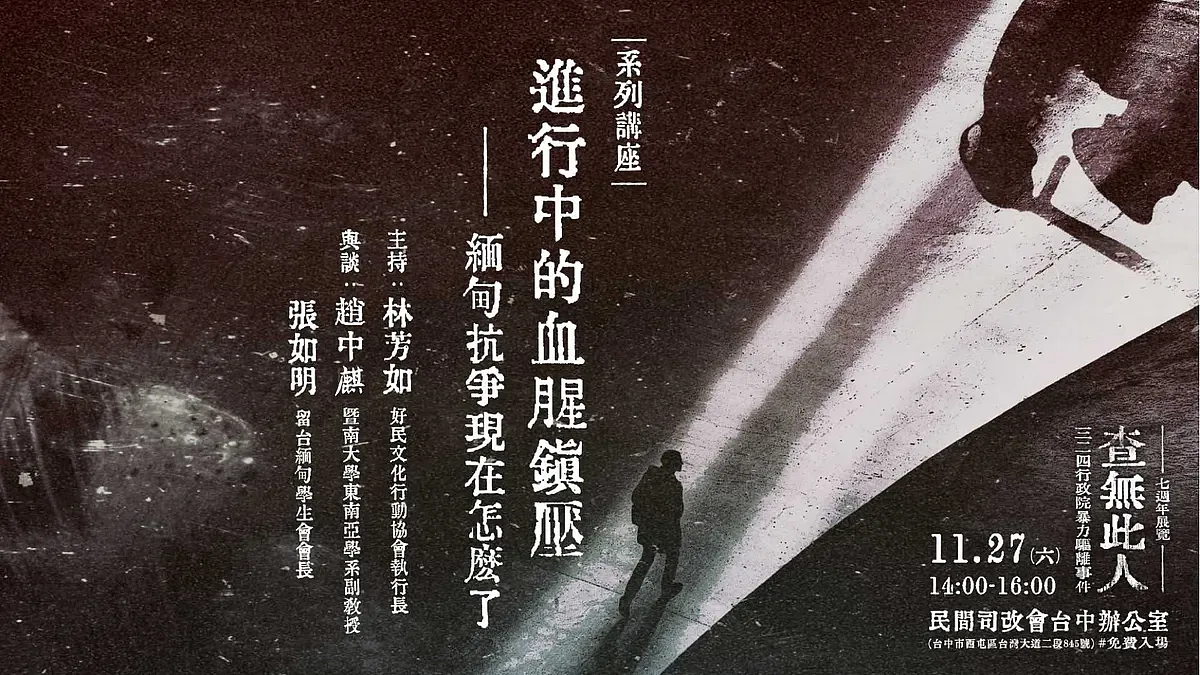
Seminar Transcript | Unidentifiable: Ongoing Bloody Repression-What Is Happening with the Protests in Myanmar?
Last edited: 2026-08-30
The *Unidentifiable* exhibition presents state violence that actually occurred in Taiwan seven years earlier and traces how that movement continued to shape society in different forms. Around the world, resistance to abuses of state power has not ceased. Among the most harrowing recent examples is the protest movement in Myanmar.
Since Myanmar's military launched its February coup, it has continued suppressing protesters and drawn international attention. On May 2, people took to the streets in as many as 41 cities-including locations in Myanmar, Taipei, and Tokyo-for the Global Spring Revolution, expressing solidarity with Myanmar's anti-coup movement.
What happened in Myanmar, and why has the repression become so bloody? We invited Chao Chung-Chi, Associate Professor in the Department of Southeast Asian Studies at National Chi Nan University, together with a representative of Myanmar students in Taiwan, to explain the background and development of the protests. Lin Fang-Ju, Executive Director of the Haomin Cultural Action Association, moderates the discussion as the speakers consider what Taiwan and the international community can do in response to violence taking place far away.
Unidentifiable: Ongoing Bloody Repression-What Is Happening with the Protests in Myanmar?
▮ Time: November 27, 2021 (Sat.), 14:00-16:00
▮ Moderator: Lin Fang-Ju / Executive Director, Haomin Cultural Action Association
▮ Speakers: Chao Chung-Chi / Associate Professor, Department of Southeast Asian Studies, National Chi Nan University; Chang Ju-Ming / President, Association of Myanmar Students in Taiwan
▮ Transcript: Wang Yu-Chen / Intern, Department of Law, Providence University
 Moderator / Lin Fang-Ju
 Speaker / Chao Chung-Chi
 Speaker / Chang Ju-Ming
Key Takeaways
The Protests in Myanmar
In February, the military announced that the previous year's election had been unfair and, invoking Myanmar's Constitution, placed Aung San Suu Kyi and President Win Myint under house arrest. Large numbers of people then took to the streets demanding their release. By March, international news was filled with distressing reports, including children and teenage girls being shot by soldiers while protesting. The international community condemned the situation, but the speakers argued that condemnation had produced little concrete assistance.
Behind the Myanmar Coup
Myanmar's constitutional structure allows a national-security body, under specified circumstances involving threats to national sovereignty, to assume executive power. After the 2020 election, Chinese Foreign Minister Wang Yi visited Myanmar, and Commander-in-Chief Min Aung Hlaing raised allegations of electoral fraud. The speaker argued that this already suggested preparations for a coup. On February 1, Aung San Suu Kyi was detained, the election was declared invalid, legislators were prevented from taking office, and legislative authority was effectively suspended. The military framed its takeover as constitutionally authorized protection of national sovereignty and treated its use of force as enforcement rather than unlawful mass repression. In that sense, the coup was described as a calculated political act carried out in the name of defending the Constitution.
People's Defense Forces formed in different cities and armed organizations established by ethnic minorities may share the goal of democratic self-determination, but cooperation could fracture if their relationships and competing interests are not managed carefully. Several tensions were identified:
- They share a common enemy but lack a single unified command or mobilizing structure.
- Different ethnic groups all seek political power, raising the question of how power would ultimately be allocated.
- The Rohingya crisis has left ethnic relations deeply strained.
These tensions help explain why observers remain uncertain whether overthrowing the military would automatically open a stable new democratic chapter for Myanmar.
Aung San Suu Kyi remains a powerful symbolic leader. The military has long feared that she could mobilize popular resistance and has used constitutional mechanisms to justify its own governing authority. Yet violence carried out against civilians in the name of protecting the state is precisely what many people find impossible to accept.
Conditions During the Myanmar Resistance
The speakers questioned the constitutional legitimacy of the military's detention of Aung San Suu Kyi. From the perspective of many protesters, the 2008 Constitution had effectively been rejected and a new constitutional order was being imagined. The military, by contrast, treated its actions as authorized by the existing Constitution. Many protesters recognized only the democratic forces associated with Aung San Suu Kyi and viewed the junta itself as a terrorist organization.
Why has this coup generated even greater anger than earlier ones?
- For people who had concrete plans for the future, the sudden coup destroyed life plans that had seemed attainable.
- Myanmar had been moving upward in many respects, particularly economically, and the coup abruptly reversed that trajectory.
- Before 2008, Myanmar was far more closed and information was difficult to obtain or circulate. Younger generations grew up with the internet, greater access to the outside world, and a clearer understanding of democracy and of how different their country could be.
The suffering inside Myanmar and the pain of losing homes are difficult to put into words. For people on the front lines, survival from one day to the next is uncertain. If ethnic armed organizations and the broader democratic movement could stand together, overthrowing military rule might become possible. But ethnic armed organizations also have their own interests, which do not always align with the priorities of ordinary protesters.
The parallel government's declaration of war against the military was described as serving two purposes: reassuring an anxious public and forcing ethnic groups to decide where they stand. The junta has said it will return power to the people after two years, but in practice governing authority remains in military hands. What people are demanding is genuine freedom, not a promise on paper.
Revolution is a long road and no one knows when it will succeed. People on the front lines live with uncertainty about whether they will survive. Those outside Myanmar may be able to offer only moral and material support, but young people continue taking to the streets because the struggle concerns not only this generation but the next. They do not want their children to inherit a country without human rights, freedom, or democracy.
Myanmar's History of Coups
In 1962, the military abolished the 1947 Constitution. After the 1988 student protests, the military briefly appeared to return power to civilians, but then again seized control and abolished the 1974 Constitution. When elections were held in 1990 and Aung San Suu Kyi's party prevailed, the military refused to accept the outcome and detained her and others. Earlier coups were therefore commonly associated with openly abolishing constitutions or large-scale repression. What makes the current situation especially paradoxical is the military's insistence that it is acting through the Constitution itself. Outsiders call the takeover a coup; the military says it is protecting national sovereignty. That raises a difficult question: if democratic forces overthrow a military government that claims constitutional authority, how should that act itself be characterized?
Drafting a new constitution would also be extremely difficult because the military retains guaranteed representation in the legislature. In practical terms, constitutional change requires military consent. That leaves Myanmar's prospects for long-term political stability deeply uncertain.
What People in Taiwan Can Do
Following reliable reporting on Myanmar is itself a form of support. Movements also require material resources, so donations can matter where people are able to give. Participating in events organized by Myanmar students and communities in Taiwan can also help more people understand what is happening.

This article is an AI-generated translation of the original Chinese text. In the event of any discrepancy, the Chinese version shall prevail.