
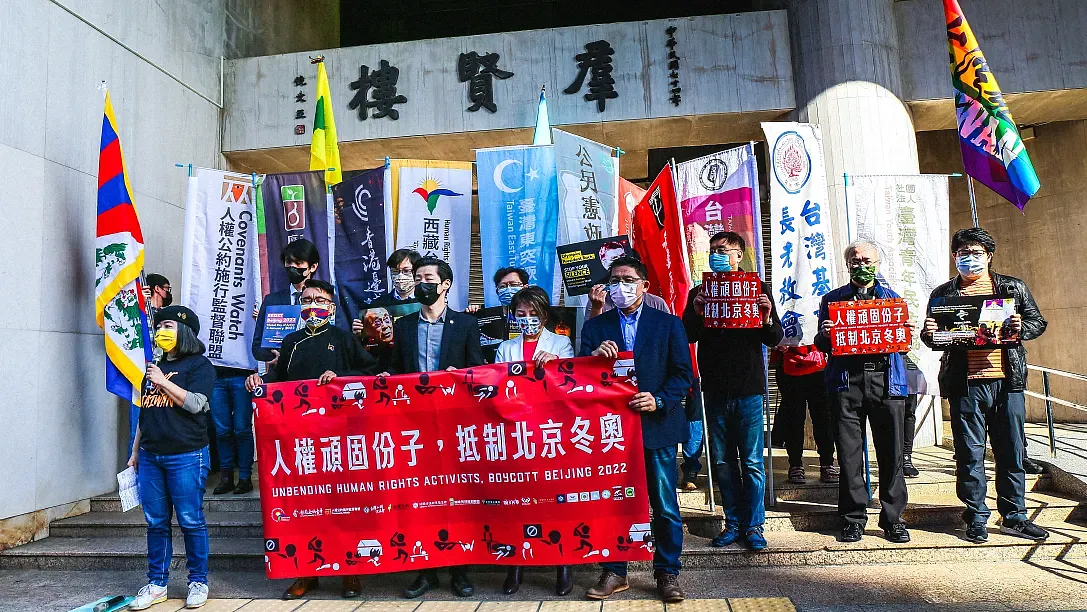
Joint Press Conference | Human-Rights Diehards: Boycott the Beijing Winter Olympics
Last edited: 2026-08-30
Ahead of International Human Rights Day, 27 Taiwanese human-rights organizations and three legislators held a press conference outside the Legislative Yuan's Chun-Hsing Building, calling on the public to remain "human-rights diehards" and join the boycott of the 2022 Beijing Winter Olympics.
Moderator Lin Hsin-Yi, a board member of the Human Rights Network for Tibet and Taiwan, explained that Taiwanese civil-society organizations traditionally hold activities before International Human Rights Day to press Taiwan's own government on human-rights issues. For the past two years, however, the theme has focused on China-not because Taiwan no longer has human-rights problems, but because Taiwan's democratic and free institutions provide tools for improving them, while people under Chinese rule lack comparable space. Eighteen groups joined the action last year; this year, 27 organizations used Taiwan's freedom of speech to speak for friends facing human-rights abuses in China.
Participants then chanted: "Stop human-rights violations," "Boycott the Beijing Winter Olympics," and "Boycott Beijing 2022."
Legislators from different parties and representatives of civil-society organizations then spoke in turn:
Legislator Freddy Lim said the world is paying close attention to human-rights repression affecting Uyghurs, Tibetans, Hongkongers, and rights defenders inside China. Taiwan occupies a critical position in the Indo-Pacific, and people in these communities look to Taiwan with significant expectations. Taiwan therefore has no reason to stand outside an international response. From campaigns against Xinjiang cotton onward, human rights have become an increasingly important benchmark across industries and international cooperation. As regional integration seeks to improve people's lives and expand visions of a better future, human-rights standards cannot be ignored.
Legislator Fan Yun emphasized gender-based violence in China's human-rights abuses, including allegations that women who survived detention camps were subjected to forced sterilization and that some survivors holding foreign nationality were beaten, tortured, or continued to face threats after leaving China. She invoked the international debate over participation in the 1936 Berlin Olympics as a warning about the consequences of compromising on human rights. Lithuania, the United States, and Australia had announced diplomatic boycotts of the Beijing Games by sending athletes but no government officials, and the European Parliament had also supported a diplomatic boycott. "Now is not the time to remain silent," she said.
Legislator Chiu Hsien-Chih listed groups whose rights and freedoms have been suppressed under Chinese Communist Party rule, including people in Xinjiang and Tibet, Hongkongers, Taiwanese facing threats from China, and human-rights lawyers inside China. He argued that these abuses are incompatible with the spirit of the Olympic Games.
He recalled that the Nazis dissolved the German parliament in 1933 and that, despite the regime's increasingly clear authoritarian direction, many countries continued policies of accommodation, allowing Hitler to use the 1936 Berlin Olympics for nationalist propaganda. The New Power Party caucus had recently asked the President of the Legislative Yuan to convene cross-party negotiations on a boycott. Chiu urged the legislature to adopt a resolution expressing unified opposition to the Beijing Winter Olympics.
Moderator Lin Hsin-Yi then announced that the participating groups would hold a boycott march on Friday morning, December 10, walking from the Bank of China to Taipei 101 to protest China's human-rights repression and call on governments around the world-including Taiwan's-to join the growing international boycott. Beginning that week and continuing until the Games opened on February 4, 2022, the groups would also hold a Lhakar flash protest outside the Bank of China office every Wednesday at noon. "Lhakar," or "White Wednesday," refers to a nonviolent resistance movement initiated by Tibetans inside Tibet in 2009. Seven actions were planned for December 15, 22, and 29 and January 5, 12, 19, and 26. The organizers invited the public to join and speak for values of human rights, freedom, and democracy long cherished in Taiwan.
Tashi Tsering, Chairperson of the Human Rights Network for Tibet and Taiwan and an organizer of the International Human Rights Day actions, said Tibetans have endured more than 70 years of suffering under Chinese Communist Party rule, including damage to religion, culture, and education. He criticized propaganda videos by foreign YouTubers portraying Tibetans as living happily under Chinese rule and urged the international community to remain vigilant.
Attorney Ho Chao-Tung / Chairperson, Taiwan Association for East Turkistan said millions of Uyghurs had been detained in East Turkistan and noted that legislatures in the United States and Europe had adopted measures calling for a boycott of the Beijing Winter Olympics. He also referred to the independent Uyghur Tribunal in London, which had conducted a series of hearings and was expected to issue its conclusions in December on allegations of genocide and crimes against humanity.
Fung Cho-Tin / Executive Committee Member, Hong Kong Outlanders said that Hong Kong, once regarded as one of the world's freest cities, had become a place where people lived in fear after imposition of the Hong Kong National Security Law. Beijing is the first city to host both the Summer and Winter Olympics, he observed, but that distinction is being achieved by an authoritarian state. "The Winter Olympics should take place on ice and snow, not on people's blood," he said, before chanting the event slogan in Cantonese: "Human-rights diehards, boycott the Beijing Winter Olympics."
Lu Liu / Representative, Taiwan No. 1 Teamsaid the Olympics have symbolized the highest level of athletic competition and ideals of international peace and friendship for more than a century. In light of China's treatment of Uyghurs, Tibetans, and Hongkongers, he called on the International Olympic Committee to recognize that China was not qualified to host the Games.
Shih Yi-Hsiang / Secretary-General, Taiwan Association for Human Rights said the Taiwan Association for Human Rights had joined a statement initiated by the Swiss and German branches of the Society for Threatened Peoples concerning human-rights violations and cultural destruction under Chinese Communist Party rule. He called on people around the world to join the boycott: "Human-rights diehards are not only in Taiwan; human-rights diehards around the world are gathering."
Attorney Wang Lung-Kuan / Judicial Reform Foundation challenged the claim that "sports should be sports and politics should be politics," noting that apartheid-era South Africa was excluded from the Olympics for decades. Although the Beijing Winter Olympics appeared likely to proceed despite years of advocacy, he argued that Taiwan should not stand aside. Taiwan should work through the International Olympic Committee system to protect athletes' personal safety and freedom of expression, and the Taiwanese government should issue a formal statement of its position.
Min Po-Ling / Chairperson, Taiwan Parents for Education Association approached the issue through parent-child dialogue and children's rights. With reports about citizen journalist Zhang Zhan and tennis player Peng Shuai appearing in the news, she said parents cannot avoid children's questions about the contrast between Olympic ideals and the conduct of the Chinese government. That tension, she said, is one reason parents should speak out.
Wang Hsing-Huan / Secretary-General, Taiwan Statebuilding Party recalled taking part in protests against the 2008 Beijing Olympics in Paris and cited Reporters Without Borders' criticism at the time that China's human-rights record was inconsistent with Olympic values of equality and nondiscrimination. Thirteen years later, he argued, the 2008 Games were remembered as a symbolic turning point in "China's rise." As a Taiwanese community facing pressure from Chinese nationalism, Taiwan should stand with democratic partners in a diplomatic boycott of the 2022 Beijing Winter Olympics.
Yang Hsien-Hung / Chairperson, Taiwan Association for China Human Rights argued that Chinese authoritarianism causes concrete harm to Taiwan. If Taiwan's government and the Chinese Taipei Olympic Committee sent official representatives despite China's pressure on Taiwan, he said, that would amount to yielding morally to authoritarian violence. Other countries were undertaking diplomatic boycotts while supporting Taiwan; Taiwan should not undermine its own moral position. "Without human rights, there are no Olympics."
Yang Kang / Researcher, Covenants Watch reviewed the progression from the previous year's call for solidarity against Chinese repression to this year's campaign to boycott the Beijing Winter Olympics. He noted that China has signed international human-rights instruments including the International Covenant on Civil and Political Rights and the International Covenant on Economic, Social and Cultural Rights, while its human-rights record remains the subject of serious criticism. He invited the Taiwanese public to join the boycott campaign and the series of actions beginning on International Human Rights Day, December 10.
December 10 is Human Rights Day. Since 1948, the Universal Declaration of Human Rights has served as a global reminder of the value and importance of human rights. The United Nations' 2021 theme was "EQUALITY - Reducing inequalities, advancing human rights." The participating organizations argued that this goal matters in every society, while Taiwan's particular international position also requires close scrutiny of human-rights abuses by China: repression within China; restrictions on Tibetans, Uyghurs, Southern Mongolians, and Hongkongers; pressure on Taiwan's international space; and the export of technology-enabled authoritarian practices to Southeast Asia and other developing democracies. The 27 organizations therefore called on the public to use Human Rights Day to scrutinize China's human-rights record.
27 Participating Organizations
Human Rights Network for Tibet and Taiwan; Taiwan Association for East Turkistan; Hong Kong Outlanders; Taiwan Association for Human Rights; Taiwan Labour Front; Judicial Reform Foundation; Taiwan Parents for Education Association; Presbyterian Church in Taiwan; Taiwan Association for Supporting Hong Kong; Covenants Watch; Students for a Free Tibet Taiwan; Taiwan Forever Association; Taiwan United Nations Alliance; Taiwan No. 1 Team; Economic Democracy Union; Citizen Constitutional Promotion Alliance; Taiwan Youth Association for Democracy; Taiwan Association for China Human Rights; Taiwan Alliance to End the Death Penalty; Taiwan Parliamentary Human Rights Network for Tibet; Taiwan Parliamentary Human Rights Network for Hong Kong; Taiwan Parliamentary Human Rights Network for Uyghurs; Regional Tibetan Youth Congress Taiwan; Civic Front; Tibetan Welfare Association in Taiwan; Taiwan Statebuilding Party; Soochow University Nan-Yung Club.
This article is an AI-generated translation of the original Chinese text. In the event of any discrepancy, the Chinese version shall prevail.