
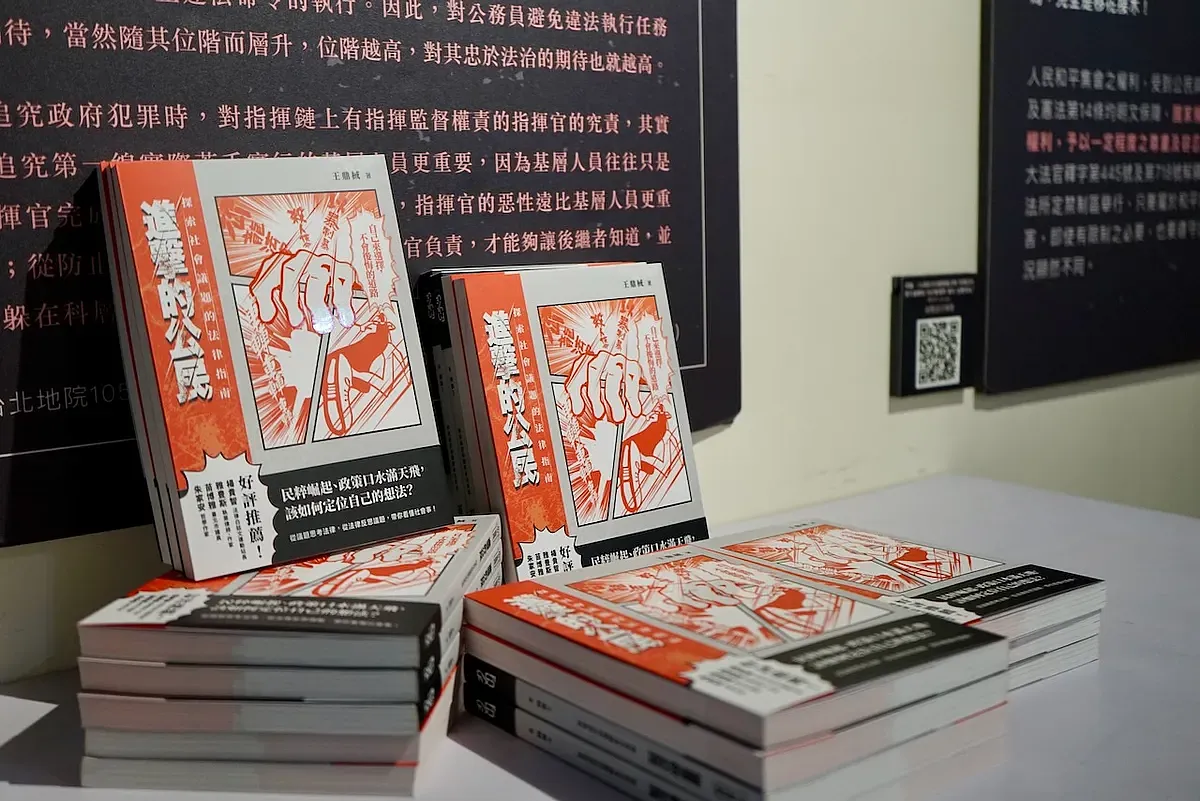
Book Talk | Attack on Citizens: Why Does State Violence Become Excessive-or Fail to Act?
Last edited: 2026-08-30
*Attack on Citizens: A Legal Guide to Exploring Social Issues* starts from real events in Taiwan, cuts through the noise surrounding policy slogans, and asks readers to think about what law is for. Its goal is to give readers standards they can use to form their own judgments amid competing claims.
Whether we like it or not, we live behind walls built in part by politicians and the media. Everyday noise can make reality difficult to see. Should fake news be regulated? What does populism do to democracy? How far should transitional justice go? These questions resemble the giants in *Attack on Titan*: if people refuse to confront them, they risk simply becoming prey.
The choice also resembles the world of *Attack on Titan*. Some people remain behind the walls, accepting a fragile peace built on ignorance and fear. Others refuse to remain blind and vulnerable; they climb the wall, try to see the world as it is, and confront the giants in order to reclaim genuine autonomy.
Book Talk | *Attack on Citizens*: Why Does State Violence Become Excessive-or Fail to Act?
▮ Time: November 21, 2021 (Sun.), 14:00-15:30
▮ Moderator: Chang Hua-Che / Legal Specialist, JRF Taichung Office
▮ Speaker: Wang Ting-Yu / Author; Editor-in-Chief, Plain Law Movement
▮ Transcript: Tu Chih-Yu / JRF Intern, Department of Law, Providence University
 Speaker / Wang Ting-Yu
Discussion Transcript
State violence was especially visible in 2014, yet accountability afterward remained incomplete. That is why this series uses the title *Unidentifiable*. I want to look at why this kind of "unidentifiable" state violence occurs from both sociological and legal perspectives. I will focus on three points: first, the historical impact of the Sunflower Movement; second, why presidential power expanded and why the Legislative Yuan became unable to function effectively in some contexts; and third, several legal questions that arose around the Sunflower Movement.
The first point is that both Taiwan and Hong Kong experienced periods of unusually intense protest. What most clearly distinguishes the Wild Lily Student Movement, the Sunflower Movement, and Hong Kong's anti-extradition movement? One major difference is the internet. During the Wild Lily era, there was no comparable internet or mobile communications infrastructure through which ideas could circulate instantly or supporters could be mobilized. By the 2000s and especially the 2010s, mobile communications allowed protesters to connect rapidly and build networks. I see four overlapping "puzzle pieces" behind that change.
The first piece is the search for one's own values; the second is a sense of justice; the third is China. Taiwan is economically intertwined with China through trade and tourism, making China a major part of Taiwan's economic environment. The fourth piece is the rise of student movements. Changes in the broader political environment made students more willing to express their views and participate publicly.
After democratization, political decisions could no longer be dictated by one person; elections created incentives that affected how parties responded to social movements. Why, for example, did the Democratic Progressive Party eventually stand with the protesters? It would be naïve to describe that purely as benevolence. The movement attracted enormous public attention, and an opposition party competing with the Kuomintang inevitably had electoral incentives to engage with it. That is part of the political logic produced by democratization.
Returning to the main question-why did state violence erupt? Sociologically, civic power had accumulated and confronted the state; the state, possessing superior physical and institutional force, responded with coercion. But law requires us to ask a different question: what institutional conditions allow state violence to be concentrated and deployed in this way? One underlying factor, I would argue, is Taiwan's unresolved national identity and the constitutional and political structures built around it.
The second point concerns the President's dominant role in questions of unification and independence. During the authoritarian era, Chiang Kai-Shek and Chiang Ching-Kuo personally concentrated power. After democratization, some of that political reality became embedded in institutions. Under the original constitutional design, the President was not intended to exercise the kind of executive dominance later associated with the office; Chiang Kai-Shek himself at one point publicly said he preferred to serve as President of the Executive Yuan because that office was then conceived as the center of executive authority. Martial law and the perceived need to respond to external and domestic threats drove power toward the presidency, and those changes left institutional legacies after democratization.
The third point concerns legal issues that the Sunflower Movement brought close to the surface. One is civil disobedience. Civil disobedience does not mean protesting while ignoring every legal consequence. It involves deliberately refusing compliance with an existing order while accepting that the legal system may respond. The Sunflower Movement did in fact lead to prosecutions and trials, and those consequences are part of the idea rather than something external to it.
Civil disobedience is not a buffet from which people select only the parts they like. A person invoking it must be prepared to face accountability under the existing order. I would also emphasize two features: objectively, ordinary institutional procedures must face an urgent and serious failure or threat; subjectively, the actor must understand the disobedience as a means of protecting or preserving the constitutional or institutional order rather than simply rejecting it. Civil disobedience is therefore not a label that settles the legal question; it is an exceptional response that requires justification. The second legal issue is how citizens read judgments. Whether a case involves the Kuomintang, the Democratic Progressive Party, or anyone else, we should ask whether criticism actually engages with the court's reasoning rather than merely attacking the outcome. A democratic legal culture cannot be built if citizens look only at who won and never read what the judgment says.

This article is an AI-generated translation of the original Chinese text. In the event of any discrepancy, the Chinese version shall prevail.