
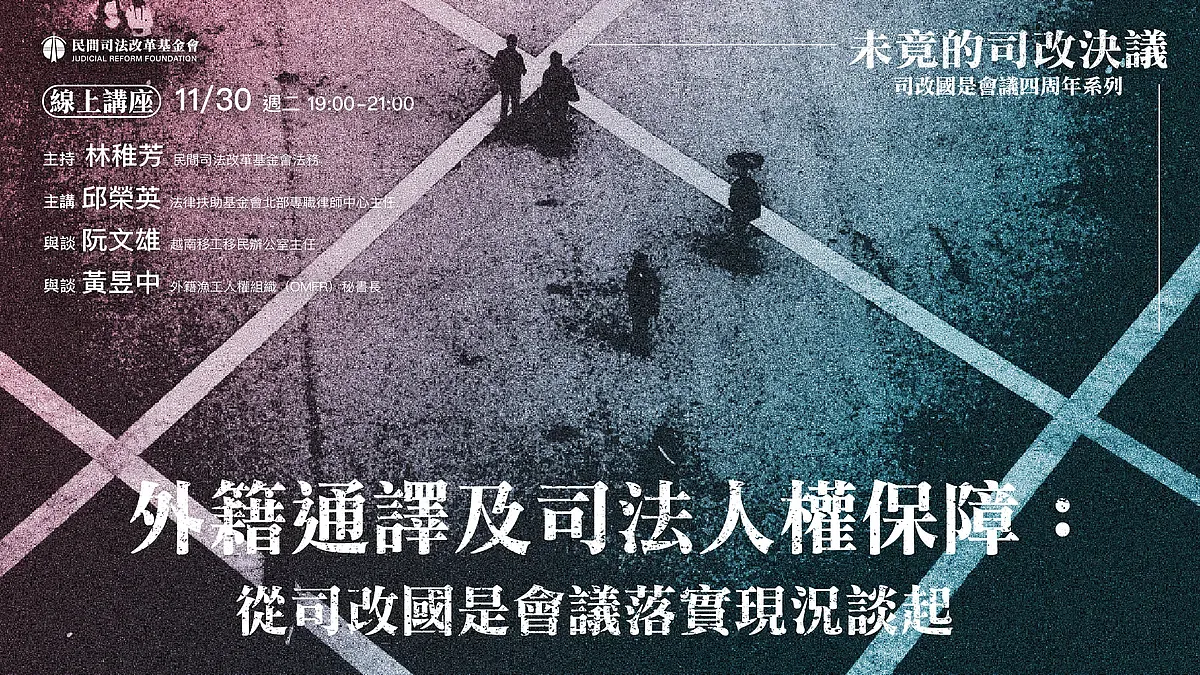
Seminar Transcript | Unfinished Judicial Reform Resolutions: Foreign Interpreters and Judicial Human-Rights Protection
Last edited: 2026-08-30
A sound judicial interpreting system is essential to ensuring that parties and other participants can understand what is happening in judicial proceedings, express themselves fully, assert their rights, and receive meaningful legal protection. In 2017, the National Conference on Judicial Reform adopted Resolution 10-7, calling for appropriate means to enable people who do not understand Chinese to grasp the substance of relevant judicial documents. Yet there is still no reliable mechanism for determining whether documents provided to non-Chinese-speaking parties are actually translated or whether the translations are accurate and usable.
Taiwan also lacks a unified framework for interpreter training, certification, appointment procedures, and fees. Although the National Immigration Agency has established a national interpreter database, access is limited to eligible agencies, organizations, and interpreters, and its actual rate of use is unclear.
This session invited Attorney Chiu Jung-Ying, Director of the Northern Staff Attorney Center at the Legal Aid Foundation, as the principal speaker, with Reverend Peter Nguyễn Văn Hùng, Director of the Migrant Workers and Immigrants Office (MWIO), and Attorney Huang Yu-Chung, Secretary-General of the Organization for Migrant Fisher Rights (OMFR), as discussants. Attorney Chiu reviews implementation of the National Conference on Judicial Reform resolutions and uses actual cases to illustrate interpreting problems encountered by foreign defendants and witnesses, as well as feedback from Legal Aid Foundation interpreter-training programs. Reverend Nguyễn discusses the Vietnamese-language interpreting environment and his long experience assisting migrant workers and immigrant spouses. Attorney Huang then draws on his own cases involving interpreters before joining the general discussion.
The goal of the seminar is to assess how Taiwan's judicial interpreting system has changed since the National Conference on Judicial Reform and to identify practical ways to make that system more complete and rights-protective.
Foreign Interpreters and Judicial Human-Rights Protection: Reviewing Implementation of the National Conference on Judicial Reform
▮ Time: November 30, 2021 (Tue.), 19:00-21:00
▮ Moderator: Lin Chih-Fang / Legal Specialist, Judicial Reform Foundation
▮ Speaker: Chiu Jung-Ying / Director, Northern Staff Attorney Center, Legal Aid Foundation
▮ Discussants: Peter Nguyễn Văn Hùng / Director, Migrant Workers and Immigrants Office; Huang Yu-Chung / Secretary-General, Organization for Migrant Fisher Rights (OMFR)
▮ Transcript: Yang Yun-Jou / Department of Law, Providence University; JRF Intern
Seminar Transcript
Lin Chih-Fang
Thank you for joining the fifth session in our "Unfinished Judicial Reform Resolutions" series marking four years since the National Conference on Judicial Reform. Tonight's topic is foreign interpreters and judicial human-rights protection. Whether interpreting works properly can determine whether a party or other participant truly understands the proceedings, can express views fully, and can protect legal rights in practice rather than only on paper.
The 2017 National Conference on Judicial Reform adopted seven resolutions on interpreting, including increased funding for interpreter training, language-proficiency testing, creation of a judicial interpreter database, and development of appropriate ways for parties who do not understand Chinese to understand judicial documents. Four years later, whether those resolutions have been implemented adequately still requires public monitoring.
We are honored to have Attorney Chiu Jung-Ying, Director of the Legal Aid Foundation's Northern Staff Attorney Center, as our speaker, together with Reverend Peter Nguyễn Văn Hùng of the Migrant Workers and Immigrants Office and Attorney Huang Yu-Chung of the Organization for Migrant Fisher Rights. Attorney Chiu will begin with the status of implementation after the National Conference on Judicial Reform and share practical problems encountered by foreign defendants and witnesses.
 Attorney Chiu Jung-Ying / Director, Northern Staff Attorney Center, Legal Aid Foundation
Chiu Jung-Ying
Some people may not be familiar with what a national conference is. It is an ad hoc political forum convened around major national policy issues, bringing together ruling and opposition parties and members of civil society. It resembles political consultation, but it is not a permanent institution and has no independent statutory authority.
Why did the National Conference on Judicial Reform discuss interpreters? The resolutions focused mainly on interpreting in judicial proceedings: communication across different spoken languages, sign-language interpreting, and assistance that enables defendants, witnesses, judges, prosecutors, and other participants to understand the case and the procedure. Taiwan currently uses a mix of full-time interpreters, contracted interpreters, and interpreters paid on a case-by-case basis.
But interpreting needs do not begin and end in the courtroom. Taiwan had more than 710,000 migrant workers at the end of March 2020; even after pandemic-related declines, the number remained above 690,000 in August 2021. More than 650,000 immigrants had obtained Taiwanese nationality or identification documents, and there were also children born to migrant workers or in other circumstances who lacked nationality or were never formally reported. Foreign residents in Taiwan numbered more than 790,000, with large communities from Indonesia, Vietnam, and the Philippines. When people in these communities encounter disputes over work, family status, residence, identity, or criminal matters, interpreting may be essential long before they ever enter a courtroom.
In 2017, *The Reporter* published an investigation on "aphasic migrant workers," describing how migrant workers and immigrant spouses can be unable to communicate adequately at police stations or during prosecutorial questioning because interpreters are unavailable, too few in number, or unable to translate accurately. I will return to several similar cases from my own practice.
The post-conference reform agenda includes interpreter training, professional standards and certification, expansion of interpreter rosters, the important question whether parties may choose their own interpreters, and improved services for people who use sign language or real-time transcription. Another major issue is translation of judicial documents. The JRF has an online platform tracking implementation of the interpreting-related reform resolutions.
Improving both the quality and the number of interpreters requires funding. Court interpreters need language ability, but they also need sufficient familiarity with legal terminology, litigation procedure, and the documents used in proceedings. They must learn interpreting techniques rather than simply know two languages, and they need continuing training as law, institutions, and language use change.
A 2019 Control Yuan investigation illustrates the stakes. An Indonesian caregiver was reported by a former employer in 2017 in connection with a criminal matter. The assigned interpreter was not sufficiently proficient in the relevant Indonesian dialect, leaving the caregiver unable to communicate her position fully. The Taipei District Prosecutors Office later issued a wanted notice without adequately resolving the communication problem. The incident shows why interpreters are not an optional convenience: they are the bridge between law-enforcement personnel and people who otherwise cannot meaningfully communicate. It also raises a basic question-can a party affirmatively insist on an interpreter?
In one investigation I handled, my client was a foreign national who had lived in Taiwan for more than ten years. Because he could answer basic questions in Chinese, people assumed he could understand the proceedings. But he specifically told us that he needed an interpreter in court. We filed a written request. The prosecutor first said there was not enough time to arrange one and later questioned the need because the client could answer questions such as his name and age. We repeatedly explained that understanding everyday Chinese is not the same as understanding legal terminology, rights warnings, or evidentiary questions. Without an interpreter, I asked whether I could slow down and explain the questions to my client myself. The prosecutor resisted even that, saying the questions were already in plain language.
At the next session, the problem became undeniable. The prosecutor had shown my client Chinese-language documents that he simply could not read and acknowledged that an interpreter would be necessary. Once one was arranged, my client could finally explain his position fully. We then learned that the suspicion against him was largely a misunderstanding and may have involved retaliatory accusations by the person who reported him. The prosecutor ultimately issued a non-prosecution disposition. That experience showed both why interpreting matters and why parties and counsel sometimes have to insist on it.
In another case, some witnesses were foreign nationals. Judges and prosecutors in the cases I now handle are generally willing to arrange interpreters for foreign defendants or witnesses when the need is identified. But another question arises: should the same interpreter remain with a case from the police interview through the investigation and the first and second instances, or should a different interpreter be used at each stage?
Practice varies. In one New Taipei case, the same interpreter who had assisted at the prosecutors office continued in the District Court, while the High Court later used someone different. In a Shilin case, the court appointed a different interpreter from the person used during the investigation. Changing interpreters means the new interpreter has to reconstruct the factual and procedural background before effective communication can begin. When the same interpreter has followed a matter from the police interview onward, the interpreter understands the case, the questions, and the parties' way of communicating, which can make the process faster and more accurate.
I once represented a case in the High Court involving a foreign witness. The court had arranged an interpreter, but when the judge asked whether the witness's prior police interview record was accurate, the interpreter began translating the record and the witness tried to respond. The judge instructed the interpreter to finish translating the entire record before allowing the witness to comment. A police interview record can run several pages and contain many factual details. Even lawyers reading such a document often have to turn back to earlier passages. Requiring a witness unfamiliar with Taiwan's language and legal system to listen to the entire record before correcting anything risks turning interpreting into a formality: an interpreter may be physically present without the process actually enabling meaningful testimony.
Interpreting is equally important outside court. Some projects I have handled lasted for years and were resolved primarily through settlement negotiations rather than litigation. We needed interpreters simply to contact foreign clients, explain what we proposed to do, understand whether they agreed with a settlement approach, and make sure they understood the proposed terms before we could take the next step.
For that reason, I do not think interpreting should be treated as something needed only inside a courtroom. Mediation, settlement discussions, attorney-client meetings, and other parts of a legal matter may be just as important. I have personally worked with interpreters in mediation proceedings as well.
Another case involved several foreign witnesses whose police statements were relied upon when the prosecutor sought a summary judgment. My client, also a foreign national, disputed the accusation, so we asked the court to convert the case to ordinary proceedings and summon the witnesses. When we investigated whether their earlier police questioning had been audio-recorded, the police told us it had not been recorded because they were witnesses rather than defendants. After later statutory amendments, questioning of witnesses and other persons must also be recorded. But recording is only part of the problem: if a foreign witness cannot understand the police, an audio file faithfully preserves a conversation that still may not reflect meaningful comprehension. Interpreting remains necessary.
The court ultimately summoned two of the witnesses. At the beginning of their testimony, the judge explained their obligations and asked them to take the required oath. They could not read the Chinese oath form, so the interpreter had to read it aloud sentence by sentence for them to repeat. That alone cast doubt on whether they could ever have read or verified the Chinese police interview records attributed to them. The lesson is straightforward: foreign witnesses and other participants should be able to request both a complete recording of questioning and an interpreter when needed.
Let me turn to two homicide cases I handled involving Vietnamese defendants, one in New Taipei District Court and one in Shilin District Court. I represented both from the investigation stage through the first instance. Because the charges were serious, both defendants were detained, and restrictions on visits were possible. As migrant workers with few or no relatives in Taiwan, their principal channel for meaningful communication with counsel was the interpreter. In the New Taipei case, the same interpreter had been involved from the police and investigation stages. Because the interpreter already understood the case and the defendant's way of communicating, our meetings were more efficient and the relationship of trust was stronger. Even then, cultural and personal distance remained; a detained foreign defendant may still hesitate to trust an attorney fully or disclose everything that happened.
The Shilin case was much more difficult because the interpreter used by the prosecutors office was not the interpreter later used by the court. We repeatedly tried to communicate evidence and strategy to the defendant through different interpreters, including the prosecutor's view that surveillance footage made the accusation more serious than the defendant believed. The defendant nevertheless continued to insist on an account that did not match what we were seeing. The problem involved both trust and communication. When a new interpreter enters at the court stage without knowing what occurred during the investigation, counsel has to repeat factual and procedural background before any meaningful discussion can begin. Continuity of interpreting is therefore worth serious consideration and can be beneficial to defendants.
I have also brought my own interpreter to proceedings. Some prosecutors offices will accept that arrangement, especially when counsel explains that the interpreter appears on the Legal Aid Foundation, court, or prosecutors-office roster. In my cases, however, self-arranged interpreters have rarely been used inside the courtroom because judges and prosecutors understandably worry about the interpreter's qualifications, character, and relationship with the defense. Outside court, by contrast, we often rely on interpreters we arrange ourselves, which generally makes attorney-client communication more flexible.
Language is not the only communication barrier. Deaf people and people with speech disabilities may face very similar problems. I have represented two deaf clients. One could read, but only if the language was short and simple; dense or technical writing was not workable.
One deaf client in Taipei did not use sign language, so I had to communicate by writing short messages on paper and giving him time to read and process them. Another client in Taichung wore a card explaining that he was deaf and giving basic instructions on how to communicate with him. Deaf people differ in whether they use sign language, read lips, read written language, or rely on real-time transcription. Mask wearing during the pandemic made lip-reading even harder.
The Taipei client was a defendant. He looked no different from anyone else but could neither hear nor speak, so calling to him from behind accomplished nothing. No sign-language interpreter or real-time transcription provider was present during the proceeding, so the prosecutor wrote questions on paper, the client wrote responses, I handed them back, and the prosecutor dictated the answers into the record. At one point the prosecutor asked counsel and the defendant to leave the courtroom temporarily. I instinctively told my client aloud that we were leaving, then realized he could not hear me and had to write it down. When he picked up all his bags, I again spoke before remembering that I had to write: "You do not need to take these-we are only stepping out and will come back."
Even after spending time with him before the hearing, I still sometimes defaulted to spoken communication and only remembered the barrier when he did not respond. That experience reminded me how easily misunderstandings can arise. I once asked whether he wanted MRT staff to help guide him, but he declined because he did not want strangers to know he was deaf. A person who cannot hear someone calling from behind or who uses unfamiliar gestures may be misread as rude, confrontational, or uncooperative when in fact the problem is simply communication.
Judicial documents create another major barrier. A foreign person who receives a court notice may understand the Arabic numerals showing the hearing date while being unable to read the address, case information, or instructions. Service receipts are likewise entirely in Chinese and can be confusing even for native speakers. A person may sign a document without understanding what is being acknowledged or what legal effect follows.
Criminal summonses also identify the recipient's procedural role. I once represented a foreign person involved in two matters, one as a defendant and another as a complainant. He told us he had received a notice but could not tell which case it concerned or in what capacity he was being summoned. Unless he sent us the document, we could not know which hearing he was expected to attend. Witness oath forms present the same problem: legal terms that are difficult even for many Chinese speakers are effectively inaccessible to someone who cannot read Chinese.
Victims of sexual assault may have important procedural rights, including protections concerning whether they must appear together with the defendant. But rights notices and protective-information forms are generally in Chinese. Foreign victims may therefore never learn what protections are available. Courts may provide oral interpretation of warnings and rights in the courtroom, but without translated written materials we cannot know whether a person can retain and understand that information afterward.
The same applies to probation and deferred prosecution. A foreign defendant facing a less serious charge may be eligible for those outcomes but may not understand the conditions or what conduct could lead to revocation. Monetary conditions may be especially difficult for low-income migrant workers. In some cases, community service may be available instead of an additional payment. If a person does not understand that possibility, an otherwise realistic path to deferred prosecution may disappear. Making this information accessible in languages defendants understand is therefore important.
I have also encountered interpreters who went well beyond the minimum required to make communication possible. If a court would not allow me to bring my own interpreter into the hearing, I would still use one while waiting outside so the client could understand what was about to happen. Once, when my client failed to appear, the interpreter repeatedly helped me contact him by phone in his own language and even left a message from the interpreter's own phone so the client could call back and speak with someone he understood.
In another case, oral argument had already concluded but the High Court scheduled an additional hearing to extend a travel restriction. The defendant could not understand why another hearing was necessary. The judge explained that the case might still be appealed to the Supreme Court and that the travel restriction therefore could not yet be lifted. Even with interpretation in court, the explanation remained difficult. After the hearing, the interpreter saw that the defendant still seemed confused and voluntarily stayed to explain the procedural situation again in more accessible language.
In a Shilin District Court case, an interpreter arrived at a later hearing with a Vietnamese translation of the indictment and gave it to the defendant. We could not evaluate the translation ourselves, but the existence of a document the defendant could read at least gave him a direct way to understand what he had been accused of. Other interpreters have helped explain the legal consequences of appearing or failing to appear, the prosecutor's position, possible settlement effects, and likely next steps. These experiences also highlight an important difficulty: lawyers and judges who do not speak the defendant's language cannot independently know whether the interpreter has conveyed the person's full meaning accurately or has added, omitted, or reshaped content.
The Legal Aid Foundation therefore conducts interpreter-training programs that address professional boundaries as well as language. If a party repeatedly gives an answer that does not respond to the prosecutor's or judge's question, may the interpreter tell the person to answer differently? If a party begins explaining material beyond the question, may the interpreter summarize or redirect it? Interpreters may want proceedings to move efficiently, but once they decide what is relevant or modify a person's answer, they risk crossing from interpreting into legal or factual judgment. Training must make those boundaries clear.
Legal Aid is available before a dispute reaches court as well as during litigation. A person who receives a police notice can seek assistance, including police-station accompaniment in appropriate cases. Early access to legal advice and interpreting can prevent communication problems from hardening into evidentiary or procedural errors later in the case.
Lin Chih-Fang
Thank you, Attorney Chiu. One important point is that long residence in Taiwan does not mean a person understands legal Chinese. Even native Chinese speakers can struggle with legal terminology. A foreign party may function well in everyday conversation and still be unable to understand the rights, allegations, documents, or procedural consequences involved in a case.
 Reverend Peter Nguyễn Văn Hùng / Director, Migrant Workers and Immigrants Office
Peter Nguyễn Văn Hùng
Thank you, Attorney Chiu. You have already covered many of the structural problems, so I will add several observations from more than three decades of working with migrant workers and immigrants in Taiwan.
The first concerns what interpreting actually covers in the courtroom. A party or victim may have an interpreter when the judge is questioning them, but often the interpreter translates only the judge's questions and the person's own answers. The person may not receive interpretation of what the prosecutor, opposing party, other witnesses, or attorneys are saying. Yet all of that can affect the person's rights and understanding of the case. Interpreting should support participation in the proceeding as a whole, not merely enable the court to extract answers.
Language ability also cannot be assumed merely from education or bilingual background. A person may speak both Vietnamese and Chinese conversationally without having the vocabulary needed to interpret legal concepts accurately. Conversely, children of immigrants raised in Taiwan may read Chinese fluently but have limited literacy in a parent's language. Interpreter qualification therefore has to be assessed professionally rather than inferred from identity.
We often hear interpreters shorten, add to, or reshape lengthy questions from judges and prosecutors according to their own understanding. When that happens, migrant workers may no longer be hearing the same question the court asked. Accuracy requires the interpreter to preserve meaning rather than decide what matters.
Interpreters may also feel pressure from judges or prosecutors to provide a concise answer quickly. That pressure can cause them to explain a question in their own way or effectively coach a party toward what they think the court wants to hear. Once that happens, the interpreter's own judgment begins to affect the content of testimony.
Class and status can also affect interpreting. In some Vietnamese-language cases, interpreters may view migrant workers as socially inferior and speak to them in a dismissive or controlling way. If judges and prosecutors do not understand the source language, they may never realize that the interpreter is changing tone, adding criticism, or influencing how the person presents their position.
Written translation raises the same issues. Parties are routinely asked to sign records or other documents drafted in legal Chinese. Even people who know some Chinese may have no realistic ability to understand them fully. Translation should not be treated as an afterthought that begins only when the judge asks a question aloud.
Taiwan also has a growing number of children in immigrant families who can move between languages in everyday life but are not trained interpreters. Family members, children, or bilingual acquaintances should not be used as substitutes for a professional system simply because they happen to know two languages.
Interpreter compensation is another practical issue. Government agencies often talk about the need for training and professionalism without providing enough resources to support them. At an Executive Yuan meeting on interpreting, the discussion repeatedly returned to the same question: if we expect trained professionals to be available, who will fund recruitment, training, certification, and reasonable compensation? A system built on goodwill and low fees will not produce stable professional capacity.
Lin Chih-Fang
Thank you, Reverend Nguyễn. You have highlighted problems that arise not only from individual interpreter quality but also from the structure of the system: what portions of proceedings are interpreted, whether documents are translated, how interpreters are trained, and whether adequate resources exist. Attorney Huang will now discuss the legal framework and problems he has encountered in practice.
 Attorney Huang Yu-Chung / Secretary-General, Organization for Migrant Fisher Rights (OMFR)
Huang Yu-Chung
Someone asked about Reverend Nguyễn's organization and background. He received the U.S. Department of State's Trafficking in Persons Hero Award in 2006 for his work in Taiwan. He came from Vietnam and has spent many years assisting immigrant spouses, Vietnamese migrant workers, and victims of human trafficking, including through shelter and support services.
My topic is foreign interpreters and judicial human-rights protection, which connects directly to this series marking four years since the National Conference on Judicial Reform. I will focus on the legal rules governing interpreters, the different rosters maintained by government agencies, and several practical gaps between rules and actual access.
Why do we need judicial interpreters? Think of the old commercial built around the misunderstanding "Vidal Sassoon? Italy?" It is funny as an advertisement, but the same kind of language mismatch is not funny when the person is a defendant, victim, or witness whose liberty or legal rights are at stake.
The most important international legal basis is Article 14(3)(f) of the International Covenant on Civil and Political Rights (ICCPR), which guarantees a criminal defendant the free assistance of an interpreter when the person cannot understand or speak the language used in court. That right reflects the more basic principle that a defendant must be able to understand and participate in the proceedings.
Taiwan's courts also have rules governing the use of interpreters for parties, witnesses, expert witnesses, and other participants; the right is not limited to criminal defendants. As Attorney Chiu's examples show, the need may arise whenever a person cannot communicate adequately in the language of the proceeding.
Police and prosecutors maintain their own interpreting rules and rosters. Because prosecutors investigate crime, their systems encounter defendants, complainants, informants, and witnesses in different procedural roles. Witnesses, too, may need an interpreter. The result is not one integrated national system but several overlapping systems administered by different agencies.
The National Immigration Agency's interpreter database is especially interesting because access is not open to everyone who needs an interpreter. Its management rules allow designated agencies, organizations, and interpreters to obtain access, but an ordinary individual cannot simply search the database. That becomes a serious practical problem for a private attorney or a Legal Aid lawyer who urgently needs to find an interpreter for a client.
Courts, prosecutors offices, police agencies, and administrative bodies therefore all have some form of interpreter resources, yet people still struggle to obtain competent interpreters. The existence of a roster does not answer questions about availability, language proficiency, legal knowledge, conflicts of interest, regional distribution, or who is actually allowed to contact the people listed.
The court system is comparatively strict in selecting contracted interpreters. The relevant rules require, among other possibilities, recognized proof of language proficiency or other specified qualifications. But formal eligibility is only a starting point. Court interpreting also requires legal vocabulary, ethical training, and the ability to convey meaning accurately under pressure.
The Taiwan Judicial Interpreters Association is one of the larger civil-society organizations working in this area. It was established by Chen Yun-Ping, a former judicial police officer, after observing interpreting problems in cases involving migrant workers. The organization has worked on interpreter training and professionalization.
The National Immigration Agency has a particularly large demand for interpreters because its specialized operations units frequently encounter migrant workers whose status is irregular or who have lost contact with employers. That operational need explains why the Agency built substantial interpreter resources, but those resources are not necessarily available to a migrant worker, attorney, or ordinary person trying to protect their own rights.
The problem becomes even more serious when a defendant is detained and communication is restricted. Counsel who wants to bring an interpreter to an attorney-client meeting may need to notify the prosecutor or court in advance and provide identifying information for the interpreter. Access therefore depends not only on finding a qualified person but also on navigating the institution's security procedures.
The court roster for contracted interpreters is publicly searchable, but a list alone does not tell counsel whether a particular interpreter is available, has relevant dialect skills, understands the type of case, or presents a conflict of interest. In practice, an attorney still has to do substantial work to determine whether someone on the list is actually suitable.
New Taipei District Prosecutors Office maintains its own interpreter roster with clearly listed qualifications and names and updates it regularly. That transparency is useful, but it also illustrates the fragmentation of the system: courts, prosecutors offices, the Immigration Agency, and local governments may all maintain different pools, with different access rules.
The National Immigration Agency's database is marketed with the slogan "No matter the language, communication connects." But an attorney representing a client cannot necessarily use it. Under the database rules, access is limited to approved government agencies and qualifying organizations. A sole practitioner handling a Legal Aid matter may therefore be unable to obtain contact information for an interpreter even when the government itself has that resource.
In other words, the state possesses interpreting resources, but control over those resources remains largely with administrative agencies. Some local governments have tried to improve access by compiling their own lists of interpreters. Yilan County, for example, published available interpreting resources that attorneys and others could identify more easily.
Even then, access may require going through a government caseworker in a health, labor, education, or police agency before the interpreter can be contacted. That is better than having no list at all, but it remains cumbersome in urgent situations-for example, when a person is detained late at night or faces imminent removal and counsel needs an interpreter immediately.
Conflict of interest is another recurring problem. In migrant-worker cases, police sometimes rely on an employer or labor broker to locate a bilingual person. The interpreter may therefore come from the same broker company that arranged the worker's employment, even when the employer or broker is itself involved in the dispute. That can seriously compromise trust and neutrality.
Police guidance recognizes the problem and instructs officers not simply to use brokers as interpreters when a conflict may exist, but practice can be different when an arrest occurs suddenly and no qualified local interpreter is available. In rural areas especially, officers may reach for whoever can communicate immediately. The structural shortage then turns into an ethical problem.
Court and prosecutorial rules likewise require attention to an interpreter's identity, qualifications, and relationship with the person being interpreted. Yet rosters do not always make conflicts transparent, and people associated with labor-broker businesses can still appear as interpreters. Rules on paper therefore need actual screening and enforcement.For anyone interested in the subject, Chen Yun-Ping has published a book titled *Judicial Interpreting: Training and Professional Development of Interpreters*.Information about the book and related materials is available through the Taiwan Judicial Interpreters Association and online booksellers.
Lin Chih-Fang
Thank you, Attorney Huang. When I searched for materials before this seminar, I also found the system difficult to understand. Rules on interpreters and certification exist, but they are scattered across agencies and institutions. Whether they are consistently implemented is another question. We have about ten minutes left, so I would like to invite any final comments from Attorney Chiu, Reverend Nguyễn, or Attorney Huang.
Huang Yu-Chung
After listening to one another, one point I strongly agree with is Reverend Nguyễn's suggestion that Taiwan needs a dedicated institution or coordinating mechanism for interpreter training and oversight. He also wanted to say more about compensation and resources, so I'll let him begin.
Peter Nguyễn Văn Hùng
It is difficult for civil-society organizations to build this system by themselves because the resource requirements are substantial. When I lived in Sydney, I knew interpreters who trained, sat examinations, obtained professional certification, and worked in defined areas of specialization. Agencies that needed a particular language and field would contact qualified interpreters directly. Taiwan, by contrast, developed multiple interpreter initiatives after the National Conference on Judicial Reform without establishing a single coherent professional system. At government meetings, agencies often seemed to pass responsibility from one to another. That kind of bureaucratic fragmentation is exactly what needs to change.
Huang Yu-Chung
Regional inequality is another serious issue. In a Filipino migrant-worker case I handled in Pingtung, the prosecutors office arranged an interpreter who spoke only limited Tagalog and used English for much of the communication. My co-counsel and I could understand enough English to realize the problem and asked the prosecutor to replace the interpreter, which the prosecutor eventually did. But qualified interpreters are simply harder to find in southern Taiwan.
The same regional shortage disrupts continuity. We hoped to use one interpreter from investigation through indictment and the first instance, but availability and travel made that impossible. By contrast, in some Taipei-area cases, judges try to retain the interpreter from an earlier stage. Good interpreters keep case numbers and notes, remember the parties, and can continue assisting at later hearings. When I find someone like that, I ask for a business card and try to bring the same interpreter to detention-center meetings. Familiarity with both the facts and the client can make an enormous difference.
Peter Nguyễn Văn Hùng
Our office sees the same thing. When one interpreter begins with a client at the social-work stage, helps the person apply for Legal Aid, and later accompanies the person through court proceedings, communication is much smoother because the interpreter understands the history. Yet the Judicial Yuan, Immigration Agency, and prosecutors offices each maintain separate groups of interpreters. Taiwan should integrate those systems gradually and build a coherent professional framework.
Chiu Jung-Ying
I am grateful for Reverend Nguyễn's presentation because it emphasizes that interpreting is needed throughout a proceeding, not only when the defendant personally answers a question. A defendant should also be able to understand what other defendants, witnesses, prosecutors, and attorneys are saying when those statements concern the case. Otherwise, the person becomes almost isolated inside the courtroom-present physically but unable to follow what is happening.
The same need exists in civil cases. Stateless children or children born to migrant workers may later be involved in proceedings concerning identity documents, parentage, residence, or family status. Their mothers may be foreign migrant workers and may be the only people who know key facts. A judge cannot obtain reliable information from them without adequate interpretation.
In one civil matter, we did not have time to arrange an interpreter and were fortunate that the child's biological father could communicate with the mother. But family members should not be the system. Foreign parties should be encouraged to request interpreters affirmatively whenever they need them. Courts and prosecutors offices today are generally more receptive to such requests. For detained defendants, counsel can notify the court or prosecutors office in advance and provide the interpreter's identifying information so the person can enter the detention facility. Meetings will take longer, but the interpreter can also translate documents and explain what motions and procedures are underway. In my experience, that difference is substantial.
Huang Yu-Chung
Experienced attorneys tend to focus on examination, cross-examination, argument, and attorney-client meetings. Attorney Chiu's examples remind us to look at the entire environment in which the interpreter, defendant, and other parties are operating. Reverend Nguyễn also mentioned judicial impatience. Interpreting necessarily slows proceedings: counsel speaks, the interpreter translates, the party answers, and the interpreter translates back. In cases with several foreign defendants, the additional time can be considerable. Judges may become impatient and tell the interpreter or attorney to "get to the point." But that pressure can damage both interpretation quality and the way attorneys conduct examination.
Even native speakers can struggle with legal Chinese, especially when nervous in court. A foreign person who depends entirely on an interpreter is in an even more vulnerable position. If the judge appears irritated by the time interpreting takes, the party and interpreter may shorten answers, omit details, or become afraid of speaking fully. Human-rights protection therefore requires attention not only to whether an interpreter is present, but also to whether the proceeding gives interpretation enough time and respect to work.
Lin Chih-Fang
Thank you to Attorney Chiu, Attorney Huang, and Reverend Nguyễn for sharing both legal frameworks and practical experience. The old "Vidal Sassoon? Italy?" advertisement may once have seemed simply funny, but tonight it illustrates a serious point: two people can be talking about exactly the same thing and still understand completely different meanings because of language. When legal rights are at stake, that gap cannot be treated casually. And one final reminder: if you encounter a legal problem, Legal Aid may be able to help. Thank you, everyone, and good night.
Further Reading
Hsieh Meng-Ying / Where Did Judicial Reform Go? When People Cannot Even Read Their Own Interview Records-An Attorney Describes the Reality Facing the Most Isolated Court Participants Storm Media
Chiang Yi-Ting / Aphasic Migrant Workers: Taiwan's Chaotic and Distorted Interpreting System The Reporter
Chiang Yi-Ting / Giving Voice to Migrant Workers: The Difficult Road of Judicial Interpreters The Reporter
This article is an AI-generated translation of the original Chinese text. In the event of any discrepancy, the Chinese version shall prevail.