
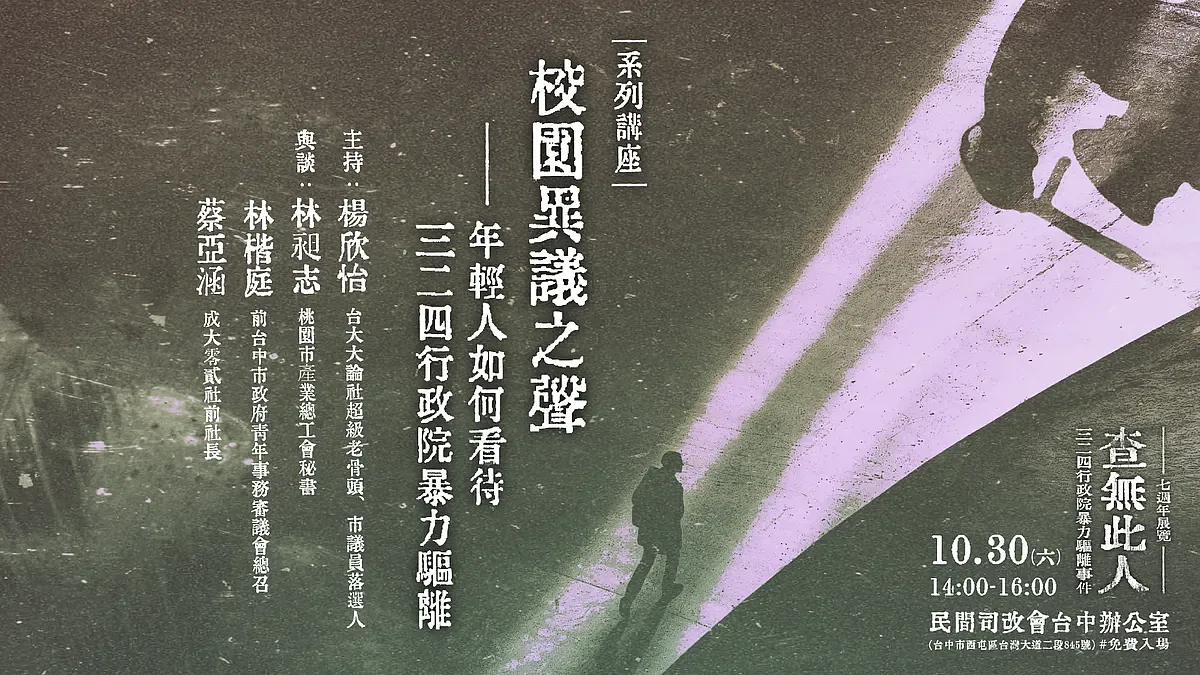
Seminar Transcript | Unidentifiable: Voices of Campus Dissent-How Young People View the March 24 Executive Yuan Violent Eviction
Last edited: 2026-08-30
According to the audience feedback forms, more than 60% of respondents were students who had never participated in the March 24 events and had only been in junior high or high school at the time. The March 18 and March 24 events nevertheless left a deep mark on Taiwan's civil society. One visible change has been the way students approach public issues: campus debate became more open, and student organizations concerned with social issues became more active.
Voices of Campus Dissent: How Young People View the March 24 Executive Yuan Violent Eviction
▮ Time: October 30, 2021 (Sat.), 14:00-16:00
▮ Moderator: Yang Hsin-Yi / Senior Member, NTU Greater Discourse Society; City Council Candidate
▮ Speakers: Lin Chang-Chih / Secretary, Taoyuan Confederation of Trade Unions; Lin Kai-Ting / Former Convener, Taichung City Youth Affairs Advisory Council; Tsai Ya-Han / Former President, NCKU Ling-Er Society
▮ Transcript: Chang Hung-Ming / Social Work Intern, Providence University
Seminar Transcript
Yang Hsin-Yi
Welcome to the JRF Taichung Office for today's *Unidentifiable* youth panel. Beside me are Ya-Han, Kai-Ting, and Chang-Chih. We will ask each of them to share three parts of their experience: how they first became engaged with public issues on campus; how social movements outside campus affected them; and how their generation has been shaped by social media-and in turn uses media to influence others. Each speaker will have about twenty minutes, and then we will open the discussion.

Tsai Ya-Han
Hello, everyone. I'm Ya-Han. I'm currently a senior studying Taiwan culture, and I graduated from Taipei First Girls' High School. My first real exposure to social issues came in my first year of high school. I had missed both the March 18 Movement and the anti-curriculum-revision movement. It was only after I started school in Taipei, after those events, that I encountered a much wider range of information and activism.
The issue at school then was dress-code reform. Students at Taichung Girls' Senior High and Taichung First Senior High had already been pushing similar changes, including the right for girls to wear shorts rather than being required to wear uniform skirts when commuting. My reaction at the time was very simple: I hated wearing skirts. Why did the school insist on controlling something so formalistic? We were told that "students should look like students," that "girls should look like girls," or even that certain clothes would supposedly affect teachers or damage the school's image. I thought those explanations were absurd.
A group of senior students created the "First Girls' High Shorts Freedom Front" to push the issue. Many of them were actually involved in the student association, but they could not pursue the campaign openly in the association's name, so they created an outside organization that could act more freely without making every step formally attributable to student government.
That was the first time I began thinking about the difference between working inside an institution and organizing outside it. Inside the student association, people could serve as representatives and enter formal school meetings. Outside the system, students could organize public opinion, talk to media, and apply pressure in ways student government could not. In practice, it was often the same people dividing the work between those two spaces.
From dress codes and bodily autonomy, I gradually moved into feminism, children's and youth rights, and student rights. I came to know groups such as the Humanistic Education Foundation and the Taiwan Youth Association for Democracy. During the marriage-equality debate, we also created a nationwide coalition of high-school and vocational-school students supporting marriage equality.
Later I took responsibility for the dissent-oriented student club at First Girls' High and realized that organizing is not only about pushing an issue. It is also about cultivating people and maintaining a place where those interested in social issues can find one another. A campus organization can serve as a bridge, bringing resources and people from outside society into the school and giving students a community in which to grow.
When I went to university in Tainan, I joined both the student association and the Ling-Er Society because I wanted to see what each kind of organization felt like. Over time I became clearer about what I wanted to do. I stayed with Ling-Er for roughly three years, from being supported as a first-year student to eventually becoming its president.
The student association taught me another lesson: doing things requires resources. An extra-institutional club has almost none. You write proposals, apply everywhere for small subsidies, collect dues, and do a huge amount of unpaid work. Student government, by contrast, has an institutional budget if the proposal passes school review. But those resources also come with constraints: review procedures, administrative expectations, and people within the institution whom you cannot easily offend.
If compromising in order to obtain resources meant continually narrowing the space or intensity of what I actually wanted to do, I found that unappealing. So I ultimately stayed with Ling-Er. For its first two years during my time there, the group mainly organized lectures and reading groups. At the same time, we inherited a history of involvement in issues such as sanitation workers and public-space disputes. We had to ask ourselves whether we should keep carrying those issues forward and what responsibility we had to earlier members.
Then I became involved in resistance to forced demolition in Tainan. I first met graduate students from Soochow University's Graduate Institute for Social Transformation Studies who were supporting the Huang family. I went to evening events and rallies, gradually met organizers, and was invited to participate. At first I did not actively pull younger students in because I worried they might be dragged into something they had not chosen. But they came on their own, identified strongly with the issue, and eventually stood alongside us.
From September of one year to the following September, we probably traveled to Taipei around ten times and joined repeated actions in Tainan. I became tired of seeing police. We had confrontations and tried more than once to block forced demolition. Workers at the site could be as aggressive as police, shouting insults or using physical force. Looking back, being only twenty-one or twenty-two-and having even younger students beside me-made a full year of that intensity feel very early and very hard.
That movement also introduced me to a form of organization very different from a campus club: the flatter structure often used in land-rights movements. People came from different generations, occupations, social positions, and places. Decision-making and relationships could not rely on a familiar student hierarchy. We were a much more diverse group brought together around something that the outside world might see as small, yet we were confronting the machinery of the state and public authority.
For me, that was the most extra-institutional period of my life. We had almost no meaningful resources inside government institutions, and very few legislators or political parties were willing or able to lobby or interpellate on our behalf. The New Power Party helped at a few critical moments, for which we were grateful, but most of the time we were operating outside formal channels.
We also saw how officials could publicly promise transparent negotiation while privately trying to negotiate only with the directly affected homeowner, excluding students and supporters. What we wanted was an open, equal process in which everyone understood what was being discussed. What officials seemed to want was to isolate the homeowner, wear her down, obtain an agreement, and then present that agreement to the rest of us as a completed result. Those fundamentally different ideas of negotiation never converged. The process collapsed, the Huang family's house was forcibly demolished again, and many of the demands we had fought for were lost.
When I look at the March 24 exhibition today, the events feel distant in age-I was still in junior high school then-but the structure feels familiar. The ruling party has changed, yet the relationship among police power, the state apparatus, and law as an instrument for maintaining order often feels remarkably similar.
During the forced-demolition struggle in Tainan, the commanding police official at the scene was Fang Yang-Ning. The details were different from March 24, but we repeatedly encountered police efforts to control the scene, remove people, and manage what could be seen.
At one point reporters were removed first and driven several kilometers away in unmarked sedans, leaving almost no media footage from inside the site. The next day, after the demolition, the lack of images shaped what the public could know. Experiences like that made the role of media in documenting state action feel very concrete rather than abstract.
Yang Hsin-Yi
All right. We will leave thirty to forty minutes for general discussion later and can return to these broader questions. Before moving on to Kai-Ting, I'm curious who here came specifically from Taichung for today's event. That local perspective may be especially relevant to what he is about to share.

Lin Kai-Ting
Thank you, Hsin-Yi. I'm Lin Kai-Ting, and I'm still studying urban planning at Feng Chia University. I have lived in Taichung all my life, so I want to share how political and social participation looked to me from a local perspective.
My family has always been interested in politics, so even in elementary school I saw a lot of political events through television or by being taken to campaign rallies. For me, political participation did not suddenly appear in college; it was part of the environment I grew up in.
My first concrete memory is the 2010 election held around the merger of Taichung City and County into a special municipality. That was when politics first became something I consciously paid attention to.
Transportation and the MRT appeared in almost every Taichung election I can remember. Watching candidates make repeated promises about the same infrastructure taught me early that local politics is often organized around very concrete questions of how a city develops.
Before the city-county merger, major campaign rallies in Taichung City were often held at Civic Square. One of my childhood memories is simply being brought there by my family and watching politics as a public performance before I had any sophisticated understanding of it.
By junior high school, the March 18 Movement and the anti-curriculum-revision movement occurred one after another. I attended a private school, and although teachers discussed those events and students talked among ourselves, the school environment did not necessarily encourage active participation.
We were also young. Our political thinking was not mature, and we did not yet have a broad social framework for understanding what we saw. Much of it was simply television footage and conversation among classmates.
The anti-curriculum-revision movement happened as I entered high school. Although the Ministry of Education was headquartered in Taipei, the K-12 Education Administration had offices in central Taiwan, so the issue felt geographically closer than March 18 had. That was one of the first times I became aware that political action did not have to happen only in Taipei.
The March 18 Movement had been something I watched on television, and the March 24 events took place while I was a junior high student asleep before an early school day. It was only during the anti-curriculum-revision movement that public protest began to feel like something people my age might actually enter rather than merely observe.
In high school I did not join the student association, but the period coincided with the early years of the Tsai Ing-Wen administration and broader reforms of school discipline and dress codes. Students increasingly challenged rules that had long been justified simply by saying "this is how schools work."
That experience also made me think about the value and danger of private lobbying. Sometimes quiet communication with administrators can produce a result students want. But when change depends on private negotiation rather than an open institutional rule, it can also leave the underlying power relationship untouched.
Our goal at Wenhua Senior High School was to leave as little room as possible for punishment based on vague notions of "positive discipline." We argued that once a person's student identity could be verified, clothing or appearance should not become a pretext for punishment. The campaign gave me my first practical experience of how school rules can be contested and changed.
During high school I also became involved with what is now the Taichung City Youth Affairs Advisory Council. That introduced me to a different kind of participation: not protest from outside, but a formal advisory body created by local government.
When Mayor Lu Shiow-Yen took office in 2018, the earlier Youth Parliament was not abolished through a dramatic public announcement. Instead, the relevant rules and budget quietly disappeared. That taught me how institutions can also be dismantled administratively, without a large political confrontation that attracts public attention.
That period also showed me how important media framing can be. When we challenged the abolition of the Youth Parliament, reporters wanted to know whether we were connected to the DPP, whether opposition politicians were directing us, and how our actions fit into partisan conflict. The substantive question-whether young people should have an institutional channel to participate in local government-could quickly become secondary.
Newly elected city councilors and other political actors did assist us, and that made the partisan framing even easier for the media. But receiving help from a politician is not the same thing as being controlled by that politician. Student or youth organizations can have their own goals while still using institutional allies when those allies are willing to help.
We were nevertheless repeatedly portrayed as a DPP-aligned force or as evidence of factional conflict. That experience showed me how local news can be shaped by relationships among media outlets, local political networks, and government. If a movement does not learn how those relationships work, it can easily lose control of its own public narrative.
Yang Hsin-Yi
Thank you, Kai-Ting. There is much more behind those twenty minutes than we can cover immediately, so I hope we can bring some of it back during the general discussion. You have also raised the local-media question that we wanted to explore with all three speakers.

Lin Chang-Chih
Hello, everyone. I'm Lin Chang-Chih. My name differs from Freddy Lim's Chinese name by only one character, so people often ask whether we are related. We are not, even though I also live in Zhongzheng-Wanhua.
During the March 18 Movement I was a high-school senior preparing for entrance examinations. My classmates talked about the movement, but mostly at a superficial level. I remember asking myself whether the people occupying the legislature were simply causing trouble or whether there was something more important I did not yet understand.
I did not enter student or social movements because of one dramatic event. I studied communications at university, met people through the student association, and gradually encountered labor, education, campus democracy, and other issues. Participation accumulated rather than beginning with a single awakening.
One event connected indirectly with March 24 occurred when former Premier Jiang Yi-Huah was invited to speak at National Taiwan University and students protested his appearance. That made me think again about responsibility for the Executive Yuan eviction and about how universities respond when controversial public figures are invited onto campus.
At my own university, many students and professors had supported the March 18 Movement. The school also had an "Academic Freedom Monument," which made the decision to welcome Jiang Yi-Huah feel especially contradictory to some of us.
We therefore held a press conference and organized opposition. I remember feeling that if a university publicly celebrates academic freedom, students should also be able to question the institution's choices and express dissent when a speaker symbolizes unresolved state violence.
At the time, dissent-oriented student clubs on campus had become quite weak and existed mostly online, so the student association partly filled that role. That raised an institutional question similar to what Ya-Han discussed earlier: how far can student government go in representing political dissent while still operating inside the university's formal structure?
Student-association members went from college to college explaining the issue. Many students did not care, and some actively disagreed. That face-to-face experience was valuable because it forced us to speak to people outside our own social-media circles and hear reactions we would never encounter inside an online echo chamber.
My path toward the Taoyuan Confederation of Trade Unions began through campus governance. Before joining the student association, I had already served as a student representative in university affairs and student-affairs meetings and saw how difficult it could be for students to change policy from inside formal committees.
At one important meeting, students and administrators prepared competing versions of a proposal. We spent enormous time negotiating wording and procedure, and I began to see both the value and limits of institutional participation.
I kept asking: when the institutional route reaches a dead end, what comes next? How do you get students who are not already involved to care enough to object publicly? Those questions eventually pushed me toward organizing beyond university committees.
At graduation, we staged a protest and hung a banner reading, "The president is a dictator, trampling campus democracy." The school later convened a review meeting. Whether one agrees with the slogan or not, the action showed how outside pressure can force an institution to reopen questions it had been able to contain inside committee procedure.
Another issue that drew me toward labor organizing was whether student assistants should be treated as workers. Universities often distinguished "learning-based" assistants from employees, meaning people doing similar work could receive very different legal protection depending on how the school classified them.
The gap between formal categories and actual working conditions made me want to understand unions more seriously. I began attending union workshops, saw organizational methods that seemed effective, and tried applying those lessons to student organizing.
After graduation I began working with the Taoyuan Confederation of Trade Unions (TCTU). Online searches may turn up all kinds of political labels and controversies around the organization, but the basic reality is that a federation of unions has to organize workers with very different political views and interests around concrete workplace issues.
Much of union work is relationship-building: attending member unions' meetings, reporting on issues, visiting key organizers after meetings, and persuading people one conversation at a time. A union cannot simply post a position online and assume everyone will follow it.
That experience also shaped how I think about media. I studied communications, so I had been taught stories about Facebook helping fuel the Arab Spring and Telegram helping protesters in Hong Kong organize quickly without relying on traditional channels. Digital media can lower the cost of mobilization and allow people who were not recruited through a formal organization to join an action on their own.
That can make movements less hierarchical. After one protest officially ended, for example, some participants chose to remain even though no union leader had told them to do so. They had encountered the action through news or social media and decided independently to stay and face police dispersal. That self-mobilization is one of the powerful things digital media can make possible. But the negative effects can be just as significant.
The November 24, 2018 referendums were a sharp lesson. Inside my College of Social Sciences and online circle, almost everyone supported the same positions. We kept reposting similar messages and felt as if public opinion was overwhelmingly on our side. When the results came out, many people were stunned. Our online environment had given us a distorted picture of the electorate.
Meanwhile, the KMT had local networks and political brokers in communities across Taiwan. Online algorithms could not help us reach people who had little interest in our issues or actively opposed us. That is why I came to believe physical organization matters so much. Traditional media create another problem. Movements still need television and newspapers to reach beyond their own followers, but media companies have owners, commercial interests, and political relationships. During the EVA Air strike, flight attendants told me some camera crews privately said they could not produce favorable coverage because their employers would not allow it; at best, they could try not to make the coverage too negative.
Those constraints are real. Independent media provide alternatives, but movements still cannot simply abandon mainstream coverage. At TCTU, we continue using press conferences and public actions to generate news while using Facebook and other platforms to maintain a core audience and explain our work directly. The challenge is to use media without mistaking any one platform for the movement itself.
Yang Hsin-Yi
Chang-Chih has already touched on the first issue we wanted to discuss together: where people obtain information and how those sources shape what they see. I'd like everyone here to think about an issue you care about. Where did you first learn about it? What sources do you now rely on? Chang-Chih has given us his view of media; Ya-Han and Kai-Ting can add their own experiences.
Tsai Ya-Han
I would divide the issue roughly between traditional media and the channels movements control themselves. Traditional news organizations depend heavily on traffic, editorial priorities, and decisions made by people above the individual reporter. After organizing more than twenty press conferences in a year, I learned that a large part of advocacy work is media work: writing advisories and releases, choosing speakers, deciding slogans, planning visuals and banners, estimating turnout, and thinking about what reporters can actually capture on camera.
A press conference can take a surprisingly long time to prepare. If confrontation is possible, you also have to plan divisions of labor, communicate with police, prepare the public message, and think through what happens afterward. Details that seem trivial-how a banner is worded, whether it reflects light, where people stand-can affect whether the issue is communicated at all.
Local media can be especially complicated because outlets may be embedded in local political and business networks and maintain close relationships with police or government. During the Tainan forced-demolition struggle, for example, we experienced reporting that seemed closely aligned with official or police narratives.
Anonymous accusations and rumors could then be amplified through those relationships. That was extremely frustrating, particularly when the same reporters had close access to police while protesters were struggling even to keep cameras at the scene. A movement can quickly find itself spending enormous energy responding to a narrative it did not create.
Traditional media can be infuriating, but we still cannot simply do without them. If we rely only on independent media, self-media, or our own social networks, algorithms can filter out disagreement until we are speaking only to people who already agree with us. Mainstream and local media still reach audiences that our own pages cannot.
That is why offline outreach matters too. When we organized events in high school, we would divide thirty or forty classrooms among ourselves and go door to door explaining the issue. Some students did not listen and some disagreed, but at least we were encountering people outside the algorithm. That kind of face-to-face work is slow, but it creates contact that social media cannot guarantee.
Yang Hsin-Yi
Kai-Ting, could you add to what you said earlier about local media and smaller platforms? How do you think movements should use them?
Lin Kai-Ting
My first real encounter with local media came during the campaign over abolition of the Youth Parliament. People with more media experience taught us that even a good substantive argument has to be translated into something reporters can recognize as news: who is speaking, what conflict exists, what visual can be filmed, and why the audience should care.
I gradually realized that if a local issue is going to reach people who are not already involved, local news coverage still matters enormously. At the same time, watching which issues receive attention-and which disappear-teaches you a great deal about how local media define what is politically important.
Yang Hsin-Yi
Chang-Chih, anything you want to add?
Lin Chang-Chih
Two examples. First, the Miramar strike. Most people have heard of the China Airlines and EVA Air strikes because they received enormous media attention. The Miramar strike was very different. It involved workers who had far less public visibility and therefore had to struggle much harder simply to make the dispute visible.
During pandemic restrictions, outdoor gatherings were limited to ten people and indoor gatherings to five. The Miramar union responded by making twenty-six life-sized cardboard cutouts and using them at a press conference. It was a creative way to produce an image the media might cover while complying with the restrictions.
But limited public attention also reduced pressure on government and management, and the strike dragged on for 105 days. Only after workers protested outside the Presidential Office on August 23 did the issue gain broader visibility. Media attention does not determine whether a labor claim is valid, but it can change the political cost of ignoring it.
Second, a small plug: I made a documentary called *Workers' Backing*. If anyone is interested, contact us and we can arrange a screening and discussion.
Yang Hsin-Yi
Ya-Han, anything to add?
Tsai Ya-Han
I want to add something about how police handle protests. People often assume police use force only after protesters become threatening or agitated. In practice, police tactics can themselves escalate a crowd. Officers may push, shout, isolate people, or create ambiguous confrontations before protesters have done anything that obviously explains that level of response.
Once the crowd reacts, the reaction can then be used to justify more force. That cycle is common enough that we should not evaluate an incident only from the final few seconds of video. We need to ask what happened before the confrontation and how police strategy shaped the situation.
Yang Hsin-Yi
Police are one visible part of state violence, but the larger issue is institutional: how public power treats the people standing opposite it. The uniformed officer at the scene may look ordinary, yet policing practices, legal rules, administrative decisions, and political responsibility all sit behind that encounter.
We have about five minutes left, so I want to end with the songs each speaker chose in advance. Rather than only asking what issues they work on, I want to ask why they keep going and what song captures their current state of mind. Ya-Han, let's start with you.
Tsai Ya-Han
Right now, I feel uncertain about where I am going next. I have not decided what kind of work or path I truly want. Since high school, I have often felt that I received a great deal from social movements and from people who brought me into these communities, so part of me also feels a responsibility to give something back. But that does not automatically tell me what I should do for the rest of my life.
Yang Hsin-Yi
Why did you choose this song?
Tsai Ya-Han
Because it matches that sense of uncertainty and searching better than anything else.
Yang Hsin-Yi
Kai-Ting chose "Mountain Bitter Melon." You have spoken a great deal from a local Taichung perspective. Could you explain why you chose that song and how it connects with the direction you want to take?
Lin Kai-Ting
In 2018, I had just entered university and did not yet have major financial responsibilities. An election happened at exactly that moment, so I began helping with campaign work in Taichung's coastal districts. That experience made local politics feel immediate rather than abstract and pushed me to spend more time understanding the place where I had grown up.
That is why I hope to keep doing work connected to Taichung. For me, it is important that this remain something I genuinely care about rather than only a job title. If I can work on issues I would still want to understand even in my own time, that gives me the motivation to keep going.
Yang Hsin-Yi
And why "Mountain Bitter Melon"?
Lin Kai-Ting
Because it feels connected to what I have been describing. The things that shape you are rarely events you planned in advance. They appear because you happen to encounter certain people, places, and problems. Only afterward do you realize those experiences have quietly pushed you toward a particular path.
Yang Hsin-Yi
Chang-Chih chose "Stranded People." Could you use that song to tell us why you chose this path and how you feel about it now?
Lin Chang-Chih
Calling the path "winding" may be too dramatic. There are many issues that receive less attention than the ones people recognize immediately, yet are just as important. Trade unions at least have some stable organizational resources because membership dues can support long-term work. Many other movements do not have even that.
The November 24 experience reinforced my belief in ground organizing. Online, we could not break through the information environment around us. But when you stand in front of someone and actually talk, there is at least a relationship, a possibility of questions, and a chance for the person to reconsider. That is much slower than posting, but it is also more durable.
The song reminds me that many people who entered social issues in high school or university share a similar feeling: you discover things in the system that make you deeply angry, and once you realize those problems affect people around you, it becomes difficult simply to pretend you never saw them.
Yang Hsin-Yi
Thank you to all three speakers for sharing different chapters of your lives. As Chang-Chih said, these issues are not someone else's affairs; they concern all of us. I hope today's discussion makes it easier for everyone to understand why people enter public issues, how media and institutions shape what they can do, and why the work continues even when the results are uncertain.

This article is an AI-generated translation of the original Chinese text. In the event of any discrepancy, the Chinese version shall prevail.