
JRF Newsletter
Living on the Streets | Interview with Wanhua Social Welfare Center Social Worker Chu I-Chun, Da-Pang, and Professor Wu Tsung-Sheng (Part 1)
Last edited: 2026-08-30
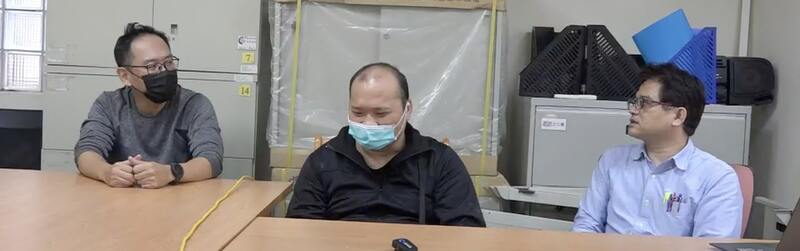 Photo: Wanhua Social Welfare Center social worker Chu I-Chun, Da-Pang, and Professor Wu Tsung-Sheng
Professor Wu Tsung-Sheng of the Department of Sociology at Fu Jen Catholic University has long worked with a debtors' self-help association, helping people resolve consumer debt and rebuild their lives. At Professor Wu's introduction, we visited the Wanhua Social Welfare Center. The elevator opens onto a semi-open space with a simple counter and several tables where residents can speak face-to-face with social workers. Farther inside, the center resembles a supermarket warehouse, with boxes of warm clothing, bottled water, canned food, and other supplies stacked almost to head height. We walked through the supplies to a meeting area with a long table and began the interview.
The term "vagrant" was used in Taiwan's former Measures Governing the Control of Demobilized Soldiers and Vagrants and remains embedded in Article 17 of the Social Assistance Act and in local regulations governing placement and assistance for vagrants. In recent years, advocates have increasingly used the more neutral term "unhoused person" to describe the condition of being without stable housing.
Taiwan has more than 3,000 unhoused people, roughly one quarter of them in Taipei City. More than 200 stay around Taipei Main Station and more than 100 around Bangka Park. Zhongzheng and Wanhua Districts together account for roughly 550 people. The population also turns over constantly, with about 100 people leaving and another 100 arriving each quarter.
Chu I-Chun, nicknamed Da-Chu, has worked at the Wanhua Social Welfare Center for ten years. During her first two years she served low-income families, older people living alone, and unhoused clients; for the past eight years she has focused specifically on homelessness. Although all 12 Taipei districts have social-welfare centers, homelessness is concentrated heavily in Zhongzheng and Wanhua, so the Department of Social Welfare established a dedicated homeless-services team in Wanhua. Five social workers serve approximately 550 to 600 unhoused people.
Da-Pang has known Da-Chu for eight or nine years. When they first met, he was sleeping in internet cafés in Ximending. At the time, Ximending had many telephone-dating advertisements, and Da-Pang worked by riding a bicycle with a lit "0204" advertising sign mounted on the back. He has also worked in security and telemarketing. Social workers later helped him rent a place and obtain a disability certificate. He now lives in a psychiatric rehabilitation residence and works during the day at the Wanhua Social Welfare Center. Da-Chu said many clients need this kind of sustained support-someone helping with the countless small details of daily life and watching whether money and identification documents are being managed safely-because otherwise it is easy to fall into another cycle.
An Ever-Changing Range of Schemes
Most unhoused people do not understand what may happen after they hand over identification documents or bank accounts. The schemes have also become so varied that even social workers can have difficulty recognizing which situations are dangerous.
One recent case reached the news after a clinic used unhoused people's National Health Insurance cards to make fraudulent NHI claims. The scheme was discovered when an unhoused client was injured in a fight and taken to an emergency room. He did not have his NHI card, which meant emergency treatment could cost several thousand NT dollars. When asked to retrieve the card, he explained that a clinic was holding it because it had enrolled him in a "program" requiring weekly visits. A doctor asked a few basic questions each time, and he received a NT$200 transportation allowance.
At first, the social worker thought it might be a Health Promotion Administration program and assumed the clinic was holding participants' cards for convenience. But after obtaining the client's treatment records from the National Health Insurance Administration, the social worker discovered visits to a smoking-cessation clinic. The client said he had never smoked, and the social worker had never seen him use nicotine patches or similar products. The center therefore contacted the NHI authorities, asked them to investigate, and demanded return of the card. It then emerged that the clinic was holding several unhoused people's NHI cards and using them to claim reimbursement.
The same client had previously been taken to register mobile-phone lines. He was told a company needed "business phones" and offered him NT$2,000 to help open seven lines. After the social worker learned what had happened, they went back to the telecom companies one by one, terminated the contracts, and signed declarations that the client would not open further lines with those companies. The companies waived the early-termination charges, and all seven lines were shut down.
Later, five or six men dressed in black came to the social-welfare center and told the social worker to stop interfering. In addition to canceling the phone lines, the social worker raised some money to give the group. While the client was physically at the center, the men were unlikely to assault him; once he returned to the street, however, he could be beaten.
Account Collectors on the Street
Da-Chu observed that these men regularly appeared near parks, approaching unhoused people for identification documents or signatures. They often gathered at cafés or convenience stores near Longshan Temple to smoke and talk. Only then did social workers realize how large this underground "business" on the street had become. When familiar account collectors appeared again, staff would alert the police, but officers could do little more than watch and try to keep them away from particular unhoused people.
When social workers learned that someone was being taken to open phone lines, calling the local police station often produced no concrete response because, at that point, no completed "crime" had yet occurred.
"Who is the victim right now?"
"The unhoused person's identification documents were taken."
"Were the documents returned?"
"Yes, but the phone lines opened with them are going to be used for fraud."
"Has anyone actually been defrauded?"
"Not yet."
"If not, how can you say there has been fraud?"
And that was where the attempt to report the matter ended.
For fraud rings, unhoused people can become a convenient "labor pool" for obtaining dummy accounts and recruiting low-level money mules. Their connections with mainstream society are often weak, they are highly visible on the street, and being approached by strangers is already part of daily life. Police officers, social workers, volunteers, and members of the public regularly come through parks and other street spaces asking questions or offering assistance.
If the person approaching them also controls access to day labor, temple-fair troupe work, or simply holds greater power within street life, refusing a request for identification or a bank account becomes even harder.
"Give me your ID so I can put you on the insurance."
"If you don't, I won't call you for the next troupe job."
"You won't cooperate? Then don't expect to sleep here."
Da-Pang said the period when he was caught up in a dummy-account case was extremely stressful because people involved kept threatening to come after him.
The Street, the Hospital, and the Correctional System
Da-Chu has also found that many unhoused people have limited cognitive functioning or difficulty understanding abstract concepts, while their familiarity with legal rules is extremely weak. She once saw someone at Taipei Main Station carrying a thick stack of labor-remuneration forms and asking unhoused people to sign them. They signed without understanding what the documents were because charity groups sometimes use a superficially similar process-provide personal information, sign a form, receive relief money. In this way, personal data could be obtained and used by companies for tax purposes.
Police, prosecutors, and judges may likewise have difficulty determining the circumstances in which an unhoused person handed over an ID, account, or signature and whether the person actually had the intent or capacity required for aiding fraud. In serious criminal cases, resources may be available for psychiatric or intellectual-disability evaluations. In these comparatively "small" cases, those resources rarely enter the process.
The Wanhua Social Welfare Center helps more than 100 people each year with placement or rental housing, yet the overall number of unhoused people in the area does not decline. Around 70% come from other counties or cities and had already been homeless for some time before reaching Wanhua. In recent years, the population has also become older and more medically vulnerable, with higher proportions of disability and mental illness. People who can be connected successfully with employment and housing often leave the street; those who remain are increasingly the most vulnerable among the vulnerable.
Da-Chu said some clients spend years moving among only three places: the street, the hospital, and a correctional institution. They become ill and enter a hospital, where staff discover an outstanding warrant. They are then incarcerated, psychiatric treatment is interrupted, and after release they return to the street. Another offense or warrant may follow. The cycle begins again.
A Candle in the Wind
Professor Wu Tsung-Sheng said the debtors' self-help association had previously worked with Homeless Taiwan Association to help five unhoused people address debt and pursue financial rehabilitation. Within three months, all five stopped participating because more urgent crises had overtaken them; debt was no longer the most immediate problem.
Compared with most people, unhoused people face more frequent and more severe risks while having much less capacity to absorb them. Their lives can feel like protecting a candle in the wind: at any moment, a new and urgent crisis can extinguish what little stability remains, or life can be consumed gradually as a person moves among the street, the hospital, and the correctional system.
Da-Chu described dummy phone lines and dummy accounts as a "critical gear" in the criminal supply chain. The people whose identities are used are necessary to the fraud but cannot hide themselves. She compared them to disposable chopsticks: the fraud ring uses them to pick up large amounts of stolen money, then leaves the stained chopsticks behind to be thrown away.
That returns us to Da-Chu's opening observation: social workers often have to follow clients carefully through the small details of life, because one misstep can send an unhoused person back into yet another cycle.
This article is an AI-generated translation of the original Chinese text. In the event of any discrepancy, the Chinese version shall prevail.