
JRF Newsletter
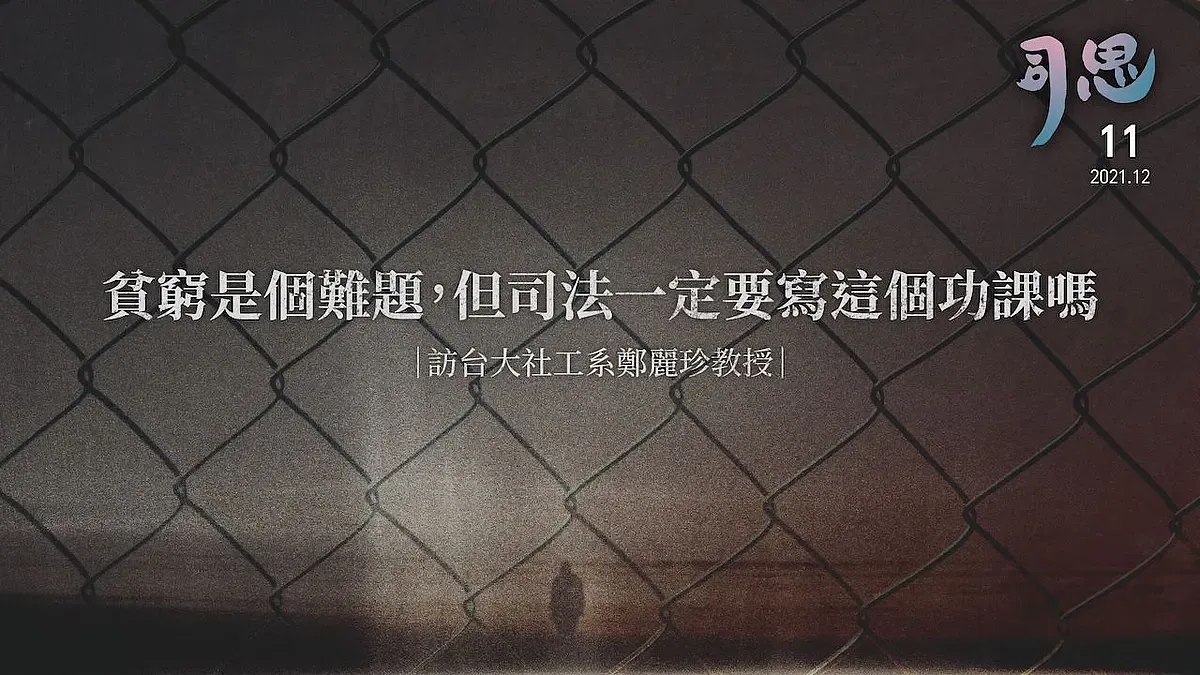
Poverty Is a Difficult Assignment-but Must the Judiciary Complete It? | Interview with NTU Professor Li-Chen Cheng
Last edited: 2026-08-30
As a student studying both law and social work, I understand both fields as professions that try to "help people." Yet their training emphasizes different things. Law classifies behavior through legal elements; we learn to identify the applicable rule, fit the facts to it, and reach an appropriate legal evaluation of conduct. Social work places much less emphasis on judging people. In fact, withholding judgment is a basic professional discipline. Because that runs against ordinary human habits, social-work education spends far more time teaching students to look for the meanings behind behavior and to understand the environments and contexts in which people act.
Law and social work therefore help in different ways and see problems from different angles. But if both professions are forms of "working with people," it seems impossible to separate conduct completely from the environment in which it occurs. I remain optimistic that bringing the two together can produce a fuller understanding of the person. That was one reason I interned at the JRF: I wanted to see how legal and social-work perspectives might complement each other.
I am clearly not the only person curious about the intersection. Li-Chen Cheng, Professor Emerita in the Department of Social Work at National Taiwan University, specializes in poverty, family social work, and child welfare. She began her career as a frontline social worker and accumulated more than a decade of practice experience before earning a doctorate in the United States. After returning to Taiwan, she became involved in research on homelessness and began combining empirical study with practice experience to promote asset-based anti-poverty policies, some of which were later adopted by government. In 2021, she received a Ministry of Health and Welfare award recognizing her contributions to social work. More recently, driven by her own curiosity, she also completed legal studies and became, in her words, a student of law.
When I began my JRF internship this semester, the Foundation was working on disputes surrounding dummy-account cases. In practice, prosecutors and judges often infer that a person who handed over an account knew something was wrong and nevertheless accepted the risk that it would be used for fraud or money laundering. The person may therefore be prosecuted and convicted on a theory of dolus eventualis for aiding fraud or money laundering. Yet for more than a decade, people who urgently needed money or lacked social experience have repeatedly said they were deceived into giving up their accounts. Because many defendants are economically vulnerable, the issue has also generated debate over class bias.
We used that controversy as a starting point for an interview with Professor Cheng, hoping to understand more about poverty and the justice system and to compare how legal and social-work thinking approach the same public debate.
Looking Back at Taiwan's Governance of Homelessness: What Is Poverty Trying to Tell Us?
We did not begin by asking what poverty means. Instead, we jumped directly to how social work and the justice system view people in poverty. Professor Cheng quickly brought the conversation back to "poverty attribution": academic research has long shown that how people explain the causes of poverty strongly shapes their attitudes toward those who are poor.
The public often relies on individual attribution-the idea that poverty results from laziness or insufficient effort. Unhoused people are consequently among the most stigmatized and disliked populations in social welfare, and service outcomes are often difficult to achieve. Taiwanese culture also strongly values the idea that anyone who is physically capable should work and that hard work will necessarily produce economic security.
Reality is more complicated.
Professor Cheng conducted major studies of homelessness in 2004 and again in 2013. The projects reviewed domestic and international research and administrative materials, surveyed unhoused people about demographics, living arrangements, employment, social networks, and use of resources, surveyed local homeless-service providers about welfare delivery, conducted in-depth interviews about street life, and held focus groups with both unhoused people and service workers. The goal was to understand homelessness as a process rather than merely record a static population.
Both studies emphasized that homelessness does not occur overnight. It develops through a sequence of adverse events and disadvantaged conditions: limited human capital, disability, domestic violence or family disruption, economic downturns, weak labor markets, welfare restrictions tied to place of registration, and fragile family networks. Homelessness therefore reflects not only individual dysfunction but also broader economic structures. Although many respondents had worked and earned income, their jobs were often temporary, unstable, and low-paid, making it difficult to escape a downward spiral (Cheng, 2004; Cheng, 2013).
Street life itself also creates risk. People living outdoors may face police enforcement, verbal abuse, theft, or violence arising from use of public or private space. The 2013 study also noted that some respondents had histories involving imprisonment-for example, drug offenses, domestic violence, assault, or fraud involving accounts-as well as traffic injuries, illness, and collapse on the street. Living outdoors is a high-risk way of life.
The surveys identified housing and employment as especially important factors in homelessness. Addressing those barriers can reduce risk. Ke-Hsien Huang's 2021 book *Precarious Living*, however, argues that Taiwan's housing system remains highly commodified and dependent on the private market. Powerful interests surrounding housing, together with stigma toward unhoused people and policy expectations of "self-reliance" and return to family or conventional work, have made Housing First difficult to adopt.
Professor Cheng emphasized that poverty is multidimensional and cannot be separated from social structure. The COVID-19 pandemic, for example, sharply reduced employment opportunities and closed many places that had previously provided food or supplies, exposing unhoused people to a macro-level shock they could not control. A structural perspective therefore changes the question from "why did this person fail?" to "what combination of personal events and economic and institutional conditions produced this situation?"
What Dummy-Account Debates Reveal About Legal and Social-Work Thinking
Historically, social workers and courts interact most often in family cases, juvenile matters, and criminal cases involving people with mental disabilities. In those fields, social workers have gradually acquired a recognized role and judges are increasingly willing to hear their views. But when "poverty"-a classic social-work issue-enters a courtroom, the two professions still seem unfamiliar with one another.
People living on the street are frequently targeted by fraud rings. Identification cards, bankbooks, seals, and bank accounts may be purchased or obtained and then used as dummy accounts. Courts may infer that the account holder had dolus eventualis to aid fraud-that the person knew the account might be used unlawfully and nevertheless accepted that possibility-and convict the person as an aider.
We asked Professor Cheng what she thought of that practice.
If you punish these people, have you actually deterred the conduct? Criminal law always says deterrence is one of its purposes-but what, exactly, have you deterred?
She turned the question around: what is the justice system trying to achieve?
Sometimes what frightens me most is the idea of "just doing one's duty." Think of *Les Misérables*: the prosecutor is doing his duty, and yet the story makes everyone who reads it heartbroken. There has to be something wrong somewhere.
Legal professionals talk about justice, and social workers talk about justice too. Why does social work enter these fields? Because some people face much stronger structural disadvantages and have fewer opportunities to survive or recover than others. To restore balance, we provide resources and support so that they have something closer to equal opportunity. That is roughly our mission. Social justice, to me, means recognizing when one side is weaker and strengthening that side enough to make equality possible. I often feel the justice pursued by law is something different.
So we have to return to the root of the question: what is the justice system seeking? What does "justice" mean to legal professionals?
What I often hear is a concern with right and wrong. But justice, to me, is not only about right and wrong; it is also about equity and equality.
Professor Cheng joked that she originally studied law because she wanted to understand criminal law, only to discover that everyone seemed to be looking for "punishment"-how to punish the person before them. Law and social work both care about justice, but if their basic conceptions of justice begin from different places, that helps explain why dialogue between them can be difficult.
Whose Assignment Is Poverty? Why Should Any of Us Have to Study It?
But on what basis can we say that everyone has an obligation to care about poverty?
Because any of us could become poor. The probability of falling into poverty can be much higher than people imagine, especially after a large external shock. A financial crisis can send unemployment to 9% and suddenly affect entire families. Even at NTU, a student may enter first year with a stable family situation and then see the family collapse financially in second year. The student takes a campus job that pays very little, then adds outside work where exploitation and long hours are common, returns to class exhausted, and enters a downward cycle.
How should I put it? Sometimes I think what is needed is simply a little more *thiann-sim*-a Taiwanese expression for feeling another person's pain and caring for them.
If we all live in the same society, why should some people have so much less than the rest of us? It should not have to be that way. Without that kind of human-rights understanding, it becomes very difficult to keep explaining why someone deserves help.
For Professor Cheng, developing awareness and sensitivity toward poverty begins with something very basic: seeing and understanding the constraints and pain experienced by people who are poor is a natural part of recognizing their humanity.
Structural explanations do not mean individuals have no agency. They mean that agency can be severely constrained by the structure in which a person lives. A major shock can push almost anyone out of the social safety net. Poverty reminds us that what we possess is not solely the result of hard work; luck and circumstance matter enormously.
And What About the Judiciary? Does It Have to Do This Difficult Assignment Too?
Discussion of homelessness often begins with the right to adequate housing under the International Covenant on Economic, Social and Cultural Rights: a right held regardless of income or economic resources, including the right to live somewhere in security, peace, and dignity and to receive legal protection against forced eviction, harassment, and other threats.
Legislatures and executive agencies bear the primary responsibility for protecting basic living rights. But when the state fails earlier in the process, the justice system may become the last institution to encounter the person. Public debate therefore asks how courts can support rather than obstruct rights. Yet perhaps an even more basic question must come first: what is the purpose of the judiciary, and how far do its obligations extend?
Professor Cheng did not give us a definitive answer. Instead, near the end of the interview she recalled first encountering homelessness research in 2004, when living conditions on the street were extremely poor and even places to wash were rare. Government and service organizations gradually began providing food, washing facilities, medical care, and other emergency assistance. After the first decade, more private organizations entered homeless services. After the second, even more groups were providing direct support and challenging the stigma attached to poverty. She hoped the third decade would continue moving in the same direction:as long as those who see do not turn their heads away,perhaps one day poverty will no longer be a label that people cannot tear off.
And I keep wondering: if the justice system also refuses to look away, can it recognize, at the very moment it "evaluates" a person, both the muddy water stirred up by a thrown stone and the futility of throwing a stone into the sea?
Huang, Ke-Hsien (2019). "'Vagrants,' 'Workers,' and 'People Having a Hard Time': Social Actors in Taiwan's Field of Homelessness." *Taiwanese Sociology* 38: 63-64.
Huang, Ke-Hsien (2021). *Precarious Living: The Social World and Helping Networks of Homeless People*. Taipei: Spring Hill Publishing.
Cheng, Li-Chen (2004). *Research on Homelessness: Investigation, Analysis, and Policy Responses*. Commissioned research report, Department of Social Affairs, Ministry of the Interior.
Cheng, Li-Chen (2013). *Survey of the Living Conditions of Homeless People*. Commissioned research report, Ministry of the Interior.
This article is an AI-generated translation of the original Chinese text. In the event of any discrepancy, the Chinese version shall prevail.