
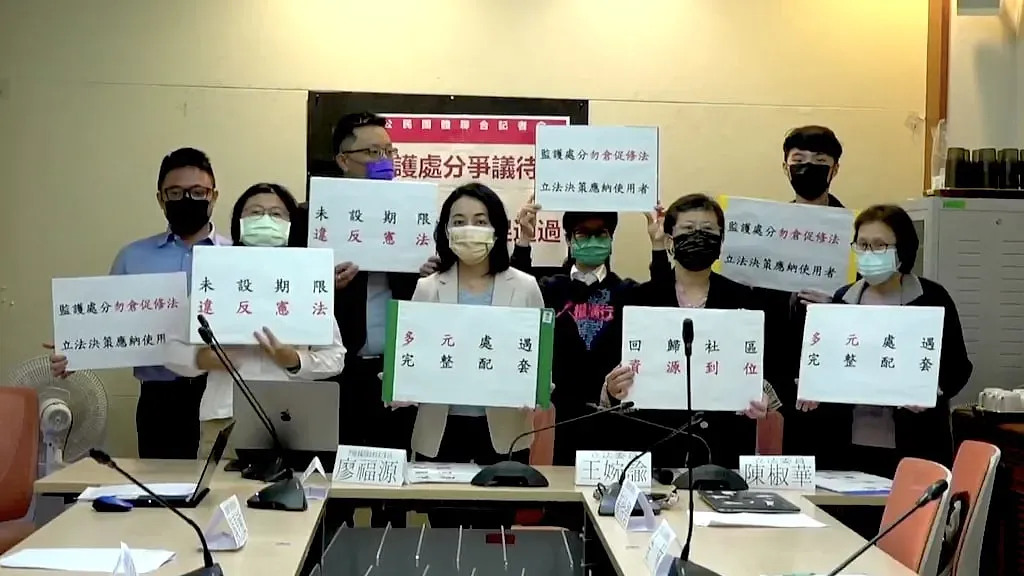
Joint Statement | Do Not Rush the Custodial-Protection Amendments Before Constitutional and Preventive Concerns Are Resolved
Last edited: 2026-08-30
On January 5, 2022, the Legislative Yuan was scheduled to set the agenda for the extraordinary session. The Democratic Progressive Party caucus proposed handling "one constitutional amendment, two budgets, and ten bills," including amendments concerning custodial protection under the Criminal Code, Code of Criminal Procedure, and Rehabilitative Disposition Execution Act. Yet the proposals remained highly controversial, and the closely related Mental Health Act had not even cleared the Executive Yuan. Without coordinated legislation, implementation risked creating a fragmented and confused legal framework.
With an extraordinary session already expected to handle major matters such as constitutional amendment and the budget, these technically complex and controversial bills should not be rushed. Passing them before the underlying problems are resolved could create new problems without improving public safety and could infringe the rights of people with mental illness who come into conflict with the law. The undersigned civil-society organizations therefore call for removing the custodial-protection amendments from the extraordinary-session agenda, resolving the disputed issues carefully, and coordinating the framework with the Mental Health Act so that reform genuinely responds to social needs while protecting human rights.
-
Applying Custodial Protection to Minor Offenses Without a Firm Execution Limit Raises Multiple Constitutional Concerns
J.Y. Interpretation No. 471 states that a rehabilitative disposition must be proportionate to the seriousness of the act, the dangerousness demonstrated by the person, and reasonable expectations concerning future conduct. Custodial protection is a form of rehabilitative disposition and must comply with that principle. Yet statistics from 2016 through March 2020 show that theft-an offense carrying a maximum term of five years or less-accounted for 34% (297 cases) of final custodial-protection decisions. These were not the serious violent offenses that dominate public discussion, raising a substantial mismatch with the principle stated in Interpretation No. 471.
J.Y. Interpretation No. 812 further requires that rehabilitative dispositions restricting personal liberty leave courts room to consider the circumstances of the individual case and decide both whether a disposition is necessary and what it should contain, in order to satisfy substantive due process, the ideal of a fair court, and proportionality between punishment and rehabilitative disposition. The same 2016-March 2020 data show 183 theft cases involving one year of custodial protection, 85 involving two years, 19 involving three years, and 10 exceeding three years. By comparison, among final theft convictions from 2011 through 2020 in which custodial protection was not imposed, 44.1% resulted in short-term imprisonment and another 36% in imprisonment of less than six months-nearly 80% were six months or less and many were commutable to a fine. The disparity risks discriminatory treatment of people with mental illness who come into conflict with the law and raises serious concerns under Interpretation No. 812.
J.Y. Interpretation No. 799 warns that indefinite compulsory treatment can become disguised indefinite deprivation of liberty or even the equivalent of life imprisonment, exceeding what a person can reasonably be expected to bear. Treatment cannot become a pretext for indefinite confinement. Yet the proposed Article 87, Paragraph 3 of the Criminal Code would remove the existing time limit on custodial protection and permit continued restrictions on liberty in the name of treatment. The Judicial Yuan itself expressed concern that the proposal could conflict with Interpretation No. 799. A regime exposing a person to potentially indefinite confinement also places defense counsel in a difficult position and can substantially impair the right to assistance of counsel.
Taken together, the data show that nearly 35% of final custodial-protection cases involved theft-an offense generally low in seriousness and dangerousness-while the periods of confinement could be lengthy. The draft would not cure this defect; it would remove the existing five-year ceiling. Civil society therefore calls not only for preservation of a meaningful time limit but also for exclusion of minor offenses such as theft where the required seriousness and dangerousness are absent. Appropriate statutory thresholds should be established before the legislation proceeds.
-
Resources Are Overconcentrated on Institutions, While a Transition Meeting Only Two Months Before Release Is Far Too Little
The second phase of the Social Safety Net Project allocated NT$3.46 billion to "enhance custodial protection," including development of forensic psychiatric hospitals and security staffing, and another NT$260 million for forensic psychiatric wards. Enormous resources were directed toward institutional settings serving roughly 200 people a year. At the same time, psychiatric services inside correctional institutions were not strengthened proportionately, and comparable or greater resources were not invested in community mental-health care. Yet front-end prevention and community support are precisely what can prevent people with mental illness from falling through gaps in the system.
The proposed amendments also neglect reintegration at the back end. Draft Article 46-3, Paragraph 1 of the Rehabilitative Disposition Execution Act would require prosecutors to convene a transition meeting only two months before custodial protection ends, without a detailed statutory framework. Japan's Medical Treatment and Supervision Act, by contrast, incorporates social-reintegration coordination mechanisms. A throughcare approach requires social resources to enter the institution early, individualized release planning to begin well before discharge, and institutional and community services to work together. That is also consistent with the principles of independent living and inclusion in the community under Article 19 of the Convention on the Rights of Persons with Disabilities.
The overall allocation of resources should therefore be reconsidered. Front-end prevention and diverse community services should be strengthened instead of continually expanding institutional treatment. Article 46-3 of the Rehabilitative Disposition Execution Act should at minimum require an individualized social-reintegration plan, specify the procedures and participants for planning and transition meetings, and require the Ministry of Justice to adopt implementing rules. Without those safeguards, the amendments should not be rushed through.
-
The Draft Does Not Solve Forensic-Psychiatric Evaluation During Investigation and Excludes Diverse Treatment Options
Article 203 of the Code of Criminal Procedure provides a basis for detention for expert examination and can support forensic-psychiatric evaluation during an investigation. Points 79 and 80 of the Directions for Prosecutors Handling Criminal Cases also address the subject. In practice, however, these are general provisions without detailed operational guidance, budgets are inadequate, and qualified psychiatric experts may be difficult to secure. The draft does not solve that problem. Proposed Article 121-1 of the Code of Criminal Procedure does not establish a procedure or method for identifying defendants whose mental condition may be legally relevant; its legislative explanation merely says that an application should include relevant evaluation reports, differential diagnoses, or medical records for the court to review.
At the same time, temporary placement could last as long as five years while the proposed framework focuses on institutional placement, such as admission to a forensic psychiatric hospital, without building in sufficiently diverse treatment options or mechanisms for adjusting treatment as the person's condition changes.
Article 121-1 of the Code of Criminal Procedure should therefore expressly address forensic-psychiatric evaluation during investigation and authorize the Ministry of Justice, in coordination with Article 203, to adopt practical rules and concrete guidance. Temporary placement should likewise include diverse treatment options that can be adjusted as the person's condition changes.
Complex Problems Cannot Be Solved with a Simple Fix; Reform Must Be Coordinated with the Mental Health Act
In summary, the custodial-protection amendments fail to establish application thresholds tied to seriousness and dangerousness and raise constitutional concerns by permitting potentially indefinite restrictions on liberty. Resource allocation remains overly institutional, prevention is underdeveloped, and reintegration mechanisms are inadequate. The temporary-placement provisions do not resolve forensic-psychiatric evaluation during investigation and do not provide sufficiently diverse treatment options for a placement that may last up to five years. Even after those defects are addressed, the system must be coordinated within the broader framework of the Mental Health Act. Without that legislation and without careful discussion of its own unresolved issues, there can be no complete package. Reform should protect both public safety and the human rights of people with mental illness who come into conflict with the law, rather than offering a populist response to public anxiety that ultimately solves little.
The undersigned civil-society organizations therefore urge the legislature not to pass the amendments until these issues have been fully addressed and the framework has been coordinated with the Mental Health Act.
Co-Signing Organizations
Eden Social Welfare Foundation
Taipei Life of Heart Association
Prison Watch
Taiwan Association for Human Rights
Covenants Watch
Judicial Reform Foundation
Taiwan Alliance to End the Death Penalty
Taiwan Criminal Defense Lawyers Association
Taipei Bar Association
Public Interest and Rule of Law Education Committee, Taoyuan Bar Association
Attendees
Chin Lin / Secretary-General, Taipei Life of Heart Association
Liao Fu-Yuan / Director, Fountain House, Eden Social Welfare Foundation
Chen Hui-Min / Chairperson, Prison Watch
Weng Kuo-Yen / Executive Committee Member, Taiwan Association for Human Rights
Sylvia Yi-Pi Huang / Executive Director, Covenants Watch
Lin Chun-Ju / Director, Legal Policy Department, Judicial Reform Foundation
Lin Tzu-Wei / Legal Affairs Director, Taiwan Alliance to End the Death Penalty
Press Contact
Lin Chun-Ju / Director, Legal Policy Department, Judicial Reform Foundation
This article is an AI-generated translation of the original Chinese text. In the event of any discrepancy, the Chinese version shall prevail.
Because of you, we have the power to reform and progress !
Support judicial reform activities
Donate Now