
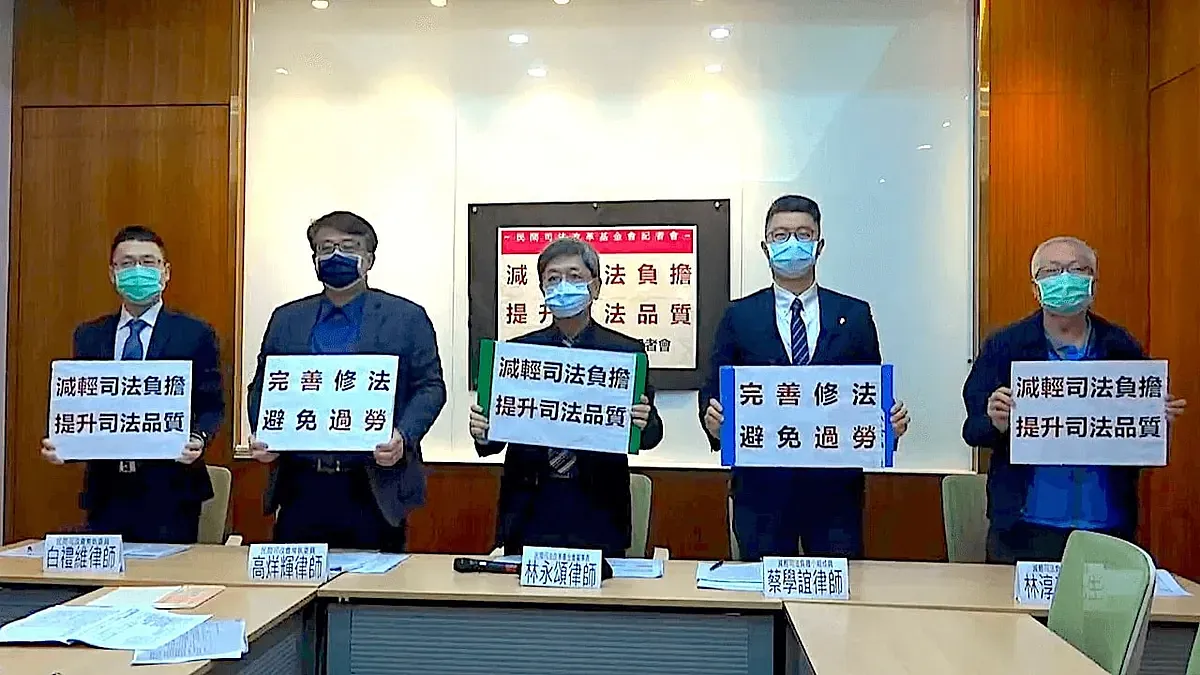
Press Conference | Reducing Judicial Workload and Improving Judicial Quality-Release of the Judicial Workload Reduction Draft
Last edited: 2026-08-30
The need to reduce judicial caseloads was already raised at Taiwan's first National Conference on Judicial Reform in 1999. By the conclusion of the 2017 National Conference on Judicial Reform, reformers were still debating how to build a more efficient judiciary with authority and responsibility properly aligned, including simplification of judicial decisions, control of abusive litigation, staffing, decriminalization of selected offenses, and implementation of a pyramid-shaped litigation system. More than two decades later, Taiwan's judicial workload remains heavy.
Statistics from the Judicial Yuan and Ministry of Justice show that courts and prosecutors offices continue to face overwhelming case volumes. The burden falls not only on judges and prosecutors but also on clerks, judicial assistants, and court security personnel, contributing to chronic overwork and affecting the quality of case handling. In 2020, even counting only newly received investigation matters, a district prosecutor in Taiwan handled an average of 36 new cases per month compared with 9 in Japan-a fourfold difference. Including enforcement and other matters, the monthly average in Taiwan reached 155 new cases.
| Monthly Cases Disposed of by District Courts (2020) | |
| Criminal Cases | 58.92 cases (average processing time: 85.46 days per case) |
| Civil Cases | 74.36 cases (average processing time: 33.37 days per case) |
| Monthly New Cases per District Prosecutor (Jan.-Oct. 2021) | |
| 187 cases (investigation, enforcement, and other matters combined; average processing time: 61.67 days per case) | |
| Source: 2020 Overview of Cases Received and Disposed of by the Judicial Yuan and Its Subordinate Agencies 2021 Statistical Summary, Ministry of Justice |
|
| Annual Newly Received Cases |
Prosecutorial Staffing | Average Annual Caseload per District Prosecutor |
Average Monthly Caseload per District Prosecutor |
||
| Supreme Prosecutors Office | |||||
| High Prosecutors' Offices | |||||
| District Prosecutors' Offices | |||||
| Total Staffing | |||||
| Taiwan |
499,607 328,797 1,342,008 |
19 |
429 282 1,152 |
36 (New Investigation Matters) 24 (Enforcement Matters) 96 (Other Matters) |
|
| 173 | |||||
| 1,165 | |||||
| 1,357 | |||||
| 2,170,412 (All Cases) |
1,863 (All Cases) | 155 (All Cases) | |||
| Japan | 283,429 (New Regularly Accepted Cases) |
18 | 109 (New Regularly Accepted Cases, including assistant prosecutors) 164 (New Regularly Accepted Cases, excluding assistant prosecutors) |
9 (New Regularly Accepted Cases, including assistant prosecutors) 14 (New Regularly Accepted Cases, excluding assistant prosecutors) |
|
| 130 | |||||
| 2,610 | 1,731 excluding assistant prosecutors |
||||
| 2,758 | 1,879 | ||||
|
|||||
As Posner, Epstein, and Landes observe in The Behavior of Federal Judges, judicial behavior cannot be understood only through formal rules or political theory. Judges and other participants in the judicial labor market also respond to time constraints, working conditions, quality-of-life concerns, professional norms, and institutional incentives. Excessive caseloads therefore create a practical obstacle to better adjudication and meaningful protection of individual rights.
Against that background, the Judicial Reform Foundation convened practitioners concerned with judicial workload and, after repeated discussions, released the draft "Reducing Judicial Workload and Improving Judicial Quality" proposals today (see Appendix). The proposals seek to reduce unnecessary workload through five areas of reform: making better use of prosecutors' authority not to require transfer of an arrested suspect and to grant deferred prosecution; simplifying unnecessary trial procedures; adjusting plea-bargaining rules; clarifying judicial assistants' work; and expanding outsourced transcription. The JRF hopes this can begin a broader dialogue with the Judicial Yuan and Ministry of Justice about the working conditions of frontline judicial personnel and how the litigation system can deliver better-quality justice.
Making Better Use of Prosecutors' Non-Transfer and Deferred-Prosecution Authority
As a rule, judicial police who arrest or receive a flagrant offender must immediately transfer the person to a prosecutor. Existing exceptions are narrow: non-transfer generally requires prosecutorial approval and is limited to relatively minor offenses or certain complaint-based offenses. As a result, police and prosecutors may have to complete transfer procedures within 24 hours even in straightforward drug-use or minor-theft cases, compressing investigative time and contributing to late-night work. The proposal would broaden Article 92 of the Code of Criminal Procedure so that, with prosecutorial approval, non-transfer could also be used for minor theft, offenses carrying a maximum term of no more than three years, and offenses prosecutable only upon complaint or request.
Proposed Amendment
Article 92 of the Code of Criminal Procedure
- A person without authority to investigate crimes who arrests a flagrant offender shall immediately deliver the arrested person to a prosecutor, judicial police officer, or judicial police.
- A judicial police officer or judicial police who arrests or receives a flagrant offender shall immediately transfer the arrested person to a prosecutor.
-
Where any of the following circumstances exists and a prosecutor determines that transfer is unnecessary, the preceding paragraph need not apply:
- The offense is a minor violation of Article 320, Paragraph 1 of the Criminal Code.
- The offense carries a maximum principal punishment of imprisonment for no more than three years.
- The offense is prosecutable only upon complaint or request.
- A person who arrests a flagrant offender under Paragraph 1 shall be questioned as to name, domicile or residence, and the reason for the arrest.
Deferred prosecution is currently unavailable for offenses punishable by death or life imprisonment or carrying a minimum principal punishment of imprisonment for three years or more. The JRF argues that this leaves prosecutors too little room to divert appropriate cases and sends more matters into resource-intensive court proceedings. In 2015, Taiwan prosecuted 42.71% of the relevant cases, compared with 19.01% in Japan. Japan, with a population of about 127.09 million, prosecuted roughly 180,000 people, while Taiwan, with about 23.53 million people, prosecuted approximately 226,000. The comparison suggests that Taiwan makes relatively limited use of prosecutorial mechanisms for filtering and diverting cases.
| Total | Prosecuted | Deferred Prosecution | Non-Prosecution | Other | |
| Taiwan | 529,775 (100%) | 226,278 (42.71%) | 47,743 (9.01%) | 186,278 (35.16%) | 69,476 (13.11%) |
| Japan | 947,179 (100%) | 180,044 (19.01%) | -- | 620,376 (65.50%), of which 557,415 (89.85%) were suspensions of prosecution | 146,759 (15.49%) |
| Source: Lin Meng-Huang, comparison of population, prosecutorial staffing, and criminal case dispositions in Taiwan and Japan | |||||
The proposal would remove the offense-based ceiling in Article 253-1 of the Code of Criminal Procedure and add a further condition under Article 253-2 allowing prosecutors, for matters such as environmental offenses or cases requiring restoration, to impose appropriate orders after considering the harm caused and the defendant's financial or credit circumstances. It would also narrow ex officio reconsideration under Article 256 to offenses carrying a minimum principal punishment of imprisonment for three years or more. Finally, Point 9 of the prosecutorial guidelines would award 0.02 case-performance points for each final deferred-prosecution disposition and another 0.02 if it is not revoked, while allowing district prosecutors offices to offset a specified volume of deferred-prosecution cases against ordinary investigation assignments. The goal is to create practical incentives for appropriate use of deferred prosecution.
Proposed Amendments
Article 251, Paragraph 1 of the Code of Criminal Procedure
- Unless otherwise provided by law, Where, based on the evidence obtained in the investigation, there is sufficient suspicion that the defendant committed an offense, the prosecutor shall institute a public prosecution.
Article 253-1, Paragraph 1 of the Code of Criminal Procedure
- Where the investigation establishes sufficient suspicion that the defendant committed an offense and the procedural requirements for prosecution are met, but the prosecutor considers deferred prosecution appropriate after taking into account the matters listed in Article 57 of the Criminal Code, the seriousness of the case, and the public interest, the prosecutor may issue a deferred-prosecution disposition for a period of not less than one year and not more than five years, beginning on the date the disposition becomes final.
Article 253-2, Paragraph 1 of the Code of Criminal Procedure
- When issuing a deferred-prosecution disposition, a prosecutor may order the defendant to comply with or perform any of the following within a specified period:
- Apologize to the victim.
- Submit a written statement of repentance.
- Pay the victim an appropriate amount as compensation for pecuniary or non-pecuniary harm.
- Pay a specified amount to the public treasury; the competent prosecutors office may allocate a prescribed percentage to subsidize qualifying public-interest organizations or local self-government bodies.
- Perform between 40 and 240 hours of community service for a designated government agency, public institution, administrative corporation, community, or other organization serving a public-interest purpose.
- Complete addiction treatment, psychiatric treatment, psychological counseling, or another appropriate intervention.
- Comply with orders necessary to protect the victim's safety.
- Comply with orders necessary to prevent reoffending.
- Comply with other appropriate and necessary orders after consideration of the harm caused by the offense and the defendant's financial or credit circumstances.
Point 9 of the Guidelines for Prosecutors Offices Handling Deferred-Prosecution Dispositions (excerpt)
(1) Agencies, institutions, and personnel handling deferred-prosecution dispositions shall properly safeguard defendants' personal data and maintain confidentiality.
(2) Performance-appraisal standards for relevant personnel are as follows:
- Prosecutors: for each final deferred-prosecution disposition issued under Article 253-1, Paragraph 1 of the Code of Criminal Procedure, 0.02 points shall be added to the prosecutor's overall case-handling score; if the deferred-prosecution disposition is not revoked by the end of the deferral period, another 0.02 points shall be added. Once final deferred-prosecution dispositions reach a specified volume, a district prosecutors office may offset them against the assignment of ordinary investigation cases.
(Remaining provisions omitted.)
Simplifying Unnecessary and Time-Consuming Trial Procedures
In uncontested matters, presenting each item of evidence individually for comment, reading or summarizing each undisputed document one by one, and repeatedly soliciting views after each item of evidence can consume substantial courtroom time without materially improving the trial. The proposal would amend Articles 164, 165, and 288-1 of the Code of Criminal Procedure so that, in counseled cases and with the consent of the parties and counsel, the court may circulate an evidence or document list before the hearing and obtain written views in advance. Parties and counsel could still summarize key points orally at the hearing. This would preserve defense rights while allowing the hearing to focus on genuinely disputed issues.
Proposed Amendments
Article 164 of the Code of Criminal Procedure
- The presiding judge shall present exhibits to the parties, agents, defense counsel, or assistants for identification.
- If an exhibit under the preceding paragraph is a document and the defendant does not understand its meaning, the presiding judge shall explain its gist.
- In a case in which the defendant is represented by counsel, if the presiding judge considers it appropriate and the parties, agents, defense counsel, or assistants consent, the court may provide an evidence list before the hearing and request written views from the parties, defense counsel, or agents. They may also state the gist of their views orally at the hearing, in which case the preceding two paragraphs need not apply.
Article 165 of the Code of Criminal Procedure
- Where records or other documents in the case file may be used as evidence, the presiding judge shall read them aloud or inform the parties, agents, defense counsel, or assistants of their gist.
- If a document under the preceding paragraph concerns public morals, public order, or matters that could damage another person's reputation, it shall be made available for inspection rather than read aloud. If the defendant does not understand its meaning, the presiding judge shall explain its gist.
- In a counseled case, if the presiding judge considers it appropriate and the parties, agents, defense counsel, or assistants consent, the court may provide a document list before the hearing and request written views from the parties, defense counsel, or agents. They may also state the gist of their views orally at the hearing, in which case the preceding two paragraphs need not apply.
Article 288-1 of the Code of Criminal Procedure
- After examination of each item of evidence is completed, the presiding judge shall ask the parties whether they have any comments. The preceding paragraph does not apply in the circumstances described in Article 164, Paragraph 3 and Article 165, Paragraph 3.
- The presiding judge shall inform the defendant that the defendant may present favorable evidence.
To make simplified and summary criminal proceedings more efficient and reduce time spent drafting uncontested judgments, the proposal would amend Article 454 by reference to the plea-bargaining rule in Article 455-9, under which a record of oral pronouncement can replace a full judgment, and to Article 434 of the Code of Civil Procedure, which permits incorporation of relevant documents by attachment. Under the proposal, the clerk could record the disposition, a summary of the criminal facts, and the applicable penalty provisions in the record of oral pronouncement, together with appeal instructions, in place of a separate judgment. The record could summarize or incorporate the indictment, hearing record, or other documents by reference and attach them as needed. Through Article 311-2, the same approach could be used in simplified proceedings, reducing unnecessary drafting in uncontested cases.
Proposed Amendments
Article 454 of the Code of Criminal Procedure
- A summary judgment shall contain the following:
- The matters listed in Article 51, Paragraph 1.
- The criminal facts and the evidence relied upon.
- The applicable statutory provisions.
- The matters listed in Article 309.
- Notice that an appeal may be filed within twenty days after service of the summary judgment, except where no appeal is permitted.
- The judgment may be prepared in simplified form. If the criminal facts, evidence, and applicable statutory provisions found by the court are identical to those stated in the prosecutor's request for summary judgment or indictment, the judgment may incorporate them by reference.
- In place of the judgment described in Paragraph 1, the court clerk may record the disposition, a summary of the criminal facts, the applicable penalty provisions, and appeal instructions in the record of oral pronouncement. The appeal period shall run from the date of oral pronouncement; however, a party may request delivery of a written judgment within ten days after pronouncement, in which case the appeal period shall run from service of that judgment.
- The record of oral pronouncement under the preceding paragraph may summarize the relevant matters or incorporate the prosecutor's indictment, hearing record, or other documents by reference and may attach those documents where necessary.
Creating Institutional Incentives to Use Plea Bargaining
Article 455-2 of the Code of Criminal Procedure presently permits bargaining over sentencing, confiscation, and probation, but not the offense of conviction or the number of offenses. Article 455-4 also bars a plea-bargaining judgment when the facts found by the court clearly differ from the facts agreed upon by the parties. The JRF argues that these restrictions make the procedure difficult to use flexibly. The proposal would permit bargaining over the offense so long as it remains within the same basic social facts. It would also amend Points 138 and 141 of the prosecutorial guidelines so that plea negotiations may proceed if a victim does not respond within one month after consultation; cases carrying a maximum punishment of no more than three years, short-term imprisonment, or a fine only would not require approval of the plea result by the chief prosecutor or chief prosecutor of the office; and pre-bargaining written exchanges in those cases would not require separate filing for review. These changes are intended to preserve appropriate supervision while making plea bargaining more workable.
Proposed Amendments
Article 455-2 of the Code of Criminal Procedure
- Except for offenses punishable by death or life imprisonment, offenses carrying a minimum principal punishment of imprisonment for three years or more, and cases within the High Court's first-instance jurisdiction, after a prosecutor institutes a public prosecution or files a request for summary judgment and before the close of oral argument at first instance or issuance of a summary judgment, the prosecutor may, after consulting the victim, either on the prosecutor's own initiative or at the request of the defendant, the defendant's agent, or defense counsel, and with the court's consent, negotiate outside the trial regarding the following matters. If the parties reach agreement and the defendant pleads guilty, the prosecutor may request that the court proceed under the plea-bargaining procedure and render judgment:
- The defendant agrees to accept an offense within the scope of the same basic social facts, a specified range of sentence and confiscation, or a suspended sentence.
- The defendant apologizes to the victim.
- The defendant pays an appropriate amount of compensation.
- The defendant pays a specified amount to the public treasury, of which the competent prosecutors office may allocate a prescribed percentage to qualifying public-interest organizations or local self-government bodies. A prosecutor negotiating the matters in Subparagraphs 2 and 3 shall obtain the victim's consent. The plea-negotiation period shall not exceed thirty days. Rules governing the allocation percentage and the receipt, expenditure, supervision, and management of amounts under Subparagraph 4 shall be jointly prescribed by the Executive Yuan and Judicial Yuan.
Article 455-4 of the Code of Criminal Procedure
- A court shall not render a plea-bargaining judgment under any of the following circumstances:
- The parties have revoked their agreement or the plea-bargaining request has been withdrawn under Paragraph 2 of the preceding Article.
- The defendant did not enter the plea voluntarily.
- The plea agreement is clearly improper or manifestly unfair.
- The offense is not one for which a plea-bargaining judgment may be requested under Article 455-2, Paragraph 1.
- The basic social facts found by the court clearly differ from the basic social facts covered by the plea agreement.
- The defendant has facts constituting another, more serious offense that would be treated as a single adjudicated offense.
- The court determines that it should pronounce exemption from punishment, dismissal, or inadmissibility.
- Unless one of the circumstances in the preceding paragraph applies, the court shall render judgment within the scope of the plea agreement without oral argument. The sentence imposed in a plea-bargaining judgment shall be limited to a suspended sentence, imprisonment for no more than two years, short-term imprisonment, or a fine.
- If the parties reach an agreement under Article 455-2, Paragraph 1, Subparagraphs 2 through 4, the court shall record the agreement in the record or judgment.
- When the court renders judgment within the scope of the plea agreement, agreements under Article 455-2, Paragraph 1, Subparagraphs 3 and 4 may serve as enforceable titles for civil compulsory execution.
Point 138, Paragraph 1 of the Guidelines for Prosecutors Offices Handling Criminal Cases
- Where a case has a victim, the prosecutor shall consult the victim before requesting the court's consent to conduct plea negotiations. This requirement does not apply if the victim fails to express a view within one month after receiving notice of the consultation.
Point 141 of the Guidelines for Prosecutors Offices Handling Criminal Cases
- Before plea negotiations begin, the prosecutor shall complete a form stating the time and place. If the prosecutor conducts the negotiations personally, a prosecutor's investigator or clerk shall be present to assist; if the prosecutor directs a prosecutor's investigator to conduct them, a clerk shall be present. The result shall be reduced to writing and signed by all participants.
- The plea-negotiation process may be audio-recorded where necessary.
- The plea-negotiation result shall be submitted to the supervising chief prosecutor or chief prosecutor for approval. This requirement does not apply where the defendant is charged with an offense carrying a maximum principal punishment of imprisonment for no more than three years, short-term imprisonment, or a fine only.
- Pre-negotiation exchanges shall be documented in writing and may be audio-recorded where necessary.
- The written record of pre-negotiation exchanges shall be submitted to the supervising chief prosecutor for review, except where the defendant is charged with an offense carrying a maximum principal punishment of imprisonment for no more than three years, short-term imprisonment, or a fine only.
Clarifying the Process for Judicial Assistants to Draft Judicial Decisions
Judicial assistants have long played an important role in supporting judges. In addition to assisting with procedural review, legal research, collection and organization of materials, analysis of issues, and compilation of earlier decisions, judicial assistants in practice also help prepare drafts of judicial decisions. Because the governing rules do not expressly address that work, the practice has generated controversy. The proposal would amend Article 24 of the Regulations Governing Selection, Appointment, Training, Work Management, and Evaluation of Judicial Assistants to include drafting judicial decisions and would add Article 26-1. When a judge directs an assistant to draft a decision, the judge would have to provide the proposed disposition and the reasons supporting the judge's evaluation of the case; the assistant would record those reasons and preserve an electronic revision history capable of third-party verification. The goal is to make the division of labor and corresponding responsibility transparent.
Proposed Amendments
Article 24 of the Regulations Governing Selection, Appointment, Training, Work Management, and Evaluation of Judicial Assistants
- Judicial assistants shall assist judges in litigation, non-contentious, and compulsory-enforcement matters. Their duties include:
(1) Assisting judges with procedural review in litigation, legal research and analysis, and collection of case materials.
(2) Assisting judges with procedural and substantive review in non-contentious and compulsory-enforcement matters.
(3) Assisting judges in organizing the parties' claims and evidence, analyzing disputed issues, and compiling decisions from earlier instances, and drafting judicial decisions.
(4) Assisting judges in proofreading decisions and in checking, reviewing, and confirming files for archiving.
(5) Assisting in preparing distribution schedules and certificates of claim.
(6) Assisting in preparing, transmitting, and displaying electronic case files.
(7) Other assigned matters.
Article 26-1 of the Regulations Governing Selection, Appointment, Training, Work Management, and Evaluation of Judicial Assistants
- When a judge instructs a judicial assistant to draft a judicial decision, the judge shall provide the assistant with the proposed disposition and the reasons underlying the judge's evaluation of the case.
- The judicial assistant shall record the proposed disposition and reasons described in the preceding paragraph and preserve the revision history of the judicial decision in an electronic form capable of third-party verification.
Expanding Outsourced Transcription Beyond Criminal Cases
Hearings are often constrained by the speed at which court clerks can produce a real-time written record, increasing the length and inefficiency of proceedings. Outsourced transcription has been used in criminal cases for years under the Directions for Outsourcing Transcription of Court Recordings During Cross-Examination Hearings in Criminal Trials. The model therefore appears administratively workable. Civil, family, and administrative proceedings could adopt similar outsourced-transcription mechanisms, with appropriate rules, to reduce the time consumed by courtroom transcription.
The "Reducing Judicial Workload and Improving Judicial Quality" draft is intended as a starting point rather than a finished solution. Many details require further study. The JRF invites practitioners to offer comments that can improve the proposal and make workload reduction effective in practice. It also calls on the Judicial Yuan and Ministry of Justice to address the issue directly and develop measures that reduce the burden on frontline judicial personnel while improving the quality of justice.
Appendix
Attendees
Lin Yung-Sung / Attorney; Member, Judicial Workload Reduction Working Group; Chairperson, Judicial Reform Foundation
Tsai Hsueh-Yi / Attorney; Member, Judicial Workload Reduction Working Group; Former Judge and Prosecutor
Pai Li-Wei / Attorney; Member, Judicial Workload Reduction Working Group; Standing Executive Committee Member, Judicial Reform Foundation
Kao Yang-Hui / Attorney; Member, Judicial Workload Reduction Working Group; Standing Executive Committee Member, Judicial Reform Foundation
Lin Chun-Sen / Member, Judicial Workload Reduction Working Group
Press Contact
Lin Chun-Ju / Attorney; Director, Legal Policy Department, Judicial Reform Foundation
This article is an AI-generated translation of the original Chinese text. In the event of any discrepancy, the Chinese version shall prevail.