
Post-Event Press Release | Civil Society Opposes Ineffective Custodial-Protection Amendments
Last edited: 2026-08-30
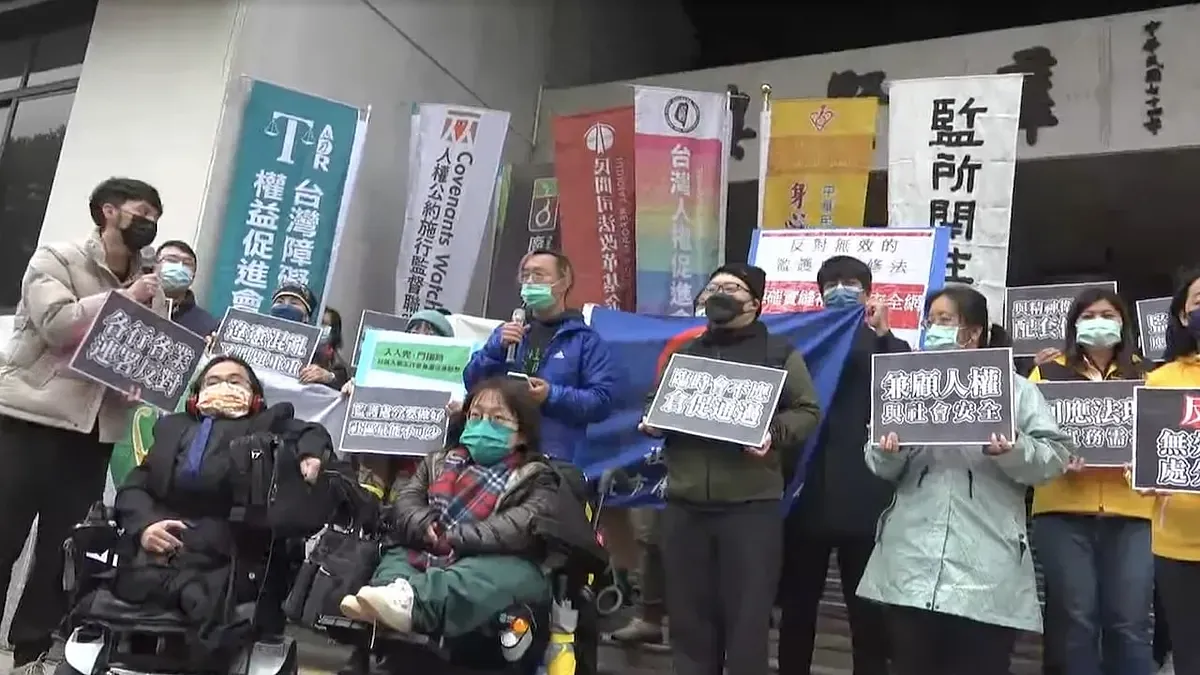
During the Legislative Yuan's extraordinary session, the Democratic Progressive Party caucus proposed consideration of amendments concerning custodial protection under the Criminal Code, Code of Criminal Procedure, and Rehabilitative Disposition Execution Act. The draft had already drawn extensive criticism, while the closely related Mental Health Act had not yet cleared the Executive Yuan, making coordinated implementation impossible. Civil-society organizations therefore launched the petition "Oppose Ineffective Custodial-Protection Amendments-Actually Mend the Social Safety Net" and held a joint press conference opposing the proposed amendments.
The petition was initiated by the Eden Social Welfare Foundation and Judicial Reform Foundation. Co-signing organizations included the Taipei Life of Heart Association, Taipei Mental Rehabilitation Association, Prison Watch, Taiwan Association for Human Rights, Taiwan Mad Alliance, Covenants Watch, The League for Persons With Disabilities, R.O.C. (Taiwan), Taiwan Alliance to End the Death Penalty, Taipei New Vitality Independent Living Association, Taiwan FamilyLink Mental Health Education Association, Taiwan Independent Living Alliance, Taiwan Association for Disability Rights, and other civil-society groups. Legislators Wang Wan-Yu and Chiu Hsien-Chih also attended.
Liao Fu-Yuan of the Eden Social Welfare Foundation said the government had long failed to provide people with mental illness and their families with support and care that matched their actual needs. From 2017 through 2021, Taiwan spent less than NT$400 million per year on mental health for the entire population-about NT$23 per person. By contrast, the second phase of the Social Safety Net Project allocated roughly NT$3 billion to about 300 people subject to custodial protection, while some 200,000 families needing long-term mental-health support were allocated only NT$9 billion over four years. In his view, the imbalance showed that the government was investing heavily in back-end confinement while neglecting treatment, community care, and front-end prevention.
Attorney Lin Chun-Ju, Director of the JRF Legal Policy Department, then reported that more than 600 people from different fields had joined the petition. He urged all parties to examine carefully whether eliminating the maximum period of custodial protection was necessary and constitutionally defensible. He also questioned whether the Executive Yuan-Judicial Yuan draft's requirement of a transition meeting only two months before release was adequate and noted concern that mental-health social workers were not guaranteed a role. Civil society hoped the petition would prompt legislators to reconsider the draft and strengthen the social-reintegration framework, including the Rehabilitative Disposition Execution Act.
New Power Party Legislator Wang Wan-Yu recalled President Tsai Ing-Wen's statement that if government could not hear the public, people should "speak louder, or even pound the table." Yet organizations serving people with mental illness and judicial-rights groups had held repeated press conferences without seeing their concerns reflected in policy. Wang argued that reform should be carefully designed rather than used to respond to fear by simply removing the ceiling on custodial protection. She also cited concerns from psychiatrists that potentially indefinite confinement could create perverse incentives for some defendants to conceal mental illness or avoid raising a mental-disorder defense, thereby losing opportunities for treatment and supported reintegration.
New Power Party Legislator Chiu Hsien-Chih noted that even the Judicial Yuan had expressed objections to eliminating the upper limit on custodial protection, demonstrating the seriousness of the constitutional concern. The New Power Party's version, he said, drew on views from civil society, frontline practitioners, and psychiatrists by requiring transition planning six months before release. Participants should include the person subject to custodial protection, relatives or guardians, and the community organizations or workers expected to provide support after discharge. A fuller social-history and needs assessment would make it possible to identify barriers in the community and connect the person with resources before release. Chiu urged parties to engage substantively with civil-society proposals and legislators' alternative drafts rather than insist on the Executive Yuan-Judicial Yuan version without meaningful discussion.
Li Yun, a founder of the Taiwan Mad Alliance, said policy debates rarely listen to people who themselves experience psychosocial disability or mental distress, relying instead on preconceived ideas about how such groups should be controlled. The Alliance itself did not include people currently subject to custodial protection and therefore could not claim to speak for them. That made the absence of those directly affected-and of disability-rights organizations-from the legislative process even more troubling. Li asked why society repeatedly waits for tragedy before acting and why people whose lives will be shaped by major legislation are excluded from the discussion.
Chen Kuan-Pin, Secretary-General of the Taipei Mental Rehabilitation Association, said that regardless of the eventual legislative outcome, the debate had already caused pain to many people with mental illness and their families. After years of community work, he found it deeply discouraging that a modern society would still consider confinement without a clear upper limit. He called on the government to recognize the rights of people with mental illness and their families and to build meaningful community supports rather than respond to longstanding service gaps with another measure that could inflict harm.
Chin Lin, Secretary-General of the Taipei Life of Heart Association, said family members are often the people most desperate to prevent illness from contributing to violence. Their opposition to the draft therefore did not reflect indifference to public safety; it reflected the belief that the amendments would be ineffective. She pointed to past tragedies and asked whether stronger economic support, home-based services, family assistance, and accessible public-health information might have prevented escalation. In her view, the repeated pattern reflected a social system that had long neglected people with mental illness and a government that had not listened adequately to patients and families.
Chen Hui-Min, Chairperson of Prison Watch, said that if legislation was politically unavoidable, lawmakers still had to consider carefully how it was designed. Medical services inside correctional institutions were already inadequate, while forensic psychiatric hospitals could consume large amounts of funding in buildings, security, and other institutional costs. She warned that the current draft risked giving the executive branch excessively broad authority over people's liberty. In a democratic society governed by law, the future of individuals should not be determined through open-ended discretion exercised by a small number of officials.
Shih Yi-Hsiang, Secretary-General of the Taiwan Association for Human Rights, said legislation should solve problems rather than create new constitutional or international-human-rights violations. He noted that a Control Yuan investigation report issued on December 15 had made recommendations broadly consistent with civil society's concerns: invest sufficient resources and personnel, learn from comparative practice, integrate criminal-justice and psychiatric expertise, and develop diverse implementation models based on individual circumstances and risk factors. Community support should be strengthened rather than directing nearly all new resources toward forensic psychiatric institutions capable of restricting liberty for potentially indefinite periods.
Most importantly, the custodial-protection framework should be considered together with the pending Mental Health Act amendments. The participating organizations questioned why the Legislative Yuan would rush highly controversial custodial-protection legislation through an extraordinary session without the broader mental-health framework in place. They opposed a process that, in their view, would neither solve the underlying problems nor produce an effective social-safety system.
Attendees
Liao Fu-Yuan / Director, Eden Social Welfare Foundation
Lin Chun-Ju / Director, Legal Policy Department, Judicial Reform Foundation
Chin Lin / Secretary-General, Taipei Life of Heart Association
Chen Kuan-Pin / Secretary-General, Taipei Mental Rehabilitation Association
Chen Hui-Min / Chairperson, Prison Watch
Li Yun / Founder, Taiwan Mad Alliance
Shih Yi-Hsiang / Secretary-General, Taiwan Association for Human Rights
Chung Yu-Jou / Covenants Watch
Yi-Hsuan / The League for Persons With Disabilities, R.O.C. (Taiwan)
Lo Li-Han / Taiwan Alliance to End the Death Penalty
Chen Yen-Ting / Special Assistant, Taipei New Vitality Independent Living Association
Huang Li-Ling / Chairperson, Taiwan FamilyLink Mental Health Education Association
Lin Chun-Chieh / Chairperson, Taiwan Independent Living Alliance
Lo Hui-Chun / Standing Director, Taipei Mental Rehabilitation Association; Chairperson, National Federation of Counseling Psychologists Associations
Hsieh Su-Fen / Standing Supervisor, Taiwan Association for Disability Rights
Wang Wan-Yu / Legislator, New Power Party
Chiu Hsien-Chih / Legislator, New Power Party
Press Contact
Lin Chun-Ju / Attorney; Director, Legal Policy Department, Judicial Reform Foundation
This article is an AI-generated translation of the original Chinese text. In the event of any discrepancy, the Chinese version shall prevail.