
Statement | Lo Shih-Hsiang: Drug-Testing Errors Expose Systemic Forensic-Science Deficiencies
Last edited: 2026-08-30
Good morning, members of the media. Thank you for joining us to focus on the systemic forensic-science problems exposed by the Kaohsiung Medical University incident.
Late last year, media reports revealed that Kaohsiung Medical University Chung-Ho Memorial Hospital may have made errors in drug identification. Nearly a month has passed. Today's press conference is intended to keep public attention on the institutional issues the incident revealed.
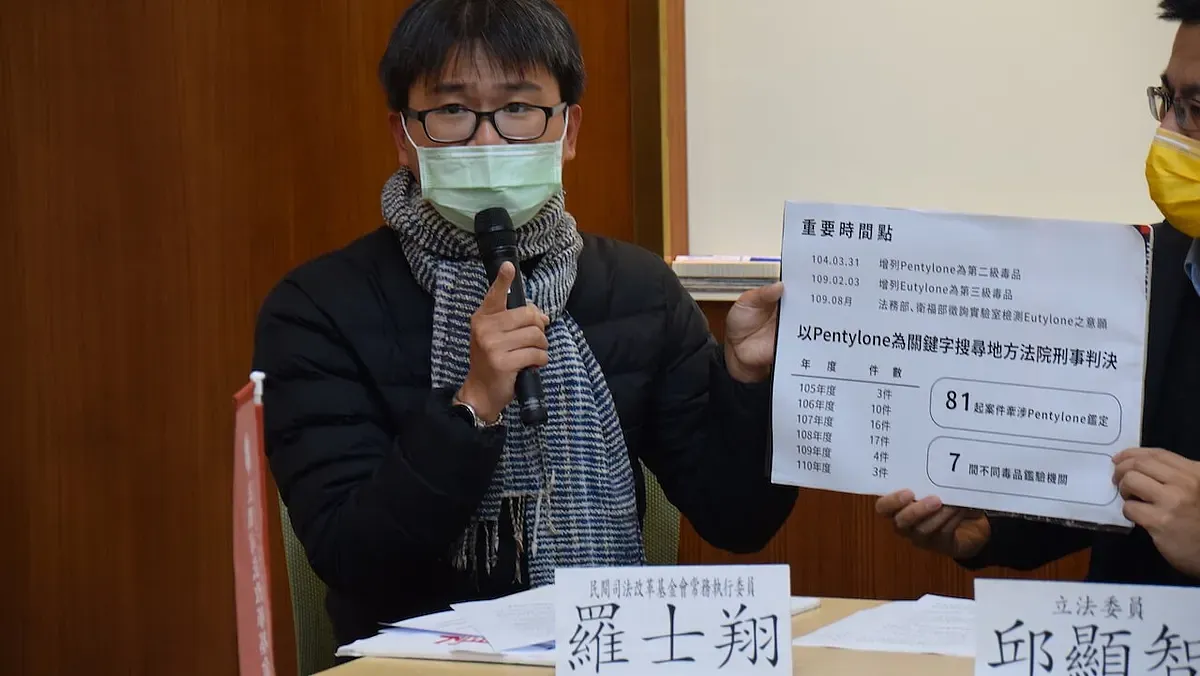
New psychoactive substances have proliferated in recent years, including mixtures sold in so-called drug coffee packets. The Ministry of Justice has accordingly added many new substances to the controlled-drug schedules. Two substances are central here: Pentylone, classified as a Category 2 controlled drug in 2015, and Eutylone, classified as Category 3 in February 2020.
The problem is that the Ministry of Justice and Ministry of Health and Welfare did not begin asking accredited drug-testing laboratories about Eutylone testing until August 2020. Kaohsiung Medical University established a reference-standard testing method only in November and then discovered that some earlier samples identified as Pentylone had in fact been Eutylone.
Our first concern is the lack of coordination between drug scheduling and laboratory capability. There was a gap of at least six months: a substance had already been placed under legal control, but private testing institutions had not simultaneously been equipped or informed to determine whether they could identify it accurately. That gap created a real risk of erroneous classification.
The Alliance's first demand is therefore: "When a new psychoactive substance is scheduled, the drug-testing capability of relevant laboratories must be verified at the same time." But the problem may extend beyond the period after Eutylone was scheduled. Were earlier samples reported as Pentylone actually Eutylone?
The Alliance identified at least 81 guilty judgments involving Pentylone between its scheduling in 2015 and the end of 2021. That number excludes observation-and-rehabilitation proceedings and juvenile matters that cannot be retrieved through ordinary judicial databases. In those judgments, courts relied on Pentylone test results to find Category 2 drug offenses. Seven testing institutions were involved, including four private laboratories.
The data show Pentylone-related guilty cases in every year from 2016 onward. We therefore have to ask how many cases could involve similar testing errors. The Ministry of Justice and Ministry of Health and Welfare should address that question immediately. The Alliance's second demand is: "All drug-testing institutions should conduct a comprehensive retrospective review for similar identification errors." Defendants in those cases may indeed have been involved with controlled substances. But if the substance was not Category 2 Pentylone, an erroneous identification could have materially changed the offense and produced a wrongful judgment.
Third, urine-testing laboratories are subject to establishment standards under the Regulations Governing Establishment of Laboratories for Drug Abuse Urine Testing by Government Agencies, but there is no comparable accreditation framework for identifying the chemical composition of seized drugs. With new psychoactive substances changing rapidly, this incident should prompt a formal accreditation system for drug-testing institutions.
Fourth, the 2017 National Conference on Judicial Reform called for establishment of a Forensic Science Commission to develop forensic-science policy, create licensing and accreditation systems for experts and laboratories, and ensure that scientific evidence used in investigation and adjudication is genuinely reliable science. That resolution has remained dormant. We call on the Executive Yuan to begin serious planning now so that forensic evidence can be tested for validity and reliability and the risk of wrongful convictions can be reduced.
At the end of last year, Premier Su stated at a drug-control meeting that the government should improve the mechanism for identifying new psychoactive substances. We believe the need extends beyond drug testing: every forensic discipline requires a sound system. The Executive Yuan should treat this incident as the starting point for establishing a Forensic Science Commission.
This article is an AI-generated translation of the original Chinese text. In the event of any discrepancy, the Chinese version shall prevail.