
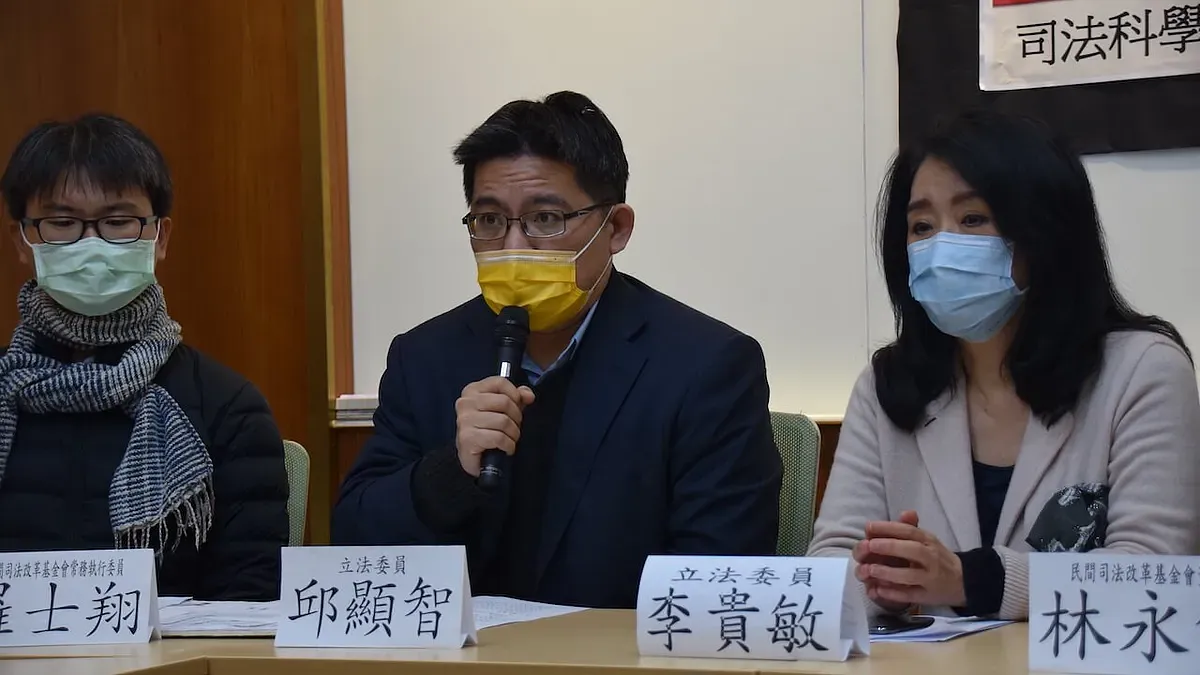
Statement | Legislator Chiu Hsien-Chih: Building a Forensic-Science System That Can Correct Its Own Errors
Last edited: 2026-08-30
This incident exposes the limits and risks inherent in forensic science. The synthetic cathinones involved are isomers: they share the same molecular formula but have different chemical structures, which makes them difficult to distinguish. Many new psychoactive substances are also created by chemically modifying known drugs to evade or reduce legal liability-the so-called "designer drug" problem. Substances that are difficult to identify accurately will therefore continue to appear, and testing error is an unavoidable systemic risk.
The Taiwan Forensic Science Promotion Alliance's demands point to effective safeguards at two stages-before and after an error-to reduce that risk and build a system capable of correcting itself:
- Before an error:
- Clearly assign and coordinate responsibility for forensic-science policy and consider establishing a dedicated body such as a Forensic Science Commission.
- Drug-testing laboratories should be subject to establishment and accreditation standards. When government contracts with private laboratories, it should identify in advance the limitations and risks of their methods and testing capacity.
- When new psychoactive substances emerge, laboratories should receive active assistance in obtaining reference standards, and a comprehensive reference database should be established and maintained.
- After an error:
- Scientific techniques have inherent limitations. The system should not be designed primarily around blame after an error occurs. It should instead encourage discovery and prompt reporting of errors to the Judicial Yuan, Institute of Forensic Medicine, prosecutors offices, and cooperating laboratories so that weaknesses can be corrected and similar errors prevented.
- When a case is found to have been misjudged because of limitations in a testing method, the responsible laboratory-and other laboratories using comparable methods-should immediately conduct a retrospective review of similar cases.
Criminal procedure is not merely a sequence for disposing of individual cases; it is a continuously operating system. No system is flawless, and every system contains risk. Each time a systemic weakness becomes visible, we should use it to improve the system. More important than addressing one isolated failure is creating an institutional capacity to discover and correct mistakes rather than conceal them. That is how criminal justice can continue to improve.
This article is an AI-generated translation of the original Chinese text. In the event of any discrepancy, the Chinese version shall prevail.