
Reflections from an External Inspection Report Reading Volunteer | Starting with Empathy: Small Efforts Can Add Up to Great Strength
Last edited: 2026-08-30
Before we begin, we would like to ask: when you see the words "prison" or "detention center," what comes to mind? Some people may think of places where people who have done bad things are sent; others may picture dark, closed-off environments. Most people would probably give similar answers, yet our understanding of correctional institutions often stops there.
Some people simply are not very interested in "correctional issues" and therefore do not seek out news about them. Many others may wonder, "Why should we care about people who have done bad things?" To be honest, that was a question we had struggled with for a long time. No matter how often we thought about it, we still could not find an answer that fully convinced us.
At the time, we attended a lecture held in conjunction with the Hai-Wang Tian-Guang special exhibition at the JRF's Taichung Office. In the basement, we saw a simulated correctional space. What struck us most was learning that people in correctional institutions eat from containers resembling small washbasins. We were puzzled: why could they not simply eat from bowls? That experience sparked a new curiosity about conditions inside correctional institutions.
Later, staff members at the JRF told us about the "Key Readers of External Inspection Reports for Correctional Institutions" program. With the questions above in mind, we told ourselves that we had to take part-to pay attention to the lives of people in custody and, hopefully, help bring about some change.
We later attended a JRF lecture on human rights in correctional institutions and judicial reform. A talk by Chen Hui-Min, then Chair of Prison Watch, helped us better understand current practices and basic issues concerning correctional institutions in Taiwan and prepared us to read external inspection reports. Chen said something that resonated deeply with us: "Once offenders are locked up, they talk about truth and fairness more than anyone else." At the end, she told us calmly and rationally: "We should first let them live like human beings before we can expect them, after release, to return to a human life." On the event poster, Grand Justice Hsu Tzong-Li was also quoted as saying: "Prisoners are citizens who happen to wear prison uniforms; they are not 'outcasts' excluded from the Constitution's protection of fundamental rights." These words helped resolve a question we had carried for a long time. They made us realize that we should pay closer attention to people in correctional institutions-their daily lives and their eventual return to society. Prisoners are human beings, and their basic human rights cannot be taken away. We should therefore pay attention to their living conditions, medical care, treatment, and more. We should not-and, more precisely, cannot-ignore their rights.
Our first meeting soon approached, and we felt far more nervous than excited. We were just ordinary high school students about to sit down with people who were older and much more knowledgeable than we were. We worried that we would not understand the issues being discussed or would be unable to express our thoughts clearly. So, on the night before each meeting, the two of us would discuss the inspection reports we had been assigned, exchange views, and look up relevant information or news reports to support our observations.
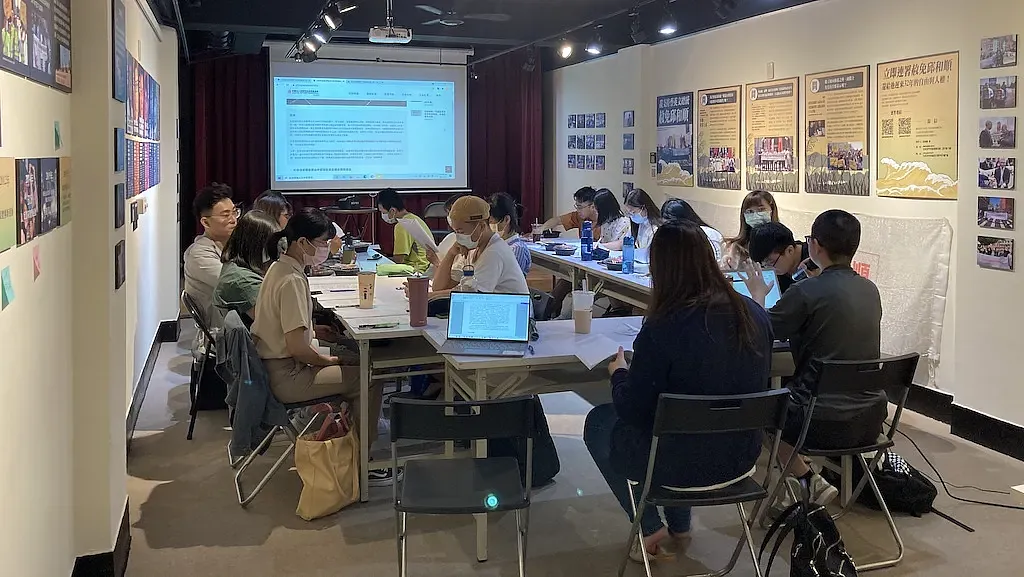
Once we actually began participating, however, we found that each discussion started with a guided reading led by JRF project researcher Lin Wei-Ting, which gave us a great sense of reassurance. Before each meeting, she took us through inspection reports from other countries, explained their strengths and weaknesses, discussed how Taiwan's policies might be improved, and supplemented our knowledge of correctional institutions-for example, the difficulties involved in gathering views from people in custody and ethical principles for monitoring. This helped us enter each day's discussion more quickly and accurately, understand current conditions and problems in correctional institutions, and offer suggestions that were more practical and better focused. Wei-Ting explained things carefully and in plain language and guided the discussion, which helped us learn more and feel much less nervous. We began to feel that we really could do this well.
After reading some external inspection reports, we found that correctional institutions were doing many things well. Some had created religious spaces to accommodate different faiths; others planned to add accessible elevators for people with mobility limitations. Institutions had also adopted measures responsive to different needs, including accessibility facilities and board games, and provided vests and knit caps for warmth. These efforts can improve care and accommodate different religious needs. To us, they were positive signs that correctional institutions were gradually paying more attention to quality of life and making improvements.
At the same time, there was much we wanted to know that the reports did not mention or show. For example: "Will people in correctional institutions be able to receive vaccines in the future?" and "How are assignments made for work performed outside the institution?" In other places, we could not tell what the reports were trying to convey-for example, where a committee member had observed a shortcoming or situation but did not explain it specifically, or where a response was too vague and contained no concrete information. Sometimes the information was simply unavailable to outside readers, with statements such as "the institution's handling of the matter was emailed to committee members" or "the matter has been referred to higher authorities." We found this somewhat passive: beyond knowing that the institution intended to seek action or had referred the matter upward, readers could not see the actual plan or the response received. We also often encountered statements such as "relevant briefing materials and data have been provided to committee members." Such broad answers make it impossible to assess concrete policy outcomes or identify how a plan could be improved. Across several meetings, our concerns were therefore quite similar: we hoped the inspection reports would be more complete-for example, by using timelines to show how matters were handled so that outcomes could be tracked. We hope future external inspection reports will disclose more detail and be clearer to outside readers.
For the final two meetings, we were joined by Song-Lih Huang, Convener of Covenants Watch; Yibee Huang, its Executive Director; and Huang Chih-I, Chair of the Haomin Cultural Action Association. They shared phenomena and problems they had observed through their work on correctional issues. One question worth discussing, for example, is whether an inspection report should resemble a verbatim transcript that records the inspection in full detail, or whether it should simply present the key points. We also need to consider whether people in custody genuinely understand the channels and methods available for submitting views to committee members, and whether correctional authorities might obstruct them from filing complaints. These are issues that deserve further thought and collective efforts from people across different sectors.
Although we are only high school students, the most important idea we took away from the "Key Readers of External Inspection Reports for Correctional Institutions" program was empathy. Things that seem simple and taken for granted in our daily lives are not necessarily so inside correctional institutions. People in custody may have made mistakes, but they are fundamentally no different from anyone else, and they cannot be deprived of their most basic rights. Through the program, we also came to understand current conditions in correctional institutions and the directions in which reform may proceed. Offering timely observations and encouragement is one thing we can do.
After taking part in these activities, we saw how much effort everyone had contributed. Adding even our own small share of effort made it seem that change really might be possible.
In the end, what we want to convey is this: if each of us pays closer attention to what is happening around us and is willing to speak up, even a small effort can matter. We have to believe that many small efforts can add up to great strength, creating more space for problems to be discussed and, ultimately, improved.
And to everyone who has kept working to speak up for them, we want to say: thank you for everything you do.
This article is an AI-generated translation of the original Chinese text. In the event of any discrepancy, the Chinese version shall prevail.