
Seminar Sidelights | Taiwan Premiere of Nos están matando (They're Killing Us): The Life-and-Death Choices of Colombian Human Rights Defenders
Last edited: 2026-08-30
Peace is built by the people-by Indigenous peoples, farmers, Afro-descendant communities, students, and trade unions; by civil society as a whole. Peace without the participation of the people is not true peace.
-Quoted from the documentary Nos están matando (They're Killing Us)
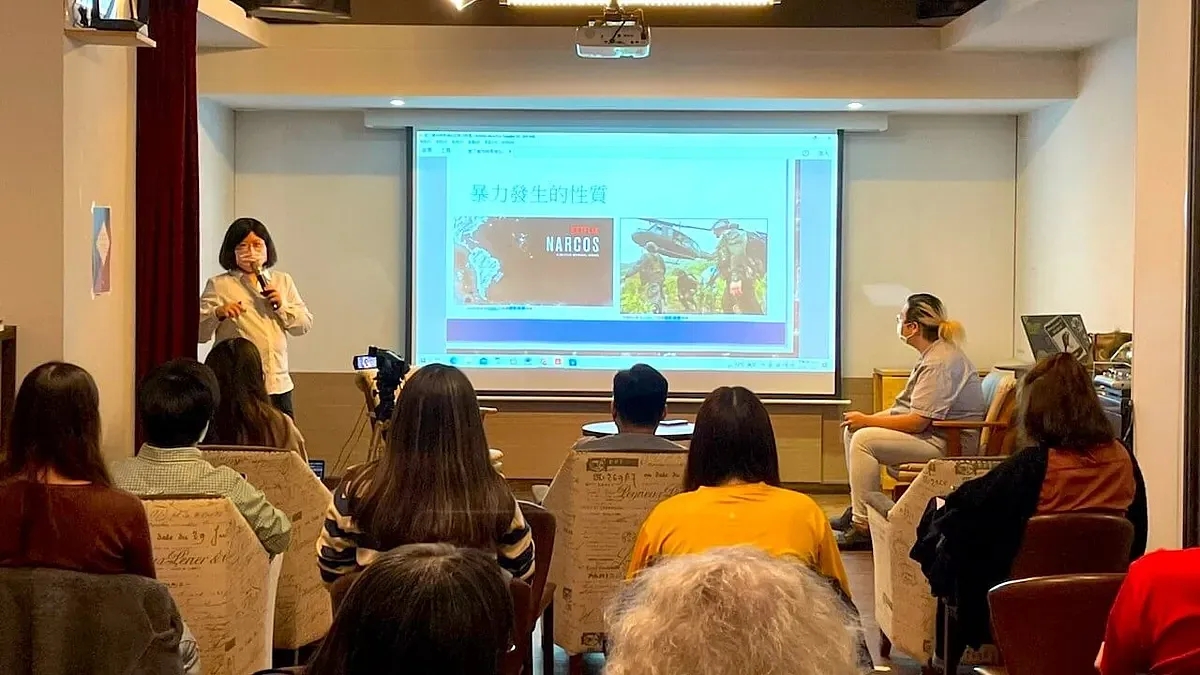
On January 22, 2022, in observance of the Day of the Endangered Lawyer (January 24), the JRF held the Taiwan premiere and forum for the documentary Nos están matando (They're Killing Us). Directors Emily Wright, Tom Laffay, and Daniel Bustos Echeverry closely followed the lives of two Colombian social leaders and interviewed local NGO workers and residents about their views of leaders in the human rights movement. The film gave the Taiwanese audience a direct view of just how little space Colombians have to defend their own rights.
Colombia Today: One Social Leader Is Killed Every Four Days
According to records kept by civil society groups, 125 social leaders were killed in Colombia in 2017. Such arbitrary killings were commonplace, on a scale difficult for people in Taiwan to imagine. Interviewees in the documentary explained that the assassinations and threats were intended to obstruct the peace process and were carried out by actors including drug traffickers and criminal groups involved in illegal mining.
Although the Colombian government and the Revolutionary Armed Forces of Colombia (FARC) signed a peace agreement in 2016, the power vacuum that followed allowed new armed groups and drug traffickers to take control locally. Social leaders seeking to protect natural resources and community rights were hunted down. More than 200 social leaders were assassinated that year, yet more than 80% of the cases did not proceed and resulted in no legal accountability, creating a climate of impunity.
Diana Sánchez, president of Somos Defensores, also stated in the documentary: "In Colombia, human rights and social movements are not treated as priorities. Colombia remains a deeply entrenched, hierarchical society in which people at the bottom are not regarded as owners of their own country." Those seeking to stop people from believing they can organize and fight for their rights use many methods, including breaking up families and destroying communities.
The Reality for Social Leaders: Branded as Military Targets and Unable to Go Anywhere Without Bodyguards
Feliciano Valencia is an Indigenous Nasa social leader and land-rights activist who has faced death threats since 2006. He has survived three assassination attempts, but his brother-in-law was killed while resting at home, and his cousin was stopped while riding a motorcycle and executed. Héctor Marino Carabalí is an Afro-Colombian community leader who organizes community protection groups and helps defend victims' rights; he has faced death threats since 2008.
Héctor Marino Carabalí understands why he is treated as a military target: a leader's role is to mobilize people to defend their land, protect human rights, and safeguard life, and that may be perceived as a threat to the government. He often sees his own photograph on leaflets offering a large bounty for his killing, like a wanted poster. Every day, he must worry that someone facing financial hardship might choose to assassinate him for the money. Diana Sánchez added that such threatening leaflets inject fear into people's minds-and in Colombia, fear is effective. Many of the threats come from the group known as the Black Eagles. Community, Indigenous, and Afro-descendant leaders are threatened because of their work, making it difficult for community leaders to preserve cohesion in their regions.
These social leaders cannot simply go out when they wish; when they do, they must travel in armored vehicles. They are constantly on the move because state protection is difficult to obtain and often ineffective, so they hire several bodyguards to remain with them. To keep family and friends from worrying excessively, they sometimes tell them that the guards are merely friends. Yet having bodyguards constantly present also distances these leaders from their communities, effectively depriving them of freedom of movement and ordinary social interaction. Eighty to ninety percent of threats are not investigated by prosecutorial authorities, leaving the organizations and individuals who issue threats-or even commit murders-without criminal punishment. That low rate of investigation also suggests that the Colombian government lacks a genuine willingness to investigate threats and killings.
"Once You Become Aware of Your Rights, Someone Will Always Try to Stop You from Defending Your Community"
At the end of the film, we see with our own eyes a young man defending his community killed in an attack by armed forces. The bloody scene strikes every viewer deeply. Even when the cost may be their lives, Colombians continue to take to the streets and defend their rights and communities at all costs, crying out to the world: "Being a social leader is not a crime. We have no weapons; we have dignity! The land is our life. The land must be loved and protected." We can only hope that one day the universal values of human rights will be practiced equally and broadly throughout the world, so that everyone can enjoy the same rights and freedoms.

Shih Ya-Ru: "If a Village Is Peaceful Because All Dissenters Have Been Killed, Is That Really Democracy?"
Professor Shih Ya-Ru is a full-time associate professor at the College of International and Interdisciplinary Studies, Tzu Chi University, and one of the younger scholars in Taiwan specializing in Latin American culture and economics and Indigenous rights. Her research addresses countries including Colombia, Spain, and Mexico. At the forum, she used extensive data and detailed analysis to explain Colombia's historical context and current social conditions, giving the audience a clearer framework for understanding them.
In her talk, Professor Shih noted that Colombia is located in the Americas, a region where a number of countries experienced prolonged civil wars in the latter half of the twentieth century. Colombia's geography also places it near the Andes, a major cocaine-producing region, while routes by land and sea provide relatively easy access to the United States, the world's largest drug-consumption market. Drug cartels therefore flourished, and traffickers accumulated enormous wealth from the drug trade, enabling them to purchase expensive military weapons and contributing to a culture in which force became a common means of resolving conflict.
To illustrate the severity of the situation, Professor Shih cited data showing that Colombia's homicide rate in 2017 was three times the global average and that human rights activists were killed at a rate far higher than in other Latin American countries. Nearly half of the world's conflicts over environmental resources also occurred in Latin America, involving issues such as drug cultivation, illegal mining, and exploitation of forest resources. Competition for resources fostered numerous private armed groups and guerrilla forces, contributing to serious public-safety and crime problems in the region.
One source of these private armed forces, Professor Shih explained, was Colombia's Law 48 of 1968, which legally allowed wealthy landowners and businesspeople to use their resources to establish paramilitary groups. These groups were formed to combat guerrillas that had emerged amid the communist movement and unequal land distribution, while also suppressing poor farmers seeking land justice. The military likewise encouraged the growth of paramilitary groups, creating a power structure reminiscent of the colonial era.
Although the law was formally declared unconstitutional twenty years later, in 1988, and new legislation was enacted to prevent disputes from being resolved through vigilante justice, the government's passive tolerance instead deepened public distrust and encouraged the growth of private armed forces. Judicial authorities took up only about 13% of assassination cases involving paramilitary groups, according to Somos Defensores. The vast majority of killers therefore remained beyond the reach of the law and could earn large sums through murder.
One report showed the following levels of public trust in institutions across Latin America: 69% for the Catholic Church, about 50% for the military and police, only 32% for the judicial system, 31% for legislatures, and 22% for political parties. The figures reflect deep public distrust of government institutions.
Professor Shih further analyzed the identities of victims and perpetrators. A 2020 report recorded 458 murdered human rights or labor advocates and leaders; Indigenous people accounted for nearly 25%, followed by community leaders and farmers. Together, these socially marginalized groups accounted for about 57% of all victims. Three of the victims were lawyers. Although that number was small, Professor Shih emphasized that no one should be killed for advocating human rights or asserting rights.
As for perpetrators, their identities could not be determined in as many as 306 cases. They may have included drug cartels, small hired gangs whose members often joined as teenagers, guerrilla fighters who refused to lay down their arms after the peace agreement, and the best-known group, the Black Eagles. Such groups favor selective violence, targeting key leaders so that advocacy organizations are left without leadership and weakened. Many act simply for money, and local political clans exploit this by hiring killers in an effort to create "democratic" elections with no dissenters. In cases where perpetrators were identified, they also included paramilitary groups legally established under Law 48 of 1968, self-defense groups organized by farmers, and armed groups formed jointly by military and police personnel.

Gloria Silva - "We Chose This Profession Because We Hold Convictions"
The forum also featured Colombian attorney Gloria Silva, who joined by video to discuss conditions in Colombia and the persecution faced by Colombian lawyers. Silva explained that the pattern of repression cannot be understood only from visible conflict and the broader condition of inequality. Colombia, she said, is an extremely unequal country, and understanding the persecution of its lawyers requires looking at the country's domestic political economy.
Silva explained that Colombia is one of the world's most unequal countries in access to land. Large amounts of land are concentrated in the hands of a few, producing exploitation and forced displacement of farmers-one of the problems most acutely felt by Colombians. Poverty and social exclusion are also extremely severe, and Colombia's Gini coefficient has risen to 54, its highest level in a decade. These conditions leave many people without access to public education or an adequate public-health system and give few the opportunity to obtain dignified work; most people struggle simply to get by. Severe corruption, what Silva described as a deeply illegitimate political class, and an exclusionary and repressive style of government further reinforce these injustices and fuel popular uprisings.
Silva continued by stressing the historical importance of popular uprisings. Colombia has long seen organized action by farmers, workers, Afro-descendant communities, and Indigenous communities resisting political and economic projects or a single hegemonic vision in different ways. Important movements arose in both rural and urban areas, becoming obstacles to the ruling class and voices of dissent that displeased those who had long held economic and political power. Historically, Silva added, one feature of repression has been the "internal enemy" doctrine promoted by imperial powers, particularly the United States. She argued that U.S. support for Colombia and training of military and paramilitary forces were used to counter popular movements, delegitimize civil society's demands for a just society, and, in the most extreme cases, lay the groundwork for genocidal patterns.
Repression, Silva said, is also legitimized through administrative measures and public policies, including legislation and judicial and prison policies. Those in power use such measures to protect their interests and eliminate dissent against large-scale projects that often deepen poverty and concentrate capital and wealth in fewer hands. Excessive use of force at every level is another characteristic of this pattern of repression.
Gloria Silva - "The Response of State Institutions and Paramilitary Groups to Popular Uprisings Has Reached a Criminal Level"
"In recent years-especially over the past five years-this pattern of repression has increasingly involved prosecution and imprisonment of protesters, people who voice their dissatisfaction in the streets, people who resist on their own land, and anyone who creates obstacles for those in power in other ways. This pattern of repression runs against the will of the people. It seeks discipline and the elimination of voices pursuing different dreams and different worlds."
Silva then explained the reasons for this repression and described the particular risks borne by human rights lawyers who accompany popular movements. Lawyers, she said, face intense stigmatization: responsibility for the causes they defend is shifted onto them, while severe repression, persecution, and surveillance by state institutions are portrayed as legitimate. One of the best-known examples involved the Administrative Department of Security (DAS), which engaged in illegal wiretapping and in monitoring, stigmatizing, and delegitimizing lawyers' work, accusing lawyers of forming part of insurgents' wartime strategy. Armed conflict was ultimately used as a pretext to persecute and eliminate the struggles and demands for dignity in which human rights lawyers participated.
The pattern has not stopped. Colombia's domestic security apparatus-its political police-continues to use military intelligence and police channels to investigate and monitor lawyers. Silva therefore emphasized that the danger does not fall equally on all lawyers; those at greatest risk are human rights lawyers who accompany popular movements.
Human rights lawyers who use domestic and international legal proceedings to pursue their struggles are not only stigmatized; the government has also enacted measures that can, in practice, be used to imprison and prosecute them. Silva cited Law No. 1908, which was presented as a law to dismantle paramilitary groups but, she argued, paradoxically strengthened them. "What this pattern of repression seeks," Silva said, "is to reaffirm a hegemonic power that in modern times has been rejected and questioned, especially by young people who have long been excluded." The law, referred to here as the Organized Armed Groups (GAO) law, did not dismantle paramilitary groups and instead introduced a series of regressive changes to legal safeguards. People alleged to belong to organized armed groups are prosecuted under it, and those prosecuted often turn out to be members of popular movements. The law also treats people who provide legal knowledge, legal services, or assistance to organized armed groups as criminals. In other words, a profession devoted to exercising the right of defense-and one that should itself receive state protection when confronting unlawful conduct-has become a high-risk profession, with increasingly difficult working procedures and conditions. This pattern of repression targets organized sectors and Colombians dissatisfied with the status quo; ultimately, Silva argued, it also targets lawyers.
Silva concluded by explaining that, in choosing the course of their lives, these lawyers decided to defend the public and oppose arbitrary exercises of state power-particularly where historically privileged classes sacrifice the well-being, peace, and right to live with dignity of the majority. The routine unlawful prosecution and imprisonment of members of the public is deeply alarming. The problem is not only imprisonment itself; it also creates enormous obstacles for professionals defending popular movements and accompanying people through judicial proceedings.
Silva said: "I insist that we chose this profession not simply as a compromise, but because we hold convictions."

Sebastián Escobar - "This Harassment and Persecution Has Deep Historical Roots"
Sebastián Escobar is a Colombian attorney and a member of the José Alvear Restrepo Lawyers' Collective (CAJAR), a human rights organization dedicated to defending the rights of victims of political violence.
Escobar first explained Colombia's background, including its geography and distinctive characteristics and the effects of its prolonged armed conflict. Although the government reached important negotiating milestones with at least two major groups, armed conflict unfortunately remains an underlying problem, and the continuing deterioration of human rights conditions is itself a consequence of decades of conflict. He then cited the scale of victimization and serious human rights violations: more than eight million people have been displaced by violence, more than 90,000 are missing, and more than 250,000 have been killed.
Escobar next discussed the 2016 peace agreement between the Revolutionary Armed Forces of Colombia-People's Army (FARC-EP) and the Colombian government. Key elements included comprehensive rural reform and measures to address illicit drugs, a problem that had seriously affected Colombia for two or three decades. The agreement also called for a transitional-justice model to address the gravest violations of international humanitarian law and serious crimes committed in the context of domestic armed conflict and political violence. It further recognized the need for security mechanisms and guarantees to protect those who signed the peace agreement, people exercising or participating in politics, and people engaged in human rights defense or social leadership.
Despite the peace agreement's importance, Escobar said, the government lacked genuine political will to implement it. In particular, conditions worsened with respect to protection for human rights advocates, the lives of those who signed ceasefire or peace agreements, and political opposition. Residual armed groups grew stronger: when groups that had participated in hostilities were dissolved or FARC forces left particular areas, other actors regained control over illicit economic activity. The result in recent years has been a worsening human rights situation, including crimes and murders targeting human rights defenders.
Escobar then described how conditions had deteriorated, citing figures to illustrate public-security problems, the intensifying armed conflict, and the situation of human rights defenders. According to figures disclosed by the body monitoring implementation of the peace agreement under the UN presence in Colombia, forced displacement had again occurred in recent months, affecting approximately 12,000 people across the country. There had also been several killings and, more seriously, renewed massacres.
Against this backdrop, the José Alvear Restrepo Lawyers' Collective continues its work, particularly accompanying victims of political violence and asserting their rights. Yet truth, justice, reparations, and guarantees of non-repetition remain absent following violence committed by the Colombian government and paramilitary groups within the framework of the armed conflict, placing lawyers in an exceptionally difficult position as they carry out their work.
Escobar concluded by describing the circumstances, difficulties, and responses facing lawyers: "On the one hand, in the context of armed conflict, denouncing and monitoring the Colombian government means that the human rights organizations doing this work are targeted, as though we were proxies for, or representatives of the interests of, dissident groups or guerrillas. We are then labeled 'internal enemies.' The Colombian government creates particular terminology to justify different forms of persecution against human rights defenders, even though all we are doing is providing legal accompaniment."
For example, lawyers from the José Alvear Restrepo Lawyers' Collective have been accused of belonging to insurgent or dissident groups, subjected to criminal prosecution, and placed under long-term surveillance by state security agencies. Today, intelligence bodies also use technology to track personal information.
The rising number of murdered human rights defenders has also exposed them to extreme danger. In response, an international campaign has been launched to challenge the Colombian government's persecution of CAJAR members, and the matter is expected to be brought before the Inter-American Court of Human Rights in the coming months.

Camilo Pérez-Bustillo - "Human rights are universal, they belong to all of us, they do not belong to any governments."
Camilo Pérez-Bustillo is a Colombian attorney and was serving as a visiting professor at National Taiwan University's College of Law. At the end of the forum, he responded to the documentary and the presentations by the two Colombian lawyers, arguing that the Colombian government's treatment of lawyers constituted serious violations of international human rights law. He also asked why Colombia's ruling class could commit such violations without being held accountable. One reason, he argued, was support from the United States, and he compared the pattern to China's repression in Hong Kong and Tibet.
Professor Pérez concluded that human rights do not belong to any government; they belong to everyone. He thanked Taiwan for standing with Colombian lawyers.
This article is an AI-generated translation of the original Chinese text. In the event of any discrepancy, the Chinese version shall prevail.