
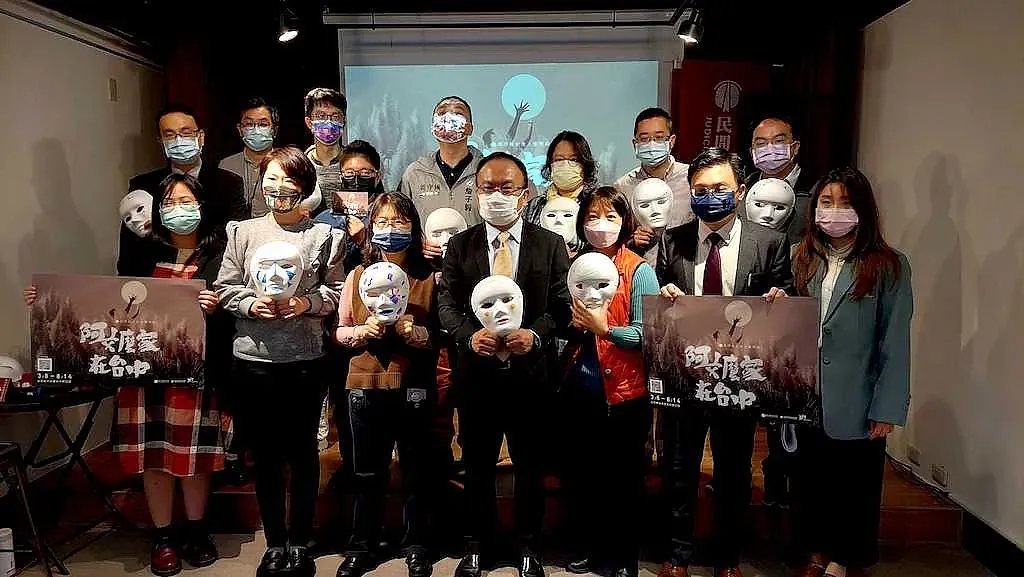
Uncovering Long-Buried Memories: Transnational Testimony After the War - Opening Press Conference for the AMA Museum's Taichung Exhibition on Peace and Women's Human Rights
Last edited: 2026-08-30
During World War II, the Japanese government used women as military sexual slaves across Asian territories under Japanese colonial rule or occupation, mobilizing them as "comfort women." The history of the "comfort women" is among Taiwan's most painful wartime memories, while the human-rights movement led by and for the survivors was also a courageous pioneer in Taiwan's struggle for women's rights.
To document the "comfort women" human-rights movement, the Taipei Women's Rescue Foundation established Taiwan's first multifunctional museum combining women's empowerment and gender-equality education in 2016: the AMA Museum for Peace and Women's Human Rights. "AMA Museum in Taichung | Special Exhibition on Peace and Women's Human Rights" marks the Museum's first exhibition outside Taipei. The exhibition focuses on recreating the 2000 Women's International War Crimes Tribunal on Japan's Military Sexual Slavery. Through photographs, video footage, and statements by the survivors, it seeks to reveal the powerlessness of people caught in the violence of World War II, particularly the grave harms inflicted on women.
Attorney Lin Chih-Chung, a JRF board member, said: "JRF hopes to strengthen gender awareness in the judiciary, because Taiwanese society can move forward only when gender-based human rights are protected. In co-organizing the 'AMA Museum in Taichung' exhibition with the Taipei Women's Rescue Foundation, we are presenting valuable historical materials from the 'comfort women' human-rights movement while also examining recent cases to show both the efforts and the shortcomings of Taiwan's justice system in advancing gender equality. We welcome everyone to make a reservation and visit the exhibition."
Tu Ying-Chiu, Executive Director of the Taipei Women's Rescue Foundation, said: "Today, March 8, International Women's Day, commemorates women who marched in the United States in 1908 to fight for their rights. It is also the thirteenth day of the war between Russia and Ukraine. During war, women and children are often especially vulnerable to persecution. Through the 'comfort women' human-rights movement documented in 'AMA Museum in Taichung,' we hope to encourage reflection on the importance of women's human rights, promote the prevention of gender-based violence, and work together to build a safe society free from gender-based violence."
Lin Fang-Ju, Executive Director of the Haomin Cultural Action Association, added: "The amas were military sexual slaves who were coerced and deceived. Taiwan may be at peace today, but workplace sexual harassment, sexual violence, and similar abuses remain all too common-to say nothing of the heightened vulnerability of women and children during wartime. This exhibition is not only about history; it is also an opportunity for all of us to reflect on what we can do on issues of gender equality."
At the press conference, invited guests also hand-painted masks as a piece of performance art depicting the inner wounds caused by war and calling attention to hard-won peace and women's human rights. Executive Directors Tu Ying-Chiu and Lin Fang-Ju both painted in purple, the signature color of the Purple Ribbon Campaign, to draw attention to the lifelong trauma that sexual violence can inflict on survivors. Attorney Lin Chih-Chung painted the mask's lips red to convey that, despite all the hardships they endured, the amas never gave up hope.
The Taipei Women's Rescue Foundation has long served survivors of sexual violence and has continued to work with civil-society organizations including JRF to build a gender-friendly judicial environment through institutional reform, improved judicial procedures, and stronger gender awareness among justice-system personnel. A lecture series will also be held during the exhibition, using the stories of the amas as pioneers of the #MeToo movement to reflect on the value of peace and women's human rights.
Attendees
Lin Chih-Chung (Attorney; Board Member, Judicial Reform Foundation)
Hung Ming-Ju (Attorney; Standing Executive Committee Member, Judicial Reform Foundation)
Lin Pei-Jung (Attorney; Standing Executive Committee Member, Judicial Reform Foundation)
Tu Ying-Chiu (Executive Director, Taipei Women's Rescue Foundation)
Yeh Mei-Ling (Deputy Director, Taichung Branch Office, Garden of Hope Foundation)
Lin Fang-Ju (Executive Director, Haomin Cultural Action Association)
Chan Tzu-Yi (Special Assistant to Taichung City Councilor Huang Shou-Ta)
Yu Ching-Chia (Deputy General Convener and Nantou Regional Event Convener, Rainbow Gender Rights Alliance)
Onishi Hitoshi (Assistant Professor, Department of Japanese Language and Culture, Tunghai University)
Li Wan-Ching (Senior Clinical Social Worker / Ph.D. Candidate, Graduate Institute of Counseling Psychology and Human Development, National Chi Nan University)
Chung Han-Shu (Director, Taichung Office, Environmental Rights Foundation)
Fu Yen-Ju (Deputy Executive Director, Good Temperature Taiwan Youth Foundation)
Hung Shih-Yu (Director, Social Work Department, Hot Chat Democracy Association)
Chen Yen-Han (Secretary-General, Taiwan GDi Association)
Contacts
Hsieh Chia-Chen, Advocacy Specialist, JRF Taichung Office (04) 2329-2372 ext. 11
Chang Hua-Che, Legal Specialist, JRF Taichung Office (04) 2329-2372 ext. 13
This article is an AI-generated translation of the original Chinese text. In the event of any discrepancy, the Chinese version shall prevail.