
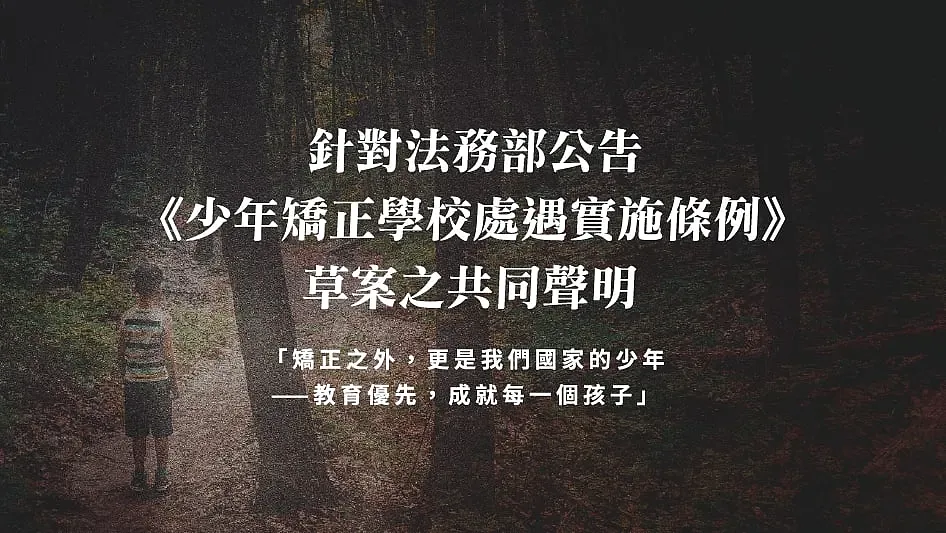
Joint Statement on the Ministry of Justice's Draft Act Governing Treatment in Juvenile Correctional Schools
Last edited: 2026-08-30
"Beyond Correction, They Are Still Our Nation's Youth-Education First, Help Every Child Thrive": Taiwan Needs a Genuine Act Governing Treatment in Juvenile Correctional Schools, Not a "Juvenile Prison Act."
On February 17, the Agency of Corrections, Ministry of Justice, published for public comment a draft Act Governing Treatment in Juvenile Correctional Schools (the "Draft Act"). Except for provisions involving judicial remedies and the allocation of responsibilities with the Judicial Yuan, which remain subject to policy decisions by the Judicial Yuan, comments are invited for 30 days beginning the day after publication. The Agency explained that because "the bill has attracted considerable public attention and expectations, and in order to increase transparency in juvenile correctional institutions, implement the principle that the treatment of juvenile inmates should be no less protective than that afforded to adult inmates, and take account of the need for prompt action, the comment period has been shortened to 30 days to accelerate the legislative process."
Yet in the name of accelerating the legislative process, the version published by the Ministry of Justice is essentially a juvenile version of the Prison Act. Its chapter structure, article numbering, and substantive provisions are nearly identical, with selected provisions from the Juvenile Justice Act and other laws concerning minors inserted. The Prison Act contains 17 chapters and 156 articles; the Draft Act contains 16 chapters and 157 articles. Apart from omitting Chapter 16, "Death Penalty," because juveniles cannot be sentenced to death, the chapter titles and article structure are almost the same. This raises serious concerns as to whether the draft can fulfill its own stated principle that "juvenile correctional education should be implemented differently from ordinary imprisonment" and the principle of the best interests of the juvenile.
The draft's general explanation also states that the reform will make "education the core of treatment." More than two decades after correctional schools were established, this has raised hopes that the Ministry of Education will finally be able to play a full role in implementing juvenile correctional education. Yet the draft does not expressly designate the Ministry of Education as the agency primarily responsible for juvenile correctional education. It merely proposes that the Ministry convene relevant agencies to establish a "Juvenile Correctional Education and Counseling Task Force." This leaves room for the Ministry of Education to continue avoiding responsibility and risks repeating the ineffectiveness of the existing Correctional Education Guidance Committee. Unless the law clearly assigns the Ministry of Education primary responsibility, "education as the core of treatment" may remain no more than a slogan.
As organizations and individuals who have long followed and worked directly on the treatment of juveniles in the justice system, we jointly call for caution: rushing legislation before a system can truly support every child will only exclude these juveniles from society once again. Taiwan needs a genuine Act Governing Treatment in Juvenile Correctional Schools, not a "Juvenile Prison Act." We also call on the Ministry of Education, which is responsible for basic education for children and adolescents under 18 nationwide, to make juvenile correctional education part of its core responsibilities, so that correctional schools can truly become "schools" and juveniles can receive a meaningful opportunity for reform through education. Every child is a child whom the education system must care for, including those who require correctional education. The Ministry of Education should not relinquish its educational responsibility, and the state should not leave juveniles trapped within the justice system and forced to experience the harshness of social reality. Otherwise, what they lose is not only their dreams, but their basic rights as citizens.
Accordingly, we jointly call for the following:
- Legislation concerning juvenile correctional education must not be rushed. The Ministry of Education should lead the planning and implementation of juvenile correctional education, with the Agency of Corrections, Ministry of Justice, participating jointly. If the ministries cannot coordinate across agencies, the Executive Yuan should convene and coordinate the process.
- Establish a Juvenile Correctional Education Research Center to confront the reality that Taiwan lacks a coherent system of juvenile correctional education and to provide practitioners with the support and resources they need.
- Juveniles in correctional institutions should receive standards of daily care consistent with those provided to all minors by the Health Promotion Administration and the K-12 Education Administration. Nutrition, classroom conditions, teaching materials, special-education needs, and other aspects of care should meet the needs of minors as citizens.
- The best interests of students must be the primary consideration in correctional education. Policies should prioritize continuity of school enrollment, work opportunities, and students' participation in decisions affecting them; the convenience of judicial or administrative bureaucracies should not be a factor in decision-making.
We reiterate: the lives of juveniles in the justice and correctional systems are continuous and should not be derailed because they made a mistake. Juveniles in the justice system are still young people of this country. Helping every child realize their aspirations is an inescapable duty and responsibility of the state.
- Organization Sign-On Form: https://forms.gle/Gp8zKn8YXbebT9xj6
- Individual Sign-On Form: https://forms.gle/SAhh1kQVnVvzToTM7
Co-Initiating Organizations
Humanistic Education Foundation
Covenants Watch
Judicial Reform Foundation
Taiwan Association for Human Rights
Prison Watch
This article is an AI-generated translation of the original Chinese text. In the event of any discrepancy, the Chinese version shall prevail.