
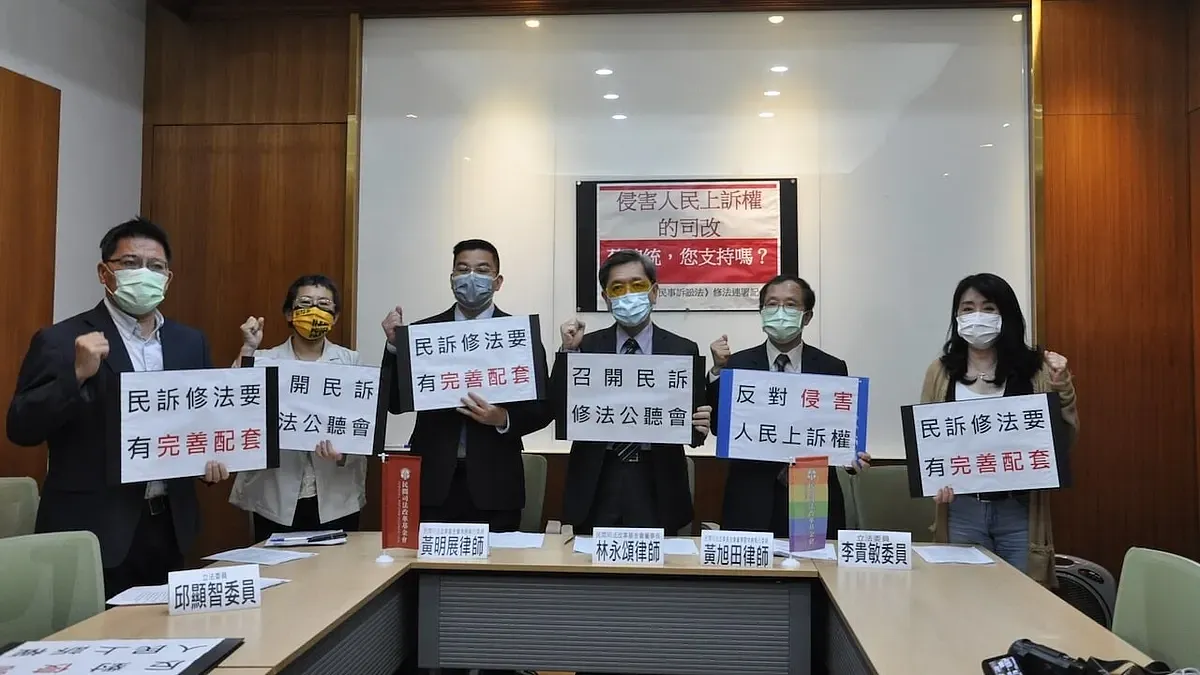
"Judicial Reform That Infringes on the People's Right to Appeal-President Tsai, Do You Support It?" Joint Petition Press Conference Opposing the Official Draft Amendments to the Code of Civil Procedure
Last edited: 2026-08-30
At the 2017 National Conference on Judicial Reform, convened by the President, it was again resolved that the existing "barrel-shaped" litigation system should be transformed into a "pyramid-shaped" system. Under a "pyramid-shaped litigation system," the first instance serves as the principal forum for fact-finding, the second instance adopts either ex post review or a strict continuation-of-trial model, and the third instance is limited to strict review of legal issues. This structure allows the first-instance court, which hears the case closest in time to the events, to establish the facts effectively; avoids duplicative fact-finding by higher courts that consumes judicial resources, prolongs proceedings, and produces little benefit; and helps address divergent legal interpretations caused in part by the large number of judges at the third instance.
JRF has long supported reform toward a "pyramid-shaped litigation system," but has maintained that reform must be implemented gradually and with adequate supporting measures. The 2017 National Conference on Judicial Reform likewise resolved that the right to appeal should not be restricted unless adequate supporting measures are in place to ensure robust fact-finding at first instance. The key concern is that if a first-instance court's factual findings depart from the truth, litigants may still formally have a right to appeal; however, because higher courts would in principle decide on the basis of the first-instance factual findings rather than take evidence anew, the opportunity for meaningful relief would be reduced. Moreover, a shift to more restrictive appellate review designed to reduce appellate caseloads could instead cause erroneous judgments to be left standing. Therefore, without adequate supporting measures, the public may bear the costs of reform before receiving its benefits. In short, any restriction on the right to appeal or on the grounds that may be raised on appeal should be premised on improved adjudicative quality in the lower courts.
With respect to the "pyramid-shaped litigation system," the Judicial Yuan has introduced two sets of draft amendments to the Code of Civil Procedure (1)(2). The portion concerning Article 447 has already entered party-caucus negotiations. However, JRF's review of the relevant provisions shows that the drafts would do little to strengthen fact-finding at first instance. Moreover, the objective conditions for restricting the right to appeal are not yet in place, and the drafts lack appropriate transitional safeguards. JRF therefore makes the following three requests:
Joint Petition Demands
-
Given the far-reaching importance of these amendments, the Legislative Yuan should hold public hearings on the proposed amendments to the Code of Civil Procedure and hear views from all sectors.
- With respect to the proposed amendments, we call for the following:
- The proposed amendments to Article 447 of the Code of Civil Procedure and other provisions that would "restrict the right to appeal" should not be addressed in this round of amendments. They should be considered only after measures to strengthen fact-finding at first instance have been enacted, implemented for a meaningful period, and evaluated for effectiveness.
- The expert commissioner system may present ambiguities in practice. It should be carefully assessed in comparison with the existing court-appointed expert system and any potential expert-witness system.
- Civil evidence law should be comprehensively strengthened, and the scope of reform should include the "procedure for examining witnesses," "an expert-witness system," "the efficiency of procedures for presenting and taking evidence," and "the limits on the court's authority to take evidence ex officio."
- To support the reform goal of stronger fact-finding at first instance, the use of collegiate panels should be further strengthened and expanded.
- If the amendments "restrict the right to appeal," the threshold for reopening civil proceedings should be relaxed as a supporting measure to provide relief from any increase in erroneous judgments.
- If the amendments expand mandatory representation by counsel, the scope of legal aid should be adjusted accordingly to protect access to the courts for people who cannot afford attorney's fees.
- The Judicial Yuan should propose accompanying legislative amendments for a pyramid-shaped organizational and staffing structure, strengthening staffing at the first and second instances while reducing the number of positions at the third instance.
-
The partial amendments to the Code of Civil Procedure approved by a Legislative Yuan committee on October 18, 2021 should be rigorously reviewed during party-caucus negotiations and must not be rushed through.
JRF has published the petition and its detailed reasons on the petition page. We invite members of the legal profession, academia, organizations concerned with judicial reform, and members of the public to join us in calling on President Tsai Ing-Wen to carry out the resolutions of the National Conference on Judicial Reform through steady, sustained reform. Both ruling and opposition parties should also oversee the Judicial Yuan's establishment of adequate supporting measures to protect the people's procedural rights.
Attendees
Lin Yung-Sung, Attorney-at-Law / Chairperson, Judicial Reform Foundation
Huang Hsu-Tien, Attorney-at-Law / Board Director and Standing Executive Committee Member, Judicial Reform Foundation
Huang Ming-Chan, Attorney-at-Law / Standing Executive Committee Member, Judicial Reform Foundation
Chen Jiau-Hua, Legislator
Chiu Hsien-Chih, Legislator
Lee Guei-Min, Legislator
Press Contact
Lu Cheng-Yen, Attorney-at-Law / Deputy Director, Legal Policy Department, Judicial Reform Foundation
This article is an AI-generated translation of the original Chinese text. In the event of any discrepancy, the Chinese version shall prevail.