
Joint NGO Statement & Support Rally | Unjustly Detained in China for Five Years, Let Ming-Che Li Return to Taiwan! Press Conference
Last edited: 2026-08-24
Ever since Ming-Che Li was subjected to enforced disappearance by China on March 19, 2017, and subsequently sentenced to 5 years in prison in September of that same year by the Intermediate People's Court of Yueyang City in Hunan Province on charges of subverting state power, Ming-Che Li has now been unjustly detained for over 1,825 days (nearly 5 years). With less than a month remaining until the end of his sentence as estimated by civil society organizations (April 14, 2022), Ming-Che Li's wife, Ching-Yu Li, still has not received the judgment document for the case, leaving her unable to confirm the official sentence and release date, nor has she received any information from the Chinese government regarding his release date.
E-Ling Chiu (邱伊翎), Secretary General of Amnesty International Taiwan, stated that Ming-Che Li has been detained in China for 1,825 days, and tomorrow marks the full completion of 5 years of detention. For 5 years, Amnesty International has continuously called on China to release Ming-Che Li. Now, even if the Chinese government insists on upholding its unjust verdict that violates freedom of expression, the period of Ming-Che Li's detention is about to exceed the so-called "5-year sentence," and the Chinese government no longer has any reason to continue detaining him or use any excuse to keep Ming-Che stranded in China. During his detention in China, Ming-Che was forced to eat spoiled food and lacked sufficient warm clothing. After the outbreak of the pandemic, all 16 applications for family visits submitted by his family members were rejected, and he was not even permitted to make family phone calls. Amnesty International calls on the Chinese government to immediately clarify the release date and under no circumstances use any reason to continue the arbitrary detention of Ming-Che Li. If China fails to release Ming-Che Li as scheduled, Amnesty International will launch large-scale mobilization activities and issue an urgent action appeal for him.
Jung-Hsiang Chiang (江榮祥), Chairperson of the Human Rights Committee of the Taipei Bar Association, stated that the Chinese court sentenced Ming-Che Li to 5 years of imprisonment with 2 years of deprivation of political rights. According to Articles 54 and 58 of the Criminal Law of the People's Republic of China, "deprivation of political rights" means the continued deprivation of a convict's rights to vote, to stand for election, and to hold positions in state organs after the prison sentence has been served. Furthermore, pursuant to Paragraph 2 of Article 12 of the Exit and Entry Administration Law of the People's Republic of China, anyone whose criminal sentence has not been fully executed is prohibited from leaving the country. Therefore, upon the completion of Ming-Che Li's prison term, the subsequent 2-year period of deprivation of political rights running until mid-April 2024 may result in him not being permitted to leave China. Chairperson Jung-Hsiang Chiang believes that if China continues to detain Ming-Che Li in China simply because it is unwilling to see him return to Taiwan to exercise his civic rights, it will sever his social ties and increase his economic burden. This constitutes "intentionally inflicting severe pain or suffering on a person mentally," which is a "cruel and inhuman punishment" and amounts to torture.
Sung-Lih Huang (黃嵩立), Convener of the Covenants Watch, stated that if Ming-Che Li is unable to successfully return to Taiwan after serving his sentence, Covenants Watch will once again update relevant information to the United Nations human rights mechanisms that have previously accepted the Ming-Che Li case. Convener Sung-Lih Huang also pointed out that in addition to Ming-Che Li, four other Taiwanese individuals (Meng-Chu Lee, Cheng-Ping Lee, Chin-Shu Tsai, and Yu-Chin Cheng) have been convicted of espionage in China following coerced confessions; China should make a public statement regarding their status and whether they have suffered other forms of persecution. At the conclusion of his remarks, Convener Huang also called upon the Mainland Affairs Council (MAC) to concretely and publicly explain the plight of Taiwanese individuals subjected to enforced disappearance or arbitrary arrest in China, while balancing the safety of the parties involved, and should not shirk its responsibility to disclose relevant information on the grounds of the individual families' attitudes.
Yeau-Tarn Lee (李酉潭), Board Director of the Association for Chinese Human Rights, pointed out that the various so-called "charges" fabricated by China against Ming-Che Li back then, along with its claims of providing a "public trial" and "sunshine justice," were all carried out under the overarching premise of "maintaining social stability" in an attempt to whitewash "illegal abduction" as "lawful arrest." Although China claims to practice "sunshine justice," it has repeatedly failed to give the family a definitive release date, leaving people still wondering when Ming-Che Li will finally be able to come home even after 5 years of coerced confession. Director Li Yeau-Tarn further pointed out that judging from China's human rights record over the past five years—such as the abuse of designated surveillance at a designated location (RSDL) to crack down on dissidents and the erosion of its 50-year unchanged promise to Hong Kong—the possibility that Ming-Che Li will face designated surveillance after completing his sentence is not unfounded anxiety. Director Yeau-Tarn Lee also urged the Chinese side to provide a concrete response regarding the release date and arrangements, and not to delay Ming-Che Li's return home under any name or method. Director Yeau-Tarn Lee reminded everyone that it would not be difficult for China to retain Ming-Che Li in the country, and it might even pressure Ming-Che Liinto expressing a willingness to remain in China; until Ming-Che Li returns to the free world, no such statements can be trusted.
Yi-Hsiang Shih (施逸翔), Secretary General of the Taiwan Association for Human Rights (TAHR), stated that to prevent cross-border human rights cases like the Ming-Che Li case from happening again, an Asia-Pacific human rights mechanism must be established to hold perpetrators of human rights violations within the Asian region accountable. Secretary General Yi-Hsiang Shih emphasized that this is not only the responsibility of various countries in the Asia-Pacific region but also an important human rights issue repeatedly highlighted by the United Nations. He further pointed out that there are currently at least 402 cases from countries such as Taiwan, Hong Kong, the United States, and Canada suffering human rights violations in China and awaiting rescue. Secretary General Yi-Hsiang Shih believes that if the Asia-Pacific region can establish a regional human rights protection mechanism akin to Europe's, there will be a unified standard of remedy and handling protocols when dealing with cross-border human rights issues.
Ting-Yu Wang (王定宇), Chairperson of the Legislative Yuan's Human Rights Committee, stated that the ongoing rescue efforts by Ming-Che Li's wife are deeply moving. Legislator Ting-Yu Wang also emphasized that Ming-Che Li is not a criminal; his advocacy committed no crime in the free world. The arbitrary detention by an ascending major power lacking the rule of law has drawn the contempt of the world. Legislator Ting-Yu Wang called on China to let Ming-Che Li come home and expressed hope that good news regarding Ming-Che Li's return to Taiwan can be received within the next month.
Legislator Yun Fan (范雲) expressed admiration for Ms. Ching-Yu Li's steadfast dedication to rescue efforts and human rights advocacy under the Chinese Communist Party's coercion. She also thanked civil society organizations such as Amnesty International, TAHR, the Association for Chinese Human Rights, and Covenants Watch for their continuous support for Ming-Che Li. Legislator Yun Fan pointed out that the Taiwanese government can be more proactive in the Ming-Che Li incident and should conduct systematic research on the situation of Taiwanese people experiencing enforced disappearances upon traveling to China, so that more Taiwanese people can understand the reality of human rights violations committed by the Chinese Communist Party. Legislator Yun Fan emphasized that she will strongly supervise the Mainland Affairs Council and other related units in the future to proactively initiate assistance, confirm the date of Ming-Che Li's release and return to Taiwan to prevent him from being stranded in China, and simultaneously restore communication links between Ching-Yu Li and Ming-Che Li as soon as possible.
Legislator Hsien-Chih Chiu (邱顯智) pointed out that the Chinese government has previously used pandemic quarantine or the execution of the deprivation of political rights as pretexts to continue placing political prisoners under house arrest after they complete their prison terms and are released from prison. Although his 5-year prison term is about to expire this April, he may also face the issue of the supplementary punishment of 2 years of deprivation of political rights. Legislator Hsien-Chih Chiu also called on the Mainland Affairs Council to make advance preparations and actively assist Ming-Che Li in returning to Taiwan immediately upon his release from prison. In addition to continuously striving for Ming-Che Li's prompt repatriation after release, the Mainland Affairs Council should also make advance contingency plans for potential transportation obstacles that "pandemic quarantine" might cause.
Legislator Wan-Yu Wang (王婉諭) stated that nearly 5 years ago, Ming-Che Li was framed and imprisoned by the Chinese government, thereby losing his personal freedom, and was even deprived of the opportunity to communicate normally with his family or learn the exact date of his sentence completion. Over the past two years, due to the impact of the pandemic, rescue efforts by his family and civil society organizations have become even more difficult, and the Chinese Communist Party's increasingly hardline authoritarian rule has made information even harder to obtain. Legislator Wan-Yu Wang called on the international community to jointly pay attention to and condemn such incidents, and urged the Chinese government to clearly inform the family of Ming-Che Li's official release date and release the unlawfully arrested Ming-Che Li as scheduled. Wan-Yu Wang finally emphasized that as a Taiwanese citizen subjected to such human rights persecution by China, the government should continuously provide assistance to the family and use this case as an example to establish a comprehensive individual case assistance mechanism.
Legislator Sun-Han Hung (洪申翰) stated that Ming-Che Li is innocent and should not have been sentenced in the first place. Furthermore, according to the Criminal Law of the People's Republic of China, pre-trial detention can be credited against the prison sentence. Legislator Sun-Han Hung called on the Chinese Communist Party to abide by its own criminal laws, stop using unreasonable and absurd excuses to strand Ming-Che Li in China, and release Ming-Che Li as soon as possible to let him return to Taiwan swiftly.
Legislator Freddy Lim (林昶佐) emphasized that even though China ranks near the bottom of the human rights index, it should at least maintain a baseline rather than continually breaking its own rock-bottom standards. Legislator Freddy Lim also pointed out that Ming-Che Li is not a criminal and should never have been detained; not only Ming-Che Li, but many individuals from various countries are also detained in China. These wrongfully detained people need everyone's attention and require greater support.
Taipei City Councilor Ted Chiu (邱威傑) emphasized that Ming-Che Li has been unreasonably detained by the Chinese government for 5 years. On April 14, this fabricated prison sentence will finally come to an end, yet at this very moment, people must still worry whether this Taiwanese citizen wrongfully detained by a foreign government will truly be able to come home. Councilor Ted Chiu stated that although China's rule of law is hard to trust, it is still hoped that the Chinese government will honor its promise, adhere to the most basic legal baseline of the international community, and allow Mr. Ming-Che Li to successfully complete his sentence, return to Taiwan, and come home.
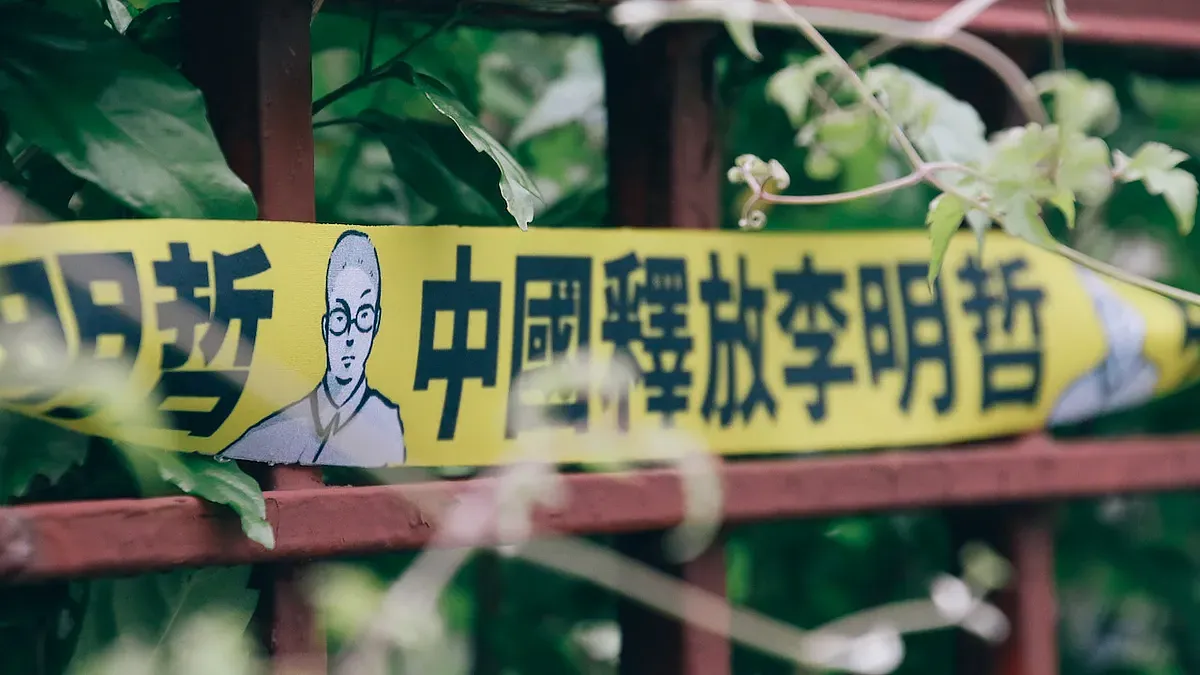
After all the attending legislators, city councilors, and civil society representatives finished speaking, the supporting crowds marched past the 228 Peace Memorial Park, Jinan Church, the main gate of the Legislative Yuan, and the Control Yuan. Along the way, they chanted slogans demanding that China release Ming-Che Li and tied yellow ribbons of support along the route. The organizations vowed that if Ming-Che Li is not released as scheduled, they will continue to launch larger-scale advocacy campaigns.
Organizers
Amnesty International Taiwan
Judicial Reform Foundation
Taiwan Association for Human Rights
Covenants Watch
Taipei Wenshan Community College
Association for Taiwan Democracy
Taiwan Alliance to End the Death Penalty
Tibet Taiwan Human Rights Network
Association for Chinese Human Rights
Taiwan Labour Front
Dr. Chen Wen-Chen Memorial Foundation
This article is an AI-generated translation of the original Chinese text. In the event of any discrepancy, the Chinese version shall prevail.