
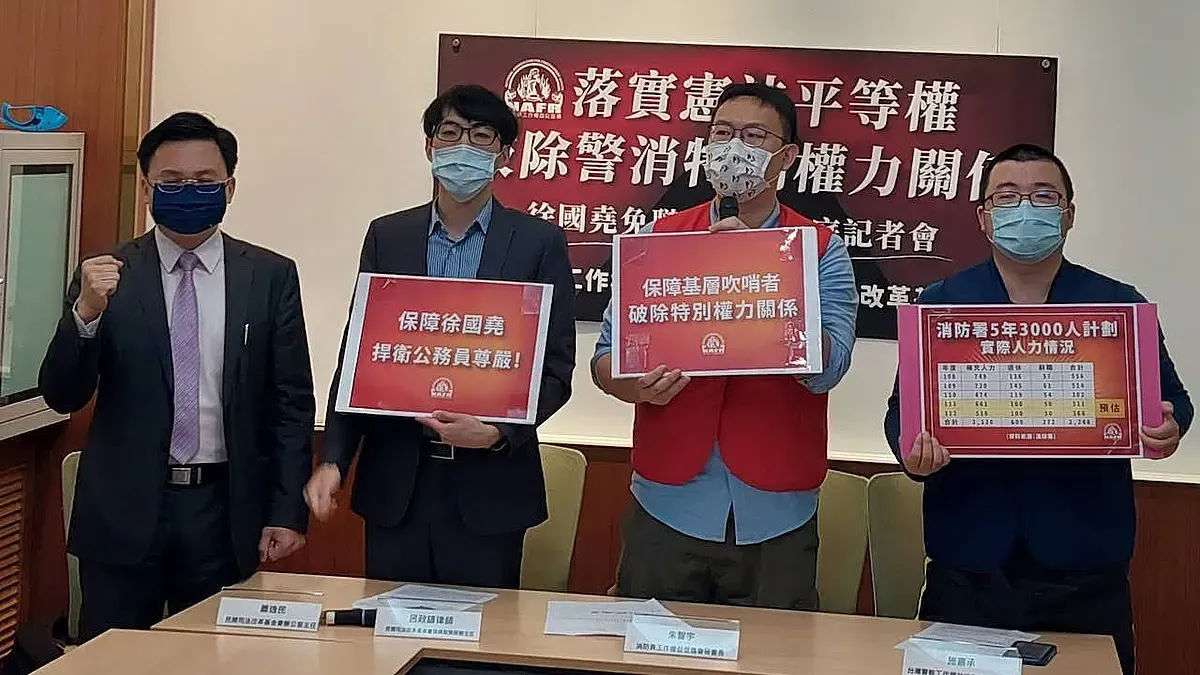
Constitutional Court Press Conference on the Dismissal Case of Kuo-Yao Hsu | Realizing the Constitutional Right to Equality and Dismantling the Special Power Relationship for Police and Firefighters
Last edited: 2026-08-27
Tomorrow, the Judicial Yuan will hold a Constitutional Court hearing on the petition filed by Ch'en Kuo-yao, who was suppressed and dismissed by the Kaohsiung City Government for advocating for firefighters' labor rights. After Ch'en organized a protest march in 2012 to advocate for firefighters' labor rights and filed a lawsuit against the Fire Bureau regarding working hours (a lawsuit that led to Judicial Yuan Interpretation No. 785 concerning the working hour reform of civil servants on external shift rotations), he was targeted by the Kaohsiung City Government and the Fire Bureau through the imposition of 42 demerits in the span of three months, ultimately resulting in his dismissal. The timing and density of these penalties set a rare precedent in the history of civil service discipline. Following limited administrative relief channels through the Civil Service Protection and Training Commission and a lawsuit that resulted only in procedural review, his case will now face Constitutional Court review presided over by Grand Justices tomorrow.
The Association for Firefighters' Rights Promotion and the Judicial Reform Foundation believe that the case of Ch'en Kuo-yao, who was unfairly targeted and dismissed, is a landmark case concerning the protection of whistleblowers within public agencies, the realization of the constitutional right to equality, and the dismantling of the special power relationship governing police officers and firefighters! Therefore, a press conference was held today to explain to the public the opinions of frontline police and firefighter groups and the professional legal opinions of the Judicial Reform Foundation regarding the petition, as well as to respond to the defense brief submitted by the respondent in this case, the Ministry of the Interior.
Administrative Authorities Play "Dirty Tricks" Even Before the Hearing Commences
The Association for Firefighters' Rights Promotion reported on behalf of the petitioner Ch'en Kuo-yao that during the preparation process of this constitutional interpretation petition, his right to defense was infringed upon by the respondent authorities, the Ministry of the Interior and the Directorate-General of Personnel Administration:
- The Ministry of the Interior provided its Constitutional Court defense brief on March 18 and sent a copy to the petitioner; however, the content differed from the defense brief published by the Constitutional Court.
- The Directorate-General of Personnel Administration was required to provide its defense brief to the Constitutional Court and the petitioner by March 21; however, the petitioner did not receive the brief through his appointed attorney until March 25.
The above actions have impaired the petitioner's right to defense and made it impossible to even verify whether the administrative authorities provided the correct briefs for the petitioner's defense. We urge the Constitutional Court to thoroughly investigate this matter. This Foundation also sternly condemns the Ministry of the Interior and the Directorate-General of Personnel Administration for employing such litigation strategies to compromise the petitioner's litigation rights!
Remarks by Chih-Yu Chu, Secretary-General of the Association for Firefighters' Rights Promotion
Kuo-Yao Hsu is the catalyst behind Interpretation No. 785. Yet, because he initiated a working-hour lawsuit and organized a protest march to steadfastly blow the whistle on the grueling working hours of shift-working civil servants, he was subjected to intensive disciplinary action, suppression, and dismissal by the Kaohsiung City Government and the Fire Bureau. This is the first case of a firefighter being maliciously suppressed and dismissed for fighting for their rights, as well as a rare case in the history of civil service discipline. The suppression subsequently triggered a chilling effect, causing frontline firefighters in Kaohsiung to silence themselves regarding rights reform. Following his dismissal in 2014, Hsu embarked on a nearly eight-year-long arduous journey toward reinstatement. Oral arguments will take place in the Constitutional Court tomorrow, and our organization, as a frontline firefighting group, has also applied to the Constitutional Court to submit an amicus curiae brief.
Regarding the Ministry of the Interior's defense brief arguing the constitutionality of current regulations, this Foundation considers it a severe misleading of the Constitutional Court's understanding and a fabricated argument deliberately tailored for litigation. We respond with the following three points:
-
Maintaining discipline has nothing to do with dying in the line of duty; the Ministry of the Interior must not slander fallen heroes: The Ministry of the Interior stated in item (4) on page 9 of its defense brief that "the number of firefighters dying in the line of duty is higher than that of general civil servants and also higher than that of police personnel. Therefore, whether or not the discipline of firefighting personnel is maintained profoundly affects the safety of the lives and property of the public and the firefighting personnel themselves." This Foundation must state that the Ministry of the Interior's defense is an insult and slander against fallen heroes. These remarks by the Ministry of the Interior can only be interpreted as insinuation that fallen heroes were incapable of maintaining discipline. Ironically, fallen heroes sacrificed their lives precisely because they met the nation's definition of "taking calculated risks"—continuing to execute missions despite knowing the danger. Their loyalty to the country and protection of the people's property long transcended personal life and death. Such rhetoric, which deliberately links the maintenance of discipline with deaths in the line of duty merely to prove that police and firefighters require stricter reward and punishment requirements in order to win the lawsuit, will severely undermine frontline morale.
Furthermore, the factors behind firefighters' deaths in the line of duty are complex and intricate; how could they be caused by a single disciplinary issue? Reviewing recent line-of-duty death cases such as the 2014 Kaohsiung gas explosions, the 2015 Hsinwu fire in Taoyuan, and the 2018 Chin Pung fire in Taoyuan, all have investigation reports by the Control Yuan or the Ministry of the Interior available for review, none of which mention any so-called disciplinary issues. Their causes are far more attributable to the government's lack of manpower, equipment, and resources. What profoundly affects the lives and property of the public and firefighters themselves is whether the Ministry of the Interior provides sufficient safeguards for frontline police and firefighters, rather than dragging down frontline personnel and fallen police and firefighters!
-
Rewards for police and firefighters largely stem from overwork; the Ministry of the Interior is reversing cause and effect: The Ministry of the Interior stated in item (6) on page 9 of its defense brief that "due to the special nature of their duties, firefighting and police personnel have more frequent opportunities and counts of receiving rewards than general civil servants." Consequently, they differ from general civil servants in the leniency and severity of rewards and punishments. This is completely reversing cause and effect! The source of most rewards received by police and firefighting personnel stems from working overtime every month under circumstances where agencies cannot fully pay overtime compensation. Yet the Ministry of the Interior, as the supervisory authority for police and firefighters, unashamedly tolerates manpower shortages, excessively long working hours, and the practice of trading overtime for commendations, only to tell the Grand Justices that this is a reasonable situation. This is misleading the Grand Justices.
- Police and firefighting duties share no similarities: The Ministry of the Interior repeatedly stated in items (1) to (3) on page 8 of its defense brief that police and firefighting duties share similarities and that police and firefighters frequently execute missions together. This is also completely erroneous and misleads the Grand Justices' understanding. Since the separation of police and firefighting in 1995, the Fire Services Act has clearly defined the three major tasks of firefighting as "disaster rescue, emergency medical services, and fire prevention," which have almost no overlap with police duties! Moreover, in practice, rescue missions and emergency medical patient transport are independently completed by firefighting units. Aside from a few cases such as suicide or compulsory medical transport, there is fundamentally no joint execution or similarity in duties. We ask the Ministry of the Interior not to blindly distort social understanding merely for the sake of winning the lawsuit.
Finally, the Ministry of the Interior repeatedly argued in its defense brief that the "Police Personnel Management Act" is constitutional because it aims to achieve stricter and more decisive disposition methods for police and firefighters to prevent impacts on supervisory leadership and team discipline, thereby rationalizing current provisions that mandate immediate dismissal upon accumulating 18 demerits. However, current provisions in the "Public Functionaries Merit Evaluation Act" already provide administrative agencies with two direct disposition methods to eliminate unsuited civil servants—namely "dismissal due to two major demerits" and "a D grade in annual performance evaluation." Yet this case utilized a strategy of continuous, dense, minor and major disciplinary actions to effect dismissal, representing a major legal loophole in the disciplinary system. While "dismissal due to two major demerits" and "a D grade in annual performance evaluation" could historically obtain relief through administrative litigation, dismissal caused by continuous disciplinary accumulation could not. This enabled administrative agencies to weaponize disciplinary measures intended for warning and correction as tools for dismissal without providing corresponding channels of relief. This constitutes the reason for the petitioner's application in this case. This Foundation urges the Grand Justices to issue a ruling declaring the "Police Personnel Management Act" unconstitutional, preventing administrative agencies from exploiting this loophole in the future and turning disciplinary actions into tools for suppressing dissidents.
Remarks by Attorney Cheng-Yen Lu, Deputy Director of the Legal Policy Department, Judicial Reform Foundation
Today, we sit here alongside the AFRP and the TPPWU to call on the public to pay attention, because this case is not merely about the protection of Kuo-Yao Hsu's individual rights; it concerns the rights of all civil servants. In fact, at the very inception of the Constitution, it was anticipated that external forces would be utilized to counterbalance the power of superiors within administrative power, thereby creating a flexible administrative system with self-reflective capacities, rather than allowing superiors to monopolize power while subordinates are reduced to blind obedience, leading to institutional rigidity.
Regrettably, such progressive legislation remains unimplemented within our institutional framework to this day.
Kuo-Yao Hsu is precisely a victim of the current system, bearing witness to how frontline civil servants are forced into compliance and abandon independent thought when superiors abuse their administrative disciplinary power. At the time, this series of disciplinary actions also caused firefighters participating in the advancement of firefighters' working rights to feel deeply endangered, triggering a chilling effect. This further demonstrates the impropriety of the current administrative disciplinary system. Therefore, we ought to return the power of discipline to the judiciary, allowing an external and more objective court to make determinations and ending the unconstitutional status quo where the judicial power of discipline is hollowed out.
The Kuo-Yao Hsu case carries profound and significant implications for safeguarding civil servants' rights and establishing an efficient civil service system to realize the public interest. The Grand Justices' constitutional ruling this upcoming day stands at a pivotal juncture, determining the future visage of the civil service disciplinary system—and indeed the entire civil service system itself. In a diverse, democratic, and open society, do we wish to continue relying on the personal, enlightened management and decisive judgment of superiors? Or are we willing to promote the public interest as much as possible through rational communication among every individual within the civil service system?
Compared to the past, today we possess even more adequate conditions to truly implement the past emphasis placed by the Grand Justices on civil servants' rights into institutional practice. We look forward to the Grand Justices rendering a judgment tomorrow that further safeguards civil servants' rights, enabling our administrative system to become more diverse and open.
Annex
Press Contacts
Chih-Yu Chu, Secretary-General, Association for Firefighters' Rights Promotion
Organizers
Association for Firefighters' Rights Promotion
Judicial Reform Foundation
Supporting Organizations
Taiwan Police Practitioners Rights Promotion Association
This article is an AI-generated translation of the original Chinese text. In the event of any discrepancy, the Chinese version shall prevail.